Wednesday: 3 x 20′ @ mp/10kp/hmp

Wednesday’s workout was another one of the basic types from the Eddie Fletcher Marathon Plan.

  • 3 x 20′ intervals
  • Pace Targets:
    • 1st interval: Marathon Pace
    • 2nd Interval: 10K Pace
    • 3rd Interval: Half Marathon Pace
  • 2′ rest between pieces
  • HR Range: 80% to 90% of HRMax (149 to 168)

These pace targets are defined by the plan from estimated current 2k pace as follows:

1-17j

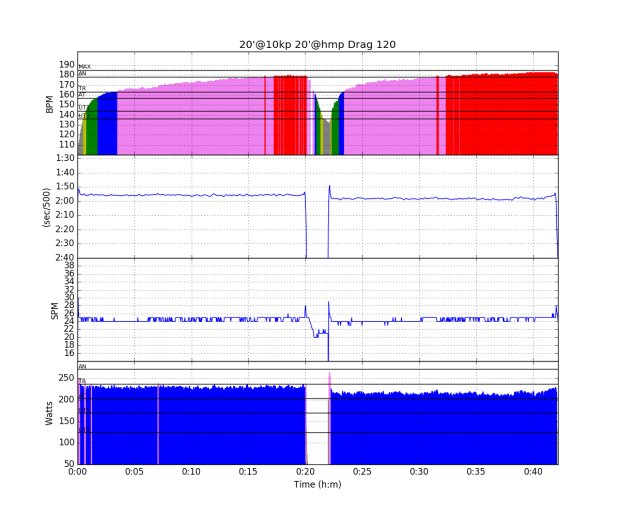
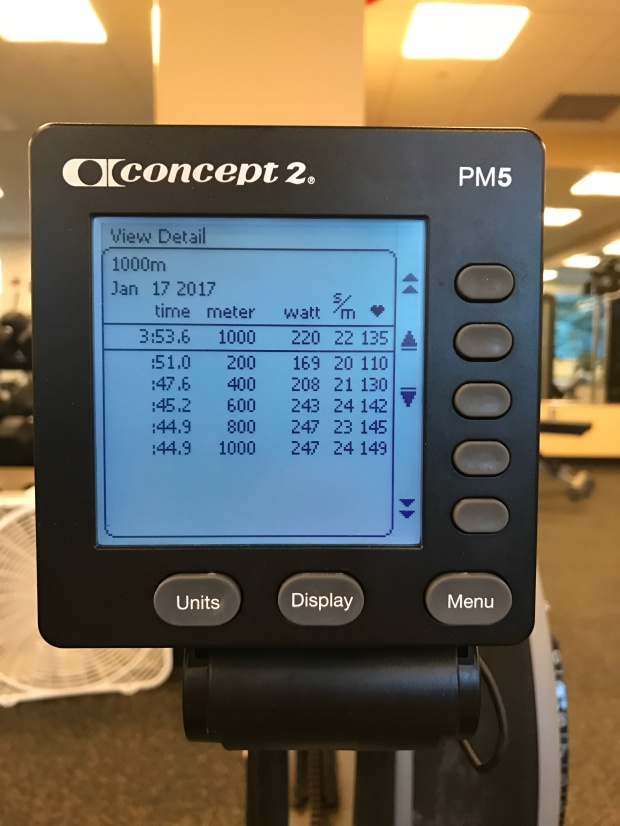
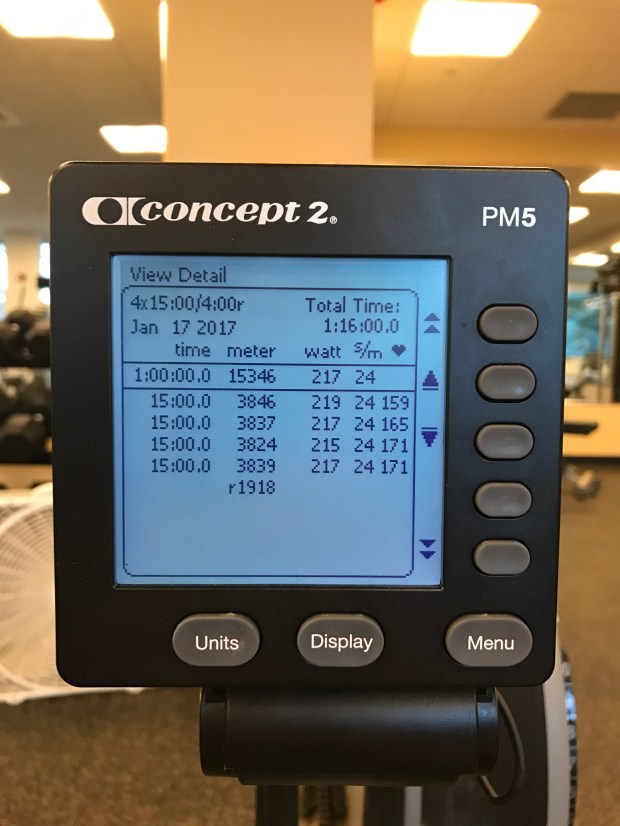
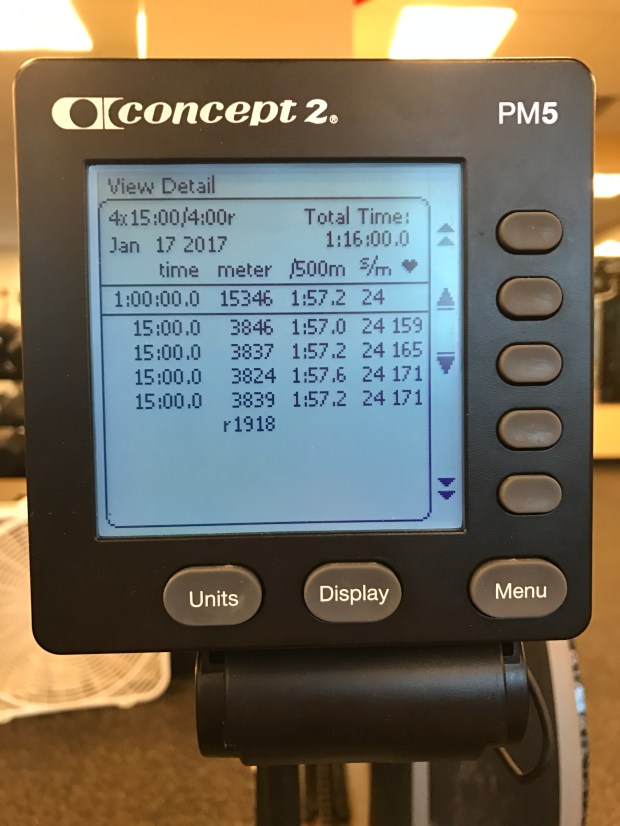
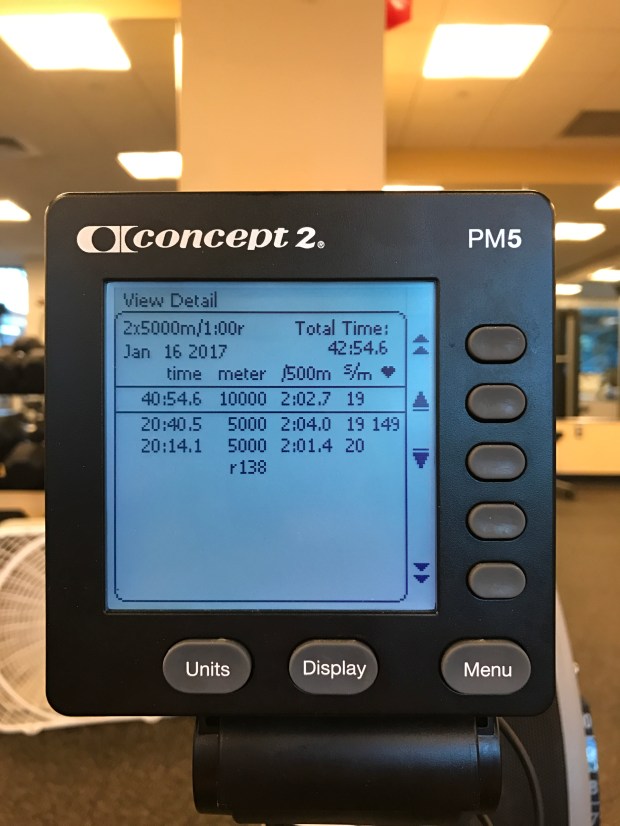
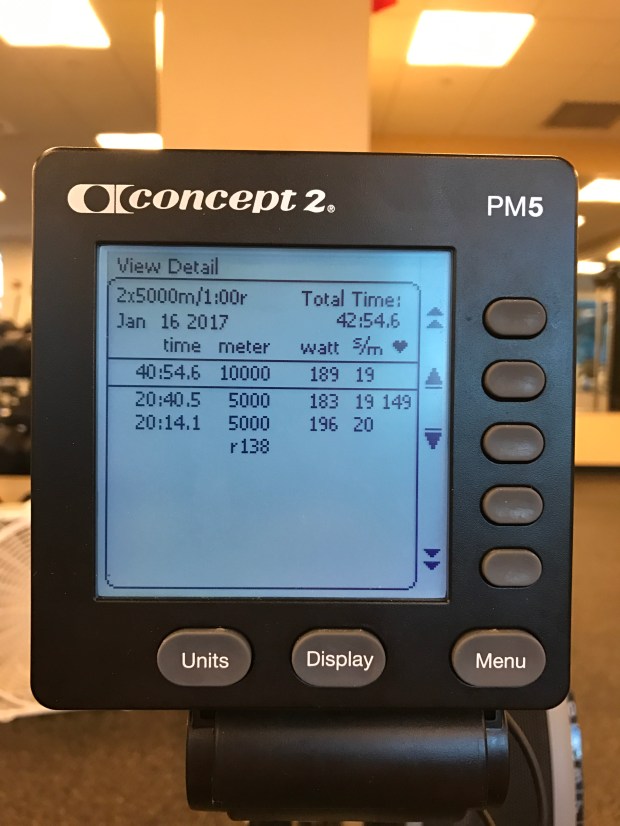
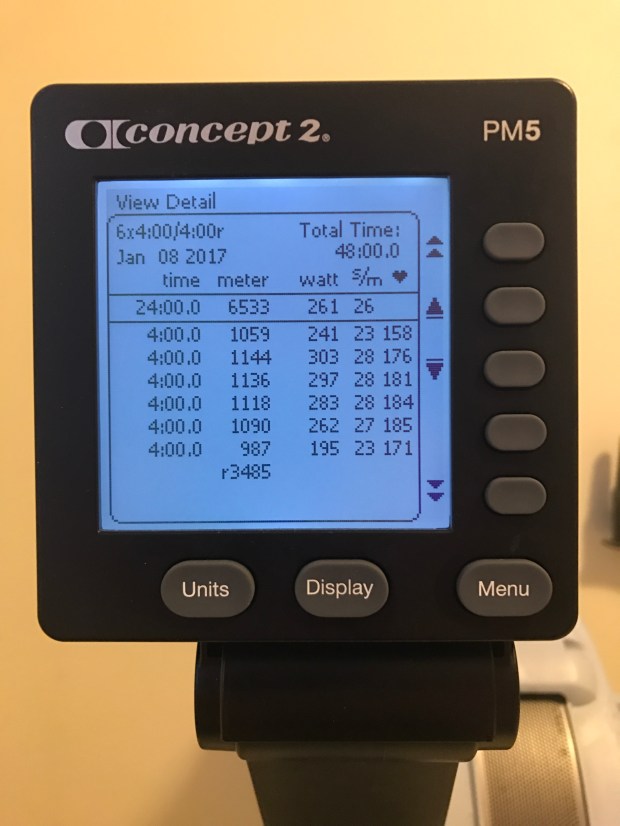
Just like the step down workout from Tuesday, I aimed at the top end of the range and ignored the HR limits.  Again, I successfully completed the workout, but it was extremely difficult.  I had some kind of a hangup on painsled during the first 20 minute piece, so I didn’t get any data for that one beyond the picture from the PM.  Form that you can see that I held 199W (vs a target of 195W), and that my HR was about 82% of HRMax at the end of it.

The second and third intervals were extremely challenging.

1-19a.png

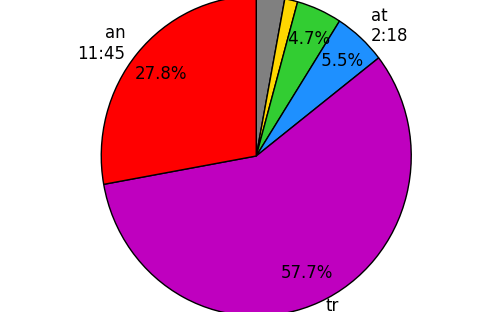
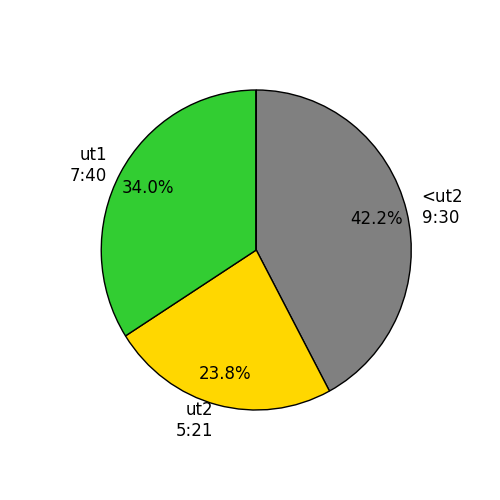
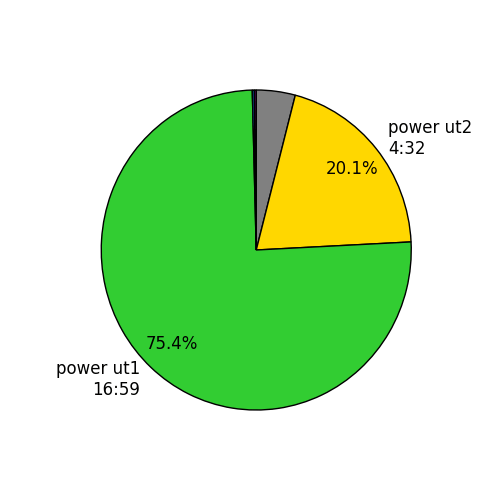
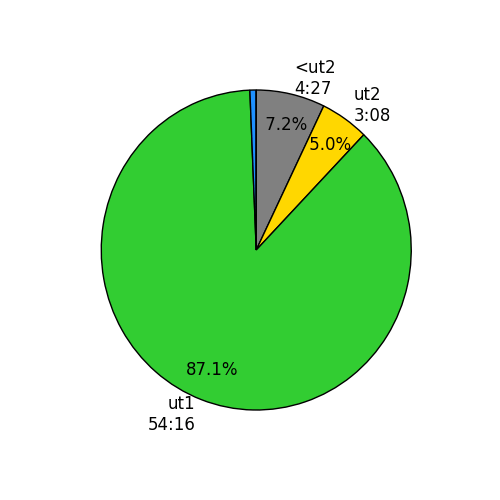
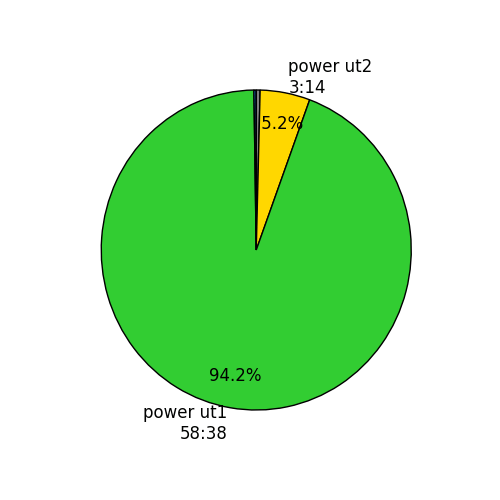
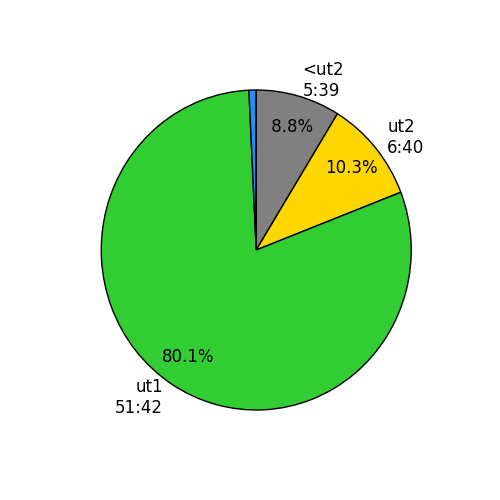
I had an astonishing 11:45 with my heart rate above 95% of HRMax.  Looking back at it today, I have no idea why I didn’t quit, or at least slow down.

So, next time, I’ll be aiming at the bottom of the ranges.

Tuesday: 4 x (6′ @ 5kp + 9′ @ mp)/4′ rest

Pretty incomprehensible title, huh?  This week I am experimenting with the week #1 workouts from the Eddie Fletcher Marathon Training Plan.

There are some very interesting concepts in the plan, and some intriguing workouts that I have never done before, so I decided to make a guess about my current capabilities, try a few workouts and then adjust as I need to when I start the plan in earnest.

Today’s workout was 4 x (6′ @ 5kp + 9′ @ mp)/4′ rest.  What that means…

  • 4 intervals each of them 15′ long
  • 4 minutes of rest between interval
  • the first 6 minutes of each interval is rowed at your current 5k pace
  • the last 9 minutes of each interval are rowed at you current projected marathon pace

The training plan does not explain exactly what the logic is for this, but having done it, I have a pretty good idea.  By starting at a 5k pace, you are working above your MLSS (Maximum Lactate Steady State) pace, which means that you are accumulating lactate.  By the time you finish 6 minutes at that pace, your heart rate is up, and you are feeling a bit like you would be much further into a marathon length row.  When you slow down to marathon pace, you are no longer building up your lactate levels, but the level of effort is such that you don’t clear much of it either, and your heart rate slowly (very slowly drifts down).  This workout seems like a very clever way to simulate rowing in the last hour of a marathon.

I just took a guess about pacing.  Based on the 4×4′ CTC, I figured that my 2k pace is around a 1:45.  For this workout plan, you use 4 basic paces, which are just percentages of your 2k power.  I did a quick table for mine.

1-17j

The plan was very clear that you should start at the low end of the power range and work your way up.  The plan also includes HR limits for the workout.  The limit for this one was 92.5% of HRMax, which for me is 172bpm.

Of course that is exactly what I didn’t do.  In typical fashion, I looked at the top end of the range as the absolute minimum that I should see on the monitor, and I completely ignored the HR limit.  And I enjoyed it.

That made it a very hard workout.  I started with a 1k warmup, since the first chunk would be at 5k pace.  I worked my way up to 240 watts over the first 400m and then held it for the last 600.

2017-01-17-08-24-39

Then into the workout.

1-17a

Workout Summary - media/20170118-145925-sled_2017-01-17T07-10-05ZEST.strokes.csv
--|Total|-Total-|--Avg--|-Avg-|Avg-|-Avg-|-Max-|-Avg
--|Dist-|-Time--|-Pace--|-Pwr-|SPM-|-HR--|-HR--|-DPS
--|17233|76:00.0|02:12.3|196.7|23.6|159.6|177.0|09.6
W-|15317|60:00.0|01:57.5|218.1|23.9|164.1|177.0|10.7
R-|01922|16:00.0|04:09.7|057.0|20.9|138.6|177.0|02.3
Workout Details
#-|SDist|-Split-|-SPace-|-Pwr-|SPM-|AvgHR|MaxHR|DPS-
00|01611|06:00.0|01:51.7|248.7|25.2|151.1|165.0|10.6
01|02238|09:00.0|02:00.6|199.5|22.3|159.9|165.0|11.2
02|01597|06:00.0|01:52.7|246.8|25.4|159.8|172.0|10.5
03|02235|09:00.0|02:00.8|198.7|22.9|166.3|172.0|10.9
04|01569|06:00.0|01:54.7|244.4|25.6|160.3|176.0|10.2
05|02236|09:00.0|02:00.7|199.3|23.1|170.8|177.0|10.8
06|01590|06:00.0|01:53.2|245.0|25.8|165.9|177.0|10.3
07|02240|09:00.0|02:00.5|200.2|23.4|172.1|177.0|10.6

The results were quite consistent, but I had to go very deep into the well for it.  The last 9 minutes at marathon pace were excruciating.

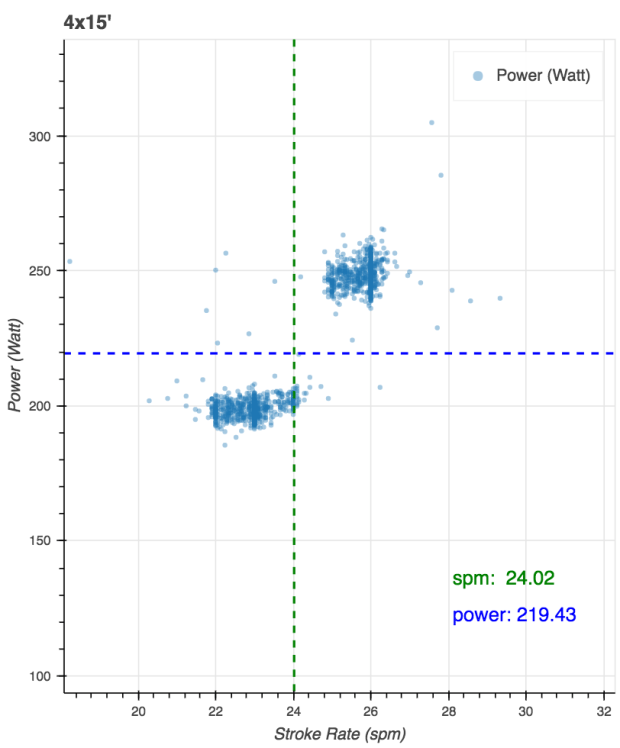
Since this workout is at higher stroke rates and pressure, I thought it would be interesting to look at some of the metrics to compare the sections done at 200W to the sections done are 245W.

Drive was consistent across the two powers, so was force ratio.  Force ratio looks like it got more erratic in the last interval (the spread around 0.8 looks broader).  I was expecting to see a bigger change in stroke rhythm between rowing at 22-23 for the 200W and rowing at 24-25 for the 245W, but it stayed around 31%.  At this point, I don’t understand that metric to know if that is good or bad or indifferent.

So, next time I do this workout, I’m aiming for the bottom of the ranges, 225w and 180W.


Monday: 3 x 5K/1′ rest

Not enough sleep on Sunday night, and I felt pretty tired going in to this session.  The whole point was to just do something and keep it easy.

Plan:

  • 3 x 5k
  • first 5k, start slow and speed up over the first 2k.
  • second 5k hold roughly marathon pace (2:00)
  • third 5k, row to a 150 HR cap.
  • Stick with a lighter stroke rate, 22 spm for 2:00 pace

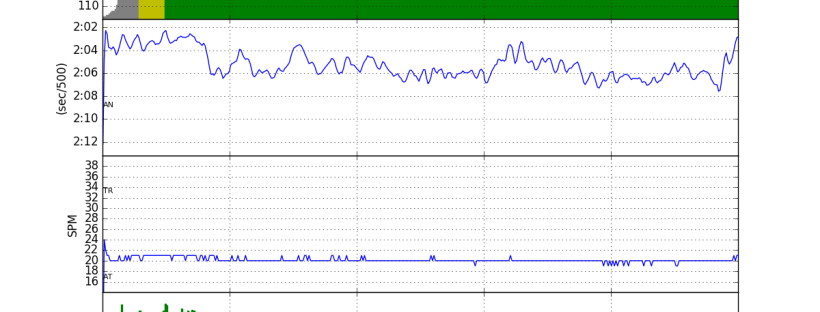
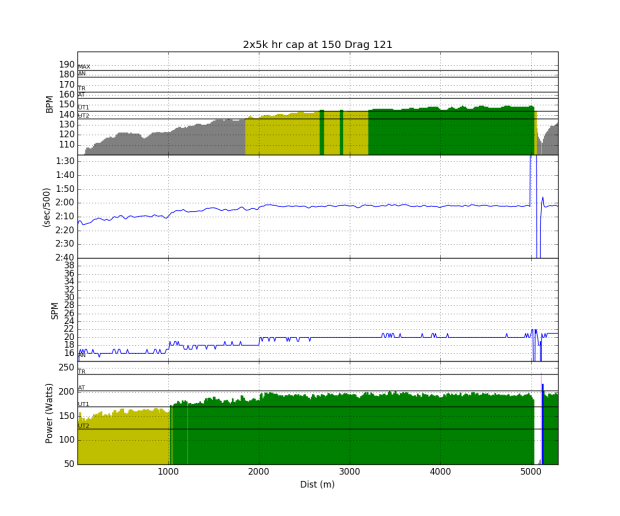
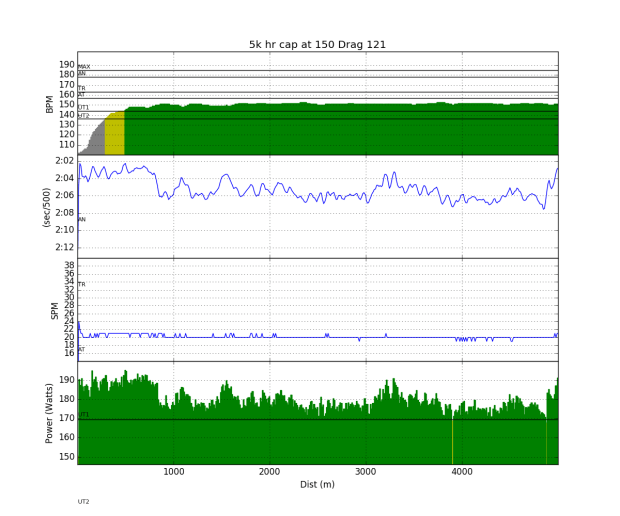
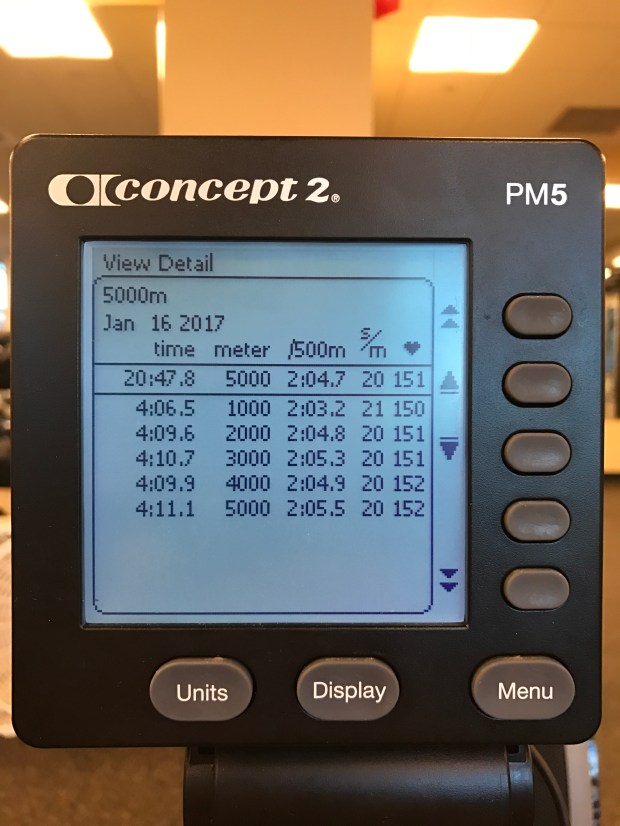
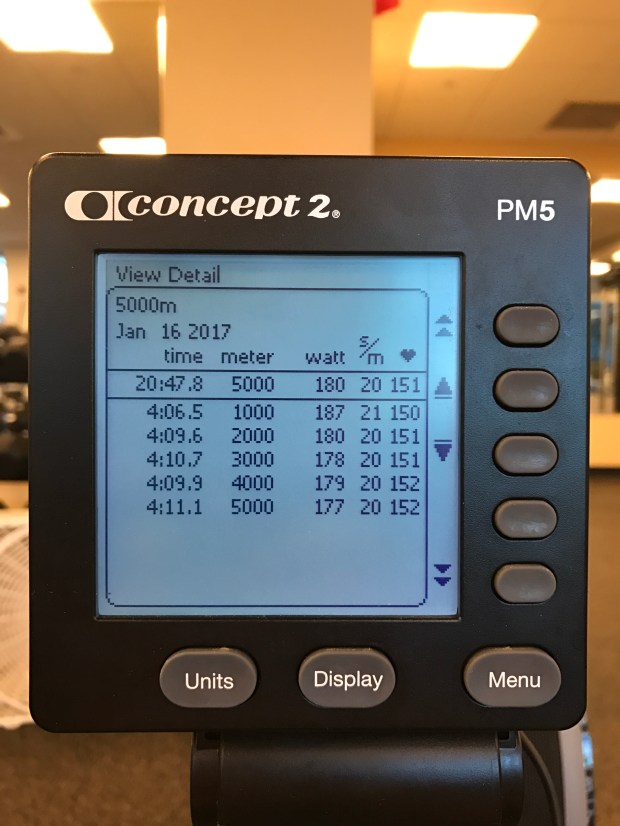
I had a hang up with painsled today.  I was rowing the session as distance intervals with 5000m and a 1 min rest.  Soon after I started the second interval, I noticed that painsled stopped updating, and so did my HR on the PM5.  I rowed out the rest of the second interval at a 2:00 pace and no idea about my HR.  It felt like I was above the cap for the last 5 minutes or so.

After I finished the second interval, I reset the PM, hooked everything up again, and setup a single 5k to finish off the workout.

The remarkable thing to me was that painsled managed to capture the first part of the workout, right up to where the hang happened.  I was impressed that it was able to recover as gracefully as it did.

The first chunk

1-16a

The last interval, I played with pace to try to hold my HR right at 150.

1-16d

Sunday: A nice long walk

Friday:  No training

Saturday: No Training

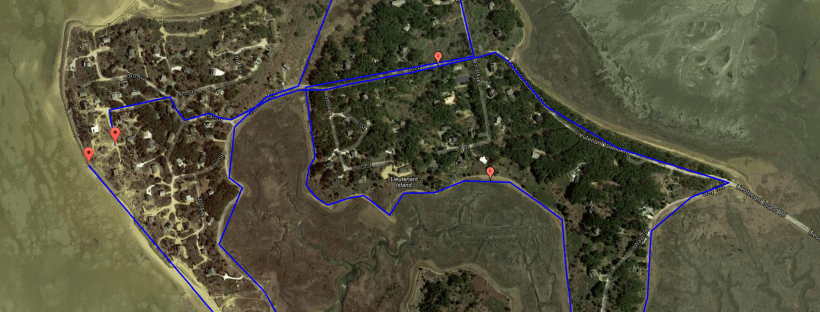
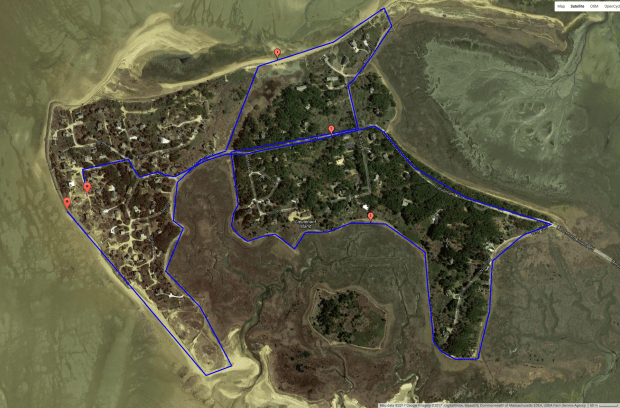
Sunday: I was down on the cape, it was too cold to ride a bike and I didn’t want to pound my knee by going running.  So, I decided to just take a nice long walk around the island.

Screen Shot 2017-01-17 at 7.52.09 PM.png

It was about 3.5 miles and I was out for about a bit more than an hour.  It was cold, windy and sunny.  I loved it.

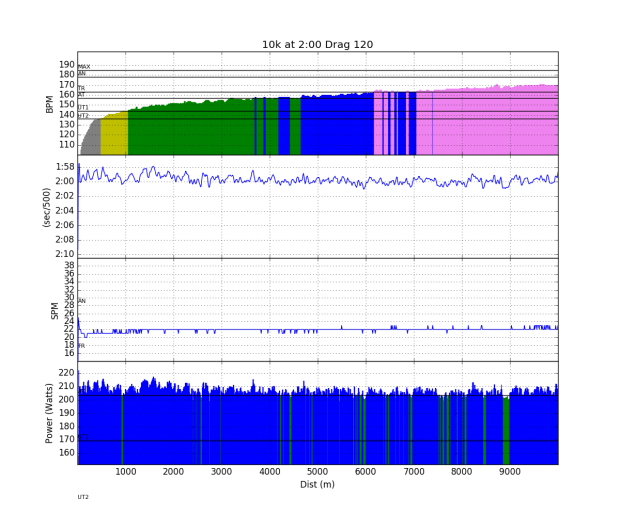
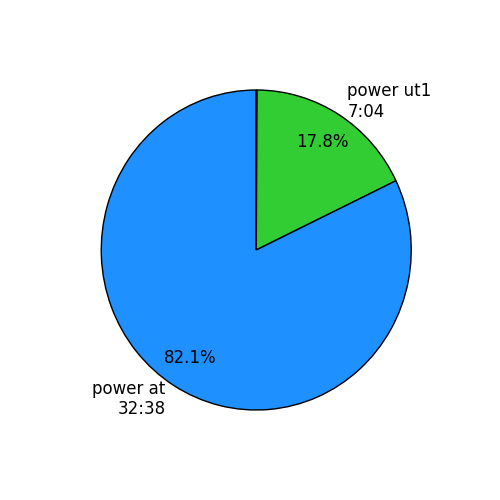
Thursday: 10K @ 2:00 split

I had limited time this morning and frankly, I was a little grumpy.  I just decided to ignore HR and just row 10K.

myimage-5

Workout Summary - media/20170112-1255080o.csv
--|Total|-Total-|--Avg--|-Avg-|Avg-|-Avg-|-Max-|-Avg
--|Dist-|-Time--|-Pace--|-Pwr-|SPM-|-HR--|-HR--|-DPS
--|10000|39:42.0|01:59.1|206.3|21.9|157.5|171.0|11.5
W-|10000|39:43.0|01:59.2|206.3|21.9|157.4|171.0|11.5
R-|00000|00:00.0|00:00.0|000.0|00.0|000.0|171.0|00.0
Workout Details
#-|SDist|-Split-|-SPace-|-Pwr-|SPM-|AvgHR|MaxHR|DPS-
00|01000|03:55.9|01:58.0|207.9|20.9|131.9|144.0|12.2
01|01000|03:57.1|01:58.6|209.9|21.8|148.2|152.0|11.6
02|01000|03:58.4|01:59.2|207.0|21.9|153.1|155.0|11.5
03|01000|03:58.3|01:59.2|206.6|22.0|156.1|158.0|11.5
04|01000|03:58.8|01:59.4|205.7|21.8|157.8|160.0|11.5
05|01000|03:59.0|01:59.5|205.1|22.0|160.3|162.0|11.4
06|01000|03:59.0|01:59.5|204.8|22.0|163.3|165.0|11.4
07|01000|03:59.1|01:59.5|205.1|22.0|165.0|167.0|11.4
08|01000|03:59.0|01:59.5|204.9|22.0|167.7|171.0|11.4
09|01000|03:58.5|01:59.2|206.4|22.3|169.7|171.0|11.3

It’s 1:20am and I’m on a work phone phone call :-O

I’m not sure I will have time to train.  If I do, it will be just a quick 30 minutes or so.

Wednesday: Very Slow Half Marathon

I’ve been ramping volume pretty hard since last week.  I’ve put in a total of 93km since January 5th.  I probably should have ramped more slowly, but I haven’t had any knee issues (which is pretty cool)

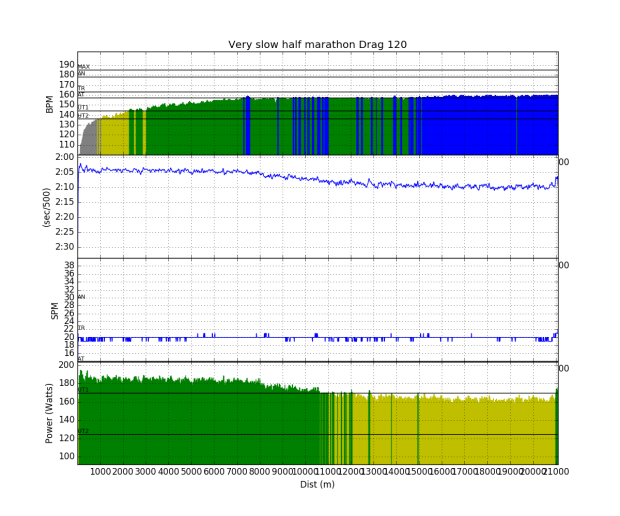
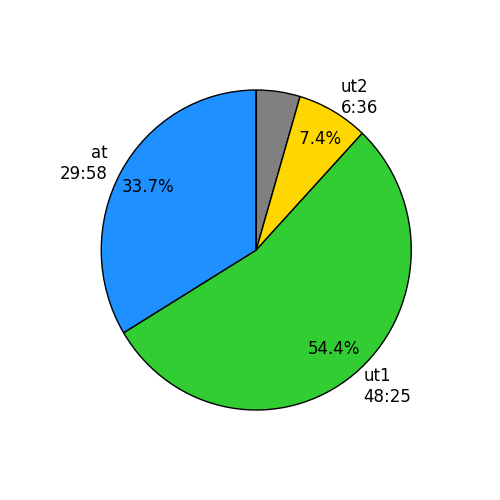
I know I need to show a little patience, but it really bugs me to be as slow and unfit as I am right now.  Today, the plan was to row a nice, slow half marathon and keep my Heart Rate below a HR cap of 150.  It did not work out that way.

I thought I would be able to hold a 2:05 split, which is just about the 180W.  I held that for about 10K, but by then, my heart rate had cruised up to nearly 160bpm.  I dropped the power down to 170W, then 160W (2:10), but my heart rate just stubbornly stayed up around 160.  I didn’t feel too bad, and I had no trouble sustaining this level of effort, but seriously?  That kind of HR for this effort is horrifyingly bad for me.

myimage-2

Workout Summary - media/20170111-1350080o.csv
--|Total|-Total-|--Avg--|-Avg-|Avg-|-Avg-|-Max-|-Avg
--|Dist-|-Time--|-Pace--|-Pwr-|SPM-|-HR--|-HR--|-DPS
--|21097|89:01.0|02:06.6|172.3|19.9|153.6|161.0|11.9
W-|21097|89:02.0|02:06.6|172.3|19.9|153.6|161.0|11.9
R-|00000|00:00.0|00:00.0|000.0|00.0|000.0|161.0|00.0
Workout Details
#-|SDist|-Split-|-SPace-|-Pwr-|SPM-|AvgHR|MaxHR|DPS-
00|01000|04:05.2|02:02.6|183.2|19.3|125.3|137.0|12.7
01|01000|04:07.4|02:03.7|184.8|19.9|139.0|143.0|12.2
02|01000|04:07.8|02:03.9|184.1|19.8|144.3|147.0|12.2
03|01000|04:07.7|02:03.8|184.3|19.9|148.1|152.0|12.2
04|01000|04:08.1|02:04.0|183.5|19.9|150.7|154.0|12.1
05|01000|04:08.2|02:04.1|183.2|20.1|152.8|155.0|12.1
06|01000|04:08.7|02:04.4|182.0|20.0|155.2|157.0|12.1
07|01000|04:08.9|02:04.5|181.4|20.0|156.4|159.0|12.0
08|01000|04:11.3|02:05.7|176.3|20.1|156.2|158.0|11.9
09|01000|04:12.7|02:06.3|173.7|19.9|156.9|158.0|11.9
10|01000|04:14.0|02:07.0|170.7|20.0|157.2|159.0|11.8
11|01000|04:15.9|02:07.9|167.2|19.8|156.8|157.0|11.9
12|01000|04:16.2|02:08.1|166.3|19.8|156.9|158.0|11.8
13|01000|04:17.1|02:08.5|164.7|19.9|157.0|160.0|11.7
14|01000|04:17.8|02:08.9|163.6|19.9|156.8|159.0|11.7
15|01000|04:17.6|02:08.8|163.8|20.0|157.8|159.0|11.6
16|01000|04:18.7|02:09.4|161.5|20.0|159.0|160.0|11.6
17|01000|04:18.3|02:09.1|162.5|20.0|158.7|160.0|11.6
18|01000|04:17.2|02:08.6|160.7|20.0|158.9|160.0|11.7
19|01000|04:20.7|02:10.3|161.9|20.0|158.7|160.0|11.5
20|01000|04:18.2|02:09.1|162.5|19.6|159.6|161.0|11.8
21|00097|00:24.6|02:07.0|172.1|21.1|159.7|160.0|11.2


3 x 20′ / 1′ rest @ r20 plus rowpro experiment

Last night I downloaded the new version Rowpro.  I used to use it a lot on my machine at home, but since upgrading the PM5 and the release of ergdata and especially PainSled, I haven’t.  Rowpro still provides an unmatched ability to row online with other people in different places, and since their is a pretty big user base for it, I thought I should give it another try.

RowPro5 is the first release that supports macOS, so I decided to download and try that one.  It doesn’t seem like the mac version is very mature.  It worked, but the UI seems incomplete.  For example, I could not find a way to save the strokes from my row, or to export the row as a CSV file the way I did on the old windows version.  That made it pretty useless to me.

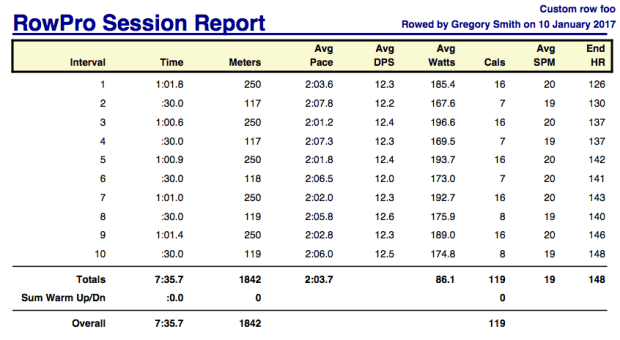
I did a quick 5 x 250m / 0:30 rest session as a test.  Here is the rowpro report that it generated.

One interesting thing about rowpro is that it connects to the PM by the USB port.  You can, in parallel connect the PM to ergdata or painsled and use that at the same time.  Why would you do that, you might ask?  I have a few good reasons.

  1.  You want to see all the cool stroke data that you get from ergdata like drive length or peak force
  2. You want to watch to cool accumulating force curve in painsled
  3. You are paranoid about using rowpro because if you get interrupted for any reason, you tend to lose all of the data from your row.

After I did the row, I remembered the way that rowpro does intervals.  It sets each interval and each rest as a completely separate row on the PM.  This allows the statistics to be accurate for each interval, but it has two negative effects.  First, the PM has lots of little rows so it’s hard to see what you were doing.  The second effect only matters if you are using rowpro with ergdata or painsled.  You get the same plethora of files as you do on the PM.

Anyway, I’m going to try to figure out how to export rows from the mac version, but I think I will only use rowpro for continuous rows, and probably only if I am going to row online.  It’s too much hassle to get it all setup for no real additional benefit.

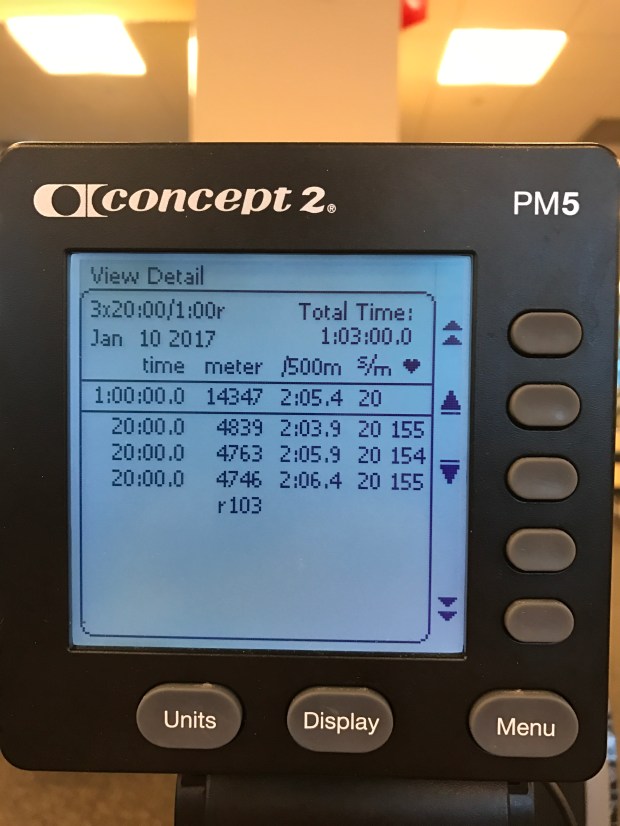
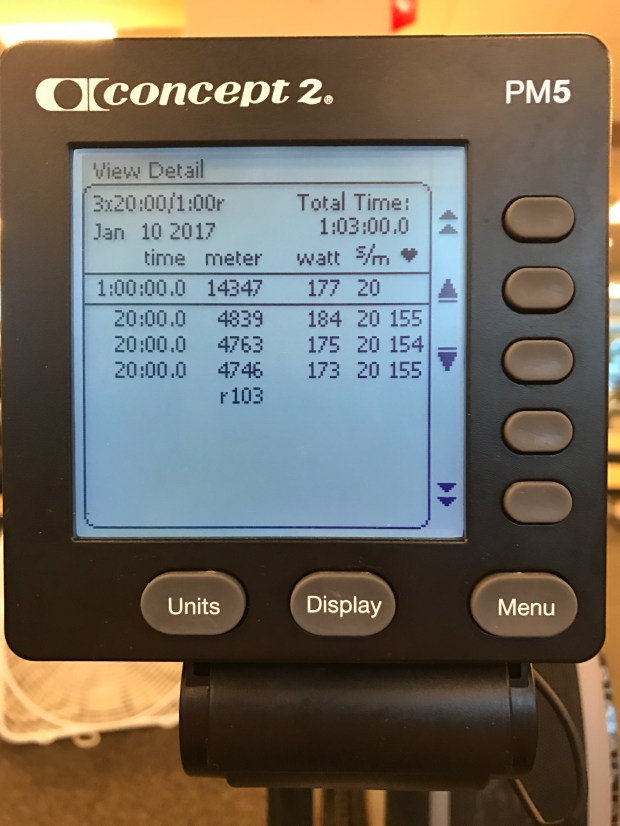
After that as a warmup, I went on to do the intended workout of the day.  I was originally planning of a 4 x 20′ session, but I did nearly 10 minutes of rowing as part of my experiment, so I cut back to 3 20′ intervals.

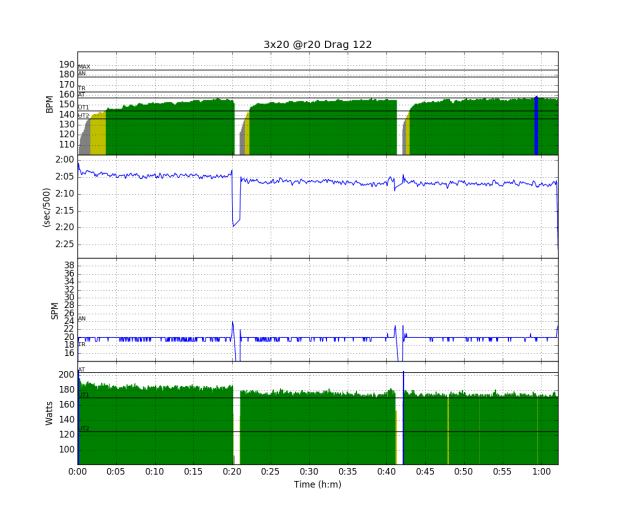
I had originally planned to try to row to a HR cap of 150, but my HR shot up so fast, and at such low power, that I decided to be satisfied to stay under 155.  Sticking to 155 required my to row at a pretty low power, but at least I found an intensity that managed the HR drift.

1-10a

Workout Summary - media/20170110-1305060o.csv
--|Total|-Total-|--Avg--|-Avg-|Avg-|-Avg-|-Max-|-Avg
--|Dist-|-Time--|-Pace--|-Pwr-|SPM-|-HR--|-HR--|-DPS
--|14440|63:00.0|02:10.9|177.0|19.8|151.5|159.0|11.6
W-|14347|60:00.0|02:05.5|177.2|19.8|151.5|159.0|12.1
R-|00095|03:00.0|15:51.9|152.4|22.3|154.4|159.0|01.7
Workout Details
#-|SDist|-Split-|-SPace-|-Pwr-|SPM-|AvgHR|MaxHR|DPS-
00|04843|20:00.0|02:03.9|183.5|19.7|148.3|157.0|12.3
01|04763|20:00.0|02:06.0|174.9|19.8|152.3|157.0|12.0
02|04741|20:00.0|02:06.6|173.1|19.9|153.8|159.0|11.9

HR drift today:

  • 2nd Interval–>  174.9/152.3
  • 3rd Interval –> 173.1/153.8
  • 2% (versus 6.5% yesterday)

Time for some patient work to build up my aerobic base.

Tomorrow:  Slow HM, HR cap of 155.

3 x 5K at r20 (155 cap)

It’s time to get serious about marathon training.  To do that, I need to rebuild my base aerobic fitness, and do some of the initial tests to set a baseline for paces.

I strongly believe that aerobic work is most effective when you limit the intensity and build duration, so this week I am going to focus on 60 to 80 minute sessions.  Then next week, I will do some baseline tests.  I am not in the mood to do lactate testing right now, so I am going to try to use strict HR limits for these sessions.  I’m going to row the sessions below 80% HRR (157).  It is probably even better to row them below 75% HRR (150), but that is just so disappointingly slow.

The other thing that I am going to work on is a lighter stroke.  I have been pursuing the 10W per stroke as a goal for a while and I think I am in a bit of rut.  When I rate up, I can’t seem to modulate power very well.  So, I think I will try to stick with r20 for the sessions this week and adjust pace by just adjusting the pressure at that rate.

So, that meant that the plan for today was:

  • 3 x 5000m
  • 1′ rests
  • initial power target ~ 180-190W
  • rate : 20 spm
  • HR cap: 155

Based on the criteria, the session went pretty well.  Of course, I wish that I was able to sustain higher power versus the cap, but that will take some time to come.  I found that I enjoyed the sensation of rowing with a “fluffier” stroke.

1-9a

The summary stats are a bit off compared to the PM.  It shows how much  the pace can vary just from a few more or less meters.

Workout Summary - media/20170109-154820-sled_2017-01-09T07-28-01ZEST.strokes.csv
--|Total|-Total-|--Avg--|-Avg-|Avg-|-Avg-|-Max-|-Avg
--|Dist-|-Time--|-Pace--|-Pwr-|SPM-|-HR--|-HR--|-DPS
--|15196|65:09.0|02:08.6|179.9|20.0|149.1|159.0|11.6
W-|15005|62:09.0|02:04.3|181.6|20.0|149.3|159.0|12.1
R-|00192|03:00.0|07:47.6|083.8|21.7|143.0|159.0|01.5
Workout Details
#-|SDist|-Split-|-SPace-|-Pwr-|SPM-|AvgHR|MaxHR|DPS-
00|05000|20:27.4|02:02.7|187.0|20.0|142.8|153.0|12.2
01|05000|20:41.2|02:04.1|183.6|20.0|151.2|157.0|12.1
02|05005|21:00.9|02:06.0|174.4|20.0|153.6|159.0|11.9

A few more geeky metrics.  Here’s an plot that you can use for HR drift.  From Joe Friel’s book “Total Heart Rate Training”,

Screen Shot 2017-01-09 at 11.30.36 AM.png

So, let’s consider the first 5k as warmup time and compute drift from the second to the third interval.

183.6W/151.2bpm – 174.4/153.6bpm = 1.214 – 1.135 = 0.079 / 1.214 = 6.5% drift

Ideally, I would like to see drift well below 5% for aerobic sessions.

1-9e

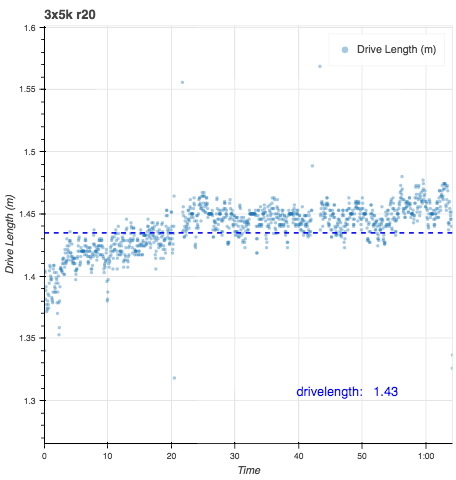
I checked drive length and it looks OK.  I see that characteristic where my drive length increases over the first 10 minutes as I loosen up.

1-9f

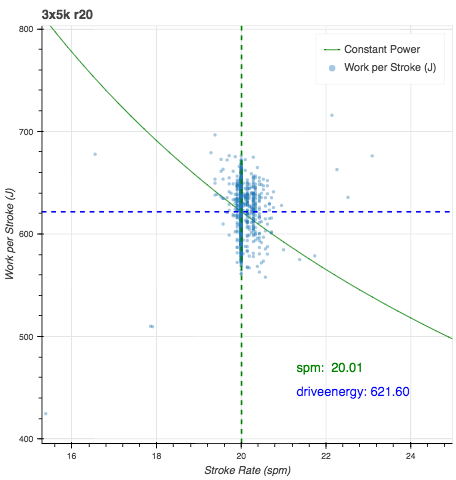
Since I was working on keeping the stroke the same as I eased off the pressure, I was looking for a vertical line in the work per stroke graph.  That’s what I got.

1-9d

And since I eased up from 10W per stroke, I expected the peak and average power to be lower than early sessions.  Here it is compared to Saturday’s aerobic session done at 10W per stroke.  Peak force was down by about 2.5%, average force was down by 6.5%.

Tomorrow: 4 x 20′ at r20, HR limit of 150 (let’s see if I can do it!)


My knee surgery

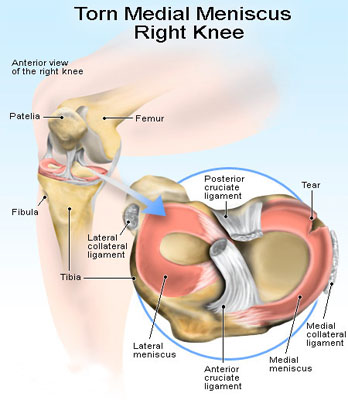
On December 22, I had arthroscopic surgery on my right knee.  I was diagnosed with a tear in the medial meniscus cartilage.  Here’s a diagram of what that means.

torn_meniscus

The tear was diagnosed by an MRI.  Unlike the diagram, my tears appeared to on the inside edge of the cartilage, not the outside.  In addition to the meniscus tear, I was also diagnosed with osteoarthritis, which showed up as “fuzziness” in the surface cartilage in the tibia and femur in x-rays.

I was under general anesthesia for the operation which took less than an hour.  Three small incisions were made to introduce the camera, light source and surgical instruments.

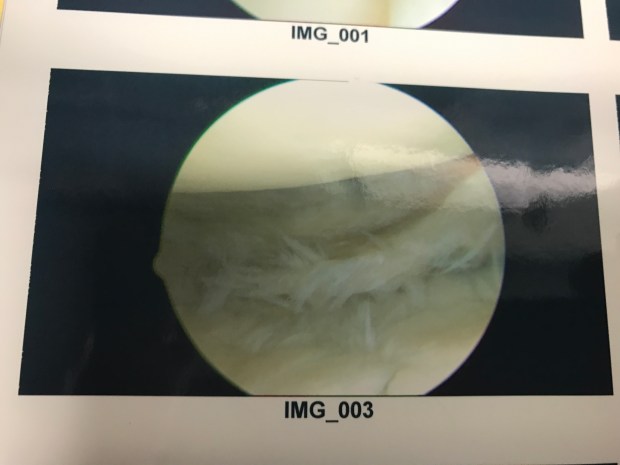
Here are a couple picture of the inside of my knee showing the torn (frayed really) menicus cartilage.  The stuff that looks like fringe is the torn up inner edge of the cartilage.

There were also some pictures of the meniscus after the repair, but I didn’t manage to take photos of that.  The doctor also showed me pictures of the surface cartilage where it was degraded from the arthritis.  He said it was likely that this will potentially get worse over time, but could be treated with cortisone, simvisc and stuff like that.

I asked him if I should avoid impact sports like running.  He said that the research was inconclusive and contradictory.  He advised me to go by how the joint felt.  If it started to hurt, then avoid running.  I asked if I was OK to start rowing again and he gave me the green light for that.

After the surgery, I recovered quickly.  I was on crutches for a day.  I kept it iced during the day over the first 2 days, and it was basically immobilized with an ace bandage for four days.  After 4 days, I took off the ace bandage and changed the little bandages on the incisions daily.  I was walking a little stiffly on day 4, but gradually increased the range of motion of the knee.  By day 6, the range of motion was just about normal.  The only time I felt a twinge was walking down stairs.  I found out later that this is likely to be related to the osteoarthritis, not the meniscus and I should just get used to it.

I didn’t have any trouble with pain.  The doctor prescribed over the counter anti-inflammatory (Ibuprofen) to minimize swelling and I took that constantly for the full 10 days until the follow up appointment.  I did not need to take any of the stronger painkillers that he gave me.

And now I’m back at it.  Yesterday’s CTC session was slower than I liked, but that’s due to a lack of fitness, not a knee problem.  This morning, after rowing hard at r28, I have no knee pain or swelling.  I’m ready to call the surgery a success.


January CTC : 4 x 4′ / 4′ rest

Well, if I wanted to test how far my sprint fitness has declined, this would be a good way to do it.  Also, it would be a good way to see how well my knee works for full pressure rowing.

I figured that it would be a stretch to do this session with an average pace of 1:45.  To try to make myself a little less obsessive about the pace, I did the challenge with the watts screen up.  1:45 is just about 300W, but somehow, I figured I would do a better job backing off if I wasn’t looking at the pace sliding away.

I set up the session as a simple time interval session.  I used the first 4 minutes as a warmup with 4 power 10s close to my target pace.  Then 3 minutes of paddling.  I let the flywheel stop completely before the first interval to stay legal.

The plan was to try to hold 10W per stroke, but I found that I was having trouble getting my rating up above 28, even with the power above 300W.  I just went with it, but it sure felt like hard work.  I finished the first interval 303 watts (1:44.6).  I felt pretty toasted, but I recovered pretty well in the rest period.

I figured I should probably back off the 300w target a bit, but I set out in the second interval at 300W, but I needed to back off a bit in the second half and I ended up at 297W (1:45.6).  This one really stung and I was desperately counting down the strokes to the end.

For the third interval, I targeted 280W and I hoped that would be enough slack.  This one started pretty well, but I sure felt it in the last minute.  I beat the 280w, but just barely with 283W (1:47.3).

The last interval was going to be very difficult.  I decided to back off some more to 260W and see how it went.  I really wanted to just make it through without putting the handle down.  I did, 262W (1:50.0).

I did a progressive cool down, and then paddled enough meters to tick over 10km.

The summary graph shows that I was pushing this one close to the edge.  My max recorded HR is 185 and I matched that the last interval.

1-8a

This workout shows how using power is a better way to manage intensity for hard workouts.  HR lags power in shorter intervals, so here, you can see that I was pushing anaerobic power levels for about 14 minutes, which was the whole workout execpt for when I faded in the middle of the last interval.  By HR, it only shows 6:38.

This workout provides a good example of how the stroke based statistics of rowsandall can have errors that have a pretty big impact on shorter intervals.  I parsed the workout data to select just the 4 work intervals, and the summary data from there was.

Workout Summary - media/20170108-2130110o.csv
--|Total|-Total-|--Avg--|-Avg-|Avg-|-Avg-|-Max-|-Avg
--|Dist-|-Time--|-Pace--|-Pwr-|SPM-|-HR--|-HR--|-DPS
--|08888|40:00.0|02:15.0|193.6|24.5|157.2|185.0|09.1
W-|04476|16:00.0|01:47.2|286.4|27.1|169.8|184.0|10.3
R-|05529|32:00.0|02:53.6|129.4|22.5|149.1|184.0|06.2
Workout Details
#-|SDist|-Split-|-SPace-|-Pwr-|SPM-|AvgHR|MaxHR|DPS-
00|00004|00:00.0|00:00.0|152.6|00.0|75.0|75.0|00.0
01|01146|04:00.0|01:44.8|302.8|27.3|165.1|176.0|10.5 - +2m
02|01130|04:00.0|01:46.2|297.0|27.2|169.7|181.0|10.4 - -6m
03|01113|04:00.0|01:47.8|283.3|27.5|171.9|184.0|10.1 - -5m
04|01084|04:00.0|01:50.7|262.5|26.4|172.4|184.0|10.3 - -6m

This is close enough for analysis purposes, and to provide a good definition of work and rest strokes, but for challenges, you definitely want to use the PM directly.

Tomorrow:  10 min warmup, 40 min steady state, 10 min cool down