Monday PM: 40′ L4

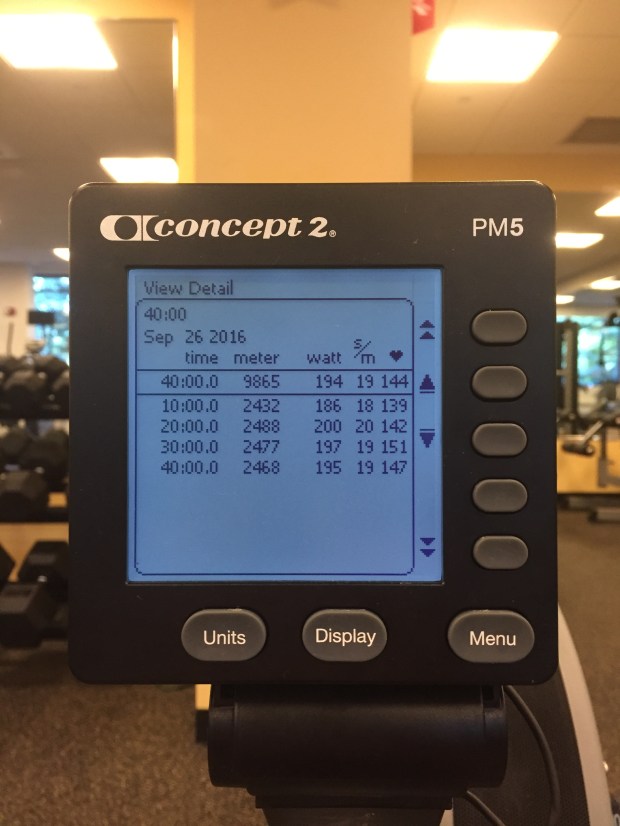
Towards the end of the day, I was still feeling a bit unsatisfied by the interrupted morning session.  It provided some HIT, but not nearly as much active time as I had hoped.  I decided to do a shortish L4 session.

Of course I was not entirely prepared to do an erg session at work.  I puyt back on my sweaty clothes from the morning, and rowed in socks, since my sneakers were at home, but it was a wonderful session.  I felt strong.

Plan:

  • L4 format
  • Start at 16spm and 160w and work up to target power over the first 10 minutes.
  • target power 185.  I figured that I would do alternating 2′ sections of 180W and 190W
  • HR cap of 150

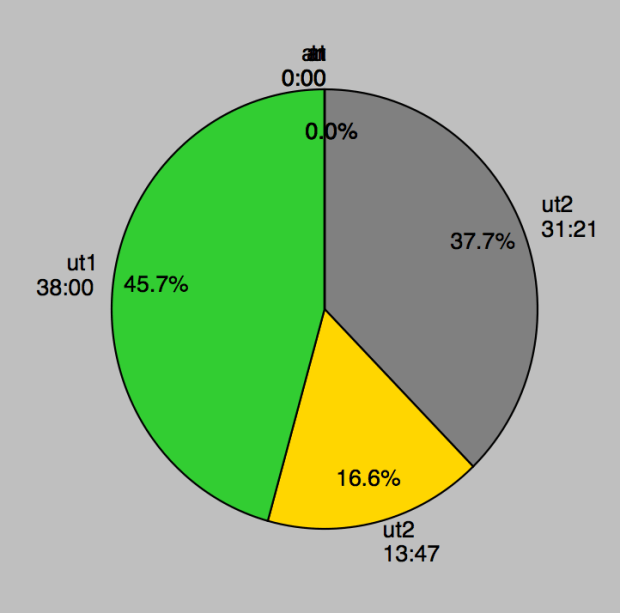
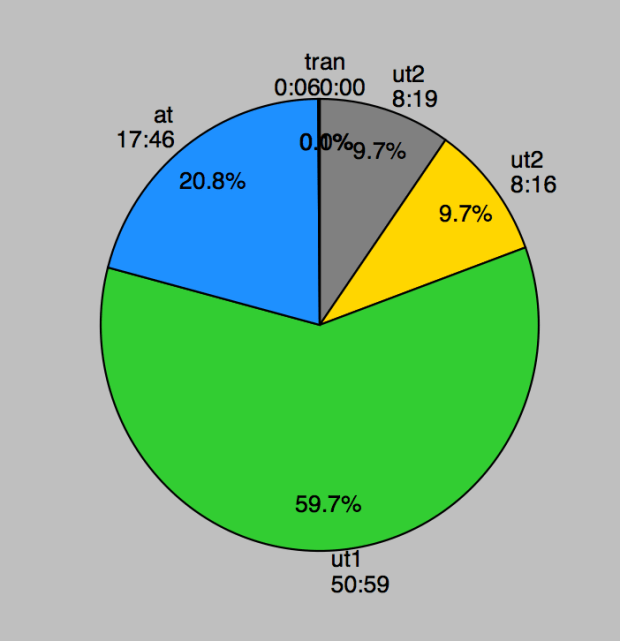
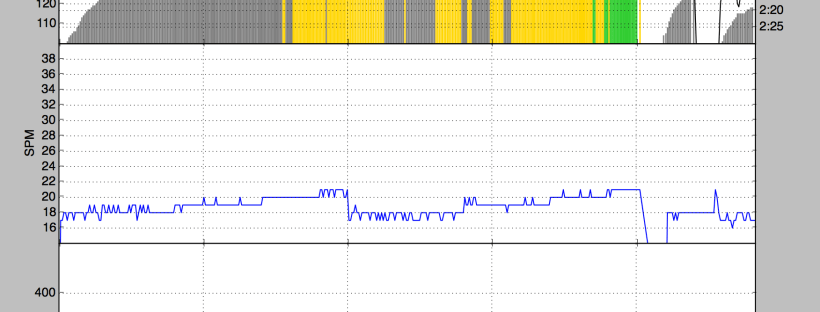
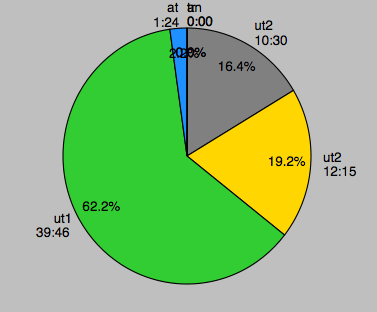
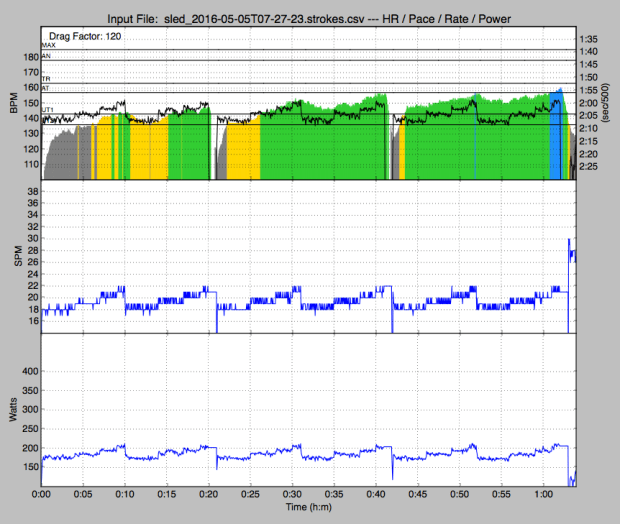
SO, I started with 2′ at r16, then 2′ at r17, then r18, then r19.  I was just barely nudging up into the UT2 HR zone, so I pushed on to r20 and 200W for 2 minutes.  The next 10 minutes I flipped back and forth between r19 and r20.  My HR went up into the UT1 zone around the 20 minute mark and I decided to back off the power a bit, so I changed the middle 2 minutes down to a r18 (180W), and my HR came down nicely.  So, for the rest of the workout, I just cycled between r18,r19, and r20.

myimage9-26b

It was a wonderful workout.  I enjoyed every minute of it.

Sunday: 4 x 20′ L4

A bit stiff and sore from the race yesterday, but time to get on with life.

Plan:

  • 4 x 20′ / 1′ rest
  • L4 format
    • base: 17 spm and 160W
    • 10W increase for each spm increase
  • HR limit at 155
  • Lactate test at 60′
  • Start low and build through first 10 minutes.

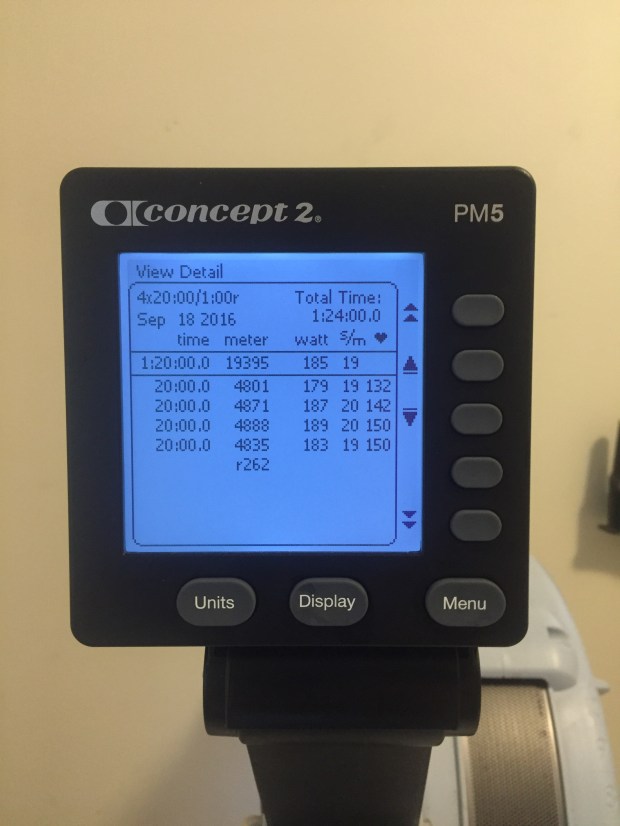
I wanted to do an L4 session because there has been a lot of discussion over on the concept forum about that style of workout.  But from my experience with L4 workouts, they tend to be too intense, so while this workout was in L4 format, it was not a “by the book” L4 workout.  What do I mean by that?  By L4 format, I mean that the workout has specific strokes rate and power defined in intervals and blocks.  But I did not use the tables from the WP to define the paces, instead I used a constant power per stroke.  I also constrained the stroke rates much more than a real L4.  I went in steps of 1 stroke from 17 to 21 strokes per minute.  The 2 spm jumps make the workout a lot more dynamic and tougher in my opinion.

2016-09-18-15-26-07

The stroke sequence I did was

  • First 20′ block
    • 1st 10′:  180 – 4′ @ 17 (160W), 3′ @ 18, 2′ @ 19, 1′ @ 20
    • 2nd 10′: 194 – 2′ @ 19, 2′ @ 20, 2′ @ 19, 2′ @ 20, 2′ @ 19 (this should be just below 185W)
  • Second 20′ block
    • 3rd 10′: 196 – 2′ @ 20, 2′ @ 19, 2′ @ 20, 2′ @ 19, 2′ @ 20 (this should be just above 185W)
    • 4th 10′: 194 – 2′ @ 19, 2′ @ 20, 2′ @ 19, 2′ @ 20, 2′ @ 19
  • Third 20′ block
    • 5th 10′: 198 – 2′ @ 19, 2′ @ 20, 2′ @ 21, 2′ @ 20, 2′ @ 19 (so, just 2′ at 200W in the  middle)
    • 6th 10′:196 – 2′ @ 20, 2′ @ 19, 2′ @ 20, 2′ @ 19, 2′ @ 20
    • Lactate test here was 2.6 mmol/l
  • Fourth block
    • 7th 10′: 194 – 2′ @ 19, 2′ @ 20, 2′ @ 19, 2′ @ 20, 2′ @ 19
    • 8th 10′: 188 – 2′ @ 18, 2′ @ 19, 2′ @20, 2′ @ 19, 2′ @ 18
    • Lactate test here was 2.5mmol/l

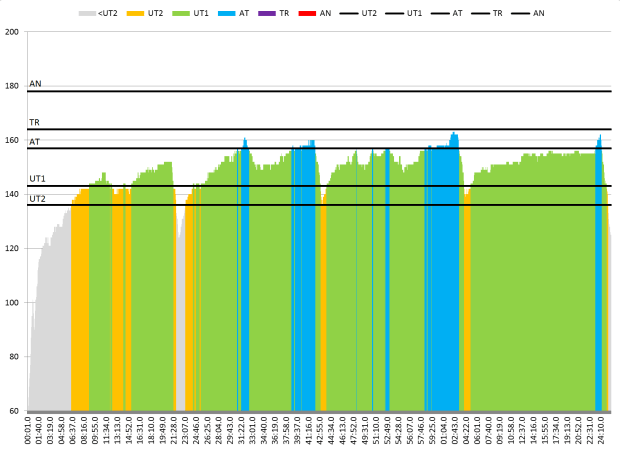
So, from a HR perspective, this was right on target.  But from a lactate perspective, it was just a little bit too intense.  I did a lactate test at 60′ and it was 2.6mmol/l.  I repeated it at 80′ and it was 2.5mmol/l.  From an RPE perspective, everything was feeling great, until I did the sequence at the beginning of the third section.  As soon as I did the little chunk at r21 and 200W, I felt like I got behind and never caught up.  Essentially, it felt like I flipped the switch that started to shut down the fat metabolism.

This provides an interesting data point to compare to a session where I start the same way, increasing my power during the first 10 minutes, but then settle on exactly 185 for the rest of the way.  Then repeat the lactate tests.  The theory would be that I would get a lower lactate reading by avoiding the higher powers.

This raises all kinds of interesting questions in my mind.

  • Many sports (like cycling) have intermittent bursts of high intensity, with stretches of lower power stuff.  How long does it take to get fat metabolism going again after you kick in with CHO?
  • Would it be good to try to train the response by doing just what an L4 does?  By dropping in some higher power chunks, will it help you develop the ability to process more lactate, or is it better to just gradually increase the training power?
  • Does it really matter?

Saturday: 3 x 20′ / 1′ r L4

Stayed up too late, and decided to sleep instead of heading to the lake.  I’ll row tomorrow instead.  Got up around 9:30 and hopped on the erg.

After yesterday’s very long row, I decided to only do 60 minutes today.  I also decided to stick with a stroke sequence and let my HR do what ever it wanted to do.

I did the following sequence: 2′ @ 16, 2′ @ 17, 2′ @ 18, 2′ @ 19, 2′ @ 20

Power was 10W * stroke rate (so 16spm = 160W)

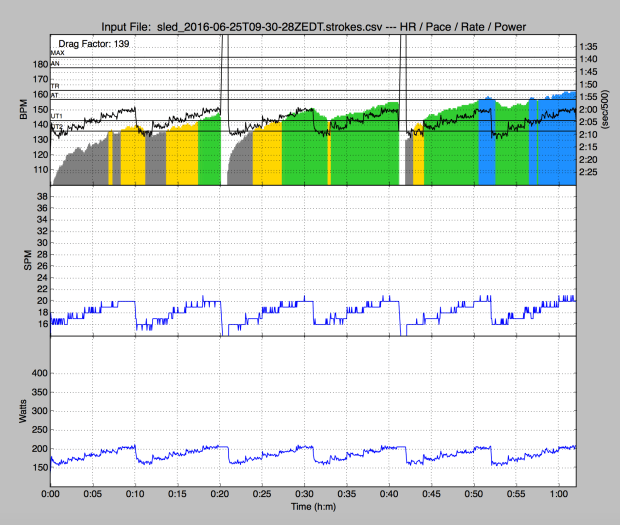
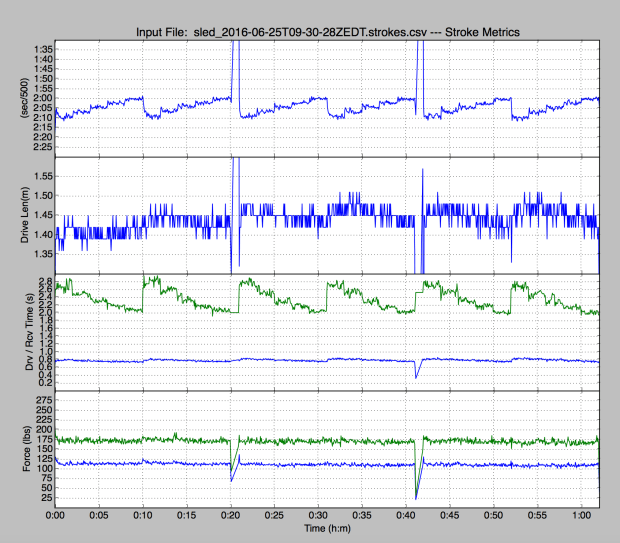
One interesting thing in the charts is the drive length.  As usual, you can see my drive length increasing over the first 10 minutes.  I think it is cool how it becomes more erratic as I get tired.  I like all the data that you can get out of painsled.

2016-06-25 10.34.09


Started off feeling great.  But I kind of hit the wall in the last 20 minutes.  HR was a lot higher.  I’ve decided to try to do my LIT endurance workouts in a fasted state.  I think the research is pretty clear that it helps keep you metabolizing fats to a higher intensity than if you have eaten recently.  The thing that I am trying to work out now is intensity.

I have the feeling that if I had limited to high end of this workout to 190W, I probably would have maintained a lower heart rate.  It might be better to go back to a constant power level for these workouts.  My suspicion is that there is a fair amount of hysteresis in the crossover between fat and CHO metabolism.  Once you flip the switch to start burning glycogen, that you have to go way down in intensity to flip the switch back to fat.  I think that where I am now, that going above 180W I am flipping the switch.

For now, if I have to do any steady state on the erg, I think I will start doing lactate testing again, and stick to constant power.  Pity.  It is very boring.  But I want to get some unequivocal data on where my base fitness is right now.

Thursday: 4 x 20′ / 1′ L4

Tuesday:  Arrived in Munich at 10AM.  Showered, connected by plane to Stuttgart.  Meetings with customer in the afternoon, back to the airport, flew to Paris, connected to Marseille.  Got to my hotel at midnight. No Training

Wednesday:  Decided to sleep in, instead of trying to workout.  Prep sessions all morning, customer meeting in  the afternoon, then back to the airport to fly back to Munich.  Arrived at the airport around 8:30PM, took the s-bahn  to my hotel.  Met with a couple of colleagues at the hotel.  Got  to bed around 1AM. No Training

Thursday:  Up at 7:30AM for a breakfast meeting with a customer.  That finished around 10AM.  My flight leaves around 4:10PM, so finally, I had a window to go to the gym.  I went to the hotel fitness center and saw a meticulously clean Concept2 Model E with a PM4.  Yesss!!!

Plan:

  • 4 x 20′ / 1′ rest
  • L4 format.  Power target –> 10W x stroke rate (16spm = 160W, etc)
  • HR Cap: 156

I figured with all the flying around, irregular meals and reasonable consumption of beer, that this would be a difficult session.  I was right.

I started slow and within 10 minutes I knew that I would struggle.  Here’s the stroke sequences I did.

  • 16 / 17 / 18 / 19 / 20
  • 16 / 17 / 18 / 19/ 20
  • 3′ @ 16 / 3′ @ 17 / 3′ @ 18 / 1′ @ 19
  • 3′ @ 16 / 3′ @ 17 / 3′ @ 18 / 1′ @ 19
  • 4′ @ 16 / 3′ @ 17 / 2′ @ 18 / 1′ @ 19 (dropped off the target power in this one)
  • 4′ @ 16 / 3′ @ 17 / 2′ @ 18 / 1′ @ 19
  • 10′ @ 16
  • 9′ @ 16 / 1′ @ 20

Very disappointed with what has happened to my aerobic fitness.  But pleased with the gigantic puddles under the erg.

Screen Shot 2016-06-23 at 12.35.23 PM

Tomorrow:  Sprint session in the boat.  6 x 750 / 5′ rest.

Sunday: 4 x 20′ / 1′ rest L4 on the erg

Plan:

  • 4 x 20′ / 1′ rest
  • Power: 10W x stroke rate
  • Heart rate cap at 155

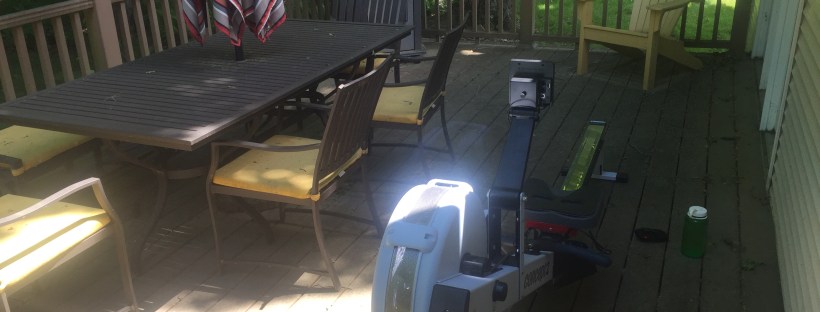
It should have been easier.  I set myself up on the porch.  It was beautiful outside.  Windy and around 70F.

2016-06-12 13.42.06

It should have been a really easy row, but I started feeling the effects very soon into it.  I started conservatively at 18spm and 180W.  My HR climbed steadily through the first 20 minutes and was well into UT1 by the end of that piece.  By the end of the second, I had pushed past the HR cap, so I retreated to a L4 format sequence

  • 4′ at 16 (160W)
  • 3′ at 17 (170W)
  • 2′ at 18 (180W)
  • 1′ at 19 (190W)

Even with this downshift, I still spent a lot of time above my HR cap.  I think I need to do some lactate testing to see where I am these days.

Screen Shot 2016-06-12 at 6.27.43 PM

Tomorrow:  Back in Newton in my own boat!  Hurray!  Steady state rate ladders 3/2/1 format at 17/19/21.  HR cap at 155.


Monday: 3 x 20′ / 1′ rest L4

Sunday:  Feeling very worn down.  Did some painting.  No Training

Monday:  Decided to skip OTW this morning.  Winds were 20 to 25 mph which would have made it not very productive.  New plan was 3×20′ L4 on slides.

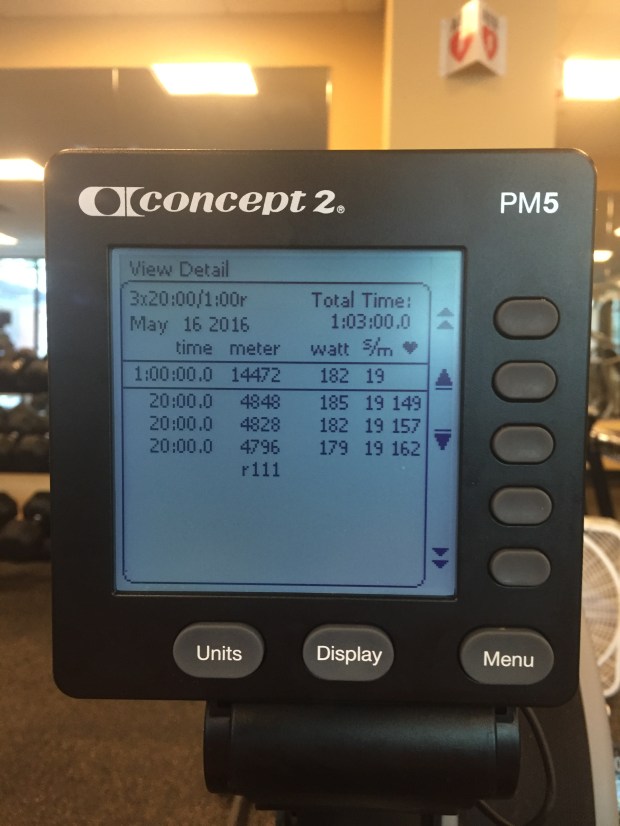
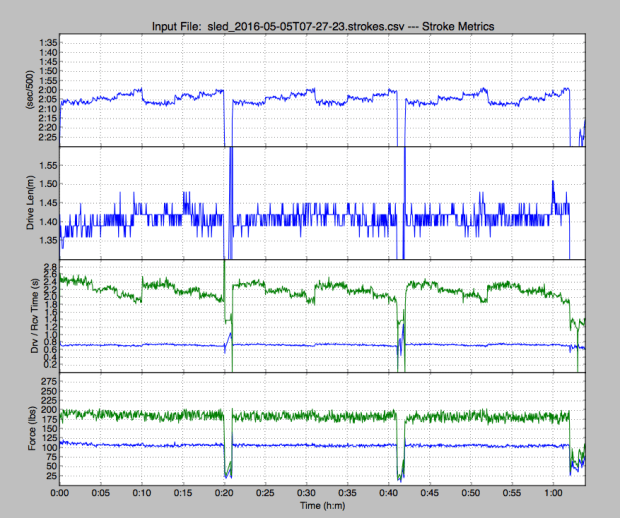
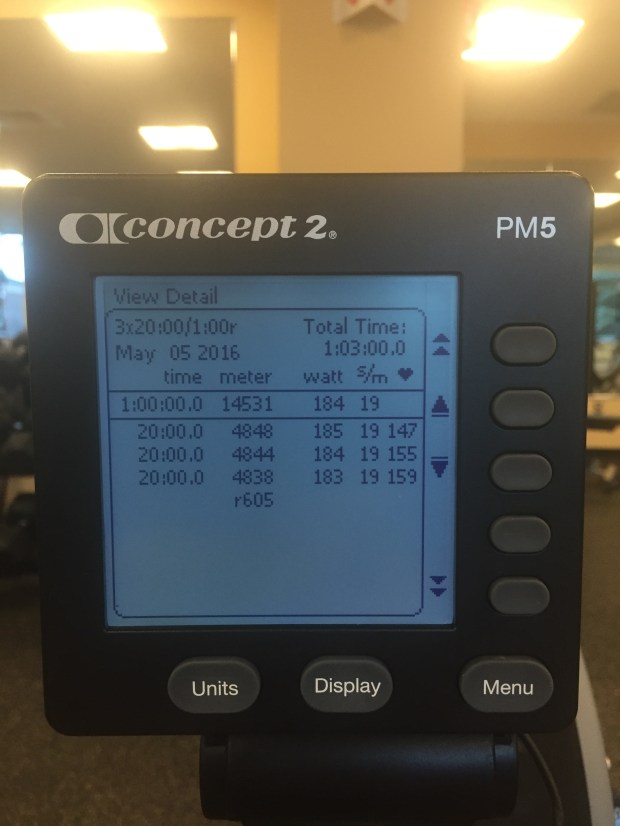
I felt pretty crappy.  My HR just kept creeping up and it was harder and harder to hold the target wattage.  I dialed back the stroke counts after the first 30 minutes a bit and it helped a little.

By the way, graphs were generated on line using a new tool developed by Sander.  It’s in beta test and active development right now, but has the potential to be a true cross platform to log and analyze rowing data.

Screen Shot 2016-05-16 at 11.57.48 AM

I’m in a bit of a rut right now.  I am really enjoying the time I’m spending on the water, and thanks to club boats and my friend Alex’s Pienert, can get on the water just about whenever I have time.  But doing sessions on the erg is a pain in the ass, and I am not sure exactly what I am training for.

Tomorrow:  OTW, something spicy, maybe 8 x 500.

Friday: WTF?

My dinner in NYC lasted until about 11:30.  I got to bed around 12:30.  Up at 7:00.  On the road by about 8:15AM.  Drove home and arrived about noon.  Then straight into a couple of work phone calls.  My day finished up around 3.  I hopped on the erg for what I planned to be a 60 minute steady state L4.

I lasted 20 minutes.  My HR was in bounds, but my RPE was very high.  I was sweaty and breathing very hard.  I started the second 20 minute piece and then decided to just bin the session.  I have no idea what was wrong with me.  Maybe I just wasn’t in the mood.

I was very tired in evening.  I wondered if I was getting sick.  But I felt much better this morning.

Screen Shot 2016-05-14 at 6.58.03 PM

Thursday: 3 x 20′ / 1′ L4

Wednesday:  after getting home around 12:30, I skipped the gym in the morning.  I was hoping to sneak in a workout later in the day, but things got pretty hectic and it was 6:30PM by the time I looked at my watch.  So, it turned into a rest day.  But, I was due.  I had managed to get sessions in every day for the past 7 days.

Today:  In the gym, normal steady state session.  On slides.  Repeating sequences of 4/3/2/1 at 18/19/20/21 spm.  On a static erg, I do these at 10W * stroke rate.  On slides, I scale back by 10 watts, so 18spm is 170W, and so on.

My legs were hurting a bit from my 10K run on Tuesday.  But it didn’t seem to effect anything.

Tomorrow:  OTW, steady state and technique.

Sunday: 4 x 20′ / 1′ L4

Nice and easy.  8 x 4’/3’/2’/1′

At home.  Static erg around 5 in the afternoon.  Cool and rainy outside with all the windows open.


Tomorrow:  I am flying off to LA for a quick one day trip.  Before I leave though, I have offered the use of a beautiful old Peinert single by a very nice gentleman that also rows out of the same facility that I do.  It will be my first outing of the season in a single.  I plan on a very easy technique oriented session.  Mostly I’m looking forward to being on the water.


Friday: 3 x 20′ L4

Another day, another L4.  Dentist appointment in the morning, so no chance to work out then.  By 4:30 in the afternoon, things were simmering down in the office, and I snuck off to the gym.

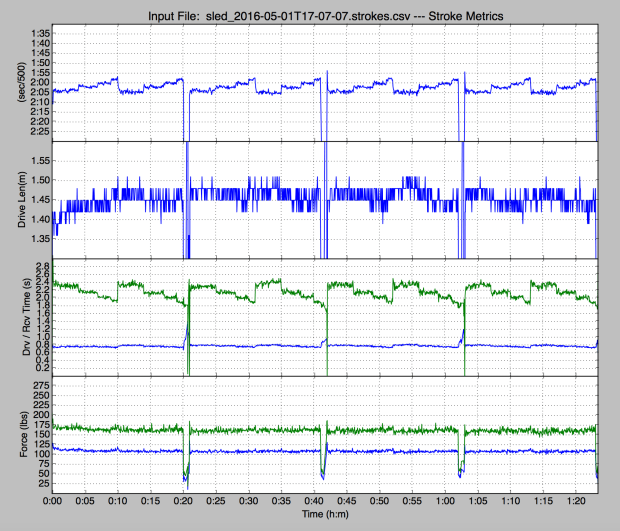
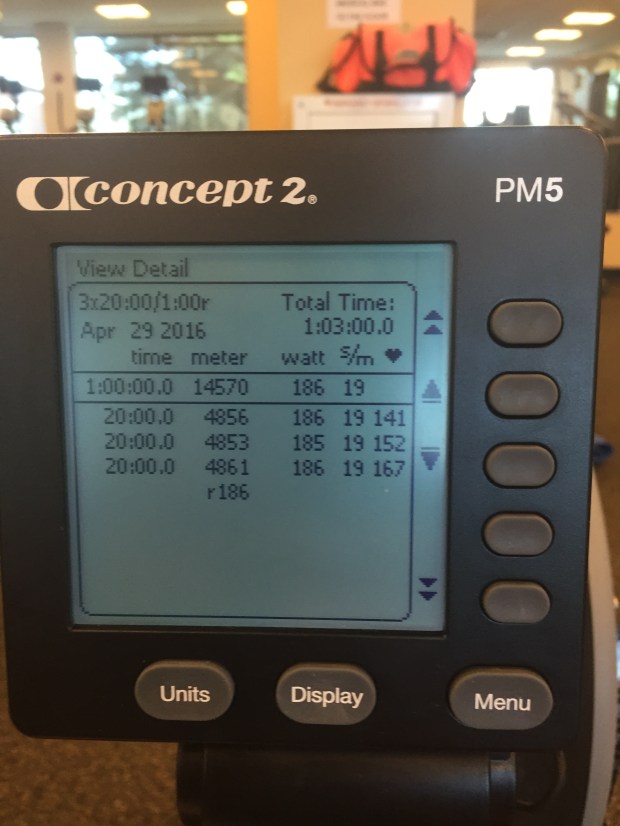
Today was a 60′ L4 on slides.  I’m just messing around with different stroke sequences.  Today it was:

4’@ 18 / 3’@ 19 / 2′ @ 20 / 2’@21 / 2’@20 / 3’@19 / 4’@ 18

Basically rowing over a big hill.  Then I did it again.  For the third one, I just did 2 repeats of 4/3/2/1, but I really amped up the power for the last 2 minutes while trying to hold the stroke rate.  This is kind of useful on slides because you need to maintain good stroke mechanics even when you are pulling really hard.  You need to focus on a nice smooth recovery or else the erg gets all kinds of upset with you.

As usual for me right now, the HR was a bit too high.  I’m not overly concerned for a number of reasons.  I’d appreciate feedback on this because my understanding of this stuff is far from complete.

At very low intensities, essentially all the energy comes from the metabolism of fat.  This form of metabolism does not generate any pyruvate, which ends up being lactate.  As intensity increases, this form of metabolism cannot supply enough energy and carbohydrates begin to be used.  This metabolic pathway generates lactate.  This is illustrated as the “crossover concept”, introduced in the mid 90’s in a paper by Brooks and Mercier

Screen Shot 2016-04-30 at 11.57.18 AMLactate is a useful form of energy which is also metabolized in exercise, so at a certain intensity, the production of lactate is balanced with the consumption of lactate.  This results in a stable lactate level that is used to determine the appropriate intensity for maximally effective endurance training.  The level can vary by athlete and fitness state, but is usually between 1.5mmol/l and 2.5mmol/l of lactate.  Exercising above this intensity leads to the incremental accumulation of lactate in the muscles and eventually to exhaustion.  Way above the limit rapidly increases lactate levels  (like a sprint) , a little above the limit results in a slow climb (like a 60′ time trial)

The fundamental theory behind polarized training is that the different energy pathways can be developed independently.  That you increase the ability to metabolize fat by exercising at levels that lean most heavily on that energy system.  That exercising at a intensity where you are at that lactate stasis level will eventually lead to improvement in the steady state power required to be at stasis.  Of course, to succeed in competition, you also need to develop your ability to tolerate high lactate levels, the maximum amount of power you can product, and the neuromuscular coordination to perform at high output levels.  That is why you do the hard part of polarized training.

So, why not just go hard all the time?  Three reasons.  First, it does nothing to help develop your ability to metabolize fat.  Two, it does nothing to develop your ability to metabolize lactate.  Third, it leaves you too depleted to go really hard when you are working on lactate tolerance and power.

So what’s up with how I’m training right now.  I’ve put myself into a holding pattern.  I have no boat, and I am rowing on the water only about once a week.  My job is requiring a lot of travel and a lot more hours than it was before so my ability to maintain a structured training plan is compromised, as is total amount of time I can devote to training.  So, I am focusing on trying to maintain my base aerobic fitness and push a little bit harder than I normally would because I am not putting a lot of energy into high impact sessions.

I am conflicted about this.  I think I would probably be better off if I turned the intensity down on these sessions and made a point of including one sprinty session a week, and I might do that, but for some reason that really isn’t making feel all that happy.  My highest priority is doing whatever I need to do to get my ass onto the erg as often as I can and less about what I do once I am there.

Anyway, back to the workout.  Basically the same deal as the usual.
Now it’s Saturday and I’m trying to figure out when to squeeze in a workout.