Sunday: Easy 4 x 20′ L4

I like late afternoon workouts.  I seem to be much better.

Today, I started around 4:30 at home after we returned from Cape Cod.

Plan:

  • 4×20′
  • L4 format
  • power target: 10W x spm
  • Slow start to warmup
  • HR limit: 155 (never got even close to that)
  • Lactate test at the end

Completely routine until about 12 minutes to go from  the end.  My phone rang, and the number that came up was my Dad.  I thought that I would call him back as soon as I finished.  But as soon as it stopped ringing, he called again. Now I was worried, so I stopped and picked up.  No emergency, thank goodness.  Then I picked up where I left off and finished.

#-|SDist|-Split-|-SPace-|SPM-|AvgHR|MaxHR|DPS-
01|02393|10:00.0|02:05.4|17.3|126.8|136.0|13.8
02|02442|10:00.0|02:02.8|18.6|133.0|136.0|13.2
03|02448|10:00.0|02:02.5|18.8|133.4|139.0|13.0
04|02456|10:00.0|02:02.1|18.9|134.3|138.0|13.0
06|02464|10:00.0|02:01.8|18.9|134.2|138.0|13.1
07|02139|08:42.0|02:02.0|19.0|131.9|138.0|12.9
08|02262|09:09.7|02:01.5|18.9|130.8|137.0|13.0

I tested lactate when I finished….1.2mmol/l

Last time I did this workout, it was over 2.


Saturday: Bumpy 14km Open Water Row

Down in Wellfleet.  I saw that the weather forecast looked good.  Sunny, calm, but a bit chilly (in the mid 40s).  I decided to go for a last Open Water row of the season.

The wind forecast proved to be wrong.  Right before I launched, it felt like the wind was freshening and it definitely was kicking up some waves.  Here’s the weather data from the station on my house.

Screen Shot 2016-11-05 at 1.52.20 PM.png

I launched at 11:07, according to RIM, and on top of my house it was blowing nearly 20mph then.  It didn’t feel like it was blowing quite as hard as that.  I think the fact that my wind sensor is about 80 feet above sea level means that it is catching a bit more wind than I was seeing on the water.  It was still pretty breezy though.

I didn’t check before I set out, but the water temperature was 55F.  When the air temp is in the 40s, this actually doesn’t feel too bad.  And for those safety sticklers, I passed the “100 degree rule” by a degree.  46F (air) + 55F (water) = 101!  But I think this will be it for open water rowing this year.  The margin for error is pretty slim at these temperatures.

Since it was cold out, I brought a towel and socks.  After I launched from the beach, I dried my feet and put on the nice dry socks.  That lasted about 2 minutes before the waves came crashing into the cockpit and soaked my feet.  The waves kept building and I decided to head pretty much straight up wind to get across the harbor over to the long sand spit on the far side, where I figure the water would be a lot flatter.

Rowing into the waves was slow, but not hard.  There is a regular pattern to the waves and you can get used to rowing in time time with them.  The key thing is to be very deliberate about placing the blades at the catch, and then load up the drive gradually, since there is a good chance that one blade or the other will miss water due to the waves.  If you have a habit of rowing in, this would sure help cure it.

I made it about 1500m before a wave managed to fool my phone into thinking that I was doing a whole lot of screen touching.  Over about 500m of rowing, the splashing did the following:

  • Went to the RIM setup screen
  • quit out of RIM
  • popped back to the home screen
  • started up Spotify
  • picked a playlist
  • and, I swear to God, pushed play.

As I approached the spit, the chop subsided.  I was still a couple hundred meters off shore, but when I looked over my shoulder, I saw a couple of big rocks poking up maybe 50 meters ahead.  I decided it was probably a good time to turn north and row along the lee shore of the spit.  I stopped briefly and stopped the music, fired up Wahoo fitness.  I decided to do that because I know that it works in background with the screen off.  So once it was started, I turned off the screen and just rowed by feel.  It was pretty enjoyable rowing unplugged like that.  Even in the lee of the spit, there was still a bit of chop and it really was trying to push my bow around when I was rowing north.  I needed to maintain a lot more pressure on my starboard oar the way along.

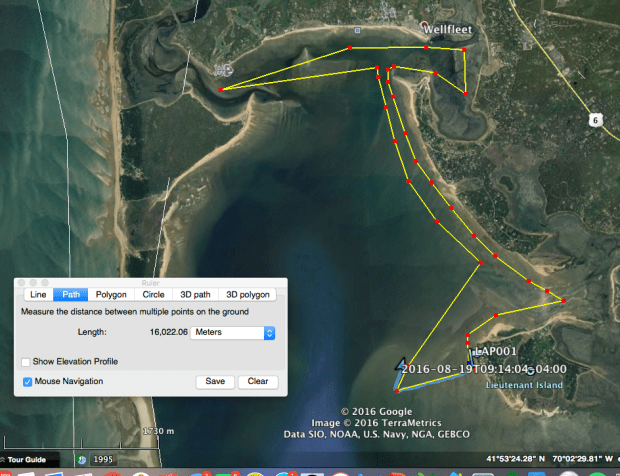
You can see a couple of sharpish turns as I approached the north end of the bay.  The first was when I saw the bottom rapidly shoaling on me as I approach the sand bar at the north end of the spit. I turned to the northeast to get back to deeper water.  Then you can see the unintentional turn towards the northwest which was induced by the wind and chop.  I finally noticed what was going on and turned east toward Wellfleet inner harbor.

As I rowed along, I again noticed the water shoaling under me.  You can see the area on the map, a little sandbar right after my turn to the east.  It got shallow enough that I touched bottom with one of my oars.  After that, I paddled along and the waves got a bigger as I got further from the spit.  I was rowing with the waves and it was kind of fun when I could time my stroke to catch a wave to surf down the front of (more on that later).

I continued past the wellfleet breakwater into the inner harbor and rowed all the way to the end of the town pier, when I spun.  Rowing with the wind, I was starting to feel a bit warm with all my layers and with a lack of splashing and spray.  That changed as soon as I turned back toward the west and started rowing into the wind.  The boat took a lot more effort to move, and the wind felt pretty strong and cold.  I wasn’t feeling overly warm anymore.  At that point I really appreciated the fantastic JL shell that I was wearing.

Once I cleared the end of the breakwater, I needed to turn south to head home.  This proved to be a significant challenge.  Going south meant that I had the northwest wind and waves coming at a angle to my stern.  Along this section the waves built to over 12″.  Now, I know that this does not sound all that impressive, but when the freeboard of the boat is less than 4″ and the oarlocks are about 8 inches above the water, it means that there is lot of water above the top of the boat, and maintaining control of the oars requires a bit of concentrated effort.  Also, since the waves are at an angle, you need to have vastly different handle heights at the catch to make sure that your blades are actually in the water.

The result of this was that I actually worked less hard in the section and rowed pretty slowly.  I continued south past my house to the beach where I launched and then turned for a last run straight downwind to the beach.  This was a blast!  The waves were over a foot, and now they were right on my stern.  I could get myself lined up and surf down the faces of the waves.  Over 5 feet of stern was completely submerged, and when I surged over the crest of a wave, my backstays would be slashing through the water sending spray all over.  The cockpit would fill with water.  The fun bit was trying to keep my stern to the waves, because they were trying to turn me broadside at the end of each of these surfs.  This kind of rowing bears no resemblance at all to flat water rowing.  This was all about timing your stroke to get you on the face of the wave and control the boat well enough that you can put in a single powerful stroke at the right time.  Honestly, the last 3 minutes of this section made the difficulties of the prior 30 minutes totally worthwhile.

screen-shot-2016-11-05-at-1-57-43-pm

One fun thing to point out on the map.  See the three little intervals at the very end.  That’s me carrying my oars to the car, then going back to the beach, then carrying my boat to the car over the dune.  I didn’t stop the wahoo app until I was in the car and had the phone out of it’s waterproof case.

Also notice the 2000m gap at the beginning.  The first path to the west is the TCX file from RIM.  It stops when the ocean started screwing around with my phone.  The line starts again after I got the wahoo fitness app running, and started to row north along the spit.

This is the RIM data for the row across to the spit.  I estimate another 2000m basically just like that is missing.

And here’s the HR and pace data for the rest of the row.  Notice the extreme difference in pace between rowing with a cross wind on flat-ish water (0 to 5000m) and rowing with a cross wind and a pretty good chop (5000m to 9000m).

From 9000m to about 10,400m was the worst wave action and I was struggling to get good strokes in.  You can see how my heart rate is dropping in this section.  I was really just trying to keep the boat on course and pick my way through the waves.  Then finally after 10,400, that was where I turned downwind and surfed to the beach.  Still not fast, but a hell of a lot of fun!

So, when you put it all together, you get

RIM:   1526m, 11:30


Guess: 2000m, 11:00

Wahoo: 10645m, 1:06:00

Total: 14171m, 1:28:30

Tomorrow:  4 x 20′ or rest day, depending when we get home.

Wednesday: 2 x 30′ Fitness Center

In San Diego.  Hotel Fitness Center

  • 30 minutes treadmill, 3.1 mph, 15% incline
  • 30 minutes elliptical, level 15, “rolling hills”

As boring as it sounds.

Tonight: back on the red eye.

Tomorrow:  I should do something higher intensity.  Maybe I’ll do the 15×3’/1′ with an easy-ish pace target like 1:52.

Tuesday: 4 x 20′ / 1′ rest L4 (and stroke metrics)

Standard session.

10W * stroke rate as the target power

10 minute blocks

Plan:

Untitled11-1c.png

Results:  About 0.7 sec fast on pace, and just about right on strokes (+4 for the whole workout)

Workout Summary - media/20161101-131736-sled_2016-11-01T06-47-09ZEDT.strokes.csv
--|Total|-Total-|--Avg--|Avg-|-Avg-|-Max-|-Avg
--|Dist-|-Time--|-Pace--|SPM-|-HR--|-HR--|-DPS
--|19719|83:09.0|02:06.5|18.5|144.9|162.0|12.8
W-|19482|80:00.0|02:03.2|18.4|144.8|162.0|13.2
R-|00242|03:09.0|06:30.6|17.1|128.3|162.0|09.2
Workout Details
#-|SDist|-Split-|-SPace-|SPM-|AvgHR|MaxHR|DPS-
01|02382|10:00.0|02:05.9|17.0|123.7|138.0|14.0
02|02437|10:00.0|02:03.1|18.4|139.9|145.0|13.2
03|02429|10:00.0|02:03.5|18.4|139.2|145.0|13.2
04|02448|10:00.0|02:02.5|18.7|145.6|149.0|13.1
05|02447|10:00.0|02:02.6|18.8|146.0|153.0|13.0
06|02451|10:00.0|02:02.4|18.9|152.5|156.0|13.0
07|02448|10:00.0|02:02.6|18.9|153.4|159.0|13.0
08|02439|10:00.0|02:03.0|18.5|158.4|162.0|13.2

In terms of effort, it felt great through the first 40 minutes, but when I added in the little 2 minute chunks at 200W, it seemed to really bury me.  My HR climbed pretty hard in the last 30 minutes of the workout.  This is a bit harder than I want to be working in these sessions.  Next time, I will go back to just alternating 18s and 19s.

Since I have the enormous power of rowsandall.com at my finger tips, I decidedto do a bit deeper analysis of the row.  This was an L4 workout so the power and stroke rate is closely prescribed.  Here’s a view of the power versus strokes rate.

bokeh_plot-10

You can see that even though my averages were about right, that there is considerable variation in the power from stroke to stroke.  I wonder if greater consistency in applied power at each stroke rate would be a sign of better efficiency?

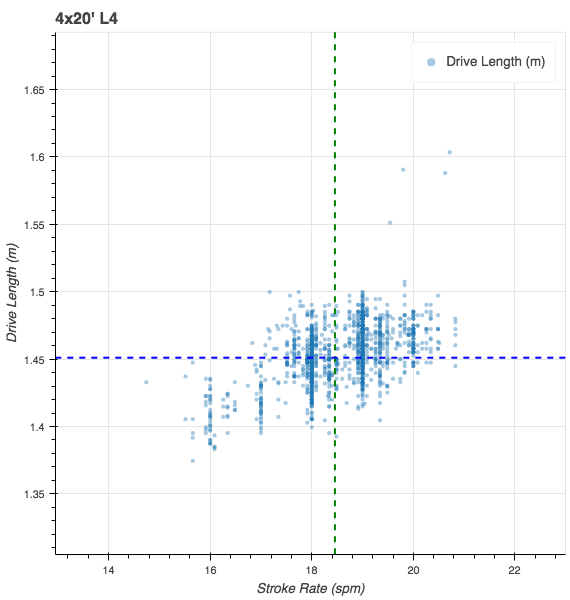
Here’s a view of Drive Length versus stroke rate. bokeh_plot-11

I would have thought that drive length would increase at lower stroke rates, but that is NOT what happened.  You can see that my stroke actually gets shorter as the stroke rate decreases.  I am also surprised at the variation from stroke to stroke, nearly 10 cm difference.  Maybe a more repeatable stroke would be more efficient?

Now a look at peak and average force

bokeh_plot-12

I haven’t really sorted this one out.  There is definitely a negative correlation between peak force and stroke rate, and a less pronounce relationship with average force.  The spread is the thing that has me fascinated.

Finally, work per stroke.  Basically “SPI”.  This by the design of the workout should be pretty flat.

bokeh_plot-13

And it is.  The interesting thing to me on this plot is that my consistency gets better as the rate increases.

I posted these for three reasons.

  1.  It’s the beginning of erg season and I need a new way to keep myself entertained.
  2. I would like to find ways to get faster that I have not yet explored
  3. I would like to capture a baseline for the beginning of the season.  Then in March, I can do this same workout and compare the graphs at the end of the season.

This afternoon, I am flying off to San Diego.  Tomorrow will be a fitness center session, then another endurance session on Thursday morning after I get off the red eye.

Hopefully during the flight today I can figure out what my next objectives are and begin to lay down a training plan.

Saturday: 75km Bike Ride

Friday:  I slept in and worked from home.  My wife and I were heading down to the cape for the weekend.  I was hoping to squeeze in a workout, but a quick look at my meeting schedule dashed those hopes.  So, I took it as a rest day.

Saturday:  I decided I wanted to do a long bike ride.  From my house all the way to the beginning of the Cape Cod Rail Trail.  The weather was a little iffy.  The wind was howling last night, over 50mph at times, with some rain as well.  By this morning, the wind had calmed down a bit and the rain was gone.  It was still very gray, and the it was quite cool, around 48F.

Screen Shot 2016-10-29 at 5.10.35 PM.png

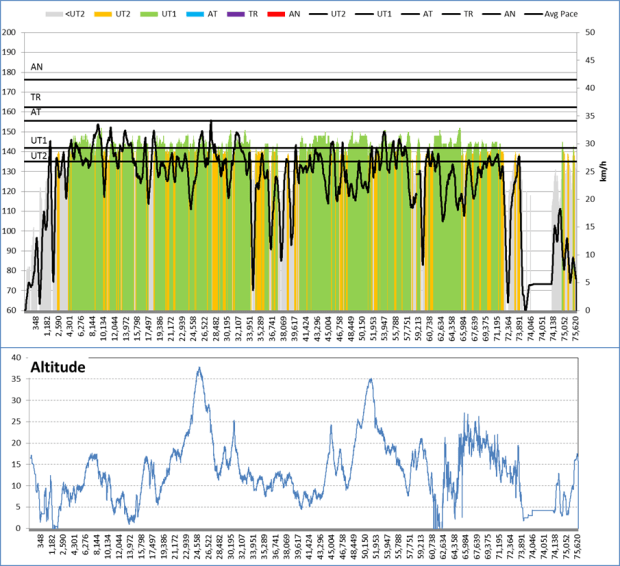
You can see from the elevation that the ride is quite flat.  The only thing that breaks it up is frequent road crossings.  It starts with about a mile of walking and riding on sandy roads on the island, then the road firms up and you can start riding.  As I crossed the bridge from the island, my jury rigged mount for my iphone busted and my phone clattered to the pavement.  I stuffed it in my pants and rode the rest of way without any speed of heart rate feedback.  I join the rail trail at mile 21, and head south.  There was a ton of sticks, leaves, pine cones and other debris on the trail from the wind storm yesterday.  It made steering a bit interesting.

I tried to keep my cadence up.  Whenever I hit a hill, I downshifted to try to keep things light.  I don’t ride very often and I have very rarely gone this far.  I still wanted to get a good aerobic workout, but I didn’t want to cramp up 20 miles from home.

There was very little traffic on the trail, and I’m proud to say that I was not passed by a single cyclist.

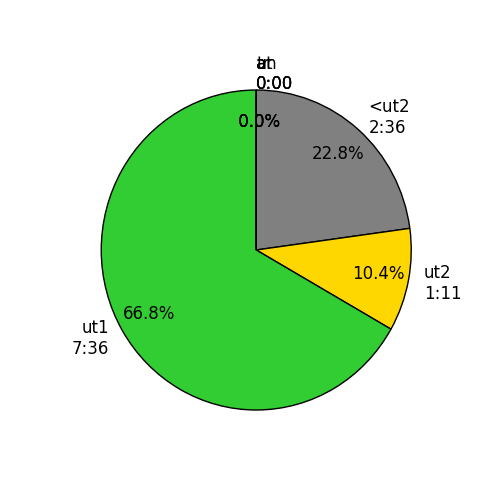
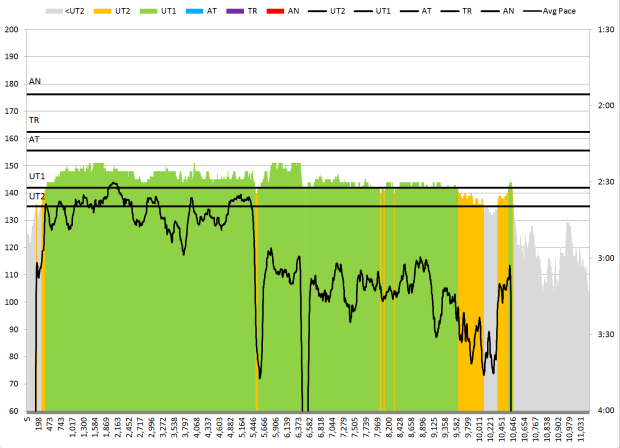
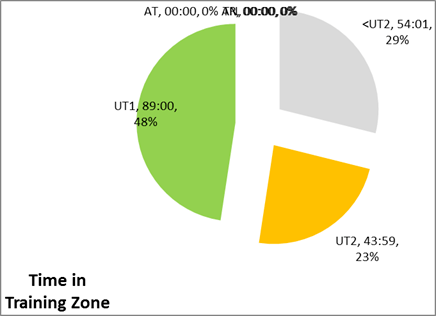
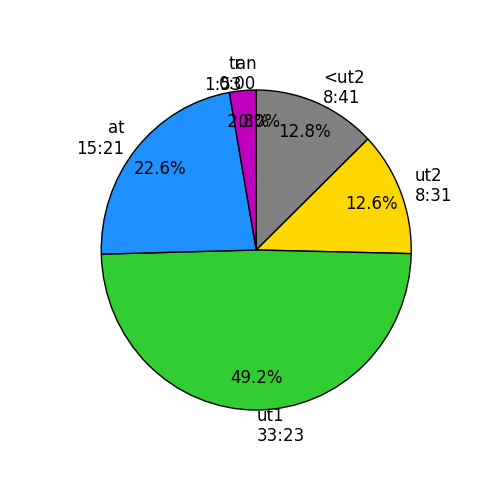
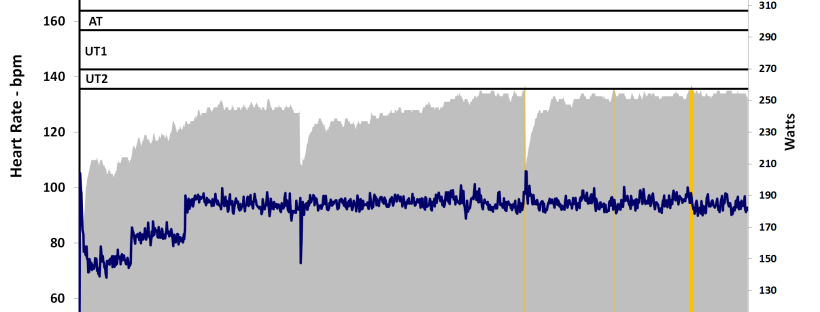
Looks like I succeeded in terms of intensity.  An hour and a half of UT1, plus 45 minutes of UT2.  Total time on the road was over 3 hours, with about 2:50 of moving time.
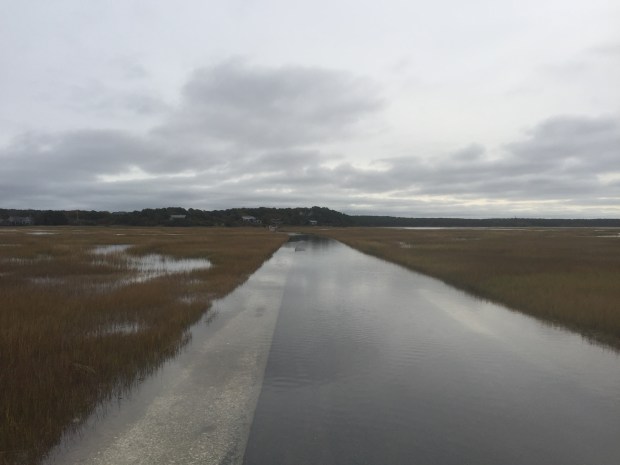
The biggest challenge of the ride was arriving back at the island at high tide.  I had to carry my bike and wade through about half a mile of flooded road.  Man, the water was cold.  Here’s the view back across it after I was finished.  You can see the bridge off in the distance.  The water was 6 to 12″ deep all the way along the road.  I’ve never seen the tide that high.

2016-10-29-11-20-59

After I finished wading, I had lost all feeling in my feet.  I got my socks and shoes back on and peddled slowly back to the house.

Wahoo fitness said it was a 2500 calorie bike ride.  I think that is probably about right.  It was pretty epic for me.

Tomorrow:  I will do an easy erg session in the evening when I get home from the cape.

Monday: UT1 Rate Ladders

Back in my single, on the Upper Charles in Newton.  I took that picture of a Great Blue Heron on the dock I used.  I saw him as I walked back from putting my boat away.  I see these birds often in the distance as I row, but this was the closest to one that I have gotten.

Weather:  flat water, cool, clear skies, with the sun slowly rising during my session

Plan:

  • 6 minute rate ladders.
    • 3′ @ 20
    • 2′ @ 22
    • 1′ @ 24
  • 4 x (2 x 6’/no rest) / 1′ rest (to turn the boat)
  • Pace target:  No real target, but I wanted to see faster paces with higher rates
  • HR Target:  None, but I was hoping that most of the session would be UT1.  I was OK with going higher to focus on technique.
  • Technique:  Work on level arm draw, avoid rowing “over the barrel”.  Work on crisper finishes and faster hands away.

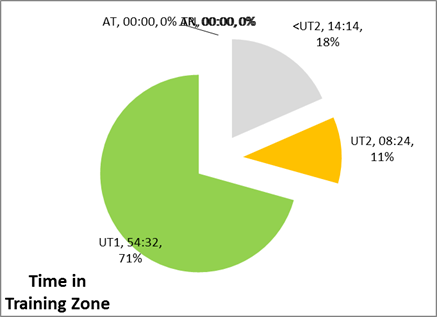
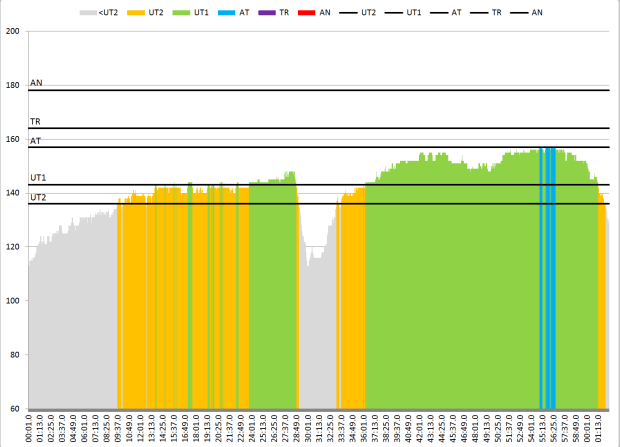
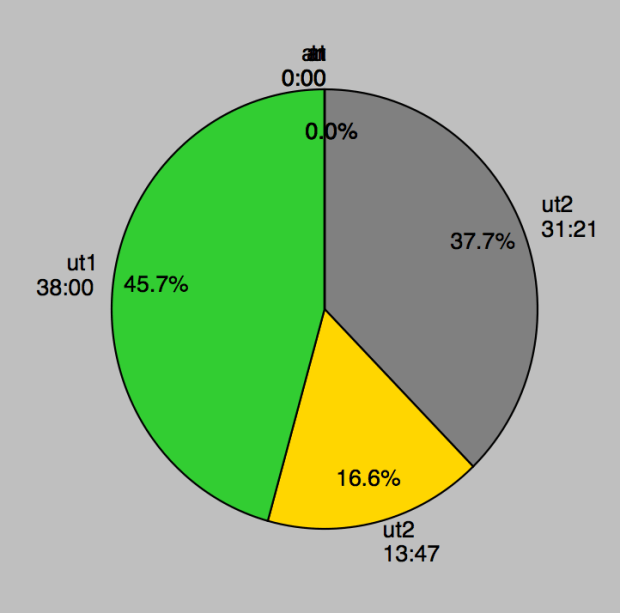
I didn’t even bother to put on the speedcoach today, I just used RIM on my phone.  Here’s the data as processed by rowsandall.com.  You can see that this was a bit harder work than most of my endurance sessions, with about 20 minutes above the top end of the UT1 band.

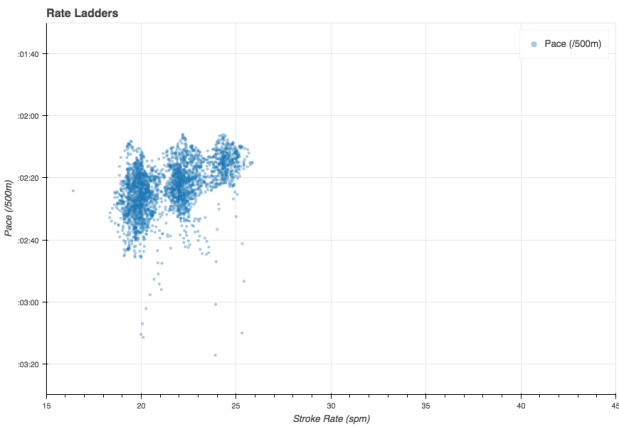
One of the cool tools that has been developed on the site is an ability to examine how different parameters in the data are related to each other.  For example, in a rate ladder workout, one of the interesting relationships is pace versus stroke rate.  The site also has a very useful interval editor so you can exclude strokes taken during warmup, rests and cool down.  Here is a plot of pace versus stroke rate.

bokeh_plot-2

You can see from the data that there are more strokes at 20spm than 22 and 24.  You can also see that there is a pretty wide variance of paces at each stroke rate.  That’s totally expected because of wind, current, effort, and steering.  But the interesting thing is trend of the centers of the cloud.

With the interval editor, you can also get accurate values for average pace, rate, dps and HR for each of the define intervals.

Workout Summary - media/20161024-152030-77825o.csv
--|Total|-Total-|--Avg--|Avg-|-Avg-|-Max-|-Avg
--|Dist-|-Time--|-Pace--|SPM-|-HR--|-HR--|-DPS
--|11964|62:00.0|02:35.5|20.6|148.3|167.0|09.3
W-|10087|48:00.0|02:22.8|21.4|153.9|167.0|09.8
R-|03307|22:00.0|03:19.6|18.8|142.8|167.0|07.6
Workout Details
#-|SDist|-Split-|-SPace-|SPM-|AvgHR|MaxHR|DPS-
02|02580|12:00.0|02:19.6|21.5|146.7|159.0|10.0
03|02478|12:00.0|02:25.3|21.4|154.0|162.0|09.6
04|02546|12:00.0|02:21.4|21.4|156.5|165.0|09.9
05|02483|12:00.0|02:25.0|21.5|158.5|167.0|09.6

This is pretty new functionality, so I checked it with an excel workbook that I have that does the same kind of processing.

| Tstart_ | Dist_ | Time_ | _Pace_ | SPM_ | avgHR | _DPS___ | Remarks
 | 00:00.0 | 01418 | 08:00 | 2:49.3 | 17.9 | 115.6 | 09.9 | warming up
 | 08:00.0 | 02577 | 11:59 | 2:19.5 | 21.5 | 146.7 | 10.0 | 1
 | 19:59.0 | 00108 | 01:00 | 4:37.8 | 20.4 | 149.2 | 05.3 | 
 | 20:59.0 | 02479 | 12:00 | 2:25.2 | 21.4 | 154.0 | 09.6 | 2
 | 32:59.0 | 00107 | 01:00 | 4:40.4 | 21.5 | 153.4 | 05.0 | 
 | 33:59.0 | 02549 | 12:00 | 2:21.2 | 21.4 | 156.5 | 09.9 | 3
 | 45:59.0 | 00086 | 01:00 | 5:48.8 | 20.7 | 152.5 | 04.2 | 
 | 46:59.0 | 02487 | 12:01 | 2:25.0 | 21.5 | 158.4 | 09.6 | 4
 | 59:00.0 | 01456 | 08:00 | 2:44.8 | 18.8 | 146.1 | 09.7 | cool down

| Tstart_ | Dist_ | Time_ | _Pace_ | SPM_ | avgHR | _DPS___ | Remarks
 | 00:00.0 | 01418 | 08:00 | 2:49.3 | 17.9 | 115.6 | 09.9 | warmup
 | 00:00.0 | 00301 | 03:00 | 4:59.0 | 20.8 | 151.7 | 04.8 | rest
 | 00:00.0 | 01456 | 08:00 | 2:44.8 | 18.8 | 146.1 | 09.7 | cool down
 | 00:00.0 | 10092 | 48:00 | 2:22.7 | 21.4 | 153.9 | 09.8 | Main set

It looks like it matches up really well.  In order to do similar analysis to the SPM vs pace with a spreadsheet, I need to slice the data into little mini intervals, one for each stroke rate and summarize it that way.  Here’s what that looks like.

| Tstart_ | Dist_ | Time_ | _Pace_ | SPM_ | avgHR | _DPS___ | Remarks
 | 00:00.0 | 01418 | 08:00 | 2:49.3 | 17.9 | 115.6 | 09.9 | warming up
 | 08:00.0 | 00638 | 03:00 | 2:21.1 | 20.1 | 138.4 | 10.6 | r20
 | 11:00.0 | 00427 | 01:59 | 2:19.3 | 22.3 | 145.7 | 09.7 | r22
 | 12:59.0 | 00224 | 01:01 | 2:16.2 | 24.2 | 150.8 | 09.1 | r24
 | 14:00.0 | 00626 | 02:59 | 2:23.0 | 19.8 | 147.5 | 10.6 | r20
 | 16:59.0 | 00443 | 02:01 | 2:16.6 | 22.6 | 151.6 | 09.7 | r22
 | 19:00.0 | 00219 | 00:59 | 2:14.7 | 23.8 | 157.3 | 09.4 | r24
 | 19:59.0 | 00108 | 01:00 | 4:37.8 | 20.4 | 149.2 | 05.3 | turn
 | 20:59.0 | 00625 | 03:01 | 2:24.8 | 20.3 | 147.8 | 10.2 | r20
 | 24:00.0 | 00414 | 01:59 | 2:23.7 | 22.2 | 155.2 | 09.4 | r22
 | 25:59.0 | 00220 | 01:01 | 2:18.6 | 23.2 | 158.4 | 09.3 | r24
 | 27:00.0 | 00594 | 03:00 | 2:31.5 | 20.0 | 153.5 | 09.9 | r20
 | 30:00.0 | 00417 | 02:00 | 2:23.9 | 22.4 | 157.3 | 09.3 | r22
 | 32:00.0 | 00209 | 00:59 | 2:21.1 | 23.9 | 161.3 | 08.9 | r24
 | 32:59.0 | 00107 | 01:00 | 4:40.4 | 21.5 | 153.4 | 05.0 | turn
 | 33:59.0 | 00637 | 03:00 | 2:21.3 | 19.9 | 149.9 | 10.7 | r20
 | 36:59.0 | 00418 | 02:00 | 2:23.5 | 22.3 | 157.2 | 09.4 | r22
 | 38:59.0 | 00226 | 01:01 | 2:15.0 | 23.5 | 161.2 | 09.5 | r24
 | 40:00.0 | 00615 | 03:00 | 2:26.3 | 19.9 | 156.6 | 10.3 | r20
 | 43:00.0 | 00437 | 02:00 | 2:17.3 | 22.5 | 159.2 | 09.7 | r22
 | 45:00.0 | 00216 | 00:59 | 2:16.6 | 24.8 | 164.0 | 08.9 | r24
 | 45:59.0 | 00086 | 01:00 | 5:48.8 | 20.7 | 152.5 | 04.2 | turn
 | 46:59.0 | 00613 | 03:00 | 2:26.8 | 20.3 | 152.9 | 10.1 | r20
 | 49:59.0 | 00419 | 02:00 | 2:23.2 | 22.3 | 159.2 | 09.4 | r22
 | 51:59.0 | 00222 | 01:01 | 2:17.4 | 23.3 | 162.3 | 09.4 | r24
 | 53:00.0 | 00593 | 03:00 | 2:31.8 | 19.8 | 157.7 | 10.0 | r20
 | 56:00.0 | 00419 | 01:59 | 2:22.0 | 22.5 | 161.4 | 09.4 | r22
 | 57:59.0 | 00221 | 01:01 | 2:18.0 | 24.8 | 165.9 | 08.8 | r24
 | 59:00.0 | 01456 | 08:00 | 2:44.8 | 18.8 | 146.1 | 09.7 | cool down

| Tstart_ | Dist_ | Time_ | _Pace_ | SPM_ | avgHR | _DPS___ | Remarks
 | 00:00.0 | 01418 | 08:00 | 2:49.3 | 17.9 | 115.6 | 09.9 | warmup
 | 00:00.0 | 00301 | 03:00 | 4:59.0 | 20.8 | 151.7 | 04.8 | rest
 | 00:00.0 | 01456 | 08:00 | 2:44.8 | 18.8 | 146.1 | 09.7 | cool down
 | 00:00.0 | 04941 | 24:00 | 2:25.7 | 20.0 | 150.5 | 10.3 | r20
 | 00:00.0 | 03394 | 15:58 | 2:21.1 | 22.4 | 155.9 | 09.5 | r22
 | 00:00.0 | 01757 | 08:02 | 2:17.2 | 23.9 | 160.1 | 09.1 | r24

Looking at the average paces, compared to the SPM vs pace plot, it appears that the 20 and 22 spm averages line up pretty well with the visual center of the data point clouds.  For 24 spm, it looks like the average is a bit slower than the center of the cloud.

Anyway, it was an amusing way to look at the data.  And it was a very fun workout.

Tomorrow:  The schedule calls for 5 x 1500m / 5′ rest.  Who am I to argue with that.  Pace target is 2:15.


Sunday: 4 x 20′ L4

A bit stiff and sore from the race yesterday, but time to get on with life.

Plan:

  • 4 x 20′ / 1′ rest
  • L4 format
    • base: 17 spm and 160W
    • 10W increase for each spm increase
  • HR limit at 155
  • Lactate test at 60′
  • Start low and build through first 10 minutes.

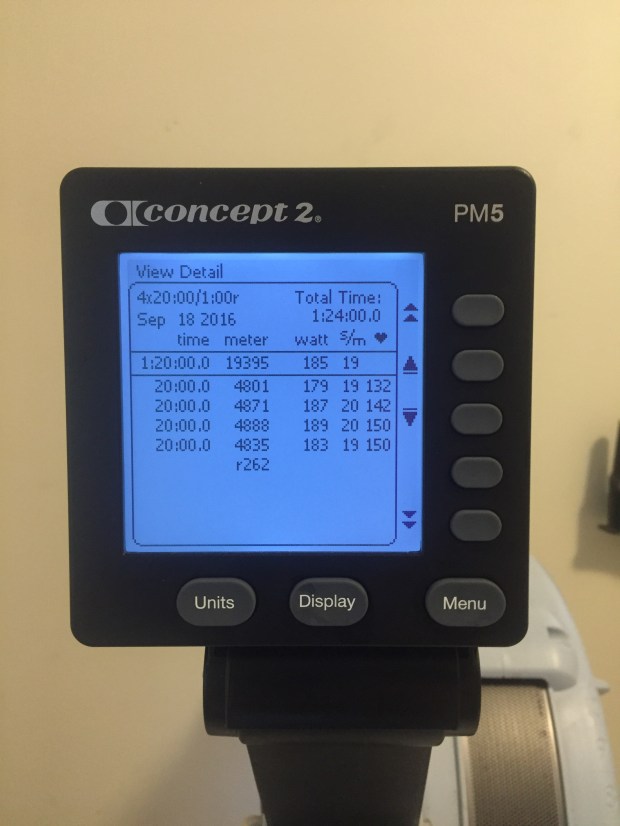
I wanted to do an L4 session because there has been a lot of discussion over on the concept forum about that style of workout.  But from my experience with L4 workouts, they tend to be too intense, so while this workout was in L4 format, it was not a “by the book” L4 workout.  What do I mean by that?  By L4 format, I mean that the workout has specific strokes rate and power defined in intervals and blocks.  But I did not use the tables from the WP to define the paces, instead I used a constant power per stroke.  I also constrained the stroke rates much more than a real L4.  I went in steps of 1 stroke from 17 to 21 strokes per minute.  The 2 spm jumps make the workout a lot more dynamic and tougher in my opinion.

2016-09-18-15-26-07

The stroke sequence I did was

  • First 20′ block
    • 1st 10′:  180 – 4′ @ 17 (160W), 3′ @ 18, 2′ @ 19, 1′ @ 20
    • 2nd 10′: 194 – 2′ @ 19, 2′ @ 20, 2′ @ 19, 2′ @ 20, 2′ @ 19 (this should be just below 185W)
  • Second 20′ block
    • 3rd 10′: 196 – 2′ @ 20, 2′ @ 19, 2′ @ 20, 2′ @ 19, 2′ @ 20 (this should be just above 185W)
    • 4th 10′: 194 – 2′ @ 19, 2′ @ 20, 2′ @ 19, 2′ @ 20, 2′ @ 19
  • Third 20′ block
    • 5th 10′: 198 – 2′ @ 19, 2′ @ 20, 2′ @ 21, 2′ @ 20, 2′ @ 19 (so, just 2′ at 200W in the  middle)
    • 6th 10′:196 – 2′ @ 20, 2′ @ 19, 2′ @ 20, 2′ @ 19, 2′ @ 20
    • Lactate test here was 2.6 mmol/l
  • Fourth block
    • 7th 10′: 194 – 2′ @ 19, 2′ @ 20, 2′ @ 19, 2′ @ 20, 2′ @ 19
    • 8th 10′: 188 – 2′ @ 18, 2′ @ 19, 2′ @20, 2′ @ 19, 2′ @ 18
    • Lactate test here was 2.5mmol/l

So, from a HR perspective, this was right on target.  But from a lactate perspective, it was just a little bit too intense.  I did a lactate test at 60′ and it was 2.6mmol/l.  I repeated it at 80′ and it was 2.5mmol/l.  From an RPE perspective, everything was feeling great, until I did the sequence at the beginning of the third section.  As soon as I did the little chunk at r21 and 200W, I felt like I got behind and never caught up.  Essentially, it felt like I flipped the switch that started to shut down the fat metabolism.

This provides an interesting data point to compare to a session where I start the same way, increasing my power during the first 10 minutes, but then settle on exactly 185 for the rest of the way.  Then repeat the lactate tests.  The theory would be that I would get a lower lactate reading by avoiding the higher powers.

This raises all kinds of interesting questions in my mind.

  • Many sports (like cycling) have intermittent bursts of high intensity, with stretches of lower power stuff.  How long does it take to get fat metabolism going again after you kick in with CHO?
  • Would it be good to try to train the response by doing just what an L4 does?  By dropping in some higher power chunks, will it help you develop the ability to process more lactate, or is it better to just gradually increase the training power?
  • Does it really matter?

Friday: 16K in Wellfleet

Today was deceptive.  I launched from the base of our stairs.  I came in yesterday at our house and stored the boat on top of the breakwater (not an easy thing to do, by the way).

This morning I had some time to think through my technique.  Basically I do it in steps.  I lift the stern, carry it halfway down the seawall and set it down.  Then I do the same thing for the bow.  Repeat as necessary to get to the beach taking care to not let the boat slide along the rocks.  It’s a bit nerve wracking but a lot easier than cartopping to a long walk to the water.

Anyway, I got myself launched and headed out.  Again it took about 10 strokes of touching sand before I was in deep enough water.  Then I headed east across the bay.  The wind was from the north and as soon as I cam out from  the lee of the island, I got hammered by the waves coming at me from the stern quarter.  They were just over a foot, with some whitecaps. I decided that turning around and heading up to indian neck would probably give me better water.  A good idea.  As soon as I turned around and was heading up into the wind, I filled the cockpit with water.  It also splashed the crewnerd hard enough to turn the damn thing off.  I could still see my splits and rate, but it wasn’t recording any data.  I need to come up with some kind of a splash cover for the phone or just give in and buy a Speedcoach GPS2.

I was right about the water.  I rowed to indian head and the water smoothed out.  There was still a fair amount of wind, but it was entirely rowable, and quite enjoyable.  I rowed up to the north end of the bay, then turned west and rowed along the north shore to the north end of great spit.  Then turned and rowed back all the way to the inner harbor, and around the outside of all the moored boats back to the end of the breakwater.  Then I cut back to indian head and rowed south along the shore all the way to where the salt marshes inland of Lt Island are.  Finally I cut back west and rowed to the north point of the island and around the shore in front of our house.

All together, I’m guessing it was about 16km in about 90 minutes.

We have some company coming tomorrow, so I am not sure if I will get a row in.  If I do it will probably be a short one.  I’m liking this open water stuff, and I’m getting a hang of rowing this boat.  Basically, I need to rate a little higher and row a little lighter, with a gentler push at the catch, building up the pressure through the stroke.  It also is pointless to pay much attention to the splits because with the wind, waves and tidal currents, it bears only the slightest resemblance to effort going in and the quality of the rowing.  A much better indicator is heart rate.  Today, my HR was generally between 144 and 150.  144 was when I was rowing downwind which is easier but requires a fair amount of concentration.  150 was rowing into the wind, which is technically simpler but a lot more work.


Article Review: Optimizing Fat Oxidation Through Exercise and Diet

One of the primary tenets of a polarized training program is to separately train the different energy systems by tailoring the intensity of the specific session.  If you are trying to training the Anaerobic Alactic system, then short sprints with long rests allow the athlete to produce more power in each rep and thereby increase the focus on that energy pathway.  Similarly, when doing low intensity endurance training, the idea is to keep the intensity high enough to elicit a training response, but low enough so that the metabolism of fat predominates.

The most direct way to determine the proper training intensity is to measure blood lactate levels.  This is because the metabolism of fat does not produce pyruvate, which is transformed into lactate, whereas the metabolism of carbohydrate (CHO) does end up producing lactate.  The body can use lactate as a fuel, so at a certain exercise intensity, the amount of lactate produce and consumed is at equilibrium and will stay stable over relatively long exercise sessions (60 to 80 minutes at least).

The problem is that routine measurement lactate is expensive, inconvenient and not continuous.  So it becomes desirable to find other measures that can be roughly correlated with lactate that are easier to measure, and more importantly to continuously monitor during an exercise session.

That brings us to this review paper:

Screen Shot 2016-06-21 at 4.20.33 PM

The key findings are:

  • Fat metabolism is maximized at a higher percentage of VO2Max for fit people than non fit people.
    • 59% to 64% of VO2Max for trained subjects
    • 47% to 64% of VO2Max for untrained subjects

Screen Shot 2016-06-21 at 4.41.46 PM.png

  • That the fat metabolism is maximized at different VO2Max percentages for different modes of exercise
    • 58% of VO2Max for walking
    • 64% of VO2Max for bicycling
    • No data about rowing 😦

Screen Shot 2016-06-21 at 4.41.53 PM

  • That ingesting Carbohydrates immediately before exercise reduces the amount of fat metabolism.
    • At the same percentage of V02Max, fasted subjects nearly doubles the fat metabolism of subjects that consumed CHO before exercise.

Screen Shot 2016-06-21 at 4.42.04 PM

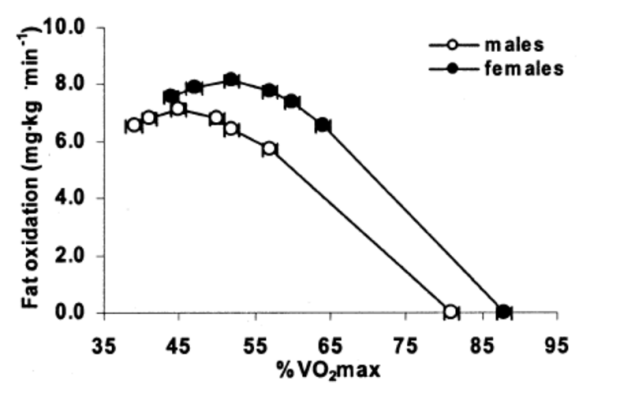
  • Men maximize fat metabolism at a higher percentage of VO2Max than women

Screen Shot 2016-06-21 at 4.42.11 PM

So, one thing that always trips me up is calibrating myself to VO2Max.  The best rule of thumb that I have read is that VO2Max power on an erg is roughly 2K pace or power.  So, if you can row a 7:00 2K (302W).  If maximizing fat oxidation occurs between 59% and 64% of VO@Max power, then the power range for endurance training would be 179W (2:05.0) to 194W (2:01.7).

Sunday: 3 x 20′ / 1′ rest

I had intended to take today as a rest day, but I was feeling antsy.  So, I decided  to do a recovery/endurance session and keep it really tame.

Plan:

  1. 3 x 20′ / 1′ rest
  2. slow start: 5′ at 2:15, 5′ @ 2:10
  3. rest of the workout at 2:04 and r18
  4. Measure lactate at end of workout.

Screen Shot 2015-10-18 at 4.53.51 PM Screen Shot 2015-10-18 at 4.54.14 PM

Workout Summary – Oct 18, 2015
–_|_Total_|_-Total-_|_–Avg–_|_-Avg-_|_Avg-_|_-Avg-_|_–Avg–_|_-Avg_|_-Avg
–_|_Dist-_|_-Time–_|_-Pace–_|_Watts_|_SPM-_|_-HR–_|_-%HRR–_|_-DPS_|_-SPI
–_|_14432_|_60:00.0_|_02:04.7_|_180.4_|_17.9_|_126.8_|_ 58.7% _|_13.5_|_10.1
Workout Details
#-_|_SDist_|_-Split-_|_-SPace-_|_Watts_|_SPM-_|_AvgHR_|_Avg%HRR_|_DPS-_|_-SPI

01_|_01131_|_05:00.0_|_02:12.6_|_150.0_|_16.4_|_105.0_|_ 43.3% _|_13.8_|_09.1
02_|_01167_|_05:00.0_|_02:08.5_|_164.8_|_17.2_|_118.3_|_ 52.7% _|_13.6_|_09.6
03_|_02424_|_10:00.0_|_02:03.8_|_184.7_|_18.5_|_128.2_|_ 59.7% _|_13.1_|_10.0
04_|_04855_|_20:00.0_|_02:03.6_|_185.5_|_18.1_|_127.8_|_ 59.4% _|_13.4_|_10.2
05_|_04855_|_20:00.0_|_02:03.6_|_185.4_|_17.9_|_132.1_|_ 62.5% _|_13.6_|_10.4

Lactate reading at the end: 2.0.  I have done this exact session the last three Sundays. Each Sunday has been the day after a race, so my level of fatigue should be roughly similar.   Here are the lactate measurements

  • October 4th: 3.2 (182W)
  • October 11th: 2.2 (184W)
  • October 18th: 2.0 (185W)

Looks like progress to me.  It is really strange to me how long my HR needs to be to keep below 2.0mmol/l lactate, but I like the trend that I am seeing.  So, I’m going to keep inching the power up a watt at a time and measuring lactates at the 60 minute mark.

Tomorrow:  It looks like it is going to be about 30 degrees in the morning and I don’t really feel like freezing my ass off.  So, I think I will go erg at work.  Probably a 4 x 20′ endurance session.