Tues PM: 3×20’/1’r with Lactate

Last week, I was on vacation.  I did a little cross training the first 3 days (Tues, Wed, Thur).  Essentially a 5km barefott run on the beach, then about 1.5km of swimming, both at a relatively leisurely pace.  Then I managed to catch a stomach bug and I was out of action from last Thursday until yesterday.

Yesterday morning, I was planning on an AM workout, but woke up with a headache and decided to try to get rid of it with a bit more sleep.  By the late afternoon, I was much improved, so I decided to dip my toe back in with a gentle steady state session.

Tuesday PM: 3×20’/1′ r on slides

I am going to try to do a lactate test after the first 20′ of my steady state sessions to try to build a reasonable database and get a better understanding of the appropriate training intensity.  Since all of my recent lactate tests have been on a static erg, and I had the 8 day break, I was pretty clueless about the right initial power to use.  I was going to target 180, but it felt so easy that I changed on the fly to 185, and when I got to the 15 minute mark, I was averaging 186W.  I decided that cutting back enough to bring the average down to 185 over the last 5 minutes might lead to erroneously low reading, so I just stuck with 186.  Lactate reading 2.3…Too high.  but not far off.  Interestingly, my HR was very low.  The lowest I have recorded for any of my recent lactate tests.  Again showing the very weak correlation between HR and Lactate levels.I rowed the rest of the session at 183 and my HR stayed remarkably low.

2015-02-25_9-19-40

2/24/2015 3×20’/1’r on slides
Time meters SPM watts pace Strokes DPS Lac
0:20:00.0 4860 20 186.0 02:03.5 400 12.15 2.3
0:20:00.0 4834 20 183.0 02:04.1 400 12.09
0:20:00.0 4834 20 183.0 02:04.1 400 12.09
1:00:00.0 14528 20.0 184.0 02:03.9 1200 12.11

Lactate Test Results

Lactate readings are taken after a 20′ piece at constant power and stroke rate.

day Date slides power SPM HR % HRR Lactate
7 2/7/2015 no 190.0 19 138.3 67% 1.7
1 2/8/2015 no 190.0 19 134.8 64% 1.8
7 2/14/2105 no 195.0 19 139.9 68% 1.8
1 2/15/2015 no 196.0 19 134.6 64% 1.7
3 2/24/2015 yes 186.0 20 132.3 62% 2.3
4 2/25/2015 yes 185.5 20 138.2 67% 2.1
5 2/26/2015 yes 183.1 20 137.0 66% 2.4
6 2/27/2015 yes 184.1 20 141.2 69% 2.5
3 3/3/2015 no 185.2 17.9 144.3 71% 2.5
5 3/5/2015 yes 176.4 20 134.4 64% 1.5
6 3/6/2015 yes 178.4 20 134.1 64% 1.7
7 3/7/2015 no 185.2 17.9 144.3 71% 2.2
1 3/8/2015 no 182.9 19.7 138.8 67% 1.9
2 3/9/2015 no 183.4 19.3 135.1 64% 1.8
3 3/10/2015 yes 178.8 20 134.1 64% 1.5
4 3/11/2015 yes 180.0 20 138.4 67% 1.1
5 3/12/2015 yes 182.1 20 140 68% 1.3
6 3/13/2015 yes 184.5 20 140.0 68% 2.2
7 3/14/2015 no 185.8 20 133.8 63% 2.4
1 3/15/2015 no 186.7 19.1 136.9 66% 1.7
4 3/18/2015 no 188.1 18.9 137.7 66% 1.7
5 3/19/2015 yes 190.0 20 140.1 68% 1.7
6 3/20/2015 no 190.4 18.6 138.3 67% 2.0
7 3/21/2015 no 190.7 18.9 141.0 69% 1.9
1 3/22/2015 no 190.6 19.3 144.4 71% 1.8
2 3/23/2015 yes 190.4 20 144 71% 1.9
3 3/24/2015 yes 191.9 20 144.2 71% 1.5
4 3/25/2015 yes 193.0 20 150.2 75% 1.9
5 3/26/2015 yes 192.0 20 150.3 75% 2.3
6 3/27/2015 yes 190.1 20 151 76% 1.7
7 3/28/2015 no 191.2 19 138.2 67% 1.3
2 3/30/2015 yes 191.2 20 140.6 68% 2.5
3 3/31/2015 no 191.4 19 144.6 71% 2.6
4 4/1/2015 yes 187.3 19 147.1 73% 1.6
5 4/2/2015 yes 186.9 18 142.9 70% 1.6
6 4/3/2015 no 186.7 17.8 145.1 72% 1.9
7 4/4/2015 no 186.7 19 137.1 66% 2.2
1 4/5/2015 no 187.0 19 135.1 64% 1.7
3 4/7/2015 no 192.0 19 138.4 67%
4 4/8/2015 no 197.0 19 147 73%
5 4/9/2015 yes 193.1 20 144.6 71% 2.4

* Average HR for last 5 minutes of 20′ piece

Feb 14 CTC

Got back home at 11PM last night. The whole place is just buried in snow. I’ve never seen snow like this.

A serious ice dam situation had developed while I was in europe and we were getting water into the house. A couple of place in the kitchen ceiling have big water stains and my wife spent a lot of time putting down towels and buckets while I was jetting around europe. So today, the first job was to go get some rock salt. The next job was to clear the snow off our north facing roof. So, I trudged with the extension ladder through the 4 feet of snow on the ground the back of the house and put my snow rake to use. I cleared all the snow up to about 5 feet from the peak of the roof, and then put rock salt on the huge ice dams. Hopefully that will soften them enough so I can remove most of them tomorrow. Then it was on to the foot paths around the house. They only had about 14 inches or so to clear, but it was still a lot of hard work. All in all it took about 2 hours and I was pretty tired after it all.

So, I waited a few hours before going to do an abbreviated erg session. I just wanted to do the Feb 14 CTC. I never knew Carol, but she has certainly made impression on this community, and I wanted to make sure that Free Spirits floated as many boats as we could.

So, a 20 minute warmup. Instead of the usual fletcher, I just did 20 minutes at 195 steady state, so that I could do a lactate test after missing a week of erg sessions. Result: 1.8mmol/l If I were going to train next week, I would shoot for that on slides. But, instead, if the weather allows the escape, I’ll be in Aruba where running and swimming will be the preferred cross training. I’ll do another lactate test next weekend when I return.

Warmup / lactate test
–_|_Total_|_-Total-_|_–Avg–_|_-Avg-_|_Avg-_|_-Avg-_|_–Avg–_|_-Avg_|_-Avg
–_|_Dist-_|_-Time–_|_-Pace–_|_Watts_|_SPM-_|_-HR–_|_-%HRR–_|_-DPS_|_-SPI
–_|_04939_|_20:00.0_|_02:01.5_|_195.3_|_19.0_|_134.4_|_ 64.1% _|_13.0_|_10.3

Workout Details
#-_|_SDist_|_-Split-_|_-SPace-_|_Watts_|_SPM-_|_AvgHR_|_Avg%HRR_|_DPS-_|_-SPI
01_|_03706_|_15:00.0_|_02:01.4_|_195.4_|_18.9_|_132.5_|_ 62.8% _|_13.0_|_10.3
02_|_01234_|_05:00.0_|_02:01.6_|_194.8_|_19.0_|_139.9_|_ 68.0% _|_13.0_|_10.3

Then in to the CTC. Simple. Row 1402m. With no speed sessions this week, I wasn;t really sure what pace to row. I figured around 1:42. But of course, with high hopes and adrenaline, I went off faster. I knew by 200m, that the 1:40 pace I was holding was no going to work. I wasn’t sure if I had done too much damage with it. I slowed down to around a 1:44, with a 1:45 popping up now and again. By the time there was 500m left, I had recovered my wind and my pride and started to pull down the splits. My rate is still way too low though. I really need to work on that.

Workout Summary – Feb 14, 2015
–_|_Total_|_-Total-_|_–Avg–_|_-Avg-_|_Avg-_|_-Avg-_|_–Avg–_|_-Avg_|_-Avg
–_|_Dist-_|_-Time–_|_-Pace–_|_Watts_|_SPM-_|_-HR–_|_-%HRR–_|_-DPS_|_-SPI
–_|_01402_|_04:46.5_|_01:42.2_|_328.3_|_28.3_|_160.0_|_ 82.3% _|_10.4_|_11.6
Workout Details
#-_|_SDist_|_-Split-_|_-SPace-_|_Watts_|_SPM-_|_AvgHR_|_Avg%HRR_|_DPS-_|_-SPI

01_|_00200_|_00:40.1_|_01:40.1_|_348.6_|_28.5_|_132.2_|_ 62.6% _|_10.5_|_12.2
02_|_00200_|_00:40.9_|_01:42.3_|_326.7_|_27.9_|_157.9_|_ 80.8% _|_10.5_|_11.7
03_|_00200_|_00:41.3_|_01:43.3_|_317.2_|_27.6_|_161.9_|_ 83.6% _|_10.5_|_11.5
04_|_00200_|_00:41.9_|_01:44.7_|_304.7_|_27.2_|_163.9_|_ 85.1% _|_10.5_|_11.2
05_|_00200_|_00:41.6_|_01:44.1_|_310.5_|_28.8_|_166.6_|_ 86.9% _|_10.0_|_10.8
06_|_00200_|_00:40.8_|_01:42.0_|_330.0_|_27.9_|_168.3_|_ 88.2% _|_10.5_|_11.8
07_|_00202_|_00:39.8_|_01:38.6_|_365.3_|_30.1_|_169.2_|_ 88.8% _|_10.1_|_12.1

I’m pretty disappointed. Maybe with a proper warmup I could have done better. I really would have like to have been around 1:40. Oh well.

Then I did a 5K “cool down”. I had intended to start at 2:00 pace and slow down gradually. But I found myself pulling 1:50. I made it nearly 500m before I slowed way down. But for the next 500, I pulled it back to 1:52. Then 1:54 and so on until I was pulling 2:08 for the last 500. The beginning was a little cathartic. The ending was nice and gentle.

Workout Summary – Feb 14, 2015
–_|_Total_|_-Total-_|_–Avg–_|_-Avg-_|_Avg-_|_-Avg-_|_–Avg–_|_-Avg_|_-Avg
–_|_Dist-_|_-Time–_|_-Pace–_|_Watts_|_SPM-_|_-HR–_|_-%HRR–_|_-DPS_|_-SPI
–_|_05000_|_19:47.9_|_01:58.8_|_208.8_|_21.7_|_159.1_|_ 81.6% _|_11.7_|_09.6
Workout Details
#-_|_SDist_|_-Split-_|_-SPace-_|_Watts_|_SPM-_|_AvgHR_|_Avg%HRR_|_DPS-_|_-SPI

01_|_00500_|_01:56.0_|_01:56.0_|_224.2_|_23.3_|_139.4_|_ 67.7% _|_11.1_|_09.6
02_|_00500_|_01:51.8_|_01:51.8_|_250.4_|_23.6_|_156.6_|_ 79.9% _|_11.4_|_10.6
03_|_00500_|_01:53.3_|_01:53.3_|_240.5_|_23.8_|_164.8_|_ 85.7% _|_11.1_|_10.1
04_|_00500_|_01:55.0_|_01:55.0_|_229.9_|_22.9_|_166.0_|_ 86.6% _|_11.4_|_10.0
05_|_00500_|_01:57.1_|_01:57.1_|_218.2_|_23.1_|_165.8_|_ 86.4% _|_11.1_|_09.5
06_|_00500_|_01:58.7_|_01:58.7_|_209.2_|_22.2_|_164.6_|_ 85.5% _|_11.4_|_09.4
07_|_00500_|_02:00.5_|_02:00.5_|_199.9_|_21.4_|_163.0_|_ 84.4% _|_11.6_|_09.3
08_|_00500_|_02:02.7_|_02:02.7_|_189.5_|_19.6_|_160.1_|_ 82.3% _|_12.5_|_09.7
09_|_00500_|_02:05.3_|_02:05.3_|_178.0_|_19.2_|_157.2_|_ 80.2% _|_12.5_|_09.3
10_|_00500_|_02:07.5_|_02:07.5_|_169.0_|_18.4_|_152.6_|_ 77.0% _|_12.8_|_09.2

Tomorrow: 4×20’/1′ with lactate test after 20′ I will work at 195 for the first 20 minutes.

Track bite fix for Fluidesign 1x

On my single, I have developed a good set of track bites. The seat tracks are as far to the bow as I can get them and my calves land on top of the ends of the slides. There is just enough of an edge between the slide and the cap that I get a pretty good sore from it.

Picture of tracks before fix

The coiled up cable is the speedcoach HR sensor cable. The sensor was directly beneath the deck that the track was on.

I fashioned 2 covers for the ends of the slides from a leather chafing guard kit. I cut the leather to length. It was pre-punched to enable the edge to be sewn. It is secured using the same bolt and wingnut that secures the track to the deck. It took 30 minutes total to craft and install.

With the fix installed
Close up

The seat will roll all the way to the front stops on top of the leather. I rowed with it this way from July through the end of the season in November with no further track bite troubles. The leather would get wet, but remained soft and pliable. I highly recommend this to other fluid owners.

Rate prescribed workouts (Like Wolverine L4 workouts)

I’ve been thinking a bit about the relationship between rate and pace in steady state workouts. It started with a suggestion from Ben Redman that his target 2K pace was based on his steady state pace governed by the relationship

steady state power ( W ) = 2k power ( W ) * 55%

I had seen this before on the Rowing Illustrated boards and it was generally paired with the guideline that one should row steady state at 18 SPM to try to make sure that power per stroke was roughly the same as race pace work.

This made me go back and dust off the old Wolverine Plan pace charts. These give specific paces for r16 up to r26 based upon your 2K test pace.  Here is an excerpt.

2015-02-12_6-20-03

When I looked at them, I couldn’t make sense of how there were derived.

They are not based on linear increase in pace with stroke rate, nor an linear increase in power, nor are they constant SPI, nor are they constant distance per stroke. They are closest to constant SPI, but start at a high SPI, decrease a bit in the middle and then increase markedly as you get up to r24 and r26.  Here are the splits, watts and SPI for a reference pace of 1:43.

2015-02-12_6-24-18

An alternative to the L4 paces that are included in the wolverine plan are to use a constant “Work Per Stroke”, or “SPI”.  to derive training pace or power for different rates.  One example of this is a model posted on the BioRow website.  There is a spreadsheet for erg training paces that allows you to plug in the intended race rate and then provides paces for stroke rates higher and lower than that rate for different 2K times.  Basically, the model calculates the SPI for your race pace and rate and then maintains that SPI for different rates.

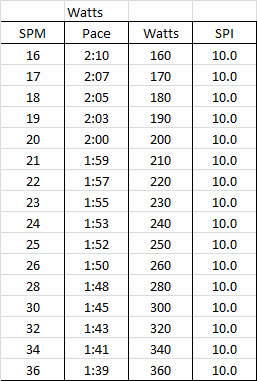
Another, different approach to constraining rate and pace is “S10MPS”.  This stands for “Strapless 10 Meters per Stroke”, and I think it was promoted as an approach by Paul Smith (His website is here).  A number of very good ergers use this approach which constrains your efforts to try to hit exactly 10 meters per stroke, indendent of stroke rate.  This naturally constrains the pace.  Here’s what that looks like from a wattage, pace and power perspective.
2015-02-12_7-43-55

Having looked at the workouts that Paul recommends for his clients, they seem to be constrained to a relatively narrow range of paces from 2:00 to 1:45, which translates to rates between 25 and 30.  I have also drawn the conclusion, but I’m not sure if it is true that S10MPS is a training technique, and then for time trials, and races and some high intensity interval sessions, you strap in and row to pace, without regard to maintaining 10 meters per stroke.  The thing I find interesting about this is that it does really hammer home the idea of maintaining stroke power as you increase rate.  You can see this with the SPI going way up as the paces get faster.

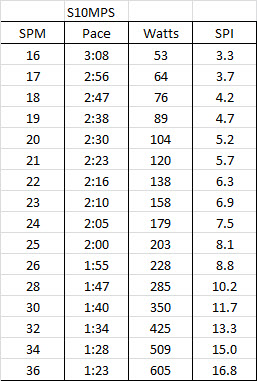
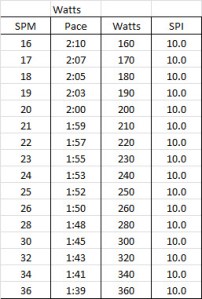
Anyway, having looked at all of this stuff, I have settled on using the simple idea of using linear increases of power with increasing stroke rate.  I am using the 55% of 2K power formula to come up with a reasonable power level for 18SPM and increasing 10 watts for every 1 spm increase.  This is not far off of the L4 levels and the same as the Biorow eWPS approach,  It’s also handy because it’s easy to remember a 10 watt change for each rate.  Here’s are my current targets.
2015-02-12_7-54-17

These are reasonable powers levels for rowing on a static erg.  For rowing on slides, where it is quite uncomfortable to row at low rates, I find that I need to shft this whole table by 2SPM.  So, I target 160W for r18, 180W for r20, and so on.

If anyone wants to play with the spreadsheet, here it is:L4 variations
60′ treadmill (mostly UT1)

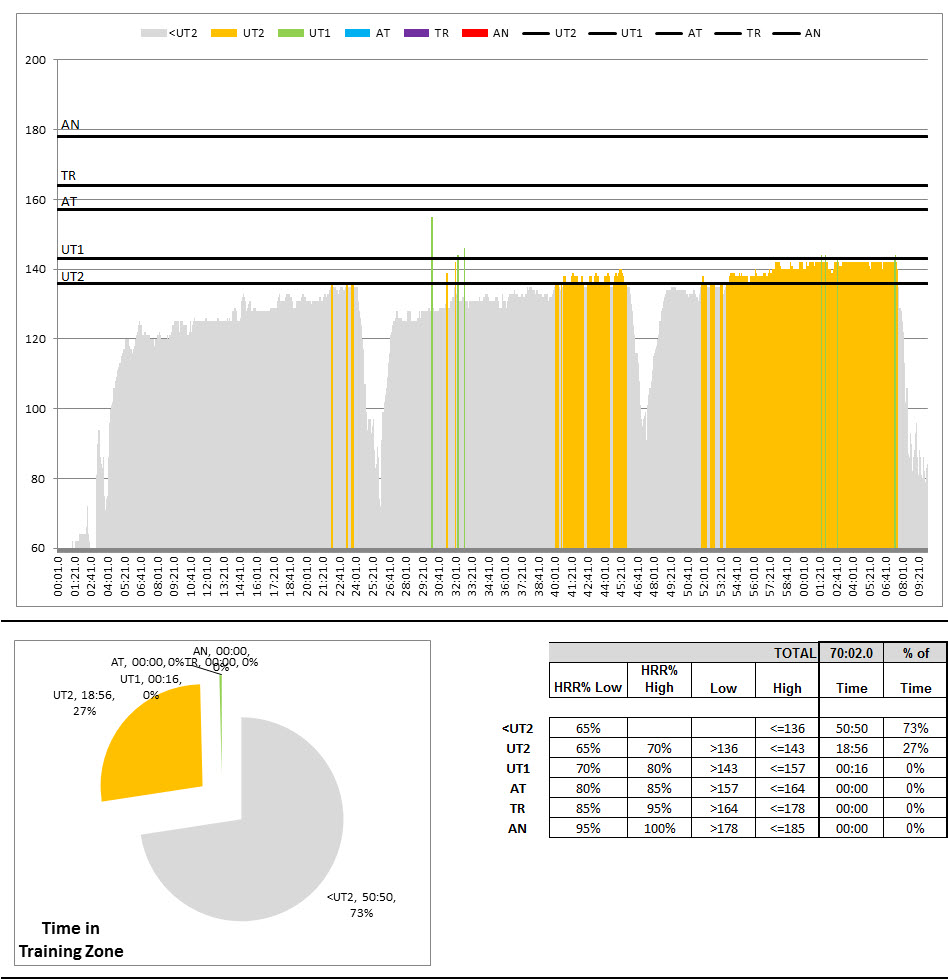
Now I’m in Milan at the Hotel “For You”.  Pitiful little fitness center in the basement. 2 treadmills and a recumbent station bike (which was broken).  I was hoping to avoid running today, but I very much wanted to work off some of last night’s dinner.

So, 60 minutes on the treadmill doing a gentle hill profile from 0% to 6% grade and from 7.5km/h to 10km/h.

I was having a bit of trouble keeping my HR strap in place.  That’s what the blue bit is about.

Short Intervals on a treadmill – 15x(2’fast/1’slow)

Still travelling.  Stuck in the hotel fitness center.

Today was short interval day. I experimented with doing them on the treadmill. The machine had a setting that enabled you to toggle between 2 speeds with button on the touch screen. I set it up on a 5 degree incline, with the slow at 4mph and the fast at 7 mph. Then I manually timed 2 minute intervals and 1 minute rests.

The plot shows a false start, where I tried to do 8mph as the fast, but it was too much for me, so I reset the machine. Then once I got going, for no reason at all, the treadmill crashed and rebooted after 7 intervals. That is the longer rest between the 7th and 8th interval. I reset for another 24 minutes (8 intervals). By the end I was really feeling the effects.

It was a pretty intense workout. The rests were quite short. But, then again, so were the intervals.

Tomorrow: During the day, I am heading by car up to Stuttgart, having some meetings there, and then flying in the evening to Milan. I’m not sure what facilities the hotel will have. In any case, it will be some kind of recovery session.

An Excel Worksheet for analyzing RowPro stroke files

RowPro Template 2014-08-03

Important Note:  Before opening this file on your computer, you need t o change the extension from .xlsx to .xlsm.  This file contains macros to do the data processing that will not work if the file name extension is not changed.  I was unable to upload the file with the .xlsm extension.

Based on a spreadsheet created by the user “danburpee” on the UK based indoor sports website.  You can get the original here.

Instructions for use:

Plug your resting and max HR into the HR Ranges tab
On rowpro, make sure you have elected to “save stroke data”
Export a row from rowpro in CSV format
On either the Tim or the distance tab, click the “Import RP Stroke Data”
In the table below, plug in either the distances or the times for different intervals in  your workout.  When you program an interval workout in rowpro, it is saved as one big file.  This table lets you get splits for each chunk.  It’s takes a little experimentation to get it right.
Then the other tabs are graphs and tables for export.  The Larry Output tab is useful for pasting results into blog posts or forum posts.  I use a screen capture for the graphs and then upload them to photobucket.

70′ in the fitness center

I’m currently in Munich on business.  In the hotel, the machines in the fitness center are from a company called LifeFitness. There is a stationary bike, a couple of treadmills and a couple of elliptical machines. They all have a cool virtual reality feature. They have the ability to select courses.

I did this yesterday and had a lovely run through Aukland, New Zealand, and then ellipticalled through Yosemite. Today, I rode my bike through Paris and Reims, and then ellipticalled through the Sierra Nevada. On the treadmill, the intensity was good because you could pick your pace and average incline. On the elliptical and the stationary bike it seems that the level settings are a bit too easy. I kept increasing the level, but then the machine would reset it back down at every “scene” transition. It’s a real pity because I was really enjoying the scenery, I would have liked to have gotten a better workout while doing it.

At any rate, it was 70′ of base work, more useful than sitting around and surfing the web.

Tomorrow: I think I will do some interval work on the treadmill. Not sure how well that will go, but I’ll give it a try. Maybe a 8×500 if I can figure out how to program the machine to do that.

Training Plan for January to April 2015

I am currently following a modified “Pete Plan“.  This plan is based on the Wolverine Plan.

This plan has 3 core sessions per week

  • Short Intervals (8×500,4×1000,250/500/750/1000/750/500/250) with rests roughly at least as long as the work time
  • Long Intervals (5×1500,4×2000, 3000/2500/2000) with 5 minute rests
  • Hard distance (5K,6K, 30min, 10K)

And 3 “steady” sessions a week.  In the Pete Plan, these are 8K sessions done at a pace a couple seconds slower than one’s pace for the hard distance session.  I am deviating from the plan for these sessions.  Based on material posted on the Rowing Illustrated forum, I believe that longer sessions at lower intensity will provide greater long term improvement in aerobic capacity.  The material posted on this thread is particularly persuasive.

To manage the intensity of these sessions I use lactate testing.  My typical steady state session is 4 – 20 minute intervals with 1 minute rests for hydration. I will typically row between 14.5K and 15K in these sessions.  I measure lactate after the first 20′ segment and try to keep my lactate reading at or below 2.0mmol/l.

I followed this plan last winter and set personal records for nearly all distances, but frustratingly not for my 2K.  This winter, I will not have an opportunity to race, but I am aiming to perform a formal time trial in late March before  the OTW season starts.