Randall Foil Test Plan

Randall Foil Test Plan

Hypothesis:  Randall Foils provide a measurable improvement in boat speed for an experienced Master sculler.

Equipment:
– My boat
– two pairs of oars
   –  existing smoothie2 soft shaft skinny oars
   –  new pair of matching oars, prepitched to deliver 0 degrees with 4 degree oarlocks
Instrumentation:
• Speedcoach GPS, with Empower oarlock and HRM
• Quiske pod

Preparation:
1.  Row at least 10 sessions with Foils oars to acclimate and adjust style
2.  Row 6 sessions alternating between foil and standard oars to acclimate to switching back and forth.

Experiment:
Test day #1 – sprint performance
• calm day
• lake quinsigamond, so I can do the lengths close to the dock
• 8 x 500m (all same direction), super long rests)
• What’s the best way to split the trials?
◦ 2/4/2
◦ 3/4/1
◦ 1/2/3/2

Test Day #2 – starts
• 4 x 5 starts (20 strokes each)
• 1/2/1

Test Day #3 – head race performance
• 4 x 2k
• 1/2/1

Analysis:
• segment elapsed time
• avg power
• end HR
• speed per watt
• blade flight path
• effective length
• peak power angle

* side video of all sessions, analyzed to overlay data

Concept2 Dynamic – Product Review

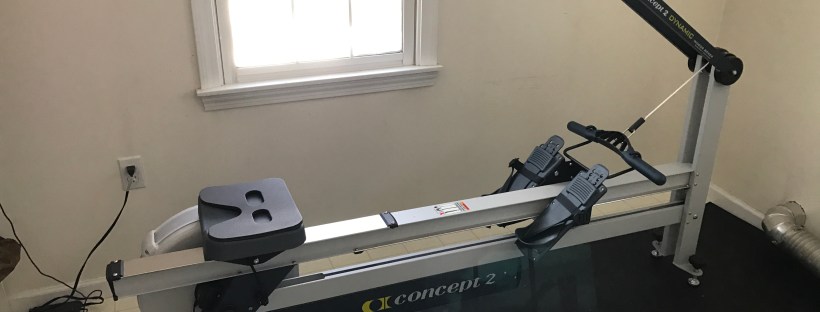
A couple of weeks ago, I brought my Model D down to our house on the cape and left it there.  I had made up my mind that I wanted to have a rowing machine in both places, since we are spending more time there off season than I had imagined, and even in season, there are a fair number of days where the conditions are not amenable to rowing.

I decided to replace it with a Dynamic.  I have always been better on a static erg than I have been on slides, and I hope that if I can spend more time rowing on slides or on a dynamic machine, that I will be faster in the boat as well.  My plan is to move my slides from work down to the cape, so I can row on slides there.

The Dynamic is more expensive than a Model D ($1250 vs $900) and Concept2 seems to go out of their way to avoid selling it.  The other rowers can be ordered online.  To buy the Dynamic, you have to call the up and basically convince them to sell it to you.  I chatted with the sales rep for a while and he told me that they had a big problem with people who bought it because it had a smaller footprint than the model D, but then were dissatisfied when it was so different from what they had used at the gym.  He said that they only want to sell it to people who have tried out or are on the water rowers.

They shipped it quick.  It arrived within a couple days of me ordering it.  It comes in two large boxes.  Putting it together is non-trivial.  It took me the better part of an hour, and would have been easier if I had a second person for a few of the steps.

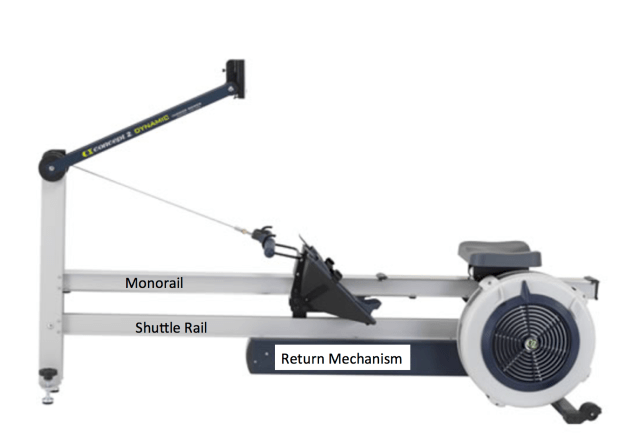
The mechanism of the dynamic is interesting, and complicated.  Start with the side view of the rower.

2-12z

The seat runs on a short rail and is constrained by a short piece of shock cord.  The foot stretcher rolls on the same rail and can move quite far, from the vertical bar at the front of the rower all the way back to the position shown.  The footstretcher is weighted, basically to provide a similar mass as a single rowing shell.  There is a hook on the bottom of the footstretcher that extends into the shuttle rail below.  The shuttle rail is where the magic starts.  Here is a diagram that I put together from the online documentation about the dynamic

2-12b.png

The handle cord comes into the shuttle rail, goes back through a pulley and terminates at the footstretcher hook.  When you pull the handle and the footstretcher in the drive phase of the rowing stroke, the pulley is pulled forward in the shuttle channel.

The drive chain runs through another pulley that is connected to the handle cord pulley.  The chain is terminated on one side and the other side goes around the flywheel drive gear and then down into the handle return mechanism.

Now things get byzantine.  The drive chain goes back and forth through two pulleys before terminating in a pulley assembly that is connected to the end of the handle return shock cord.  The shock cord runs around two fixed pulleys and is terminated on the side of the mechanism.  The whole point of all of this is to provide a consistent return force over the whole span of the recovery.  You need a lot of shock cord so that it is not pulling hard at full extension and not pulling at all at the catch.

The good part about all this is that the connection to the flywheel is just about exactly the same as on the static so it is remarkably consistent feeling to the static erg.

Like any design, it has pluses and minuses.  The pluses are a small footprint, dynamic operation, and a very solid feel.  It’s also nice to be higher off the floor, like on a Model E.  The biggest minus is noise.  The chain is going over a lot of different gears and traveling in metal channels.  All of that is a new source of noise in addition to the whooshing of the fanwheel.  It’s kind of a clattery, grindy kind of noise.  The kind of noise that you would get if you are running chains around gears through metal channels.  I assume I will get used to it, but I have to play the music a bit louder to hear over the noise.  I’m also trying to add a bit of oil to the chains to try to smooth it out a bit.

I find it quite easy to row on the dynamic.  On slides, I would have trouble with bouncing around a bit, but on the dynamic, I have no trouble.  One good thing about the dynamic is that the load at the catch is much faster and crisper than on the model D.  There isn’t that 6 inch section of the drive where you don’t have much resistance.

So far I have done an easy hour, and it was a bit more taxing than rowing on the model D.


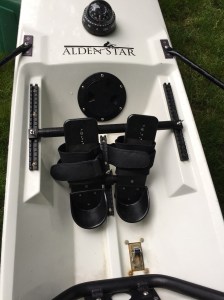
My new boat, an Alden Star

Previously owned by the Marblehead Rowing Club. I was impressed with the club.  They are set up in a corner of a big warehouse type building in a boatyard on Marblehead’s little harbor.

map

I was shown to the boat which was on the clubs immaculate racks.  There was a group of folks who had just rowed over the Manchester and back (that’s 11 miles round trip!) enjoying some coffee and scones.  The boat looked really nice.  Someone had cleaned it up nicely.  We took it out to the dock and the guy from the club who was selling the boat (and my Dad, who lives in Marblehead) got in a launch to follow me and make sure I didn’t die.

The boat seemed familiar and unfamiliar all at the same time.  It’s a lot wider, so it has a lot more intrinsic stability.  It is only 22′ long, so it has less directional stability.  I was expecting it to feel much heavier to row, but it did not.  In fact it felt quite responsive.

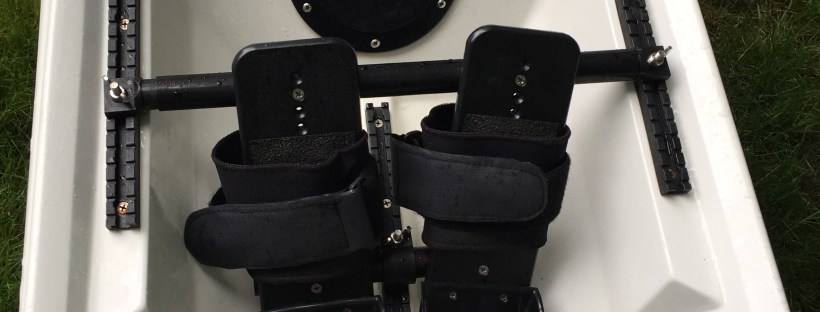
The cockpit is shallow, so that it will not get weighed down with water that inevitably gets into it.  There is an automatic bailer that will pull water out of the cockpit if you are rowing.  It has clogs instead of shoes.  These were very secure and comfortable in use.  On the stern deck is a reverse reading compass.  Even with coastal rowing, it is often very hard to get a point to steer from, and the compass is handy to keep a good line.

The riggers are a simple aluminum tube and can be removed by unscrewing 4 hex screws.  I’ve been warned that the rigger hasn’t been off in years and these screws might be tough to remove.  We’ll see if I ever need to get them off.  The oarlocks are standard issue concept2, set on pins that project up from the rigger, so the oarlocks can rotate 360 degrees around the pin.  There are two access ports.  The one on the seat deck has a gear bag inside it and a tow line in the bag.  The bow one does not.  There is shock cord tie downs to hold a PFD just toward the bow from the rower.

A close inspection of the hull and deck showed no significant scratches.  When held at the ends, there is a bit more flex in this boat than in a carbon fiber single, but I would expect that since there is more weight, the weight is in the middle and it’s fiberglass.  I didn’t notice any flexure when rowing.

I headed out of the harbor and into the confuse chop.  There was about a 1 foot swell, plus wakes from a whole bunch of motorboats buzzing around.  Coming out of the harbor, I was going up into it, and I started to get a feel for adjusting my timing to match the wave frequency.  I was a bit nervous about rowing across the waves, but the motion was not that bad and the boat was very stable when rowed.  I stopped and let the launch catch up with me and we noticed that the light mist had become a reasonably thick fog, so I decided to cut it short and loop back in behind the island.  I pushed up the pace and rate for the last 500 meters or so to see how the boat felt, and to put a bit more stress on the riggers and oarlocks.  The boat felt solid, and the riggers and oarlocks were stiff and smooth.  I was smitten.  Rowing on open water is a different experience.  The waves were quite small and I still managed to ship a fair amount of water in the cockpit from waves breaking over the bow.  I set the foot stretcher by eye and it turned out to be just about right.  I was very comfortable the way it was rigged.

On taking the boat out of the water, we noticed that it had taken on a little water, maybe a cup or so.  I suspect that there is a leak somewhere, perhaps around the bailer, or one of the ports.  I will give it a close inspection and recaulk the most obvious seams.

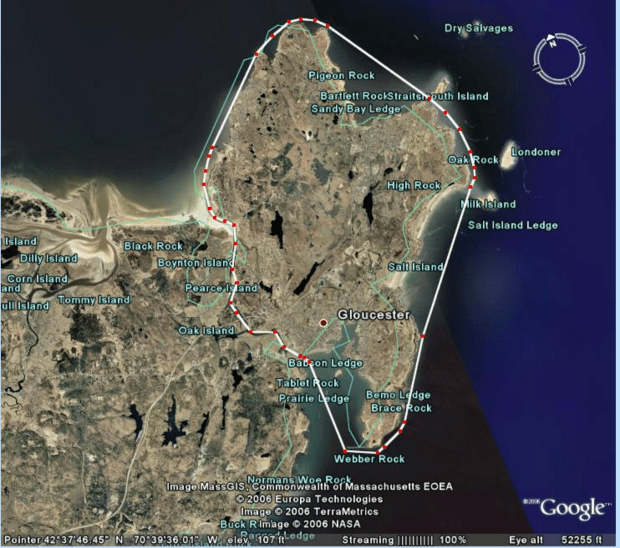
After I got the boat loaded, the guy selling me the boat gave me a scone and water and started telling me about the club.  They seem to have a lot of fun.  They send a group up to compete in the Blackburn Challenge every year.  This race is on my Rowing Bucket List.  This is a race that circumnavigates Cape Ann.  It is over 20 miles long and usually provides a pretty wild set of conditions.
Screen Shot 2016-06-05 at 7.11.30 PM.png

It starts in gloucester, around the place labeled Babson Ledge.  It then proceeds up the annisquam river to the north mouth of the river, then east along cape ann, then turns south, going past Rockport harbor, and then finally turning back south west for the leg back to gloucester harbor.  If there is a South East wind, there tends to be pretty big swells along the Southwest leg of the race.

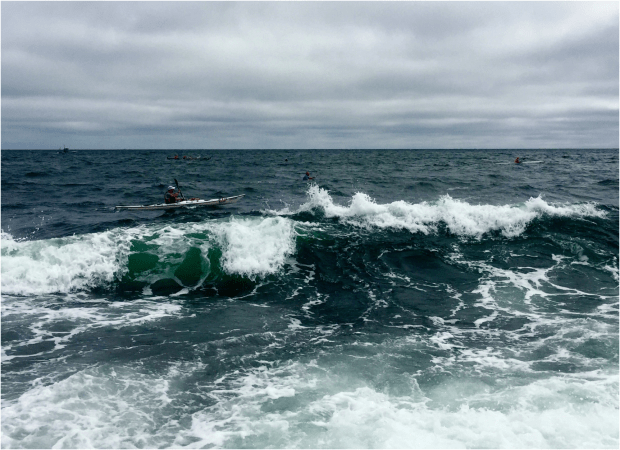
Last year it was a bit windy, and the wind was from the North.  When the races were coming out of the north mouth of the river, the tide was ebbing, so there was a wind blowing over the outgoing tide, building some big waves.
Screen Shot 2016-06-05 at 7.18.36 PM.png

Anyway, the guy who sold me the boat invite me up to join them for a practice or two, and to come with them to the race.  It’s July 16 this year, which is a bit too soon for me to feel comfortable, but I think I’m going to plan and train for it for next year.  It would basically be marathon training because it takes between 3.5 and 4.5 depending on conditions.  I think it would be a blast!
 

CrewNerd and XGPS160 – Initial impressions

When I row, I generally have both my iphone running CrewNerd and a Speedcoach XL2 in the boat.  I bring the phone because it is a reasonably lonely stretch of river and it is a recommended safety accessory.  Since I need to have it in the boat, I might as well have it do something useful.

I have used both CrewNerd and Rowing In Motion and there are pros and cons of both.  RIM is a great tool for real time feedback in the boat.  CrewNerd has better data export features and good tools to review a workout on the phone including a map view and nifty graphs of pace, rate, HR and stuff.

The major disadvantage of using CrewNerd versus the Speedcoach XL2 is the accuracy, stability and responsiveness of the pace readings.  CrewNerd works off of the GPS in the iphone.  This provides position data on a 1Hz basis, and the application uses this position data to deduce the velocity.  By comparison, the Speedcoach GPS2 has a GPS capability that provides 5 updates per second.  The impact of this is that Crewnerd needs to use significant smoothing to stabilize the coarse position data.  This causes a significant lag, up to 10 seconds between a velocity change in the boat and the pace display on CrewNerd showing a stable, accurate pace.  You can crank the smoothing dow, but then you end up with pace readings that essentially oscillate around the actual pace.

The good folks who developed CrewNerd recommend that the best way to get more accurate and responsive pace display is to pair the iphone with an external GPS receiver.  They recommend the Dual XGS160.  This provides 10Hz position data.  When paired with this receiver, the pace display responds quickly and settles well.

However, CrewNerd seems to be unreliable with the XGPS160 receiver.  Sander (of “Rows-And-All” fame) has previously described having hangups and the freezing of the CrewNerd navigation display when using the receiver.  This morning the same thing happened to me.  I was 11K into a 14K row, and then the pace and distance displays stopped updating.  The HR display was alive and displayed an accurate number.  I’m not sure what’s going on, but I am not sure whether it is better to have a laggy pace display or have the app stop functioning in the middle of a practice or race.