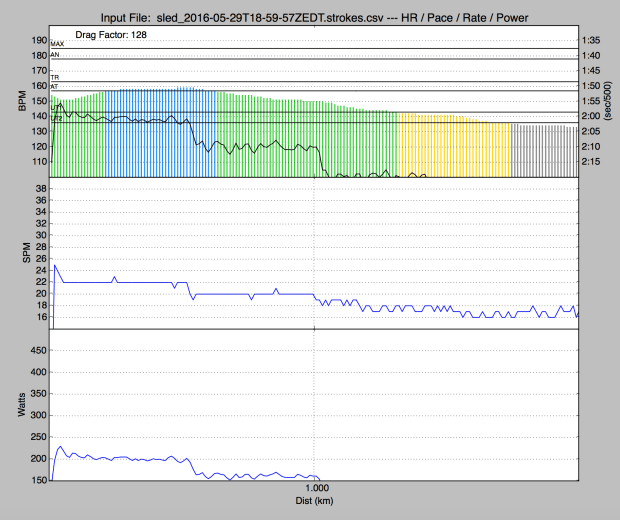
Tuesday: 3 x 20′ / 1’30” rest (w/lactate)

I had a blast in Provincetown on the 4th.  I went for a walk in the morning to go collect some breakfast.  Then we lazed around the rest of the morning.  Around noontime, we wander over to a boat rental place and rented a 2 person kayak.  We spent an hour paddling around the harbor, checking out the yachts and enjoying the sunny day.  Then the walk back to the hotel, picking up some sandwiches on the way for lunch.  Later in the afternoon, we headed out again and walked all the way across town to a favorite shop of ours.  On the way back, we picked up some wine, cheese and crackers to enjoy during the fireworks.  We settled in on the deck of the hotel, and watched the fireworks over the harbor.  All together, it was over 7 miles of walking and a brilliant day.

The drive home was unpleasant.  We set out for home around 11am on Tuesday morning.  Apparently, so did everyone else on Cape Cod.  We fought through 4 hours of traffic to get off the cape, and even then, the traffic pretty heavy  the rest of the way.  We didn’t get home until well after 5pm.  I had a snack, and drink, and then went off to do a light 60 minute session.

Plan:

  • 3 x 20′
  • 1:30 rest (to allow time for lactate tests)
  • target power: 185W
  • rate: 19-20

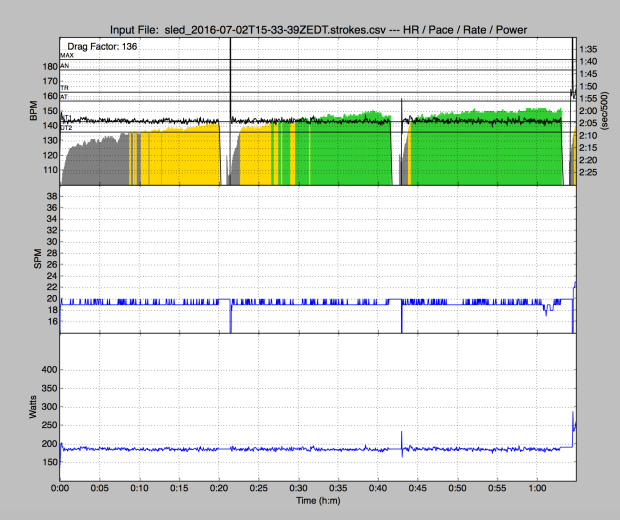
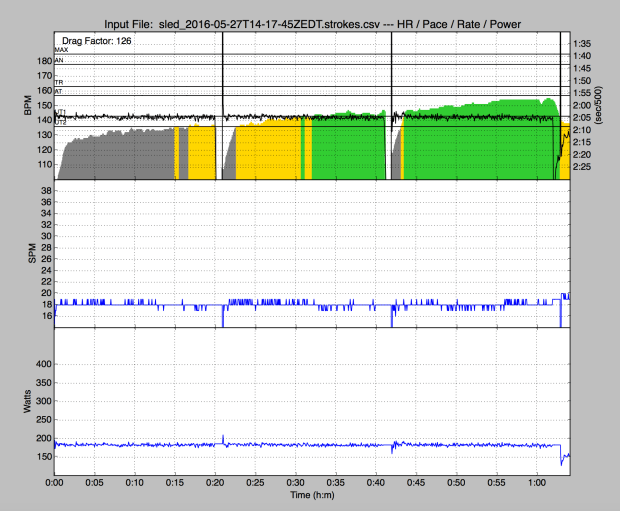
It was hot and humid.  After I finished, the temperature was 80F, and the humidity was 80%.  It was a very sweaty, and hot enough that it compromised the power I could hold with reasonable lactate levels.

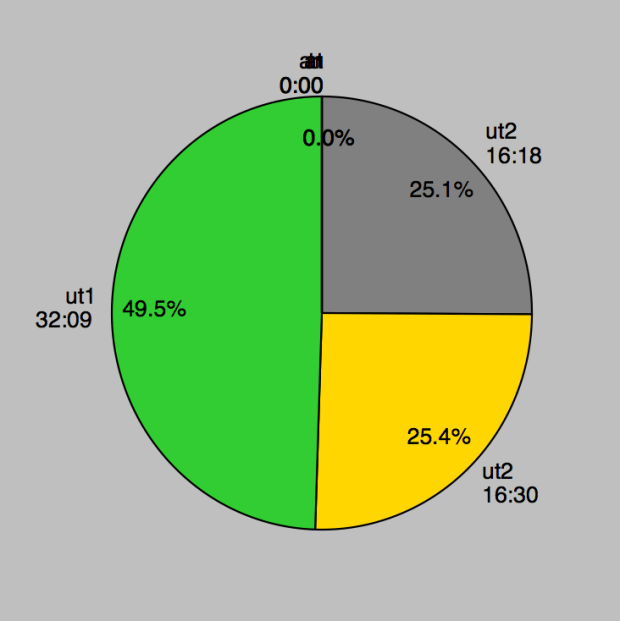
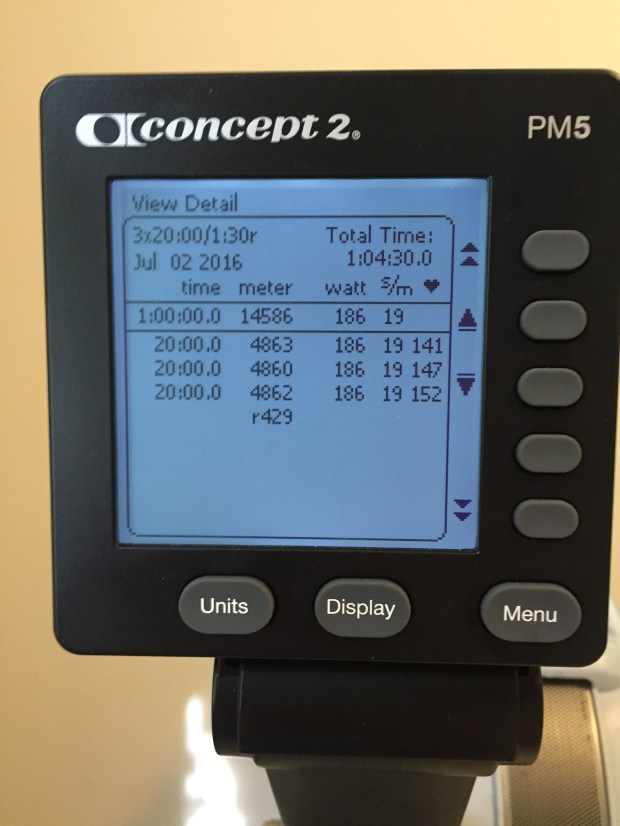
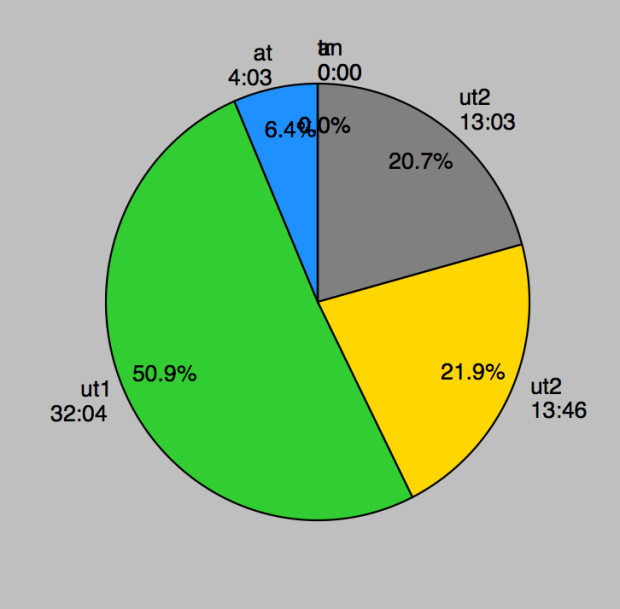
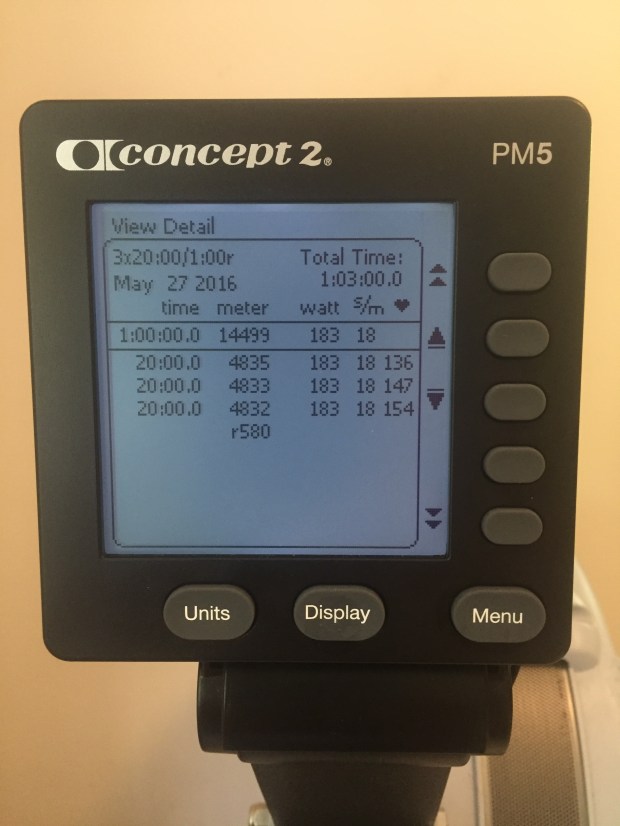
The first 20 minutes was fine.  Lactate at the end was 1.9mmol/l.   I missed the start for the second interval because I was running to get a water bottle.  So, I was chasing the target power a bit.  The power for the full interval read 182W, but I missed about 15 seconds of rowing at the beginning, so I was rowing >185W for the whole interval. I also was starting to sweat up a storm and feeling a bit overheated.  At the end of the second interval, I read 3.2mmol/l.  I suspect it might have been a bad reading, but I decided to back off the power to 180W for the last 20 minutes, and push the stroke rate up to 20 to keep things under control.  It did the trick.  My HR stabilized and my lactate level dropped back to 2.2mmol/l. by the end of 60 minutes.

myimage (35)

2016-07-05 18.56.47


Saturday: 3 x 20′ / 1’30” rest (with lactate)

My wife and I went to see Weezer outdoors at the Xfinity Center last night.  Aside from a terrible warmup band, and a massive thunderstorm that pushed through right before they went on stage, it was a very fun night.  We didn’t get home until nearly midnight, so I opted for sleep instead of rowing this morning.

I slept like a log and woke up around 9:30.  After various chores and errands, I decided to keep things ticking over with another easy erg session.  I’ll hit the time trial hard tomorrow on Quinsig.

Today, I wanted to turn down the power a bit to see if I could hit the endurance sweet spot.  Very little HR drift, end HR below 155, and a lactate below 2.0mmol/l.  I set up my meter, wet and dry towels and test strips.  As Eminem would say…”It’s back to the lab again”.

Plan:

  • 3 x 20′
  • 1:30 rests to accommodate lactate testing with minimal panic
  • target power: 185W
  • target rate: 19spm
  • HR limit: 155
  • Lactate tests after each 20′ piece.

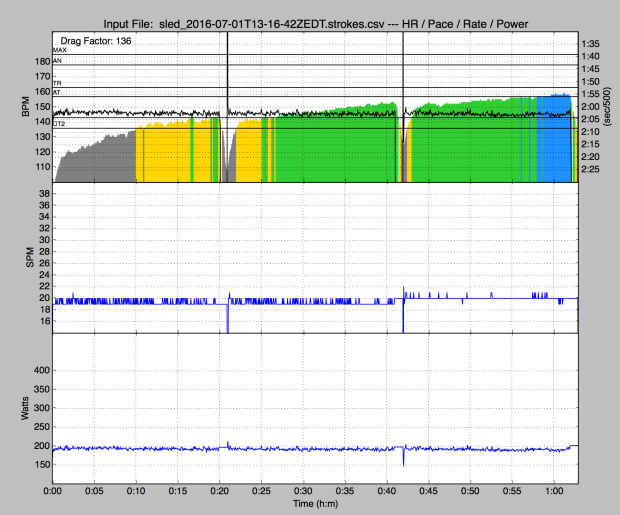
Lactate test results were:

  • 20′: 1.8 mmol/l
  • 40′: 2.1 mmol/l
  • 60′: 1.9 mmol/l

So that is the difference that 6 watts makes.

Tomorrow:  1k TT, plus starts, plus some other sprint pieces.

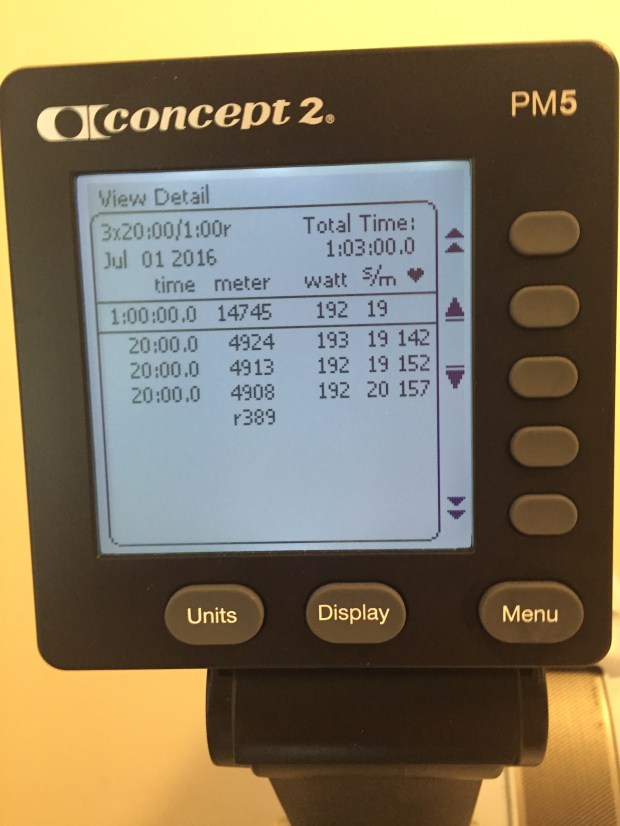
3 x 20′ / 1′ rest @ 192W

I decided to just do an erg session today.  A nice easy erg session.  I’ll do my race prep tomorrow.

Plan:

  • 3 x 20′
  • 1′ rests
  • Power target: 190W
  • Rate target: 19-20spm
  • HR Cap: 155

Today, my HR started low, but just kept going up.  I think that means that I was just the slightest bit faster than my ideal training power.  I really should have setup to do some lactate testing, but I forgot until I had gotten going.  But in the past, when my HR keeps drifting up, my lactates generally came in high.  When I plateaued and the drift decreased over the session, then they were generally in range.

Next session, I’ll go for 185W.

Tomorrow:  1K hard.  Additional sprints as I see fit.

Saturday: 3 x 20′ / 1′ r L4

Stayed up too late, and decided to sleep instead of heading to the lake.  I’ll row tomorrow instead.  Got up around 9:30 and hopped on the erg.

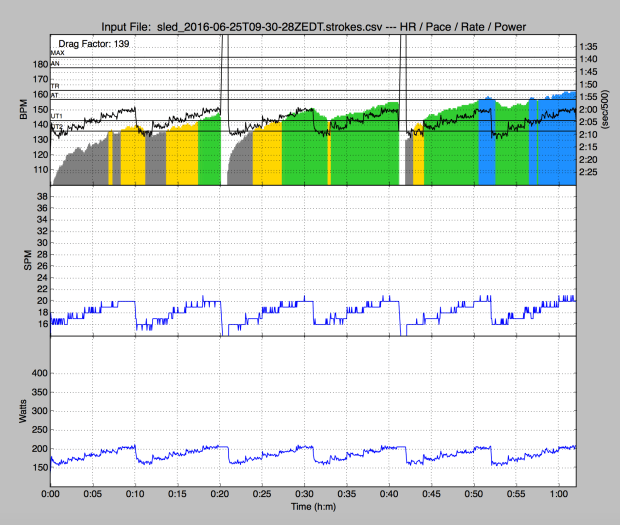
After yesterday’s very long row, I decided to only do 60 minutes today.  I also decided to stick with a stroke sequence and let my HR do what ever it wanted to do.

I did the following sequence: 2′ @ 16, 2′ @ 17, 2′ @ 18, 2′ @ 19, 2′ @ 20

Power was 10W * stroke rate (so 16spm = 160W)

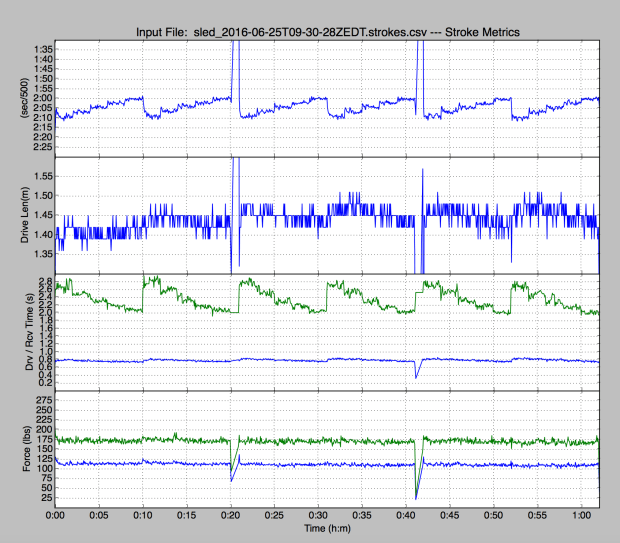
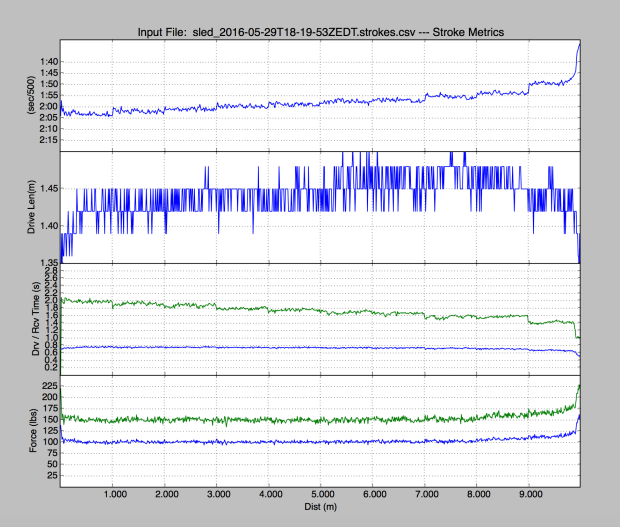
One interesting thing in the charts is the drive length.  As usual, you can see my drive length increasing over the first 10 minutes.  I think it is cool how it becomes more erratic as I get tired.  I like all the data that you can get out of painsled.

2016-06-25 10.34.09


Started off feeling great.  But I kind of hit the wall in the last 20 minutes.  HR was a lot higher.  I’ve decided to try to do my LIT endurance workouts in a fasted state.  I think the research is pretty clear that it helps keep you metabolizing fats to a higher intensity than if you have eaten recently.  The thing that I am trying to work out now is intensity.

I have the feeling that if I had limited to high end of this workout to 190W, I probably would have maintained a lower heart rate.  It might be better to go back to a constant power level for these workouts.  My suspicion is that there is a fair amount of hysteresis in the crossover between fat and CHO metabolism.  Once you flip the switch to start burning glycogen, that you have to go way down in intensity to flip the switch back to fat.  I think that where I am now, that going above 180W I am flipping the switch.

For now, if I have to do any steady state on the erg, I think I will start doing lactate testing again, and stick to constant power.  Pity.  It is very boring.  But I want to get some unequivocal data on where my base fitness is right now.

Thursday: 4 x 20′ / 1′ L4

Tuesday:  Arrived in Munich at 10AM.  Showered, connected by plane to Stuttgart.  Meetings with customer in the afternoon, back to the airport, flew to Paris, connected to Marseille.  Got to my hotel at midnight. No Training

Wednesday:  Decided to sleep in, instead of trying to workout.  Prep sessions all morning, customer meeting in  the afternoon, then back to the airport to fly back to Munich.  Arrived at the airport around 8:30PM, took the s-bahn  to my hotel.  Met with a couple of colleagues at the hotel.  Got  to bed around 1AM. No Training

Thursday:  Up at 7:30AM for a breakfast meeting with a customer.  That finished around 10AM.  My flight leaves around 4:10PM, so finally, I had a window to go to the gym.  I went to the hotel fitness center and saw a meticulously clean Concept2 Model E with a PM4.  Yesss!!!

Plan:

  • 4 x 20′ / 1′ rest
  • L4 format.  Power target –> 10W x stroke rate (16spm = 160W, etc)
  • HR Cap: 156

I figured with all the flying around, irregular meals and reasonable consumption of beer, that this would be a difficult session.  I was right.

I started slow and within 10 minutes I knew that I would struggle.  Here’s the stroke sequences I did.

  • 16 / 17 / 18 / 19 / 20
  • 16 / 17 / 18 / 19/ 20
  • 3′ @ 16 / 3′ @ 17 / 3′ @ 18 / 1′ @ 19
  • 3′ @ 16 / 3′ @ 17 / 3′ @ 18 / 1′ @ 19
  • 4′ @ 16 / 3′ @ 17 / 2′ @ 18 / 1′ @ 19 (dropped off the target power in this one)
  • 4′ @ 16 / 3′ @ 17 / 2′ @ 18 / 1′ @ 19
  • 10′ @ 16
  • 9′ @ 16 / 1′ @ 20

Very disappointed with what has happened to my aerobic fitness.  But pleased with the gigantic puddles under the erg.

Screen Shot 2016-06-23 at 12.35.23 PM

Tomorrow:  Sprint session in the boat.  6 x 750 / 5′ rest.

Monday: 3 x (6 x 1′ / 1’r) / 5’r

Inside, on the erg.  I originally planned to do it on slides, but I couldn’t get them set up so they were sliding freely.  They kept binding so that I would end up banging against the end while I was warming up, so I took the erg off of them for the rest of the workout.

The plan was

  • 4 x ( 6 x 1′ / 1′ rest ) / 5′ rest
  • Rate target: 30
  • Pace target: 1:40

While I did the workout, I had enough time to think through the plan.  That would be 24 minutes at faster than 2K pace.  Even with the generous rests, that seemed a bit excessive.  Compared to other sprint workouts like a 4 x 1k or 8 x 500, they have about 14 minutes of work.  Anyway, during the first 5 minute rest I decided to stop after 3 sets.  It certainly felt like enough.

I wasn’t all that sure about pace, since I haven’t been doing many sprint sessions on the erg lately, but 1:40 turned out to be a good pick.  I was able to beat it by a bit, but the last set really stung.

1min

I am very happy with that.

Now I am over Germany, about to descend into Munich. I’ll be connecting over to Stuttgart, and then going straight into meetings all day. So no training for Tuesday.  Hopefully, I will be able get a workout in tomorrow morning.


Saturday: June CTC – 30R24

Friday:  “Rest Day”.  Flew to San Diego in the morning, and back on the red eye.  I arrived at 7:00AM.  Drove home and slept until around 10:30.

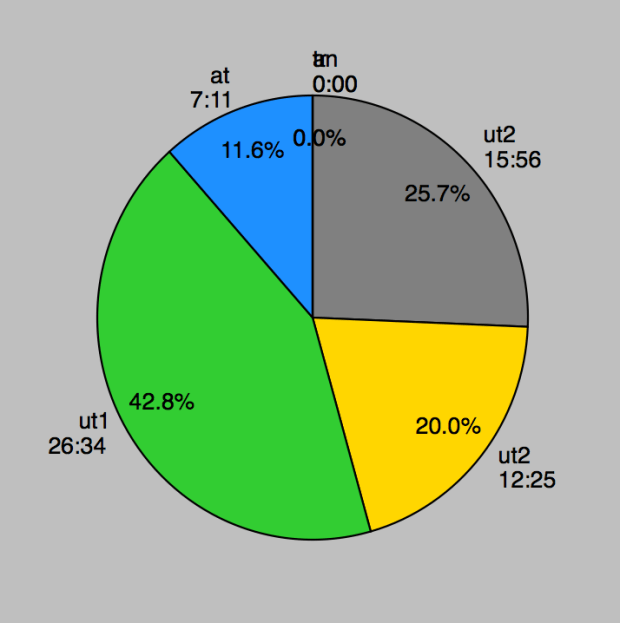
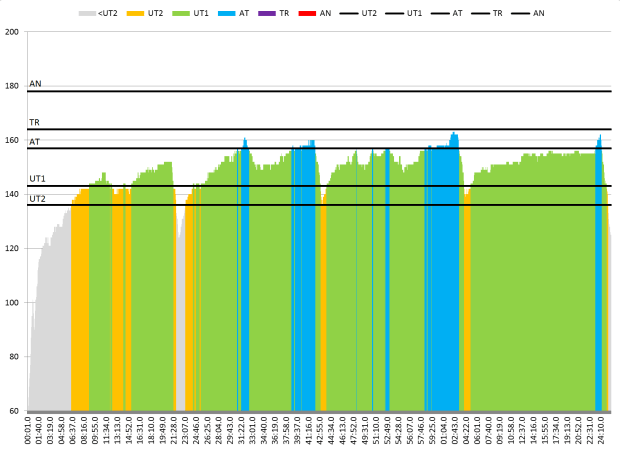
A little after 2, after doing some domestic chores, I found time for an erg session.  The month is passing and I hadn’t made an attempt at the Cross Team Challenge.

Screen Shot 2016-06-18 at 5.55.01 PM.png

I started with a 2K warmup, with 3 bursts of 20 strokes each near my target pace and rate.

Screen Shot 2016-06-18 at 5.49.51 PM

2016-06-18 14.55.56

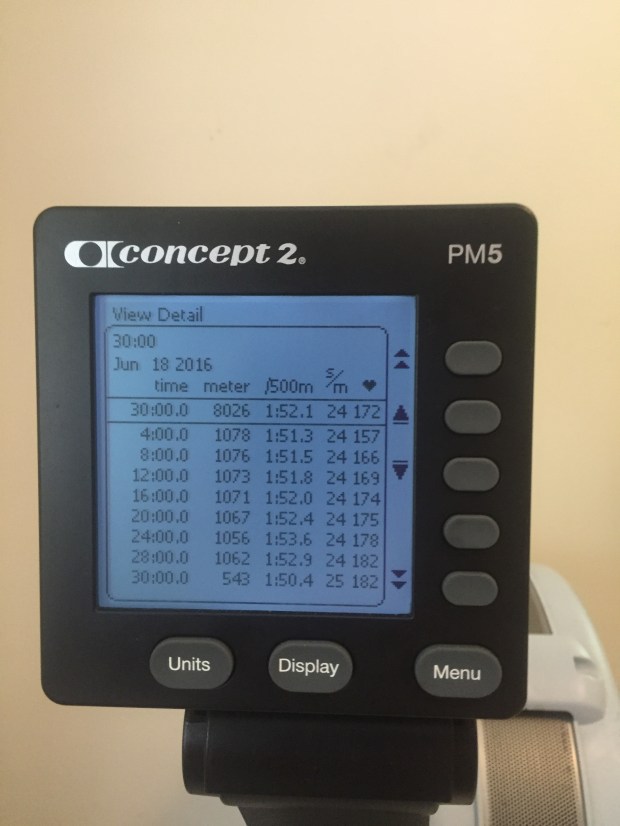
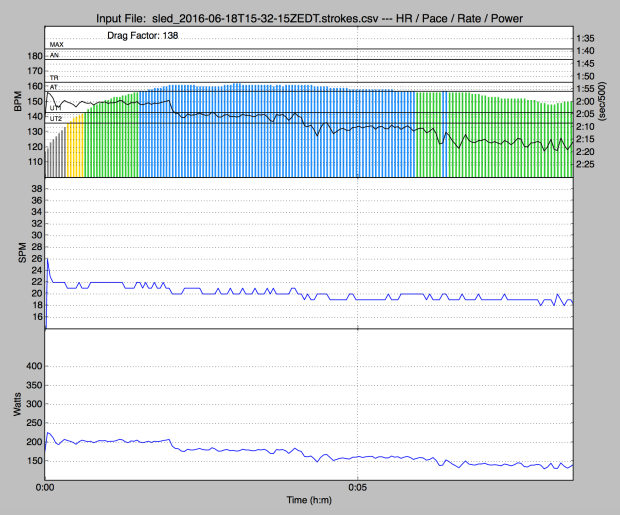
Then it was onto the main event.  I felt like an 8K target was about right.  Maybe a bit aggressive since I haven’t been doing much erging and very hard distance work, but I would have felt bad doing less.

I turned out to be doable.  I was a bit fast through the first half, and I needed to bleed off a bit of pace to keep from blowing up in the second.  It was very close to a maximal effort.

Screen Shot 2016-06-18 at 5.50.43 PM

2016-06-18 15.30.23

I took 721 strokes exactly, according to the painsled file.

Then a 2K cool down

Mission accomplished.

Tomorrow:  Steady State OTW


Training Principles

It’s a rest day, I’m on a plane heading out to San Diego, and I am bored.  I’m also still trying to workout the best way to train with my work and travel schedule as crazy as it has been.

Any training plan that I devise will need to be quite flexible and simple in order to succeed.  To do that well requires a return to the principles that I have learned about successful training approaches.

Principle #1:  Decide why you are exercising or training.

It is possible to have multiple answers to this question.  In fact, the more reasons you have, the more likely you are incorporate exercise into your life on a permanent basis.  I started exercising as part of an effort to lose weight, and it worked.  I took off 50 pounds.  I also was diagnosed with high blood pressure and my family has a history of cardiac and circulatory disease, and I don’t want to die.  These are the underlying, bedrock reasons why I want to regularly exercise.  But these have been true for my entire adult life, and they were not sufficient to motivate regular exercise until I found a way to connect in to my competitive drive.  Basically, as soon I found the Concept2 online rankings, I wasn’t exercising anymore, I was training.  Specifically, I was training to row faster.  Even more specifically, I was training to row faster than other people.

Rowing on the erg led me to rowing on the water, and that opened up new challenges, both in trying to master the technique and also new ways to compete.  Not only did physical fitness matter, but so did technique, steering, strategy and experience.

Now in addition to objectives to stay healthy, I work to be a better, faster rower than I was the year before and to try to catch up with people that are faster than I am.

Principle #2: Decide how much time you have to train.

Once you do, try to stick to it.  Be brutally honest with yourself up front.  I’ve experienced how demotivating it is to plan more training than I can do and then miss sessions and lose momentum on a training plan.  It would have been much better to set my sights lower.

Principle #3: Set specific a objective and use it to guide your training.

I choose a specific race in the future.  Right now, it is the Cromwell Cup, a 1000m sprint in a few weeks.  After that it will be the Head of the Charles, which is a 5K head race.  You need to know what you are training for to plan out how to train.

Principle #4:  Plan your training before you go to train.

This can be at different levels of specificity.  It might be much easier to decide ahead of time the exact sessions that you will be doing for the next three months, but that only works if you have very good control of your schedule.  If you schedule is erratic, a specific day by day plan won’t work.  In that case, planning a certain mix of training for the week and shuffle it around to make sure that the highest priority sessions get done.  Right now, I am in final prep for a sprint race on July 10th, so my weekly guide is:

  • 2 or 3 sessions that include racing starts
  • 1 session a week with 500m to 1000m intervals at close to race pace
  • 1 session a week with 100m to 500m intervals at faster than race pace
  • as much volume below 2.0mmol/l lactate as I have time for

Principle #5:  Hold yourself accountable.

I find this easiest to do by training publicly.  I try to define my next day’s workout the day before and put it in my blog.  I know that very few people read it, but the fact that I’ve done that makes me feel accountable to either do what I planned or explain why I didn’t.  It is important to make the distinction between accountability and rigidness.  If I don’t follow through with the planned workout, or if I don’t hit my targets, that isn’t a failure.  I just want to be honest with myself about why I changed the plan or wasn’t able to execute it.  That way I can adjust and improve.

Principle #6:  Evaluate performance objectively.

Set quantitative goals and use performance tracking to determine if they are met.  Use past performance to set goals for future workouts.  Try to do the same thing if you are working on technique.  Either use video, or acceleration data to see if changes in technique actually occur.  My ability to remember past performance and discern if I have corrected technique problems is limited at best.

Principle #7: Seek advice, carefully evaluate it and decide if you will use it

There are many people with opinions.  Not all of them are well informed.  It is up to you to figure out what advice is credible and useful and what is not.  Try to establish the quality of the source of advice.  Try to understand the principles on which the advice is based.

Principle #8: Miles make champions

Endurance is critical to all rowing competitions longer than 500m. Building a strong aerobic base is necessary to perform well. The most important factor to building endurance is the volume of training done at low intensities.

Low Intensity Training (LIT) is defined by a blood lactate level below 2.0 mmol/l at the completion of the workout. In order to maximize the effectiveness of endurance training, blood lactate level should be greater than 1.4-1.6mmol/l at the end of the session. Lactate levels should be periodically checked and as fitness improves, LIT intensity should increase to ensure that the end work criteria of 1.4-2.0mmol/l is met.

Endurance training can be continuous or interval based, constant rate or variable rate, as long as it meets the intensity criteria. Up to 1/2 of all endurance training can done as cross training.

Lactate testing is a pain in the ass, does not provide realtime feedback and is pretty much impossible to do in a boat, so an alternative method of gauging intensity is needed. The best alternative for is to use heart monitoring and Rate of Perceived Exertion (RPE) together. By using HR in sessions where lactate is checked, a rough correlation between ending HR and lactate level can be drawn. This can be used as a limit in future workouts until another lactate test is done. The important thing to remember is that this is not a very exact thing. A little too hard or a little too easy will not have much impact on the effectiveness of the workout. The key thing is that easy workouts should be easy.

Principle #9:  If all you do is row slow, you will get good at rowing slow

High Intensity training is necessary to maximize performance at any distance from 100m to a full marathon.  There are different energy systems that are used in maximal efforts.  If these are not specifically trained, performance will suffer.  At least 2 sessions of high intensity training per week.  High Intensity Training (HIT) includes very short intervals, short intervals, long intervals, and hard distance workouts.  The key criteria of these workouts is that lactate levels well above 4.0mmol/l are achieved.  The most convenient way to measure this is to track HR and measure time above lactate threshold.

Principle #10:  You need to be able to pull hard to win races

The ability to generate high peak force on the handle is critical to achieving good speed off the line and to be able to sprint at the finish.  The more force you can exert also means that you can work at lower stroke rates with higher efficiency.  Including some kind of peak power training is useful, especially for sprint racing (1Ks, 2Ks). This can be done on the erg or in the boat with very short intervals with generous rests, or through weight training.  During sprint season, at least one session per week should include peak power training.

Principle #11:  Strength Training is useful, but not critical

This is disputable.  If you have specific strength deficits, then strength training can help with them.  Otherwise, it is mainly useful for muscle group balance and injury prevention.  Right now, I have deprioritized strength training in favor of additional endurance training within the time budget that I have set.  I know that other folks believe this should be a higher training priority.

Principle #12:  Mesocycles work, change it up.

Performance improvements will plateau after 4 to 8 weeks of training with a specific focus.  To combat this plateau, mesocycles can be used to vary the focus of training in blocks.  This can be programmed in a way to build toward a specific event and yield better results than a plan that has the same types of sessions over time.  The final mesocycle before a key event should be focus on maximize performance for the event type.

Principle #13:  The overload principle

Improvement in performance comes from the overload principle. For high intensity workouts, setting targets for pace to be slightly faster than previous results.  For low intensity workouts, increasing duration, and nudging up pace to stay in the desired lactate range over time.  Gradual overload is important.  Big steps in pace are an invitation to disaster.  Big increases in volume can lead to injury as form suffers when you are fatigued.

Principle #14:  Resting is part of training

Rest and recovery are critical to progress.  It is OK to have weeks that over load and under recovery, but these must be followed by weeks where the recovery takes place.  As a general rule taking one day of complete rest per week is vital.  By complete rest, I mean no rowing at all.  The logic behind no rowing is to reduce the risk of repetitive strain injury.  Some kind of other gentle exercise is OK as long as it isn’t long duration and isn’t intense.

Principle #15:  Get a coach

A principle I haven’t been able to follow, but is holding me back.  Real time feedback on performance, especially on technique is critical to improvement.   One Caveat, you and coach need to agree on principles.

Principle #16: Training is easier and more fun if you have training partners.

Thats the thing that I miss most by developing my own training plans.

Principle #17: Lighten up.

If you are reading this, then it is more than likely that you aren’t a professional athlete. We all have jobs, friends and family that are more important than achieving perfection in the execution of our training plans. I am all for having the grit to pound out that last 500 when your legs feel like jelly. I am all for dragging my ass out of bed at 5:15 to get in a training session before work, but if life gets in the way, that’s OK. There are more important things in life than rowing a long skinny boat faster.

Principle #18: Be resilient.

This one goes along with the one before. If sports are not your number one priority, then it is likely that your life will sometime conspire to make you miss your training objectives. When it happens, and it will, just pick yourself up, honestly assess where you fitness is and make a new plan. One of the best things about keeping good training records is that you can look to see how much training you’ve missed and spot trends like regularly missing training volume plans. You can use this to make your plans more realistic or change your priorities or schedule.

Principle #19: Be skeptical.

The world is full of people that are full of crap. They use the internet to spread the fertilizer. There is a lot of good advice out there too. It’s hard to know what is real and what isn’t. Here are my thoughts.
– Research is limited and flawed, but at least multiple people with lots of training in the field have looked at and critiqued it. Its up to you to figure out if it actually applies to your situation.
– Beware of plans for Olympians: I think the most important factor in race performance is total training volume. Elite athletes spend 40 hours a week training. I spend less than 10. That difference is huge and limits the applicability of anything done at an elite level.
– Beware of the “It worked for me” folks. That means you should beware of me too. The critical test is whether or not the advocate can answer the question, “Why does this work?” If it is not based on testable principles or there are not good answers to reasonable questions, then proceed with some caution.
– Beware of facts not in evidence. If someone says that they improved their 2k score by 20 seconds by doing two high intensity erg sessions a week, try to find out what else they are doing. For all you know, they might be running 10 miles every morning. If you just do the erg part, you will probably not see the same results.
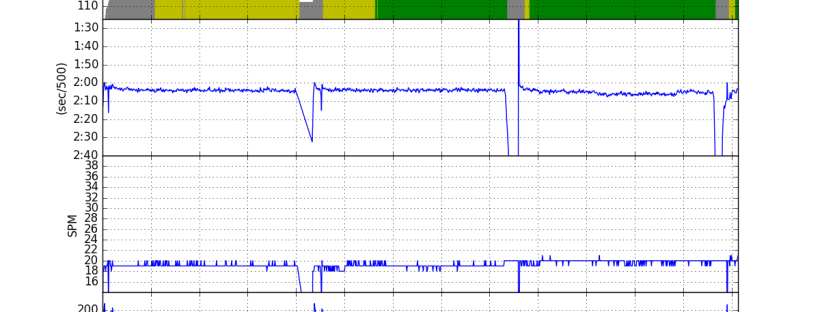
Sunday: 4 x 20′ / 1′ rest L4 on the erg

Plan:

  • 4 x 20′ / 1′ rest
  • Power: 10W x stroke rate
  • Heart rate cap at 155

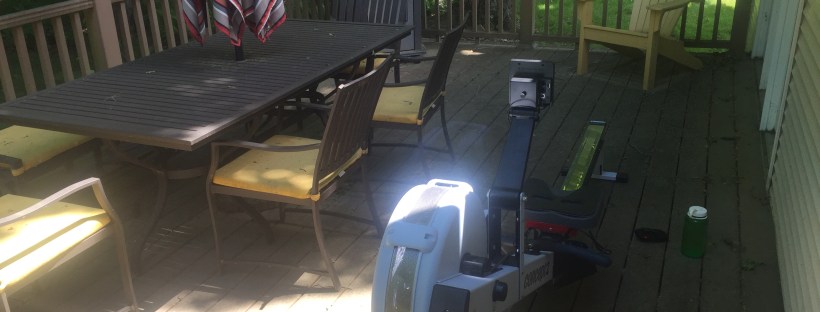
It should have been easier.  I set myself up on the porch.  It was beautiful outside.  Windy and around 70F.

2016-06-12 13.42.06

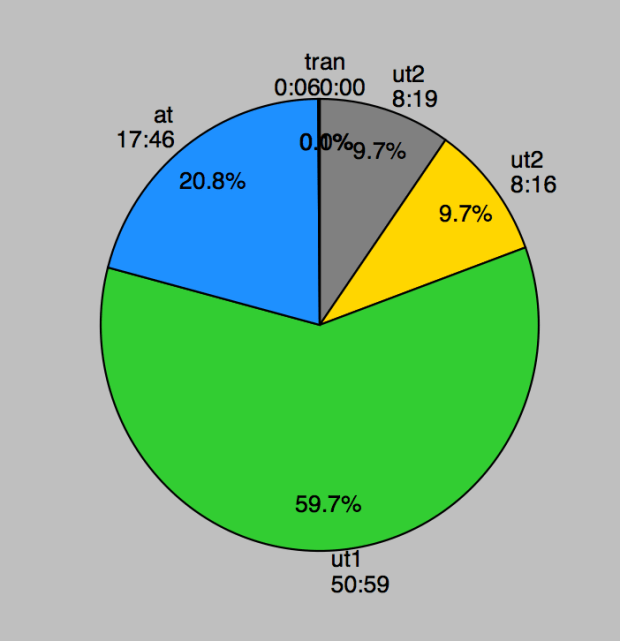
It should have been a really easy row, but I started feeling the effects very soon into it.  I started conservatively at 18spm and 180W.  My HR climbed steadily through the first 20 minutes and was well into UT1 by the end of that piece.  By the end of the second, I had pushed past the HR cap, so I retreated to a L4 format sequence

  • 4′ at 16 (160W)
  • 3′ at 17 (170W)
  • 2′ at 18 (180W)
  • 1′ at 19 (190W)

Even with this downshift, I still spent a lot of time above my HR cap.  I think I need to do some lactate testing to see where I am these days.
Screen Shot 2016-06-12 at 6.27.43 PM

Tomorrow:  Back in Newton in my own boat!  Hurray!  Steady state rate ladders 3/2/1 format at 17/19/21.  HR cap at 155.


Thursday to Sunday: Ticking along

Thursday:  Up at 4:30 to catch a 7AM flight to San Francisco.  Spent the day out in San Jose including a couple of meetings and a customer dinner.  Caught the red eye back from San Jose to Boston.  I arrived at about 6AM.

Friday:  My intent was to go home, get my rowing stuff and the then head out to the river.  But I felt pretty awful from the flight.  I managed to sleep, but it was pretty fitful.  Anyway, I climbed in bed around 8:30 and I thought I would just doze for a little while.  Next thing I knew the clock said 11:45.  I guess I needed the rest.

I finished up work stuff around 2pm and hopped on the erg for a gentle endurance session.

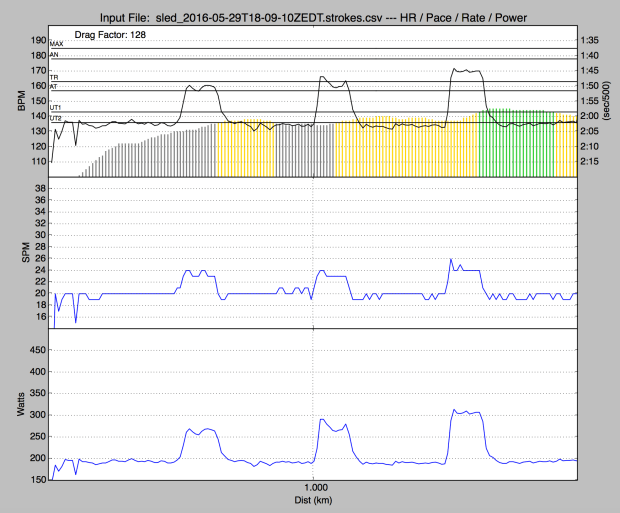
The plan was for 3 x 20′ / 1′ rest at r18 and 180W.  That’s exactly what I did.

Screen Shot 2016-05-29 at 10.57.27 PM

Saturday:  I wanted to head down to the river to install the stainless steel hardware for the oarlock and then try it out.  By the way, if you are in the US and you need hardware, check out boltdepot.com.  Great website, good selection and fast service.

I arrived around 7:30, and I had replaced the hardware and launched by about 8.  I was expecting to have to make some rigging adjustments, but it felt good as is.  No more clicking and the oarlocks were swiveling smoothly.

I haven’t had much time in the boat, so I just felt like rowing.  Nothing too intense, just steady state.  For whatever reason, I was dead slow and that was disappointing.

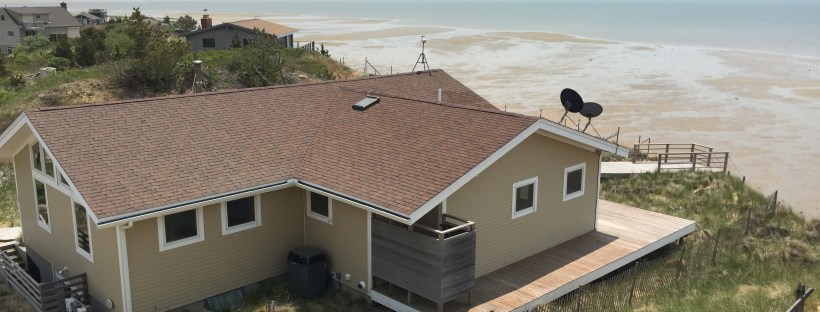
Sunday:  We took a drive out to Cape Cod to take some measurements in our new house.  We have to wait until mid-August before we close on it, and we want to be ready with furniture and everything that we need right away, so we wanted to measure all the rooms.  It’s a nice place.  Just visiting it makes me happy.  Here’s a picture.

2016-05-29 12.55.20

It’s on a 60 foot bluff above the water and it overlooks Cape Cod Bay.  I’ll be able to launch from the base of the steps you see on the right.

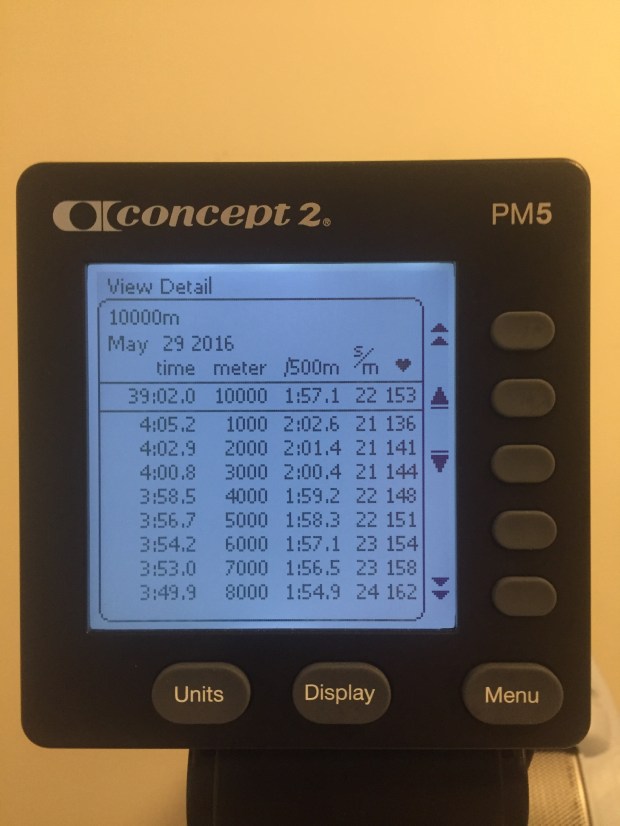
We got home around 4pm, and did a bit of yard work.  Around 6, I snuck off to do an erg session.  I wanted a bit more intensity, and I really enjoyed the 10K push from last weekend, so I did it again.  This time starting at 2:03 pace, and counting down.

I started with a 2K warmup.  2:03 pace with 10 stroke bursts at 1:50 or faster.

Screen Shot 2016-05-29 at 10.48.31 PM

Then into the 10K push.

Cool down, another 2K very slow.

Tomorrow:  It’s supposed to rain like hell.  So, I think another erg session, probably another 3×20.