Painsled review

When I compared Ergstick and Ergdata last week, I wanted to also include Painsled (simple website here), but I is still in it’s beta test phase and was still working through a bug with the developer (Rick Terrell).

By the way, participating in the beta test process has been really positive.  Rick has been very engaged and a steady stream of fixes have been included at a very rapid pace.  The product is nearly done and totally useful in it’s current state.

Painsled is an interesting product concept.  It is multiplatform (iOS, Chrome, Andriod), it works with PM5, PM4 and PM3. The PM3 and PM4 are supported using a usb cable connection, the PM5 via bluetooth).  It provides TCX and CSV output options.  Workout files can be exported from your phone via email, itunes, dropbox, or other iphone options.  In the future, they are looking at export to fitness apps like strava, training peaks, concept2.

When you launch the app you get a simple dashboard, very much like ergdata, which mirrors the data on the PM5, but provides a few additional fields.  I am hoping that some of the other parameters that get logged will become options for the dashboard in the future.  But for my primary use mode, where I start up an app to log my data and then stuff my phone into a holster on my belt, I don’t much care what is going on with the screen.

The data output is TCX format, which I have successfully uploaded to Strava Or CSV.  There are 2 different CSV file format options.  One is a CSV event format which includes a record for every data update that comes from the PM5, so there are lots of records per stroke, maybe 10 or so.  To be clear, this is not like the ergstick force curve data, but rather, and event for each stroke “state”.  I played around with the file, but it is a ton of data and getting plots out of it outstripped my excel coding skills.  In a recent release, they add the CSV stroke format.  This concatenates all the data for each stroke into a single record and ships it out.  This is very cool because that is exactly like the output from rowpro, and one of the ways that data comes out of a speedcoach.  Adapting existing tools to use this data was a simple task.

One of the nice things about painsled is that it provides a richer set of data fields than ergdata.  Here they are:

TimeStamp (sec) : Incomprehensible format, but increments in seconds through the whole workout across all reps and rests.  A nice thing to have for graphs

activityIdx: Unknown

lapIdx : Increments for each interval

pointIdx : As far as I can tell the same data as stroke count

ElapsedTime (sec) : elapsed time for the current interval, resets to 0 at the start of each

Horizontal (meters) : distance within each interval, resets to zero.

Stroke500mPace (sec/500m) : standard pace seconds per 500 (ie 2:00.0 = 120s)

Cadence (stokes/min) : SPM

HRCur (bpm) : Heart rate

Power (watts) : stroke power, watts as displayed by the PM

Calories (kCal) : calories as displayed by the PM

Speed (m/sec) : self explanatory

StrokeCount : strokes with an interval

StrokeDistance (meters) : Yes, indeed directly logged DPS!

DriveLength (meters) : Another good bit of data that ergdata displays but does not log.  painsled ships out for your pleasure.

DriveTime (ms) : How fast you pull!

StrokeRecoveryTime (ms) : How consistently you recover!

WorkPerStroke (joules) : Kinda like watts, but integrated into energy.

AverageDriveForce (lbs):

PeakDriveForce (lbs): I think this is cool, because it gives an idea of how consistent drive force across different rates

DragFactor: This is great because I never remember to look, and it’s good to have it logged.

My specific setup is as follows:

  • Model C or D erg with PM5
  • Wahoo Tikr HR belt connected to the PM5 via ANT+
  • HR sensor also connected via BT-LE to my iphone and logging HR data in the wahoo fitness app (I know I’m obsessive, but it embarrasses me to admit that I do this in writing!)
  • Also running on the iphone, either spotify, or stitcher, or another audio app.

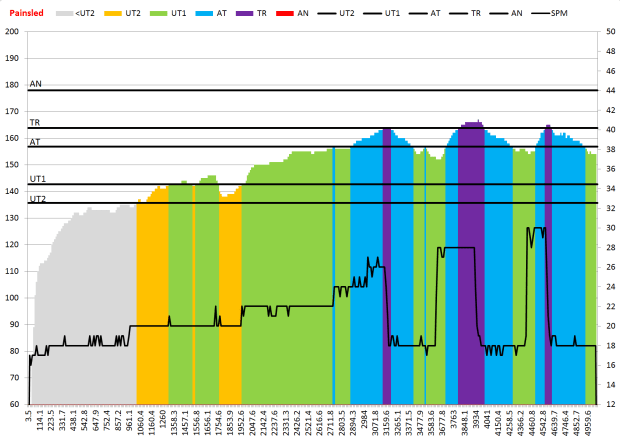
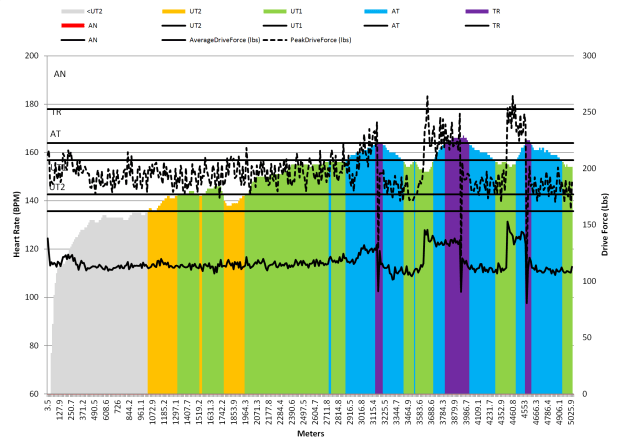
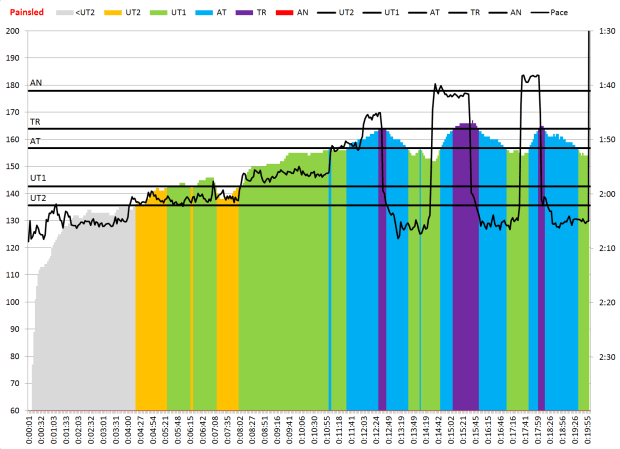
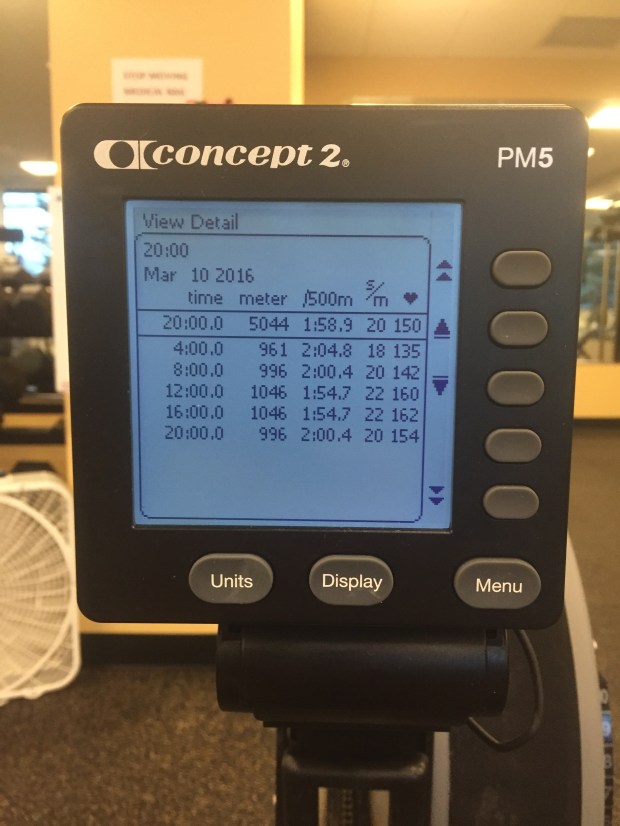
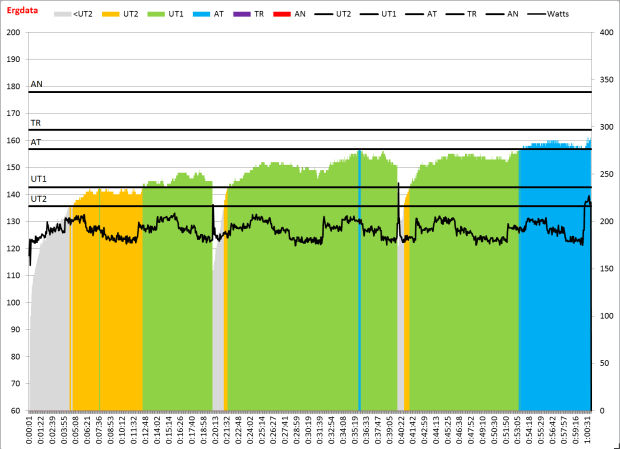
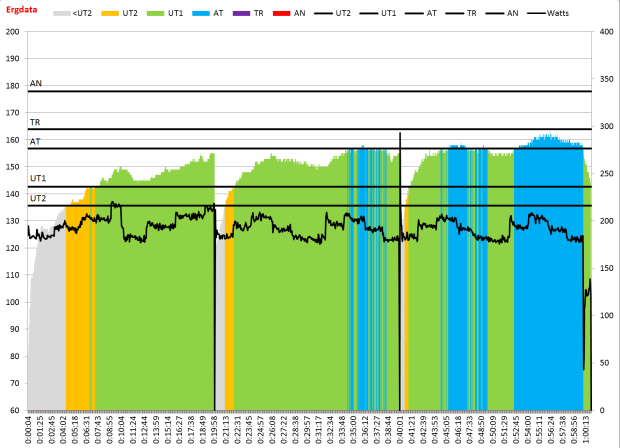
Today, I tried out painsled using this month’s cross team challenge.  I also updated my excel workbook to process the CSV stroke output file.  Here are the outputs for my warmup session today.

A couple of note son the graphs.  I was happy to see that my drive time and drive force was pretty consistent from 18 to 22 SPM, and showed a proportional bump up for the higher rate, higher pressure parts of the warmup.  I was also to happy to see that my drive length was staying consistent through all the rates and did not get shorter as my rate went up.  So, yay for me!

The CSV file has the data to generate splits and tabular summaries, but I haven’t done that work yet.  If anyone wants what I have now, drop me a line.

By the way, I am very happy with Painsled and recommend it to any data junkies out there.  The only down side is the lack of direct integration with the Concept2 logbook.  If that is added, then I think it matches all my needs!
 

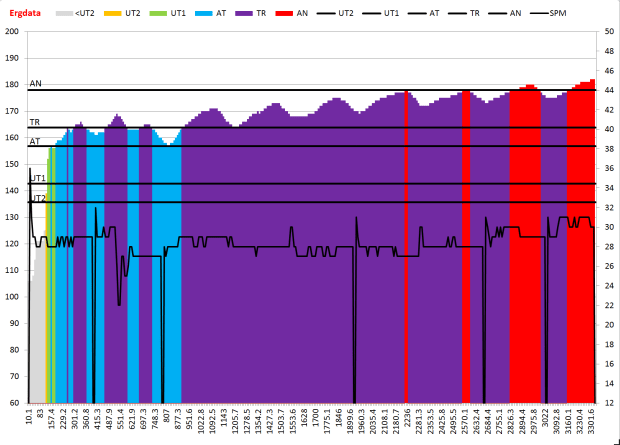
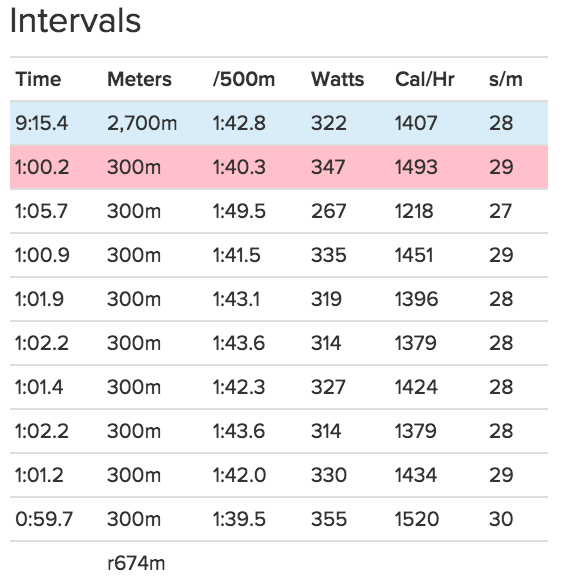
Thursday: 9 x 300 / 30″ rest – March CTC (Better)

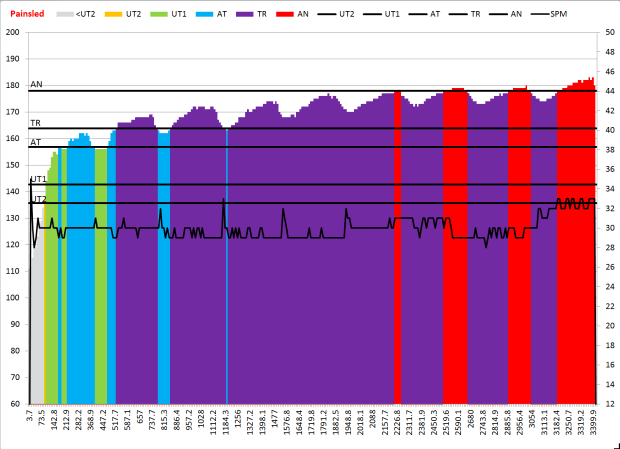
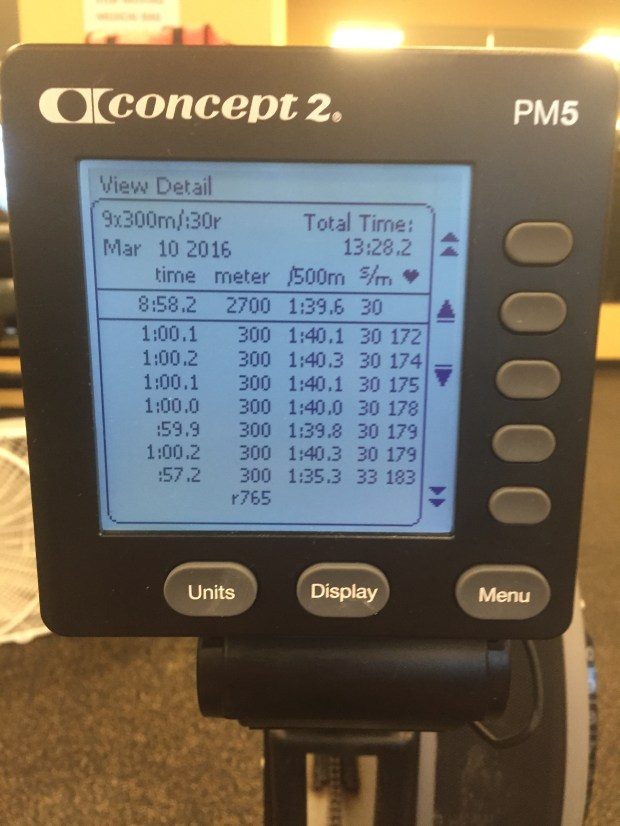
I felt better today in the warmup and in the main set.  I set a target of 1:42 and I was able to beat it on each interval.  Mainly I focused on trying to keep my stroke rate pegged at 30 and my strokes long and smooth.

  • Last time, total time 9:15.4 (1:42.8 pace)
  • Today – Total time 8:58.2 (1:39.6 pace)

Very happy with this workout.

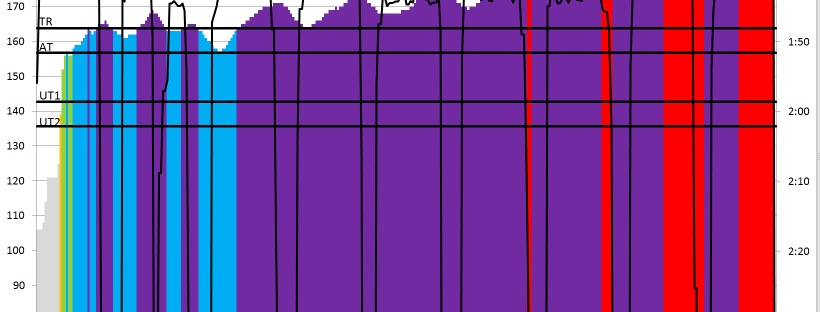
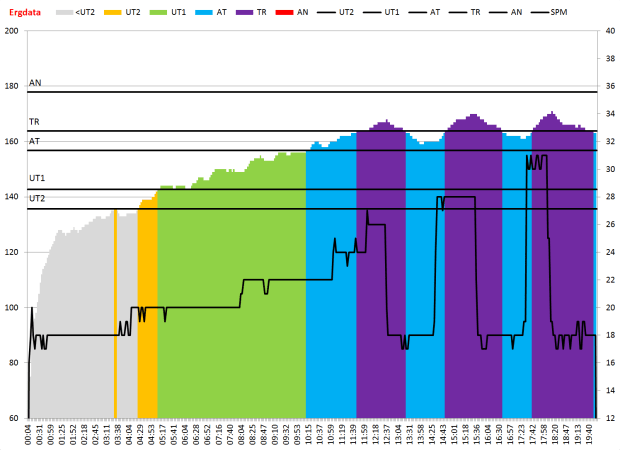
I also used Painsled, which worked perfectly.  I’ll do a separate post reviewing it, but here are the plots from the workout.

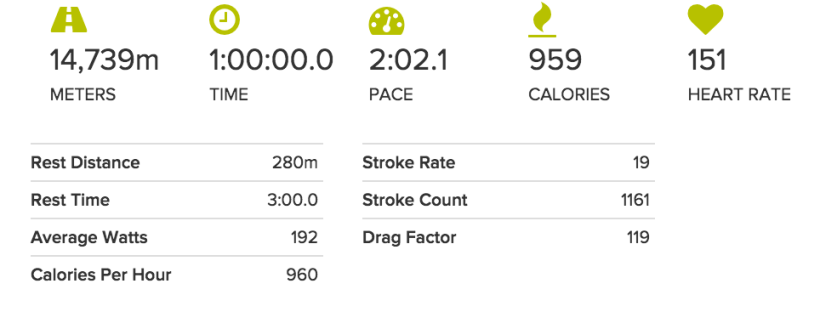
The warmup:

The main set:

The cool down


Tomorrow:  3 x 20′ / 1′ L4

Wednesday: 3 x 20′ / 1′ rest L4

Decided to stick with an easier stroke sequence today, but I still ended up working a bit too hard (judging by HR and RPE).

Today I did 6 repeats of 2′ @ 18, 2′ @ 19, 2′ @ 20, 2′ @ 19, 2′ @ 18.  At 10W per stroke, this should yield about a 188W (2:03.0 pace).   As I usually do, I ended up about 4W above that.

Tomorrow:  Another go at the CTC, target pace 1:41.


Tuesday: 3 x 20′ / 1′ rest L4 (slog)

Felt tired today.  Scaled back stroke counts in the last 40 minutes, but HR was still high.  I guess I dug pretty deep yesterday or I’m accumulating some fatigue.

Ergdata worked perfectly again!

Screen Shot 2016-03-08 at 11.09.00 AMScreen Shot 2016-03-08 at 11.08.46 AMScreen Shot 2016-03-08 at 5.38.21 PM.png

Tomorrow:  Same as today.

I received an updated painsled beta today and tried it for a quick 100m test piece.  The fatal error has been fixed and two critical features for me have been added (csv format stroke file, and seamless dropbox export).  If folks are looking for a PM5 to TCX solution, I think it’s worth a try.  I’ll give a proper tryout and write something up after this week is over.

Monday: March CTC – 9 x 300 / 30″ rest

I haven’t done a speed session since my aborted 2K time trial 9 days ago.  Since then I have missed a bunch of days training due to illness and travel.  And even before that, my training was pretty disrupted for the two prior weeks.  Basically, I blew my chance to peak.

That brings us to today.  I did nice steady state sessions Saturday and Sunday, and today, it was back to my normal schedule.  Up at 5:15AM, and working out in the gym first thing.

With too little sleep and a short turn around time after my session yesterday afternoon, there were a couple more excuse codes that I can draw on for today’s session.

Looking at some of the early CTC results, it looked like folks could do it at 2K pace or maybe 2K – 2.  So, I was hoping that I could hold a 1:40 pace.

So, how did that work out for you Mr. Smith?  Not well….Not well at all. But we’ll get there in time.

I started with a fletcher warmup, which showed alarmingly high heart rates

Then in to the main event.  I went out trying to hold 1:40 in the first rep and it hurt.  A lot.  I was barely recovered by the start of the second rep, and blew up half way through.  I reset to a target of 1:43, just to get a score into the CTC.  The rest was uneventful, but quote taxing.

I was pretty well shattered after that.  I did a 2K cool down and staggered to the locker room.

Screen Shot 2016-03-07 at 8.47.51 AM

I think I will give this one another try later this week, maybe on Thursday.  I think I can probably pull off a 1:41 or so given the right attitude.

Tomorrow:  3 x 20′ L4


Sunday: 3 x 20′ / 1′ rest L4

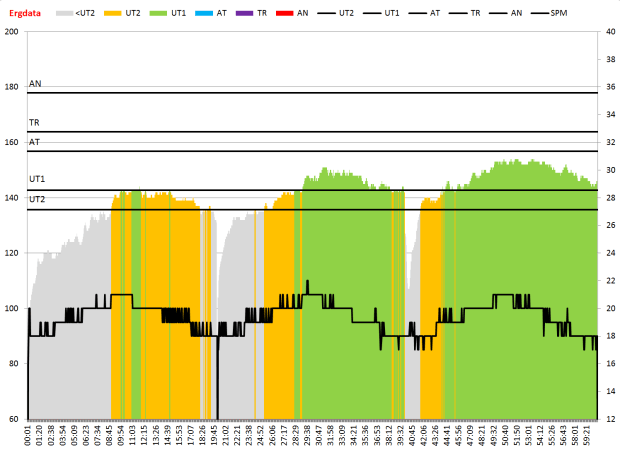
I thought about doing 80 minutes, but decided to stop after 60.  It was a lovely workout. Today, I did 3 – 20 minute segments. Each segment was

  • 3’@18, 3’@19, 3’@20, 2’@21, 3’@20, 3’@19, 3’@18
  • Every thing at 10W x spm (18 spm = 180 watts, etc)

This seems a bit harder than other arrangements of the same stroke rates because you have 8′ at 200W or above in  the middle of each section.  Makes the time go by a bit faster too.

I used ergdata today with the PM5.

Screen Shot 2016-03-06 at 5.43.03 PMScreen Shot 2016-03-06 at 5.41.26 PMScreen Shot 2016-03-06 at 5.39.50 PM


Tomorrow:  I might give the CTC a try 9 x 300 / 30″ rest.  I’ll start at a 1:40 and see where that takes me.

Catching up: 2/27 to 3/3 – sick all week

Saturday 2/27: After I managed to really blow up big time in my 2k attempts, I went downhill fast. Stomach cramps set in by around 6pm, and by 8 I was in bed shivering and strangely enough struggling with nasty leg and foot cramps. I was up and down all night

Sunday 2/28: pretty darn ill. Basically slept the entire day. Ate nothing. Manage to drink about one glass of water. This was worrying because I had a business trip coming on Monday. 

Monday 2/29: dragged myself to the airport, and got through my meetings in Chicago, but was still feeling under the weather. 

Tuesday 3/1: I had time to trading before my 9am flight to Minnesota, but decided sleep and recovery was the better choice. Another day of meetings large and small in our design center up there. 

Wednesday 3/2: again, I had the time to get in a workout, but still didn’t feel up to it. Flew from Minnesota to Portland, Oregon. Another design center and another set of meetings. Started to feel ‘normal’ in the afternoon, and by dinner I noticed my appetite was starting to return with a vengeance. 

Thursday 3/3 (today): today, I managed to get down to the fitness center for a very easy 30 minute session, 10 minutes on a cross trainer that seemed incapable of providing resistance, and then 20 minutes walking up an incline. (15 % grade, around 5 mph). This was good, heart rate right around 70% HRR. It felt good to work up a little sweat. Today, I’ll be in our second biggest design center in Los Angeles, for another day of meetings. Then I’ll grab the red eye back to Boston. 

Tomorrow, I will plan on an easy erg session, maybe a 3×20 L4. I expect that the illness and training layoff has probably set me back a month in terms of fitness. It’s time to lay out objectives for the summer and map out a training plan. 

This kind of stuff is frustrating, I need to work on making the overall training program challenging AND enjoyable on its own. I’m trying to find the balance. On one hand, setting goals to achieve certain levels of performance in competition is very motivating and enables me to really push harder workouts and not blow off training. On the other hand, I have higher priorities than competition, especially since my competition is against my own prior performance. I’m never going to set records or win big events. That doesn’t change the feeling of satisfaction that comes as you reel in and pass someone in a head race, right at the edge of your capabilities. 

Enough philosophy. Time to go talk to some engineers!

Comparison of ErgStick and ErgData

This is not meant to be a comprehensive product review.  Instead it is an evaluation of two products to figure out which one is the best for my specific needs.

Those needs are:

  • Record stroke by stroke data from the erg
  • Support PM5 (required), PM4 and PM3 (bonus)
  • Works with iphone
  • No physical connection required to phone (because I use headphones and wear the phone on my bet when I row * )
  • Works with other apps running including wahoo fitness, stitcher, spotify, etc
  • Works with wahoo tikr HR strap
  • provides CSV output for post processing (required)

* Note:  Before you ask, I have tried wireless ear buds and none of them stay in my ears, and all of them are incredibly fiddly.  Maybe someday cheap, reliable BT earbuds will be available that I can screw securely into my ears.  Until then, the phone stays on the hip.

I was going to originally include PainSled in the evaluation, but I am still working through some Beta issues with the developer.  As soon as I have something useful to say, I’ll write that one up too.

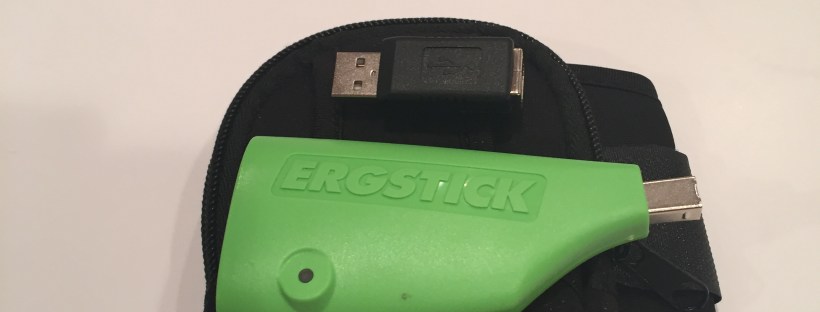
First up.  Ergstick.  Check out their website.  It is a USB dongle that is sold for $120.  This is what it looks like.

2016-03-05 21.46.22.jpg

You jam the green thingy into the back of your PM5, or the bottom of your PM3.  I haven’t  tried it with the PM3, but I plan to tomorrow.

Then you fire up the app and I made a horrifying discovery.  To get the single most important feature that I wanted from the software (CSV exports), I needed to pony up for “ErgStick Pro” to the tune of $39.99.  And this did not buy the pro version, it gives a one year subscription to the pro version.  So the cost of ergstick is $120+$40 initially, plus $40 per year.  Wow! Ouch!  On top of that, I can find nothing about this on their website.  The only place where it is defined is in the description of the app in the apple app store.

Screen Shot 2016-03-05 at 9.55.12 PM.png

OK, well I’ve come this far.  Next step is to try it out.  I paid my money (in for a penny, in for a pound) and upgraded.  The app synched right away with the dongle and provided a live screen with nifty data that I don’t look at.

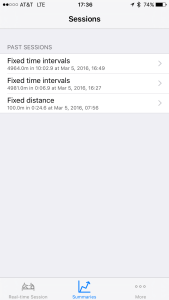
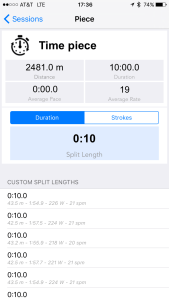
I programmed the PM5 for a time interval session (10′ with 0:00 rest), and off I went.  When I finished, I pushed menu to terminate the workout and checked out my phone.  Here are the cool screen you get.

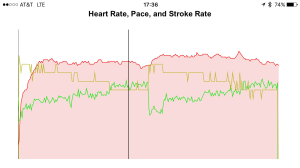
Pretty nice displays.  On the Heart Rate, Pace and Stroke Rate screen, the cursor should have been showing the values.  For some reason it didn’t in the interval session.  It did for this simple 100m test session that I did without a HR sensor.

2016-03-05 17.37.23

Getting CSV was not as convenient as some other apps, which allow you to ship to dropbox or sync multiple files automatically.  In this app you need to email each file individually.  A pain, but workable.  From there it was simple to modify my ergdata spreadsheet to deal with the ergstick format data.

Screen Shot 2016-03-05 at 5.47.57 PMScreen Shot 2016-03-05 at 6.05.03 PM

ergstick provides 4 to 6 records per stroke, and a huge number of data fields in the CSV.

Total elapsed time (s)

Total distance (m)

Stroke rate (/min)

Speed (m/s)

Current heart rate (bpm)

Stroke count

Stroke power (W)

Stroke calories (cal/hr)

Projected work time (s)

Projected work distance (m)

Split/interval time (s)

Split/interval distance (m)

Split/interval rest time (s)

Split/interval rest distance (s)

Split/interval type

Split/interval number

Split/interval ave. stroke rate (/min)

Split/interval ave. pace (/500m)

Split/interval total calories (cals)

Split/interval average calories (cal/hr)

Split/interval speed (m/s)

Split/interval power (W)

Split/interval ave. drag factor

OK, so on to ergdata.  With the PM5, it’s just the same except it doesn’t cost anything. I started ergdata on my phone, and it immediately synched up with the PM5.  I programmed the same 10’/0 rest interval session on the PM5 and did another L4 steady state session.

After I finished, I pressed menu on the PM5 to terminate the session and checked my phone.  Here are the key screens.

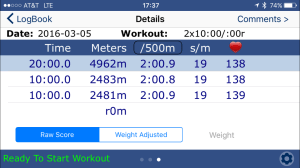
On the logBook screen you can push the sync button and like magic, the session appears in your concept2 online logbook.

Screen Shot 2016-03-05 at 10.11.38 PM.png

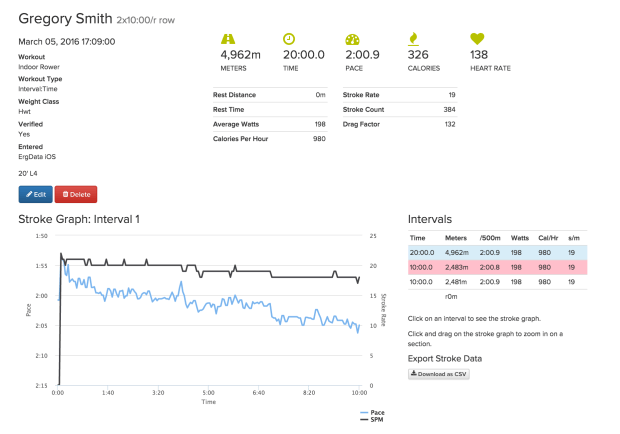
Then you can push the little magnifying glass to dive into the workout.  And then this is what you see.  I’ve heard through the grapevine that HR data will be added to the graphs and summaries soon.  The graphs show the selected interval.  There is no choice of units or ability to show the whole workout.  There are apparently some glitches in the way that it calculates pace for interval workouts with rest meters in them.  I assume for ranking distances that they have tested the crap out of it, but if you should check the numbers if you care a lot.

Screen Shot 2016-03-05 at 10.12.28 PM.png

You can see over on the right side, at the bottom there is an option to export stroke data.  This is a much less sophisticated data set than ergstick, but it has all the basics with a single record per stroke.

Stroke Number

Time (seconds)

Distance (meters)

Pace (seconds per 500m)

Stroke Rate

Heart Rate

This was easy to massage into excel.  So easy in fact, that I decided to add a watts graph to the collection.

Screen Shot 2016-03-05 at 6.05.03 PMScreen Shot 2016-03-05 at 6.05.22 PM

So, from my perspective, there is a clear winner.  Ergdata is much, much cheaper, and it provides automatic synching with the concept2 log book.  If you have a PM3 or PM4 and you are thinking of buying an ergstick, I suggest a PM5 upgrade instead because the cost will less after the second year.

There is a specific group of people that I think will prefer the ergstick.  If you are on a team or have a common practice facility with a large number of ergs that have PM4 or PM3 and you want to get workout data in a consistent format, then ergstick will be a very good solution.   It will let you use any erg and get the data you need.  But it is pretty darn expensive.


Saturday: 3 x 20′ L4 (Bliss)

Yesterday was a blur.  I got off the red eye at 6AM and I was bleary eyed and strung out.  I went home and tumbled in bed and slept until nearly noon.

After that, it was a bunch of work phone calls, mainly trying to figure out a bunch of travel coming up in the next few weeks.  There just wasn’t enough time to workout before my wife and I needed to pack up and head in to the city to celebrate my twin sons birthday (#23!).  A very frustrating day and a workout would have definitely helped my mental outlook.

Today, nothing would stop me, and I had new toys to try out.  I’ll put up a separate post, but today, I compares ergdata, ergstick, and painsled today, along with giving my new PM5 a maiden voyage.  I was in data heaven.  But we’ll get to that.  First the workout.

Plan:

  • 3 x 20′ L4 format
  • 10W per stroke
  • 2′ rests to let me change which toy I was trying.
  • Try to keep peak HR in UT1 range.  Try to keep average in UT2

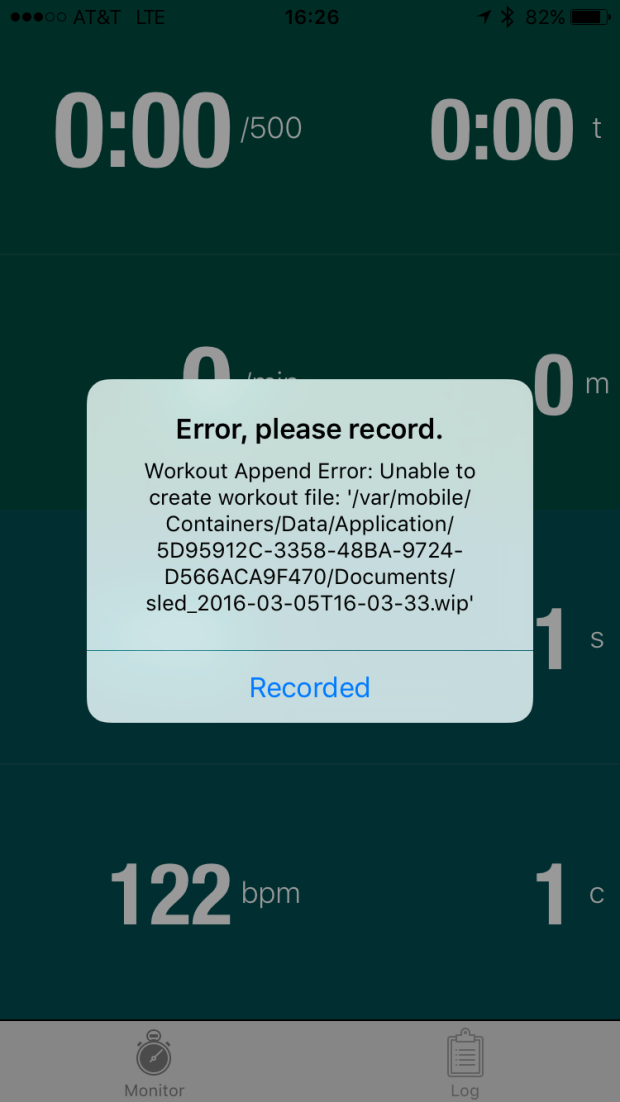
First 20 minutes, I used painsled.  No luck.  This was all I got from painsled.

2016-03-05 16.26.10

I’ve emailed back and forth with the developer and apparently, this is not an error that any other users are seeing.  Oh well.

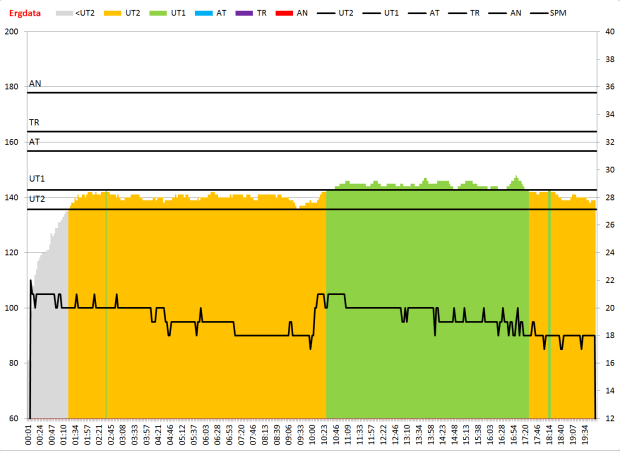
Here’s the results using the old fashioned method.  The stroke sequence was

  • 2′ @ 18, 2′ @ 19, 2′ @ 20, 2′ @ 19, 2′ @ 18
  • 1′ @ 21, 3′ @ 20, 3′ @ 19, 3′ @ 18


2016-03-05 17.11.07

Nice low HR.

Then over to ergstick for another 2×10′.  This time, I did 2 of the 1×21, 3×20, 3×19, 3×18 sequences.

Ergstick provides a CSV output that I quickly adapted my ergdata worksheet to use.  Here’s the result of that.

Screen Shot 2016-03-05 at 5.48.14 PMScreen Shot 2016-03-05 at 5.47.57 PM

2016-03-05 17.11.15

So, pretty easy stuff.

Finally, over to ergdata.  And a carbon copy of the prior 20 minutes

Screen Shot 2016-03-05 at 6.05.03 PMScreen Shot 2016-03-05 at 6.05.22 PM

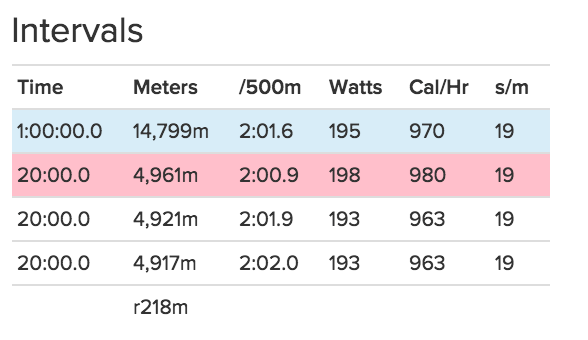
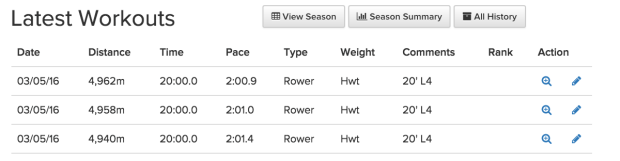
And of course with ergdata, you can seamlessly sync to the logbook, so boom, here’s the summary.

Screen Shot 2016-03-05 at 9.33.43 PM

What an enjoyable workout.  Just about the perfect intensity.

Tomorrow:  4 x20′ – All on erg data.


Catching up: February vacation week 2/14-2/21

One of the more pleasant ways to disrupt a training plan!  My wife and I have been fleeing to Aruba over the February school vacation week. We first came down, nearly 20 years ago to celebrate our 10th anniversary, we returned 10 years later with out kids to celebrate our 20th, then about 5 years ago, it became an annual respite from Boston in February. 

This year, we tried a different hotel, a place called Bacuti and Tara.  It’s a lovely place. Very different from the crowded bustle of the high rise hotels. It came equipped with a very nice and airy fitness center, and about 4km of soft sand beach.

Sunday 2/14: travel day, no training

Monday 2/15: Run on the beach. 6km, no HR data. Hot!  Threshold intensity. 

Tuesday 2/16: used the horrifyingly bad knock off version of a water rower that they had in the fitness center. I lasted twenty minutes on it and then I retreated to a cross trainer for another 40 minutes. Whole workout was <150 HR. 

Wednesday 2/17: short, hot, hard run on the beach. Around 4km, about 26 minutes. 

Thursday 2/18: 60 minutes in the fitness center, this time 40 minutes on the awful rower, and 20 minutes on a stationary bike. All <150bpm. 

Friday: 7km run on the beach, 44 minutes. Started easy-ish, BRuth then Higher intensity. Threshold intensity, 7 minutes above 170bpm. 

Saturday 2/20: 60 minutes in the fitness center. Light and easy. 

Sunday 2/21: flew home. No training. 

The objective was to try to avoid losing too much fitness and enjoy myself. It felt like a good balance. It would have been much better if the rowing machine was a proper concept2, but all in all, that’s a pretty minor quibble.