Sunday: HM (I guess it was an L3 workout)

I’ve been reading all these posts about people doing the Crazy Bear Challenge.  This challenge is to row 30 Half marathons in the 45 days between November 11 and Christmas.  I’m tempted to join in, even though it doesn’t make perfect sense with my training objectives.

Anyway, I wanted to have a little fun today, so I thought I would do a Half Marathon and target a pace just under 2:00.   That seemed like a respectable place to start.

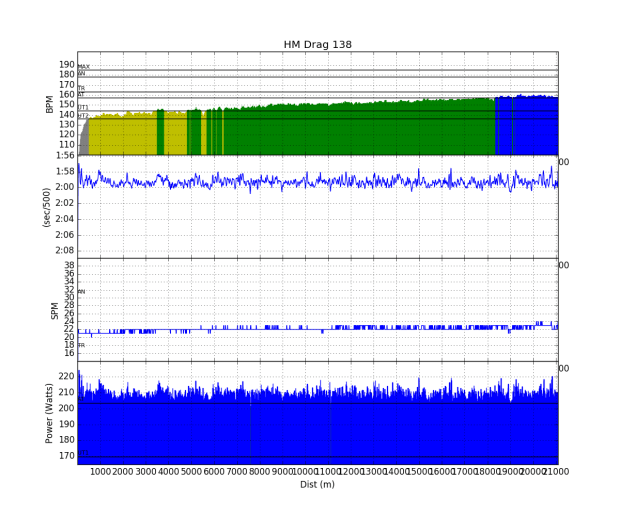
It turned out to be reasonably easy, all but the last 15 minutes or so were UT1 or below. And this result put at 25th in the rankings.  I might do some more of these and gradually psh the pace a bit faster.

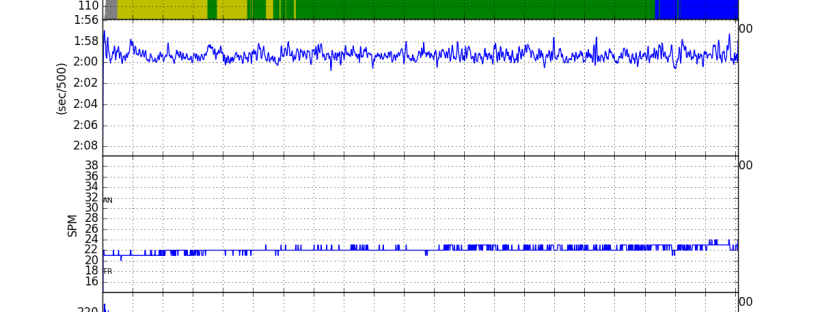
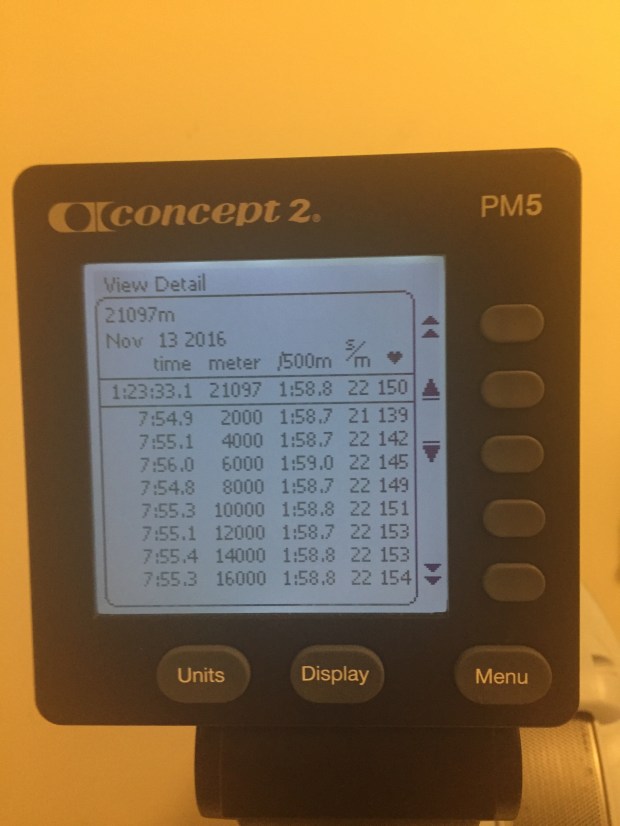
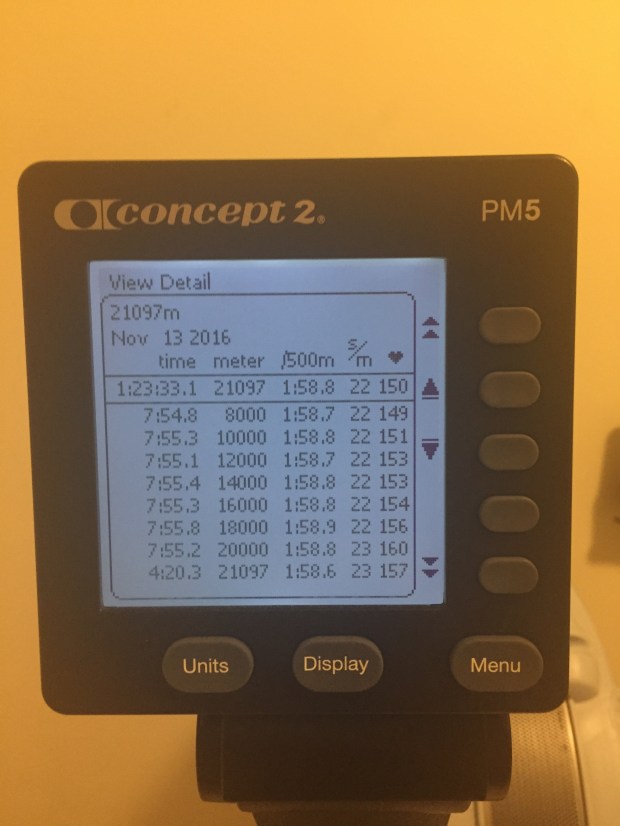
One of the fun things you can do with rowsandall.com is to arbitrarily assign new split lengths.  On the PM5, I used 2000m splits.  On rowsandall, I split the row into 1000m segments.  Looks pretty darn consistent.

Workout Summary - media/20161114-021734-sled_2016-11-13T17-25-38ZEST.strokes.csv
--|Total|-Total-|--Avg--|Avg-|-Avg-|-Max-|-Avg
--|Dist-|-Time--|-Pace--|SPM-|-HR--|-HR--|-DPS
--|21097|83:29.0|01:58.7|22.1|149.4|161.0|11.4
W-|21097|83:31.0|01:58.8|22.1|149.3|161.0|11.4
R-|00000|00:00.0|00:00.0|00.0|000.0|161.0|00.0
Workout Details
#-|SDist|-Split-|-SPace-|SPM-|AvgHR|MaxHR|DPS-
01|01000|03:55.0|01:57.5|20.8|130.2|140.0|12.3
02|01000|03:57.8|01:58.9|21.1|140.0|142.0|12.0
03|01000|03:57.8|01:58.9|21.7|141.5|144.0|11.6
04|01000|03:57.3|01:58.7|21.8|143.3|146.0|11.6
05|01000|03:58.1|01:59.1|21.9|142.8|145.0|11.5
06|01000|03:57.8|01:58.9|22.0|144.1|148.0|11.5
07|01000|03:57.3|01:58.7|22.0|145.7|148.0|11.5
08|01000|03:57.5|01:58.7|22.1|147.1|150.0|11.4
09|01000|03:57.5|01:58.8|22.2|148.9|151.0|11.4
10|01000|03:57.8|01:58.9|22.1|150.0|152.0|11.4
11|01000|03:57.6|01:58.8|22.0|150.6|152.0|11.5
12|01000|03:57.5|01:58.7|22.3|151.4|154.0|11.4
13|01000|03:57.7|01:58.9|22.6|151.3|153.0|11.2
14|01000|03:57.6|01:58.8|22.2|153.0|155.0|11.4
15|01000|03:57.3|01:58.7|22.3|153.5|155.0|11.3
16|01000|03:58.0|01:59.0|22.3|154.8|157.0|11.3
17|01000|03:57.7|01:58.8|22.2|155.2|156.0|11.4
18|01000|03:58.1|01:59.0|22.4|156.4|157.0|11.3
19|01000|03:57.7|01:58.8|22.7|157.2|159.0|11.1
20|01000|03:57.5|01:58.8|22.6|158.5|161.0|11.2
21|01000|03:57.3|01:58.6|22.9|158.5|160.0|11.0
22|00097|00:23.0|01:58.8|22.9|157.4|158.0|11.0

myimage11-13a

Another magical afternoon row.  I am sure that I could do at least 1 split faster, maybe more.


Saturday: 10K push

I had a busy day on Saturday.  I had a haircut appointment in  the morning, then some shopping to do.  I got home around 1 and we needed to head out to pick up some friends for dinner and a concert at 2:30.

I almost didn’t workout, but I was feeling antsy, so I decided to do a 10K push workout.  For those unfamiliar, these workouts are AWESOME!  Here’s how it works

  • 10K distance
  • Start at something close to your steady state pace
  • Speed up by 0:01/500 for each 1000m of the workout

I have done this workout a 3 times in the past year.

  • Dec 10, 2015:  Start at 2:00, failed at 4K to go, peak HR 180
  • Dec 15, 2015: Start at 2:02, success, peak HR 178
  • May 30, 2016: Start at 2:03, success, peak HR 177
  • Aug 15, 2016: Start at 2:05, success, peak HR 177

I was feeling pretty cocky after my good 10K last month for the CTC, so I decided to start at 1:59 today.  It worked out very well.

  • Nov 12, 2016: Start at 1:59, success, peak HR 174

No problems at all.  A nice cruise and I was only pushing hard for the last 3000m or so.

Workout Summary - media/20161114-185906-sled_2016-11-12T13-36-38ZEST.strokes (1).csv
--|Total|-Total-|--Avg--|Avg-|-Avg-|-Max-|-Avg
--|Dist-|-Time--|-Pace--|SPM-|-HR--|-HR--|-DPS
--|10000|37:52.0|01:53.6|23.5|153.1|174.0|11.2
W-|10000|37:52.0|01:53.6|23.5|152.4|174.0|11.3
R-|00000|00:00.0|00:00.0|00.0|000.0|174.0|00.0
Workout Details
#-|SDist|-Split-|-SPace-|SPM-|AvgHR|MaxHR|DPS-
01|01000|03:54.5|01:57.2|21.3|130.0|138.0|12.0
02|01000|03:54.3|01:57.1|22.2|141.7|145.0|11.5
03|01000|03:52.4|01:56.2|22.3|145.8|148.0|11.6
04|01000|03:51.0|01:55.5|23.0|147.9|152.0|11.3
05|01000|03:49.5|01:54.8|23.1|150.6|153.0|11.3
06|01000|03:47.3|01:53.7|23.3|153.7|156.0|11.3
07|01000|03:45.1|01:52.6|23.9|159.0|161.0|11.2
08|01000|03:43.4|01:51.7|24.4|162.2|165.0|11.0
09|01000|03:41.0|01:50.5|25.0|165.3|168.0|10.9
10|01000|03:34.2|01:47.1|26.5|171.0|174.0|10.6

Generally, the splits line up pretty well between the postprocessed results and the PM5 data.  The first split is off a little bit.

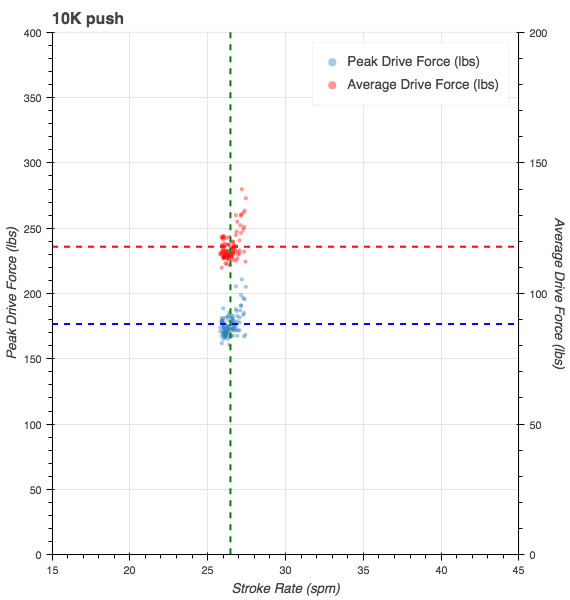
I purposely tried to use a fluffier stroke rate on this piece, so I was interested to see how my power versus stroke rate would look.  It’s kind of fun to see the results.  Here is the whole thing.  From this you might conclude that there is a positive correlation between stroke rate and drive force.

bokeh_plot-43

So, I split the data set to look at the first half versus second half.  Now you can see the the first half is flat and the tail is in the second half.  This got me thinking, is there a correlation, or did I just hammer the last 1000m.

Answer:  I hammered the last 1000 meters.  Theses two plots are the first 9000m and the last 1000m.

What a fun workout and I drank beer at dinner with little or no guilt.


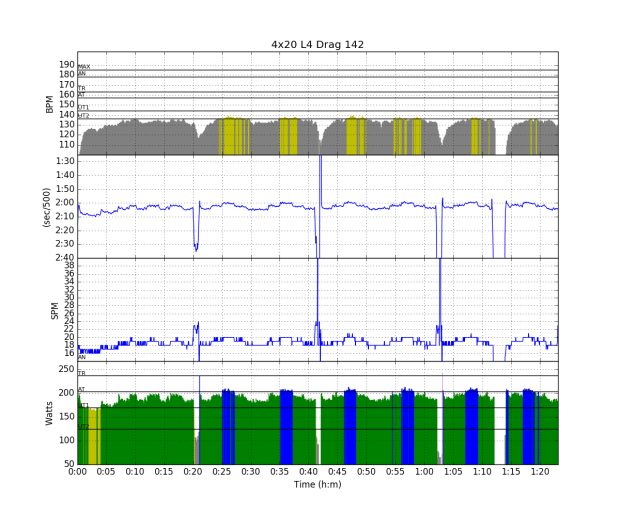
Friday: 4 x 20 L4

Thursday was a “rest day”.  Up at 5am to fly home. Driving home from the airport sucked, nearly 2 hours in traffic.

I decided a good night sleep was needed and made the call to work from home.  That made my morning a lot easier.  I woke up at 8:30, had breakfast and was in a meeting at 9.

I worked until around 3:30 and then decided it was time for some training.

Plan:

  • 4 x 20′ / 1′ rests
  • L4 format
  • Start slow, then push it a little harder than last weekend
  • 10W per stroke

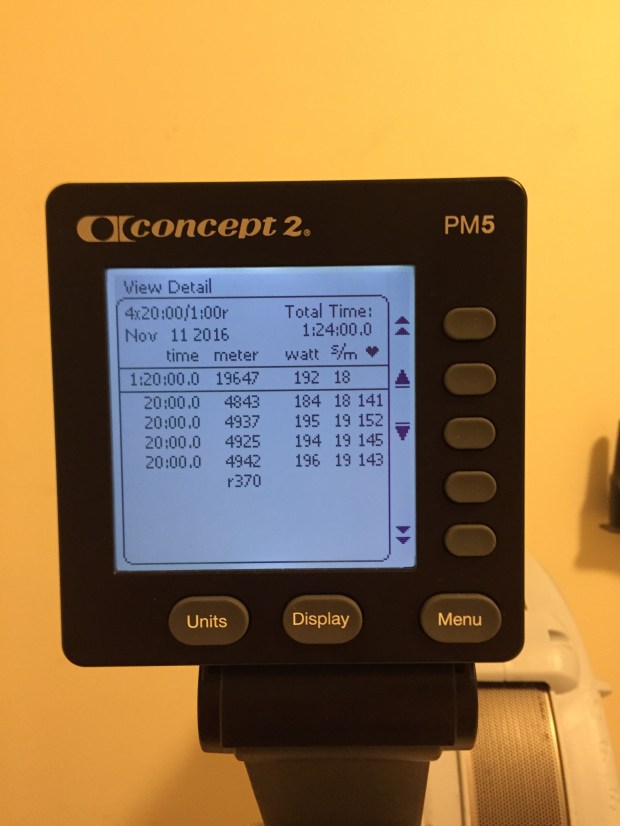
Having a little issue with the interval editor, so no details on each 10 minute segment.

Lactate test at the end, after 80 minutes, 2.0mmol/l – right on the nose.

One other note.  It was nice and cold.  57F when I finished.

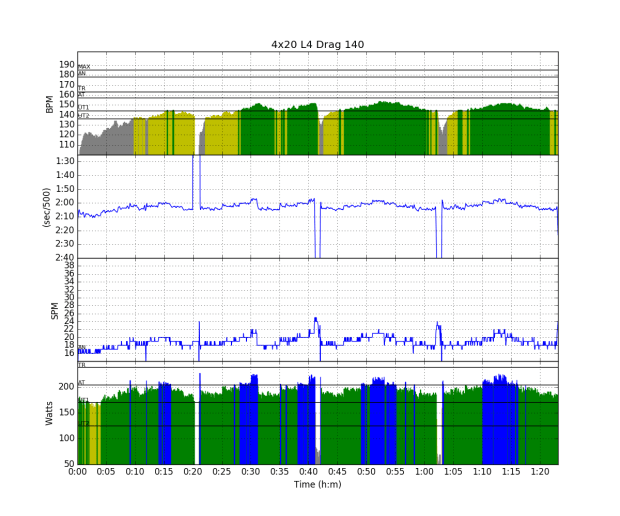
I think the key thing that I noticed is that my HR was following the power very closely.  I think that is the key for me, if I start to see more decoupling between HR and power, then I am pushing the session too hard.

By the way, I had a blast with the stroke sequence today.

Untitled11-11d.png


Strength Training Thoughts

I posted the following on the Rowing Illustrated forum.

Screen Shot 2016-11-09 at 11.15.07 AM.png

I got back a really great reply from a user SDSweep which I would like to share.

Screen Shot 2016-11-09 at 11.16.45 AM.png

So, my winter training plan will include:

  • 2 strength sessions a week.
  • These sessions will be tacked onto the end of a shortened endurance session (probably 40 minutes of endurance and 30 minutes of strength work)
  • The plan will be very simple including 4 exercises per session
    • A compound lift emphasizing the rowing muscle groups
      • squats
      • deadlifts,
      • power cleans
    • Something for upper body rowing muscles
      • Pull ups
      • Chin ups
      • Lat pull downs
    • Something for counter muscle groups
      • Push ups
      • Bench press
      • Standing press
      • Seated Press
    • Core
      • Ab roll outs
      • planks
      • leg lifts
  • In terms of reps and sets.  I will probably use some advice from some other folks to mix this up in blocks.  A couple weeks of lower reps, more sets.  Then a couple weeks of higher reps and less sets.  Generally, I will be going for 20 to 30 total reps.
  • Weight.  I will progressively increase weight, but follow the guideline that I will stop at least one rep before failure.

Power Training Zones

My friend Sander has updated the rowsandall.com online tools to provide the ability to analyze workouts in terms of power.  Many athletes, especially cyclists, use power zone training extensively.  The concept2 erg provides direct readout of power, and power can either be derived for OTW rowing or directly measured by new products coming from folks like NK.

The power zones on Rowsandall.com are based on definitions from trainingpeaks.

link to training peaks article

This defines power training zones based off of your Functional Training Power (FTP).  FTP is defined as the power you can hold for a 60 minute time trial.  I haven’t done a 60′ all out test for a while, so I used my recent 10K CTC result.  I held an average pace of 1:51.4 for the piece.  Based on Paul’s Law, I estimated that I could hold 1:54 for the full hour.  (my all time best was 1:52.0 pace).  This translates to a FTP of 236W.

So, my training zones based on the Coggan article are:

11-10

The power values show the upper bound of each of the levels.

I was curious how that compared to the power zones defined along with the HR bands from the Terry O’Neil  Interactive plan from the indoor sport services website.  These levels are defined as % of 2K power, not FTP.

11-10a

So, comparing the two is a bit of a challenge.  The boundaries are quite different.  The upper end of endurance differs by nearly 20W (177W vs 195W).  Tempo is roughly in the neighborhood of UT1, but the upper end is quite different (215W vs 228W).  Threshold level from ISS goes a bit higher than the Lactate Threshold band from Coggan.

I wonder a bit if the Coggan bands are more optimized for cycling and the O’Neil bands are optimized for rowing.  A quick check indicates that both rowing and cycling have a cube law relationship between speed and power, but since the cadences and muscles used are so different, I am not sure if the bands would align.

I’d welcome any thought about this.

Wednesday: 40′ endurance and a little strength training

In Agoura Hills, California.  At the Sheraton fitness center.

Seemed like today was as good a day as any to start doing a little bit of strength training.

Plan:

  • 20 minutes inclined march (15% grade, 3.5mph)
  • 20 minute jog (3% grade, 4.5 mph)
  • HR cap at 157
  • Easy start to strength training
    • Dumbell deadlifts (2x50lbs) – 3 sets of 10 reps
    • Lat pull down (110lbs) – 2 sets of 6 reps plus one set of 8
    • Push ups – 3 sets of 10 reps

Another bad workout after another bad night’s sleep.  The election debacle kept me tossing and turning even after I turned off the TV.

Tomorrow:  No workout.  Flying back home.


Tuesday: 3 x 20′ L4 at Fitness Evolution

In San Jose.  My hotel had a deal with the gym across the road.  By some miracle, it had a half dozen well maintained Model D rowers with PM5s.

Plan was to do 4×20 L4, but once I got going, I found that I was working very hard to go very slowly.  I cut it short after an hour.

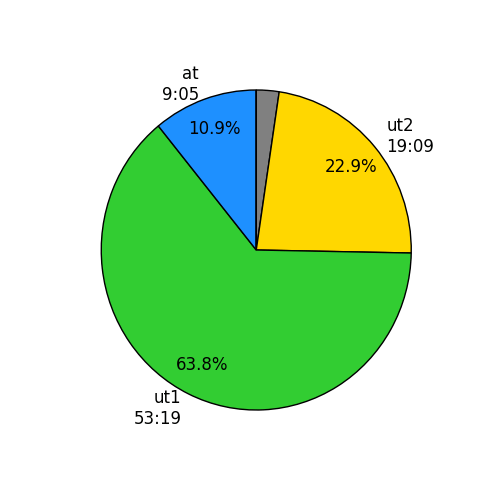
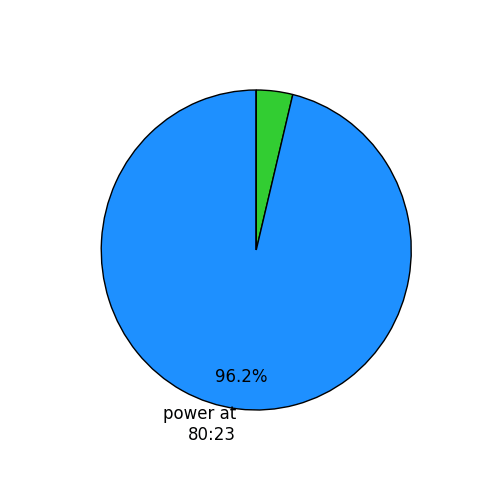
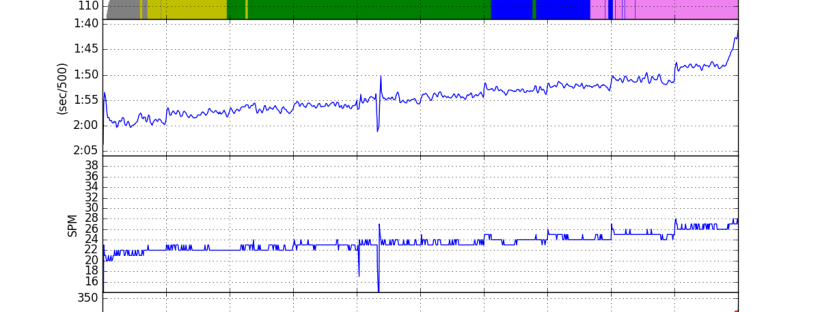
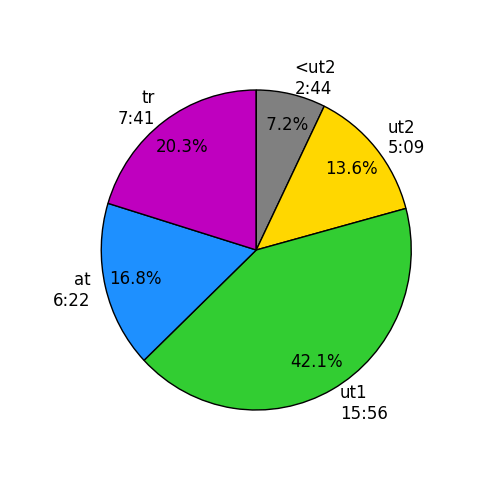
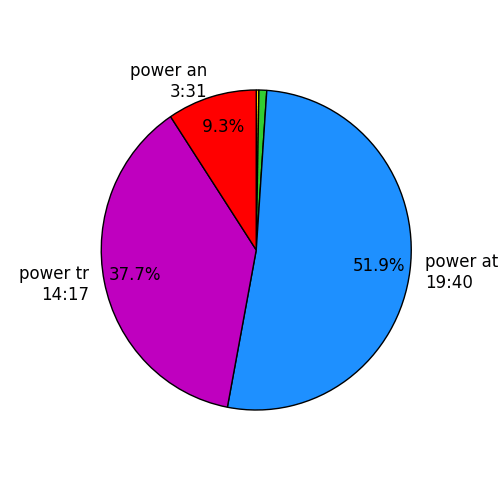
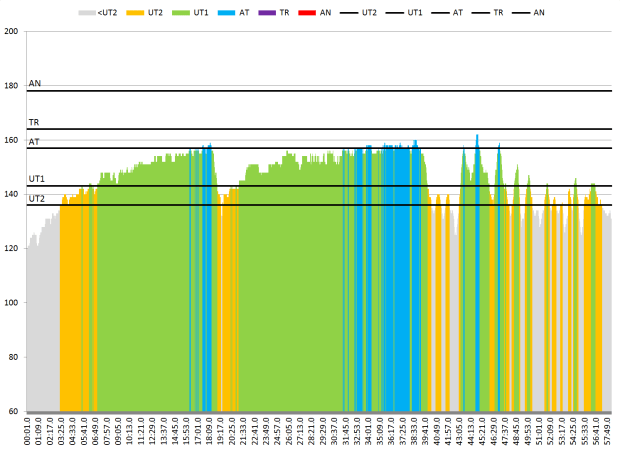
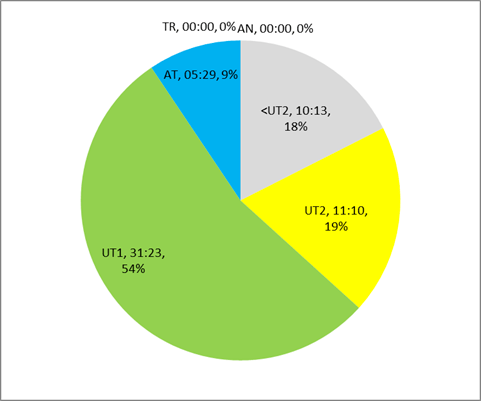
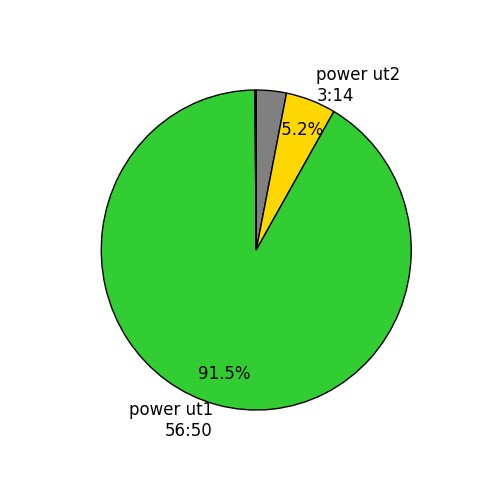
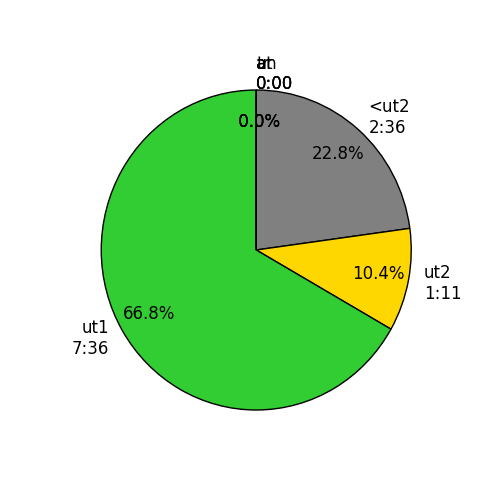
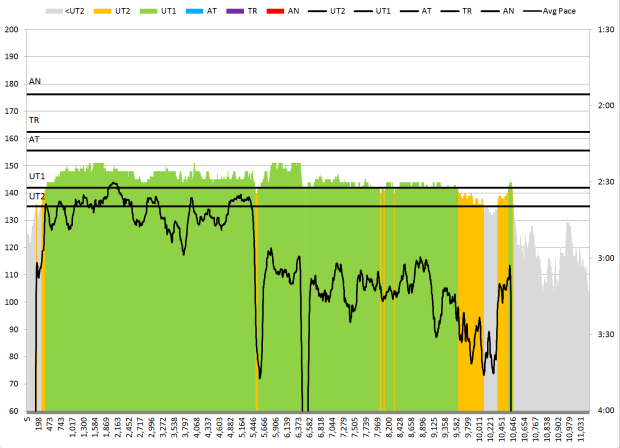
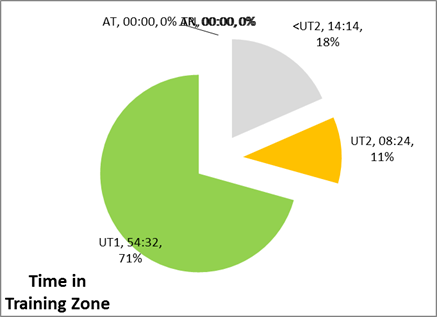
Here is the row versus time, with pie charts for HR and power.

Compare this to Sunday’s row.  Longer row, higher power, lower Heart rate.

Why the difference:

  • Time of day:  I do better in the afternoon.  Tuesday’s row was at 5:30am.
  • Rest:  I did not sleep well.  I spent 6 hours on a plane on Monday
  • Nutrition:  I had 2 beers the night before the Tuesday Row.  I think that hurts a bit.
  • Environment: Sunday was with a fan and the windows open.  It was 61F in the room when I finished.  Tuesday was in a corner of the club with no airflow.  I left big puddles.

It’s still an impressive difference.  Another reason to use RPE as the guiding principle for endurance intensity.


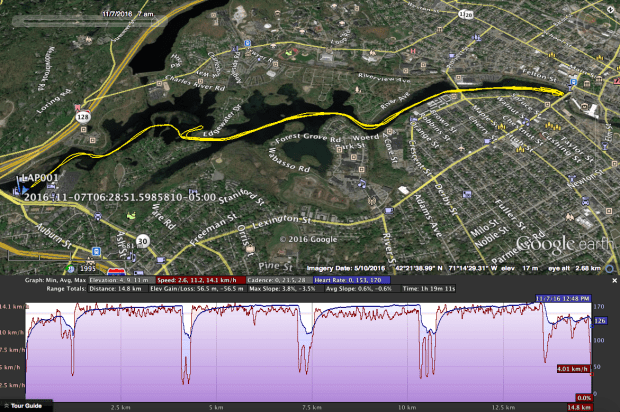
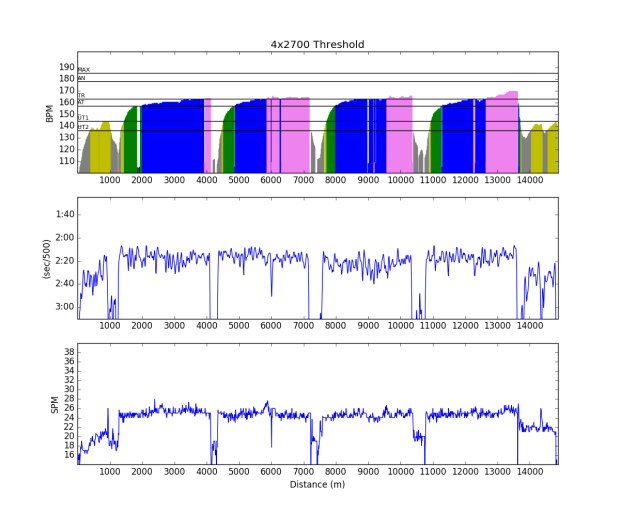
Monday: 4 x 2800m Threshold OTW

In Newton in my Fluid

Weather:  36F, Clear, light wind from the NNW 3-5mph.  This was a head wind heading down river.  It was only a factor in the straight section in front of the watch factory.

Plan:

  • 4 x 2800m
  • 3-5min rest
  • Rate: 24-26
  • Pace: ~2:15
  • HR Cap: None –> Target TR zone
  • Technique:  Clean Finishes.

Screen Shot 2016-11-07 at 9.55.57 AM.png

Workout Summary - media/20161107-143843-78581o.csv
--|Total|-Total-|--Avg--|Avg-|-Avg-|-Max-|-Avg
--|Dist-|-Time--|-Pace--|SPM-|-HR--|-HR--|-DPS
--|13608|71:23.0|02:37.4|23.1|150.5|170.0|08.2
W-|11198|51:40.0|02:18.4|24.8|160.0|170.0|08.7
R-|03680|27:30.0|03:44.3|19.1|123.4|170.0|07.9
Workout Details
#-|SDist|-Split-|-SPace-|SPM-|AvgHR|MaxHR|DPS-
02|02820|12:55.7|02:17.5|25.1|158.4|164.0|08.7
03|02804|12:46.9|02:16.8|24.7|160.1|166.0|08.9
04|02753|13:05.1|02:22.6|24.5|160.9|166.0|08.6
05|02821|12:52.3|02:16.9|24.9|160.4|170.0|08.8

A very good workout.  I pushed hard, but tried to stick to r24, and that kept the HR in a reasonable place.  I wanted to focus more on rowing clean than driving for the best possible pace.

The one interesting thing from the workout is the sharp deceleration at 6000m.  I was going through the s-turn and a goose did not get out of my way quickly enough.  I hit it hard with my oar during recovery, and lost my grip on the handle.  Luckily, the force of the “bird strike” pushed the handle toward my torso.  It was trapped between my leg and chest and I could grab it again quickly.  Good thing too, because the blade was flipping from feathered to square and starting to really catch water.  I think I avoided a flip by a fraction of a second.  Usually the geese are smart enough to get out of my way.  I think this specific goose will probably do so in the future.

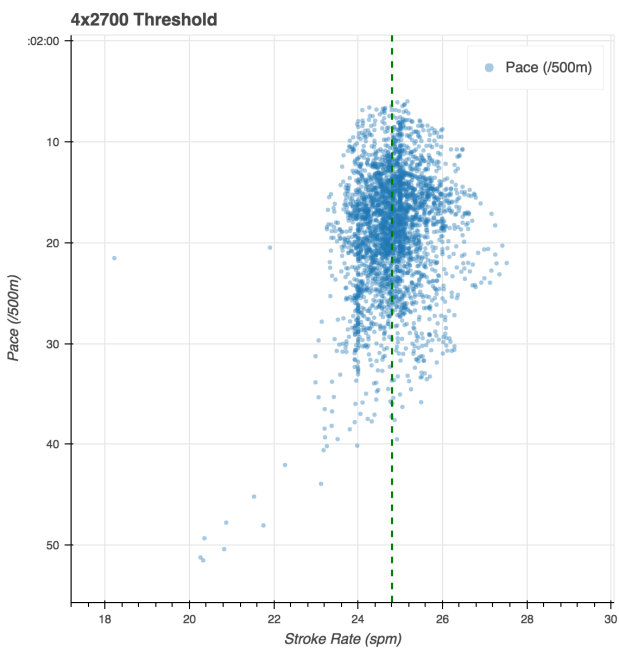
Here’s a quick look at stroke metrics.

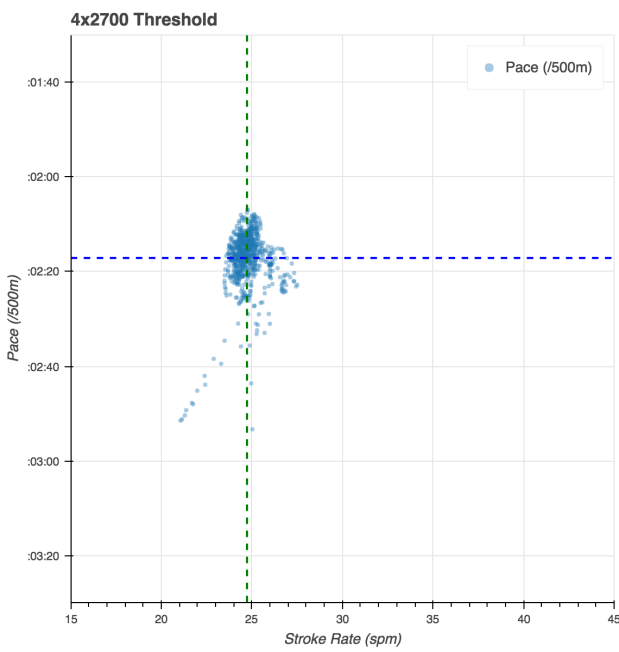
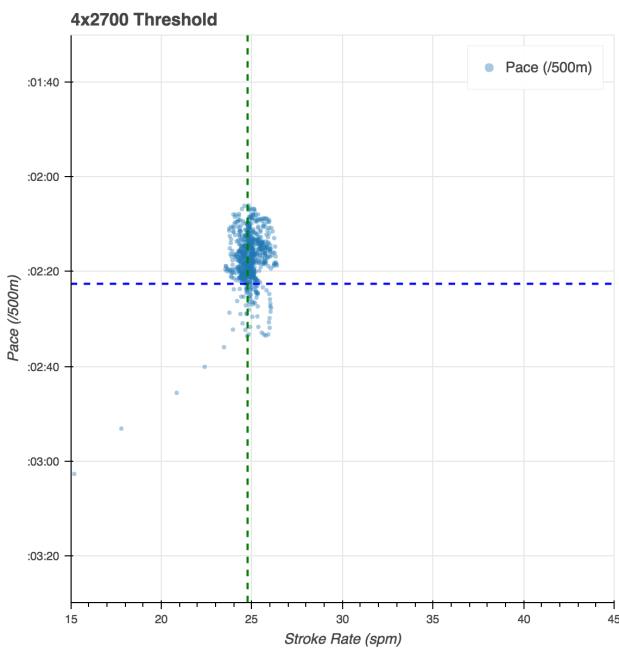
bokeh_plot-31The loop down to 20 spm at the bottom is my “bird strike”.

I did a plot of each interval to see if I could see the effect of the light headwind.  The left column is against the headwind, the right column is with the wind.

Now I am off to San Jose and LA for the week.  I will probably stick to cross training at hotel gyms for this trip.  Maybe try to do a couple of strength sessions.

Sunday: Easy 4 x 20′ L4

I like late afternoon workouts.  I seem to be much better.

Today, I started around 4:30 at home after we returned from Cape Cod.

Plan:

  • 4×20′
  • L4 format
  • power target: 10W x spm
  • Slow start to warmup
  • HR limit: 155 (never got even close to that)
  • Lactate test at the end

Completely routine until about 12 minutes to go from  the end.  My phone rang, and the number that came up was my Dad.  I thought that I would call him back as soon as I finished.  But as soon as it stopped ringing, he called again. Now I was worried, so I stopped and picked up.  No emergency, thank goodness.  Then I picked up where I left off and finished.

#-|SDist|-Split-|-SPace-|SPM-|AvgHR|MaxHR|DPS-
01|02393|10:00.0|02:05.4|17.3|126.8|136.0|13.8
02|02442|10:00.0|02:02.8|18.6|133.0|136.0|13.2
03|02448|10:00.0|02:02.5|18.8|133.4|139.0|13.0
04|02456|10:00.0|02:02.1|18.9|134.3|138.0|13.0
06|02464|10:00.0|02:01.8|18.9|134.2|138.0|13.1
07|02139|08:42.0|02:02.0|19.0|131.9|138.0|12.9
08|02262|09:09.7|02:01.5|18.9|130.8|137.0|13.0

I tested lactate when I finished….1.2mmol/l

Last time I did this workout, it was over 2.


Saturday: Bumpy 14km Open Water Row

Down in Wellfleet.  I saw that the weather forecast looked good.  Sunny, calm, but a bit chilly (in the mid 40s).  I decided to go for a last Open Water row of the season.

The wind forecast proved to be wrong.  Right before I launched, it felt like the wind was freshening and it definitely was kicking up some waves.  Here’s the weather data from the station on my house.

Screen Shot 2016-11-05 at 1.52.20 PM.png

I launched at 11:07, according to RIM, and on top of my house it was blowing nearly 20mph then.  It didn’t feel like it was blowing quite as hard as that.  I think the fact that my wind sensor is about 80 feet above sea level means that it is catching a bit more wind than I was seeing on the water.  It was still pretty breezy though.

I didn’t check before I set out, but the water temperature was 55F.  When the air temp is in the 40s, this actually doesn’t feel too bad.  And for those safety sticklers, I passed the “100 degree rule” by a degree.  46F (air) + 55F (water) = 101!  But I think this will be it for open water rowing this year.  The margin for error is pretty slim at these temperatures.

Since it was cold out, I brought a towel and socks.  After I launched from the beach, I dried my feet and put on the nice dry socks.  That lasted about 2 minutes before the waves came crashing into the cockpit and soaked my feet.  The waves kept building and I decided to head pretty much straight up wind to get across the harbor over to the long sand spit on the far side, where I figure the water would be a lot flatter.

Rowing into the waves was slow, but not hard.  There is a regular pattern to the waves and you can get used to rowing in time time with them.  The key thing is to be very deliberate about placing the blades at the catch, and then load up the drive gradually, since there is a good chance that one blade or the other will miss water due to the waves.  If you have a habit of rowing in, this would sure help cure it.

I made it about 1500m before a wave managed to fool my phone into thinking that I was doing a whole lot of screen touching.  Over about 500m of rowing, the splashing did the following:

  • Went to the RIM setup screen
  • quit out of RIM
  • popped back to the home screen
  • started up Spotify
  • picked a playlist
  • and, I swear to God, pushed play.

As I approached the spit, the chop subsided.  I was still a couple hundred meters off shore, but when I looked over my shoulder, I saw a couple of big rocks poking up maybe 50 meters ahead.  I decided it was probably a good time to turn north and row along the lee shore of the spit.  I stopped briefly and stopped the music, fired up Wahoo fitness.  I decided to do that because I know that it works in background with the screen off.  So once it was started, I turned off the screen and just rowed by feel.  It was pretty enjoyable rowing unplugged like that.  Even in the lee of the spit, there was still a bit of chop and it really was trying to push my bow around when I was rowing north.  I needed to maintain a lot more pressure on my starboard oar the way along.

You can see a couple of sharpish turns as I approached the north end of the bay.  The first was when I saw the bottom rapidly shoaling on me as I approach the sand bar at the north end of the spit. I turned to the northeast to get back to deeper water.  Then you can see the unintentional turn towards the northwest which was induced by the wind and chop.  I finally noticed what was going on and turned east toward Wellfleet inner harbor.

As I rowed along, I again noticed the water shoaling under me.  You can see the area on the map, a little sandbar right after my turn to the east.  It got shallow enough that I touched bottom with one of my oars.  After that, I paddled along and the waves got a bigger as I got further from the spit.  I was rowing with the waves and it was kind of fun when I could time my stroke to catch a wave to surf down the front of (more on that later).

I continued past the wellfleet breakwater into the inner harbor and rowed all the way to the end of the town pier, when I spun.  Rowing with the wind, I was starting to feel a bit warm with all my layers and with a lack of splashing and spray.  That changed as soon as I turned back toward the west and started rowing into the wind.  The boat took a lot more effort to move, and the wind felt pretty strong and cold.  I wasn’t feeling overly warm anymore.  At that point I really appreciated the fantastic JL shell that I was wearing.

Once I cleared the end of the breakwater, I needed to turn south to head home.  This proved to be a significant challenge.  Going south meant that I had the northwest wind and waves coming at a angle to my stern.  Along this section the waves built to over 12″.  Now, I know that this does not sound all that impressive, but when the freeboard of the boat is less than 4″ and the oarlocks are about 8 inches above the water, it means that there is lot of water above the top of the boat, and maintaining control of the oars requires a bit of concentrated effort.  Also, since the waves are at an angle, you need to have vastly different handle heights at the catch to make sure that your blades are actually in the water.

The result of this was that I actually worked less hard in the section and rowed pretty slowly.  I continued south past my house to the beach where I launched and then turned for a last run straight downwind to the beach.  This was a blast!  The waves were over a foot, and now they were right on my stern.  I could get myself lined up and surf down the faces of the waves.  Over 5 feet of stern was completely submerged, and when I surged over the crest of a wave, my backstays would be slashing through the water sending spray all over.  The cockpit would fill with water.  The fun bit was trying to keep my stern to the waves, because they were trying to turn me broadside at the end of each of these surfs.  This kind of rowing bears no resemblance at all to flat water rowing.  This was all about timing your stroke to get you on the face of the wave and control the boat well enough that you can put in a single powerful stroke at the right time.  Honestly, the last 3 minutes of this section made the difficulties of the prior 30 minutes totally worthwhile.

screen-shot-2016-11-05-at-1-57-43-pm

One fun thing to point out on the map.  See the three little intervals at the very end.  That’s me carrying my oars to the car, then going back to the beach, then carrying my boat to the car over the dune.  I didn’t stop the wahoo app until I was in the car and had the phone out of it’s waterproof case.

Also notice the 2000m gap at the beginning.  The first path to the west is the TCX file from RIM.  It stops when the ocean started screwing around with my phone.  The line starts again after I got the wahoo fitness app running, and started to row north along the spit.

This is the RIM data for the row across to the spit.  I estimate another 2000m basically just like that is missing.

And here’s the HR and pace data for the rest of the row.  Notice the extreme difference in pace between rowing with a cross wind on flat-ish water (0 to 5000m) and rowing with a cross wind and a pretty good chop (5000m to 9000m).

From 9000m to about 10,400m was the worst wave action and I was struggling to get good strokes in.  You can see how my heart rate is dropping in this section.  I was really just trying to keep the boat on course and pick my way through the waves.  Then finally after 10,400, that was where I turned downwind and surfed to the beach.  Still not fast, but a hell of a lot of fun!

So, when you put it all together, you get

RIM:   1526m, 11:30


Guess: 2000m, 11:00

Wahoo: 10645m, 1:06:00

Total: 14171m, 1:28:30

Tomorrow:  4 x 20′ or rest day, depending when we get home.