Head Racing Training Plan – 2016

Edit: Updated with some reflections on current fitness

With the Cromwell Cup behind me, it’s time to take stock and figure out how to best prepare for head racing season.  So here goes.

  • I did not have a good training plan for the spring.  With work demands, and the damaged boat, I ended up winging it.  This took away my ability to measure and adjust.  Even with my travel schedule, I need a plan.  I will have to be flexible, but try to hit the basic quantity of sessions.
  • It’s obvious from the pictures of the race that I am heavier this year than last, probably at least 10 pounds.  I need to start weighing myself and managing my calorie intake again.  I would like to be doing head races at 185 pounds.  This is a challenge with restaurant meals and work related social events, but I think with a weight target in mind, I should be able to get this done.
  • I have seen over and over again that I make good progress when my endurance sessions are longer than 60 minutes and I do not when they are shorter.  I go backward if I try to substitute higher intensity shorter sessions for long ones in the right HR zone.
  • My heart was not really in it for sprint racing.  I was dreading the intense sessions and opting for shorter intervals, and lower stroke rates.  I am not sure if I really want to do much sprint racing in the future, but that is not a decision for now.  What I do need to do is to make sure that I am enjoying what I am doing.  If things are going well, then you face hard sessions with determination and feel a lot of satisfaction when you hit your goals.  Not having enough consistency in training makes it harder to set good goals and makes it much more likely to over-reach and fail in these sessions.

So putting that together in a plan for the fall.  First, I am motivated.  I am excited for head racing and excited to do some long ocean rows.  That’s the most important thing.  I am going to be facing familiar competitors in these races, so I will be able to measure my progress compared to last season.  That should provide a ton of motivation.  Second, I think I can allocate time to do the longer sessions, but I’ll adjust as necessary.  I think the idea of getting good long sessions in on Sundays will be beneficial.  As for diet, it’s all about having a concrete goal and holding myself to it.  As soon as I get home from this trip, I’ll start weigh ins.  So, with an improved attitude, here’s the plan for the fall.

Last year, I defined my first training plan focused on head races.  You can see it here.  It was a progressive plan, like The Pete Plan, or the Wolverine Plan, but focused on improving performance for head race length events.  Overall, the plan worked great.  With the exception of the Textile River Regatta, which was marred by awful weather and lousy water, it was a really good racing season.  No injuries, no over training, and my best performances.

After last year’s head racing season, I embarked on my first experiment with periodization.  I set up 3 mesocycles.  First was a block of endurance training, then into long intervals, then finally into short intervals.  This went great through the first 2 mesocycles, and I was able to set some PRs at long distance events.  But it kind of fell apart in the short interval section due to work related travel and life just generally getting in the way.

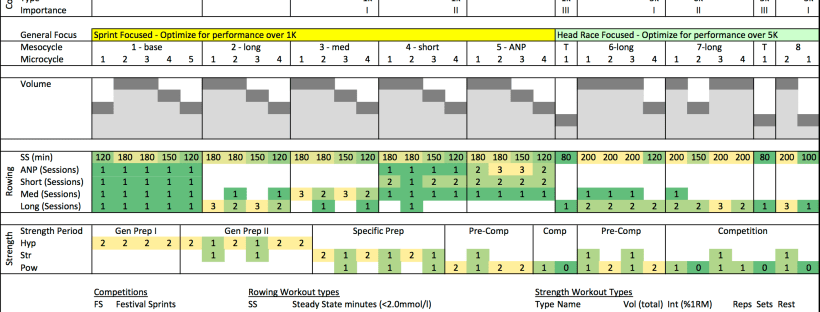
I’m thinking of combining these two plans for this fall season. I have a bunch of races that I would like to do.  The first event is on 17 September.  The last in 5 November.  I would like peak around the beginning of October and hold that peak through October.  So, between now and the beginning of October, I have 12 weeks.   I think I will break it up into two blocks.  The first block will be 7 weeks long and focus on endurance training.

Endurance Block

  • 6 sessions weekly
    • 2 steady state or technique sessions HR capped at 150, or <2.0 mmol/l lactate
    • 1 long and easy erg session at least 2 hours.
    • 3 hard distance sessions (30 to 60 min continuous or >10′ intervals with very short rests)

This will be followed by a block that will last through the rest of the season that irrors what I did last year.  This will keep the long steady state sessions, but change the high intensity sessions.

Head Race Prep Block

  • 6 Sessions weekly
    • 2 steady state or technique sessions HR capped at 150, or <2.0 mmol/l lactate
    • 1 long and easy erg session at least 2 hours.
    • 1 short rest interval session.  This is high rep, short duration intervals with short rests.  Designed to be executed at head race pace or slightly faster, these will work on technique and lactate tolerance
    • 1 long interval session.  Basically WP L2 sessions.  These are to be done at head race pace and include distances from 1500m to 3000m and usually 5 minute rests.
    • 1 head race simulation per week.  5 to 6K as fast as possible, and rate between 28 and 30.  These work on aerobic fitness, lactate tolerance and mental toughness.

I am not planning any big tapers in this plan, just a short one before the HOCR (if I get in through the lottery).

The plan is subject to change based mainly on work travel and work load.  Depending on my schedule in the fall, I might decide to skip one or more of the races.  The main thing I want to do is to have a basic plan down so I’m not inventing it as I go along.

Date Day Workout Type mode Planned Workout Notes
Meso Cycle #1 – Endurance
7/11/16 Mon Rest  rest Travel
7/12/16 Tue Hard Distance erg 60′ @ 1:57 Travel
7/13/16 Wed Steady State erg 4 x 20′ / 1′ (hr cap at 150) Travel
7/14/16 Thu Hard Distance erg 60′ @ 1:57 Travel
7/15/16 Fri Technique UT2/UT1 otw Bungee Row first half, Steady state r20 second half
7/16/16 Sat Hard Distance otw 2 x 5.5K r26
7/17/16 Sun Technique UT2/UT1 otw Square Blades / Slow Roll Up / r20 2 minutes each, repeated
7/18/16 Mon Rest  rest
7/19/16 Tue Hard Distance otw 4 x 2900 / 1′ rest r24 (HR limit 170)
7/20/16 Wed Steady State otw 4 x 2900 / 1′ rest r20 (HR limit 150)
7/21/16 Thu Hard Distance otw 4 x 2900 / 1′ rest r24 (HR limit 170)
7/22/16 Fri Technique UT2/UT1 otw Bungee Row first half, Steady state r20 second half
7/23/16 Sat Hard Distance otw 4 x 2900 / 1′ rest r24 (HR limit 170) Travel
7/24/16 Sun Rest  rest Travel
7/25/16 Mon Cross Training (UT) xt 4 x 20′ fitness center Travel
7/26/16 Tue Cross Training (TR) xt 10K run Travel
7/27/16 Wed Cross Training (UT) xt 4 x 20′ fitness center Travel
7/28/16 Thu Cross Training (TR) xt 10K run Travel
7/29/16 Fri Cross Training (UT) xt 4 x 20′ fitness center Travel
7/30/16 Sat Technique UT2/UT1 otw 2 x 5.5K r26
7/31/16 Sun long and easy erg 4 x 30′ / 1.5′ rest (lactate)
8/1/16 Mon Rest  rest
8/2/16 Tue Hard Distance otw 4 x 2900 / 1′ rest r24 (HR limit 170)
8/3/16 Wed Steady State otw 4 x 2900 / 1′ rest r20 (HR limit 150)
8/4/16 Thu Hard Distance otw 4 x 2900 / 1′ rest r24 (HR limit 170)
8/5/16 Fri Technique UT2/UT1 otw Square Blades / Slow Roll Up / r20 2 minutes each, repeated
8/6/16 Sat Hard Distance otw 2 x 5.5K r26
8/7/16 Sun long and easy erg 4 x 30′ / 1.5′ rest (lactate)
8/8/16 Mon Technique UT2/UT1  otw Bungee Row first half, Steady state r20 second half
8/9/16 Tue Hard Distance otw 4 x 2900 / 1′ rest r24 (HR limit 170)
8/10/16 Wed Steady State otw 4 x 2900 / 1′ rest r20 (HR limit 150)
8/11/16 Thu Hard Distance otw 4 x 2900 / 1′ rest r24 (HR limit 170)
8/12/16 Fri rest  rest
8/13/16 Sat long and easy owr 120′ open water (HR Cap at 150) cape
8/14/16 Sun Hard Distance owr 60′ open water (HR cap 177) cape
8/15/16 Mon long and easy owr 120′ open water (HR Cap at 150) cape
8/16/16 Tue Hard Distance owr 60′ open water (HR cap 177) cape
8/17/16 Wed long and easy owr 120′ open water (HR Cap at 150) cape
8/18/16 Thu Hard Distance owr 60′ open water (HR cap 177) cape
8/19/16 Fri long and easy owr 120′ open water (HR Cap at 150) cape
8/20/16 Sat Hard Distance owr 60′ open water (HR cap 177) cape
8/21/16 Sun rest  rest cape
8/22/16 Mon Hard Distance owr 60′ open water (HR cap 177) cape
8/23/16 Tue long and easy owr 120′ open water (HR Cap at 150) cape
8/24/16 Wed Hard Distance owr 60′ open water (HR cap 177) cape
8/25/16 Thu long and easy owr 120′ open water (HR Cap at 150) cape
8/26/16 Fri Hard Distance owr 60′ open water (HR cap 177) cape
8/27/16 Sat long and easy owr 120′ open water (HR Cap at 150) cape
8/28/16 Sun Hard Distance owr 60′ open water (HR cap 177) cape
8/29/16 Mon Rest  rest
Meso Cycle #2 – Long Intervals
8/30/16 Tue Long Intervals otw 3000 / 2500 / 2000 5′ rest
8/31/16 Wed Steady State otw 4 x 2900 / 1′ rest r20 (HR limit 150)
9/1/16 Thu Short Rest Intervals otw 4 x (5 x 2′ on / 30″ paddle) / 2′ rest
9/2/16 Fri Technique UT2/UT1 otw Square Blades / Slow Roll Up / r20 2 minutes each, repeated
9/3/16 Sat Hard Distance otw 5.5K r30
9/4/16 Sun long and easy erg 4 x 30′ / 1.5′ rest (lactate)
9/5/16 Mon Rest
9/6/16 Tue Long Intervals otw 5 x 2000 / 5′ rest r28
9/7/16 Wed Steady State otw 4 x 2900 / 1′ rest r20 (HR limit 150)
9/8/16 Thu Short Rest Intervals otw 5 x 20@32/10 off / 5 x 20@34/15 off / 5 x 20@36/20 off, 8′ between sets
9/9/16 Fri Technique UT2/UT1 otw Bungee Row first half, Steady state r20 second half
9/10/16 Sat Hard Distance otw 5.5K r30
9/11/16 Sun long and easy erg 4 x 30′ / 1.5′ rest (lactate)
9/12/16 Mon Rest
9/13/16 Tue Long Intervals otw 4 x 2500 / 5′ rest r24
9/14/16 Wed Steady State otw 4 x 2900 / 1′ rest r20 (HR limit 150)
9/15/16 Thu Short Rest Intervals otw 4 x (3 x 3′ on / 1′ paddle) / 2′ rest
9/16/16 Fri warmup only erg warm up only
9/17/16 Sat CRI Fall Classic race
9/18/16 Sun long and easy erg 4 x 30′ / 1.5′ rest (lactate)
9/19/16 Mon Rest
9/20/16 Tue Long Intervals otw 5 x 1500 / 5′ rest r26
9/21/16 Wed Steady State otw 4 x 2900 / 1′ rest r20 (HR limit 150)
9/22/16 Thu Short Rest Intervals otw 4 x (5 x 2′ on / 30″ paddle) / 2′ rest
9/23/16 Fri Steady State otw 4 x 2900 / 1′ rest r20 (HR limit 150)
9/24/16 Sat Hard Distance otw 5.5K r30
9/25/16 Sun long and easy erg 4 x 30′ / 1.5′ rest (lactate)
9/26/16 Mon Rest
9/27/16 Tue Long Intervals otw 3000 / 2500 / 2000 5′ rest
9/28/16 Wed Steady State otw 4 x 2900 / 1′ rest r20 (HR limit 150)
9/29/16 Thu Short Rest Intervals otw 5 x 20@32/10 off / 5 x 20@34/15 off / 5 x 20@36/20 off, 8′ between sets
9/30/16 Fri Steady State otw 4 x 2900 / 1′ rest r20 (HR limit 150)
10/1/16 Sat warmup only erg warm up only
10/2/16 Sun Textile  race
10/3/16 Mon rest
10/4/16 Tue Long Intervals otw 5 x 2000 / 5′ rest r28
10/5/16 Wed Steady State otw 4 x 3000 / 1′ rest r20 (HR limit at 80% HRR)
10/6/16 Thu Short Rest Intervals otw 12 x 500 / 1’30” rest (sr 22,24,26,28,30,32,32,30,28,26,24,22)
10/7/16 Fri Technique UT2/UT1 otw Bungee Row first half, Steady state r20 second half
10/8/16 Sat warmup only  erg warm up only
10/9/16 Sun Snake Race  race
10/10/16 Mon rest  rest
10/11/16 Tue Long Intervals otw 4 x 2500 / 5′ rest r24
10/12/16 Wed Steady State otw 4 x 3000 / 1′ rest r20 (HR limit at 80% HRR)
10/13/16 Thu Short Rest Intervals otw 4 x (3 x 3′ on / 1′ paddle) / 2′ rest
10/14/16 Fri Steady State otw Square Blades / Slow Roll Up / r20 2 minutes each, repeated
10/15/16 Sat Hard Distance otw 5.5K r30
10/16/16 Sun long and easy erg 4 x 30′ / 1.5′ rest (lactate)
10/17/16 Mon Rest  rest
10/18/16 Tue taper otw 4 x 500
10/19/16 Wed taper otw 3 x 500
10/20/16 Thu taper otw 2 x 500
10/21/16 Fri taper otw row the course
10/22/16 Sat HOCR otw race
10/23/16 Sun HOCR otw race
10/24/16 Mon Rest  rest
10/25/16 Tue Long Intervals otw 5 x 1500 / 5′ rest r26
10/26/16 Wed Steady State otw 4 x 2900 / 1′ rest r20 (HR limit 150)
10/27/16 Thu Short Rest Intervals otw 4 x (5 x 2′ on / 30″ paddle) / 2′ rest
10/28/16 Fri Steady State otw 4 x 2900 / 1′ rest r20 (HR limit 150)
10/29/16 Sat Hard Distance otw 5.5K r30
10/30/16 Sun long and easy erg 4 x 30′ / 1.5′ rest (lactate)
10/31/16 Mon rest  rest
11/1/16 Tue Long Intervals otw 3000 / 2500 / 2000 5′ rest
11/2/16 Wed Steady State otw 4 x 2900 / 1′ rest r20 (HR limit 150)
11/3/16 Thu Short Rest Intervals otw 5 x 20@32/10 off / 5 x 20@34/15 off / 5 x 20@36/20 off, 8′ between sets
11/4/16 Fri Short Technique UT2 otw Bungee Row first half, Steady state r20 second half
11/5/16 Sat Merrimack Chase otw

Training Principles

It’s a rest day, I’m on a plane heading out to San Diego, and I am bored.  I’m also still trying to workout the best way to train with my work and travel schedule as crazy as it has been.

Any training plan that I devise will need to be quite flexible and simple in order to succeed.  To do that well requires a return to the principles that I have learned about successful training approaches.

Principle #1:  Decide why you are exercising or training.

It is possible to have multiple answers to this question.  In fact, the more reasons you have, the more likely you are incorporate exercise into your life on a permanent basis.  I started exercising as part of an effort to lose weight, and it worked.  I took off 50 pounds.  I also was diagnosed with high blood pressure and my family has a history of cardiac and circulatory disease, and I don’t want to die.  These are the underlying, bedrock reasons why I want to regularly exercise.  But these have been true for my entire adult life, and they were not sufficient to motivate regular exercise until I found a way to connect in to my competitive drive.  Basically, as soon I found the Concept2 online rankings, I wasn’t exercising anymore, I was training.  Specifically, I was training to row faster.  Even more specifically, I was training to row faster than other people.

Rowing on the erg led me to rowing on the water, and that opened up new challenges, both in trying to master the technique and also new ways to compete.  Not only did physical fitness matter, but so did technique, steering, strategy and experience.

Now in addition to objectives to stay healthy, I work to be a better, faster rower than I was the year before and to try to catch up with people that are faster than I am.

Principle #2: Decide how much time you have to train.

Once you do, try to stick to it.  Be brutally honest with yourself up front.  I’ve experienced how demotivating it is to plan more training than I can do and then miss sessions and lose momentum on a training plan.  It would have been much better to set my sights lower.

Principle #3: Set specific a objective and use it to guide your training.

I choose a specific race in the future.  Right now, it is the Cromwell Cup, a 1000m sprint in a few weeks.  After that it will be the Head of the Charles, which is a 5K head race.  You need to know what you are training for to plan out how to train.

Principle #4:  Plan your training before you go to train.

This can be at different levels of specificity.  It might be much easier to decide ahead of time the exact sessions that you will be doing for the next three months, but that only works if you have very good control of your schedule.  If you schedule is erratic, a specific day by day plan won’t work.  In that case, planning a certain mix of training for the week and shuffle it around to make sure that the highest priority sessions get done.  Right now, I am in final prep for a sprint race on July 10th, so my weekly guide is:

  • 2 or 3 sessions that include racing starts
  • 1 session a week with 500m to 1000m intervals at close to race pace
  • 1 session a week with 100m to 500m intervals at faster than race pace
  • as much volume below 2.0mmol/l lactate as I have time for

Principle #5:  Hold yourself accountable.

I find this easiest to do by training publicly.  I try to define my next day’s workout the day before and put it in my blog.  I know that very few people read it, but the fact that I’ve done that makes me feel accountable to either do what I planned or explain why I didn’t.  It is important to make the distinction between accountability and rigidness.  If I don’t follow through with the planned workout, or if I don’t hit my targets, that isn’t a failure.  I just want to be honest with myself about why I changed the plan or wasn’t able to execute it.  That way I can adjust and improve.

Principle #6:  Evaluate performance objectively.

Set quantitative goals and use performance tracking to determine if they are met.  Use past performance to set goals for future workouts.  Try to do the same thing if you are working on technique.  Either use video, or acceleration data to see if changes in technique actually occur.  My ability to remember past performance and discern if I have corrected technique problems is limited at best.

Principle #7: Seek advice, carefully evaluate it and decide if you will use it

There are many people with opinions.  Not all of them are well informed.  It is up to you to figure out what advice is credible and useful and what is not.  Try to establish the quality of the source of advice.  Try to understand the principles on which the advice is based.

Principle #8: Miles make champions

Endurance is critical to all rowing competitions longer than 500m. Building a strong aerobic base is necessary to perform well. The most important factor to building endurance is the volume of training done at low intensities.

Low Intensity Training (LIT) is defined by a blood lactate level below 2.0 mmol/l at the completion of the workout. In order to maximize the effectiveness of endurance training, blood lactate level should be greater than 1.4-1.6mmol/l at the end of the session. Lactate levels should be periodically checked and as fitness improves, LIT intensity should increase to ensure that the end work criteria of 1.4-2.0mmol/l is met.

Endurance training can be continuous or interval based, constant rate or variable rate, as long as it meets the intensity criteria. Up to 1/2 of all endurance training can done as cross training.

Lactate testing is a pain in the ass, does not provide realtime feedback and is pretty much impossible to do in a boat, so an alternative method of gauging intensity is needed. The best alternative for is to use heart monitoring and Rate of Perceived Exertion (RPE) together. By using HR in sessions where lactate is checked, a rough correlation between ending HR and lactate level can be drawn. This can be used as a limit in future workouts until another lactate test is done. The important thing to remember is that this is not a very exact thing. A little too hard or a little too easy will not have much impact on the effectiveness of the workout. The key thing is that easy workouts should be easy.

Principle #9:  If all you do is row slow, you will get good at rowing slow

High Intensity training is necessary to maximize performance at any distance from 100m to a full marathon.  There are different energy systems that are used in maximal efforts.  If these are not specifically trained, performance will suffer.  At least 2 sessions of high intensity training per week.  High Intensity Training (HIT) includes very short intervals, short intervals, long intervals, and hard distance workouts.  The key criteria of these workouts is that lactate levels well above 4.0mmol/l are achieved.  The most convenient way to measure this is to track HR and measure time above lactate threshold.

Principle #10:  You need to be able to pull hard to win races

The ability to generate high peak force on the handle is critical to achieving good speed off the line and to be able to sprint at the finish.  The more force you can exert also means that you can work at lower stroke rates with higher efficiency.  Including some kind of peak power training is useful, especially for sprint racing (1Ks, 2Ks). This can be done on the erg or in the boat with very short intervals with generous rests, or through weight training.  During sprint season, at least one session per week should include peak power training.

Principle #11:  Strength Training is useful, but not critical

This is disputable.  If you have specific strength deficits, then strength training can help with them.  Otherwise, it is mainly useful for muscle group balance and injury prevention.  Right now, I have deprioritized strength training in favor of additional endurance training within the time budget that I have set.  I know that other folks believe this should be a higher training priority.

Principle #12:  Mesocycles work, change it up.

Performance improvements will plateau after 4 to 8 weeks of training with a specific focus.  To combat this plateau, mesocycles can be used to vary the focus of training in blocks.  This can be programmed in a way to build toward a specific event and yield better results than a plan that has the same types of sessions over time.  The final mesocycle before a key event should be focus on maximize performance for the event type.

Principle #13:  The overload principle

Improvement in performance comes from the overload principle. For high intensity workouts, setting targets for pace to be slightly faster than previous results.  For low intensity workouts, increasing duration, and nudging up pace to stay in the desired lactate range over time.  Gradual overload is important.  Big steps in pace are an invitation to disaster.  Big increases in volume can lead to injury as form suffers when you are fatigued.

Principle #14:  Resting is part of training

Rest and recovery are critical to progress.  It is OK to have weeks that over load and under recovery, but these must be followed by weeks where the recovery takes place.  As a general rule taking one day of complete rest per week is vital.  By complete rest, I mean no rowing at all.  The logic behind no rowing is to reduce the risk of repetitive strain injury.  Some kind of other gentle exercise is OK as long as it isn’t long duration and isn’t intense.

Principle #15:  Get a coach

A principle I haven’t been able to follow, but is holding me back.  Real time feedback on performance, especially on technique is critical to improvement.   One Caveat, you and coach need to agree on principles.

Principle #16: Training is easier and more fun if you have training partners.

Thats the thing that I miss most by developing my own training plans.

Principle #17: Lighten up.

If you are reading this, then it is more than likely that you aren’t a professional athlete. We all have jobs, friends and family that are more important than achieving perfection in the execution of our training plans. I am all for having the grit to pound out that last 500 when your legs feel like jelly. I am all for dragging my ass out of bed at 5:15 to get in a training session before work, but if life gets in the way, that’s OK. There are more important things in life than rowing a long skinny boat faster.

Principle #18: Be resilient.

This one goes along with the one before. If sports are not your number one priority, then it is likely that your life will sometime conspire to make you miss your training objectives. When it happens, and it will, just pick yourself up, honestly assess where you fitness is and make a new plan. One of the best things about keeping good training records is that you can look to see how much training you’ve missed and spot trends like regularly missing training volume plans. You can use this to make your plans more realistic or change your priorities or schedule.

Principle #19: Be skeptical.

The world is full of people that are full of crap. They use the internet to spread the fertilizer. There is a lot of good advice out there too. It’s hard to know what is real and what isn’t. Here are my thoughts.
– Research is limited and flawed, but at least multiple people with lots of training in the field have looked at and critiqued it. Its up to you to figure out if it actually applies to your situation.
– Beware of plans for Olympians: I think the most important factor in race performance is total training volume. Elite athletes spend 40 hours a week training. I spend less than 10. That difference is huge and limits the applicability of anything done at an elite level.
– Beware of the “It worked for me” folks. That means you should beware of me too. The critical test is whether or not the advocate can answer the question, “Why does this work?” If it is not based on testable principles or there are not good answers to reasonable questions, then proceed with some caution.
– Beware of facts not in evidence. If someone says that they improved their 2k score by 20 seconds by doing two high intensity erg sessions a week, try to find out what else they are doing. For all you know, they might be running 10 miles every morning. If you just do the erg part, you will probably not see the same results.

Re-evaluating objectives

Well, I started this blog post about 5 times and couldn’t even figure out what title to give it.  The bottom line is that I have to change how much time I devote to training, and thinking about training.  The good news is that I was promoted at work and my new job is an exciting new challenge.  But along with this new challenge, I think that I need to focus my energy on succeeding in my new role to an extent that I have to budget my time more carefully.

One of the challenges of my personality is that I am not one for moderation.  If I row, I want to achieve at the highest level that my physiology will allow.  Working out for the sake of heath and fitness bores me to tears.  I really live for competition and half the fun is trying to figure out how to get better.  I’m genuinely struggling with the idea of setting limits on training and then “doing my best” at competition.  It sounds dangerously like phoning it in.

Obviously this is something that I am going to have to figure out for myself.

The first decision I need to make is whether or not to compete at the CRASH-Bs this Sunday.  My race prep has been hampered by the fact that 2 of the last 4 weeks I have been traveling for business and last week, I was on vacation in Aruba (I know, life is tough, isn’t it).  But now I have 5 days to competition and I’m sure I will struggle to post a respectable time.  Part of me thinks using this week to determine a doable pace and going to the race is the best idea.  Part of me wants to just blow it off since I’m pretty sure I will be no where near PB territory and it might be my slowest race ever.

Beyond this weekend, I think I need to come up with a simple, periodized approach that limits weekday workouts to 60 minutes of gym (or water) time.  I also need to find a more efficient way to log and analyze training results.  Finally, I think I need to limit my OTW racing to a couple events per year.

It will be interesting to find the balance that keeps me challenged on the erg and in the boat, and manages the time commitment more closely.

CRASH-B Training Plan

Objective:  Row a 6:34 2K at the CRASH-B sprints on February 28, 2016

Plan Principles:  The plan is based on principles from The Science Of Winning, by Jan Olbrecht, and a lecture by Stephen Seiler.

  1. The plan is based on a 80/20 training volume split between endurance training and High Intensity Training (HIT).  This translates into 3 HIT sessions per week and 3 longer endurance sessions, plus second endurance sessions as schedule and time permits.
  2. Endurance training is defined as training at or below 2.0 mmol/l lactate.  This will be measured at least once a week after 60 minutes of endurance rowing.  In general this will be steady state rowing between 18 and 22 SPM, but low intensity Wolverine sessions, fartlek sessions, and other variations will be used to try to keep it from getting too boring.
  3. The three and a half month training period prior to the Crash-Bs will be divided up into 3 major mesocycles.
    1. Mesocycle 1 will focus on hard distance rowing.  The three HIT sessions per week will be basically time trial format with total rowing time between 60 and 80 minutes.  Target initial power will be 95% of LT power.  Basically, a few seconds off current best time for the distances prescribed.  These are very much like Wolverine Plan L3 sessions.
    2. Mesocycle 2 will focus on long intervals.  The three HIT sessions per week will have different long interval format workouts for a total rowing time between 30 and 40 minutes.  Roughly 5 minute rests.  Initial target power will be 105% of LT power.  These are basically Wolverine L2 sessions.
    3. Mesocycle 3 will focus on short sprint and peak power training.  The short sprints are at 115% of LT power for a total rowing time of 12 to 20 minutes.  Nice long rests.These are basically L1 sessions.  The peak power training will be tacked onto the end of shortened endurance sessions twice a week.  These will follow the format described here.  Basically a series of very short, very intense sprints.
  4. I will try to do a time trial, or enter a smaller erg race about a month prior to the CRASH-Bs.  I’ll do a short taper for that.
  5. The week before the CRASH-Bs, I will do a longer taper.
  6. After the CRASH-Bs, I will repeat the fitness test battery that I’m doing now.
  7. I will track lactate for endurance rows and HR on all pieces, but focus on incremental improvement to power for the training pieces during each of the blocks.

Of course this will change based on travel and life, but this is the basic template.

Month Day Date Mesocycle AM Workout PM Workout
November M 11/16/15 Base building Rest day
T 11/17/15 4 x 20′ UT2 / UT1 30′ UT2
W 11/18/15 4 x 20′ UT2 / UT1
T 11/19/15 4 x 20′ UT2 / UT1 30′ UT2
F 11/20/15 4 x 20′ UT2 / UT1
S 11/21/15 4 x 20′ UT2 / UT1 30′ UT2
S 11/22/15 4 x 20′ UT2 / UT1
M 11/23/15 Hard Distance
95% LT Power
Rest day
T 11/24/15 4 x 15’/2′ 30′ UT2
W 11/25/15 4 x 20’/1′
T 11/26/15 60′ 30′ UT2
F 11/27/15 4 x 20’/1′
S 11/28/15 HM 30′ UT2
S 11/29/15 4 x 20’/1′
M 11/30/15 Rest day
December T 12/1/15 4 x 5K / 2′ 30′ UT2
W 12/2/15 4 x 20’/1′
T 12/3/15 2 x 30′ / 5′ 30′ UT2
F 12/4/15 4 x 20’/1′
S 12/5/15 HM 30′ UT2
S 12/6/15 4 x 20’/1′
M 12/7/15 Rest day
T 12/8/15 15 x 3′ / 1′ 30′ UT2
W 12/9/15 4 x 20’/1′
T 12/10/15 10K 30′ UT2
F 12/11/15 4 x 20’/1′
S 12/12/15 HM 30′ UT2
S 12/13/15 4 x 20’/1′
M 12/14/15 Rest day
T 12/15/15 30′ 30′ UT2
W 12/16/15 4 x 20’/1′
T 12/17/15 60′ 30′ UT2
F 12/18/15 4 x 20’/1′
S 12/19/15 HM 30′ UT2
S 12/20/15 4 x 20’/1′
M 12/21/15 Long Intervals
105% LT Power
Rest day
T 12/22/15 Waterfall 30′ UT2
W 12/23/15 4 x 20’/1′
T 12/24/15 4 x 2K 30′ UT2
F 12/25/15 4 x 20’/1′
S 12/26/15 5 x 1500 30′ UT2
S 12/27/15 4 x 20’/1′
M 12/28/15 Rest day
T 12/29/15 3 x 10′ 30′ UT2
W 12/30/15 4 x 20’/1′
T 12/31/15 4 x 8′ 30′ UT2
January F 1/1/16 4 x 20’/1′
S 1/2/16 5 x 6′ 30′ UT2
S 1/3/16 4 x 20’/1′
M 1/4/16 Rest day
T 1/5/16 Waterfall 30′ UT2
W 1/6/16 4 x 20’/1′
T 1/7/16 4 x 2K 30′ UT2
F 1/8/16 4 x 20’/1′
S 1/9/16 6K hard 30′ UT2
S 1/10/16 4 x 20’/1′
M 1/11/16 Rest day
T 1/12/16 3 x 10′ 30′ UT2
W 1/13/16 4 x 20’/1′
T 1/14/16 4 x 8′ 30′ UT2
F 1/15/16 4 x 20’/1′
S 1/16/16 5k hard 30′ UT2
S 1/17/16 4 x 20’/1′
M 1/18/16 Short Int / Pk Power
115% LT Power
Rest day
T 1/19/16 4 x 1000 30′ UT2
W 1/20/16 3 x 20′ / 1′ plus PP
T 1/21/16 6 x 750 30′ UT2
F 1/22/16 3 x 20′ / 1′ plus PP
S 1/23/16 8 x 500 30′ UT2
S 1/24/16 4 x 20’/1′
M 1/25/16 Rest day
T 1/26/16 4 x 1000 30′ UT2
W 1/27/16 4 x 500
T 1/28/16 3 x 500
F 1/29/16 warm up only
S 1/30/16 Likely date for Cranberry Crunch
S 1/31/16 4 x 20’/1′
February M 2/1/16 Rest day
T 2/2/16 4 x 1000 30′ UT2
W 2/3/16 3 x 20′ / 1′ plus PP
T 2/4/16 6 x 750 30′ UT2
F 2/5/16 3 x 20′ / 1′ plus PP
S 2/6/16 8 x 500 30′ UT2
S 2/7/16 4 x 20’/1′
M 2/8/16 Rest day
T 2/9/16 4 x 1000 30′ UT2
W 2/10/16 3 x 20′ / 1′ plus PP
T 2/11/16 6 x 750 30′ UT2
F 2/12/16 3 x 20′ / 1′ plus PP
S 2/13/16 8 x 500 30′ UT2
S 2/14/16 4 x 20’/1′
M 2/15/16 Rest day
T 2/16/16 4 x 1000 30′ UT2
W 2/17/16 3 x 20′ / 1′ plus PP
T 2/18/16 6 x 750
F 2/19/16 3 x 20′ / 1′ plus PP
S 2/20/16 8 x 500
S 2/21/16 3 x 20′ / 1′
M 2/22/16 Race Taper 4 x 1000
T 2/23/16 Rest day
W 2/24/16 4 x 500 / 4′
T 2/25/16 3 x 500 / 4′
F 2/26/16 2 x 500 / 4′
S 2/27/16 warm up only
S 2/28/16 Crash-B Sprints!
M 2/29/16 Test Week Rest day
March T 3/1/16 2-speed
W 3/2/16 Peak Power
T 3/3/16 3 x 20′ / 1′
F 3/4/16 2K
S 3/5/16 3 x 20′ / 1′
S 3/6/16 6K

End of Season Fitness Testing

The purpose of this testing period is to determine current fitness, balance of aerobic versus anaerobic capability.  The findings will be used to set priorities for my winter training plan.

My intention is to repeat this same set of tests at the beginning of each major training period to allow me to track long term trends in fitness and witness the ravages of aging quantitatively.

There are 4 specific tests.  These tests are to be done in this specific order.  Only one test will be done in a training session.  A light day of 40 minutes of steady state rowing (<2.0mmol/l lactate power) between each test day.

  1. 2- speed lactate test
  2. Anaerobic Fitness Test
  3. 2K Test
  4. 6K Test

Detailed Descriptions

  1.  2 Speed Lactate Test.

(source:  The Science of Winning, Jan Olbrecht.  Original Source:  Mader A. and H. Heck: A theory of the metabolic origin of “anaerobic threshold”. Int. J. Sports Med. 7, 45-65, 1986)

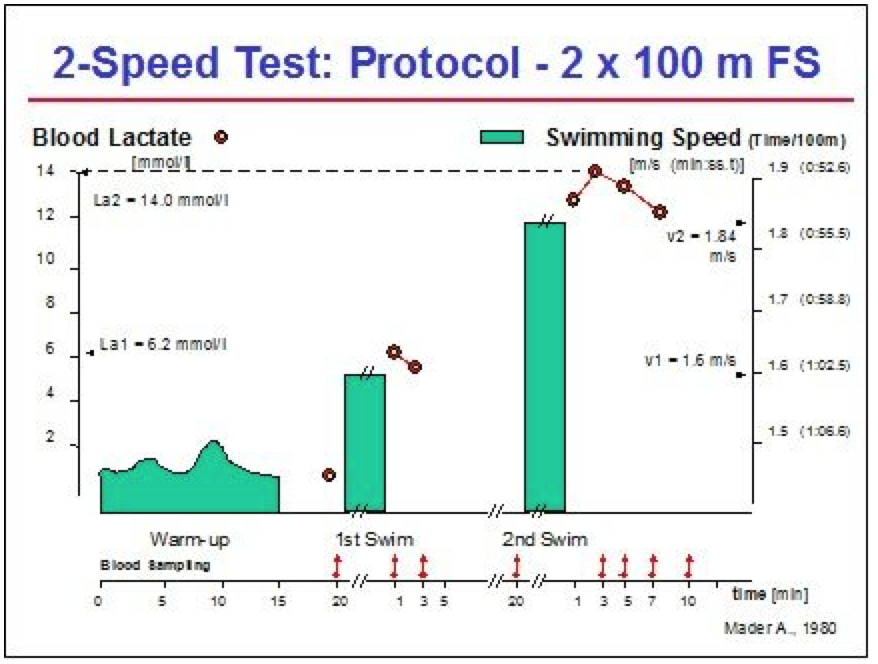
The Science of Winning is a book about training for competitive swimming.  Since spint rowing events are similar duration to longer swimming events, a lot of the training principles are almost directly applicable.  The 2 speed test is presented as a way to assess the balance of aerobic and anaerobic capability in a swimmer by completing the same test distance twice.  After a thorough warm up, the first trial is done at a submaximal pace, and then after a long rest (15 minutes, active rest) a second time as fast as the distance can be completed.  The test can be done on different distances.  In the book, it was presented with 100m, 200m and 400m distances.  For reference, the time to swim 100m is about a minute, so rowing equivalents would be 250m, 500m, and 1000m.  I believe that I will complete the test at 1000m to align better with the longer rowing competitive distances.

After each trial, a lactate reading at 1 minute and 3 minutes post exercise.  The book recommends testing at 5 min, 7 min, etc after the last trial until the lactate level starts to fall to try to get a more accurate idea of what the peak lactate level is.  Here is the graphic from the book.

Screen Shot 2015-11-09 at 10.30.09 AM

The two readings are then plotted as power versus lactate and line drawn between the two points.

Screen Shot 2015-11-09 at 10.30.31 AM

The position of the line along the x-axis provides information about aerobic fitness.  The slope of the line can be used to understand the balance of aerobic to anaerobic power.  I do not expect to get much out of the first test beyond establishing a baseline for future testing.

The thing I like about this test is that it is not as susceptible to judgement as other tests (like the Rojabo test).  Basically, since you are measuring both power and lactate, even if there is minor variation in how hard you try, the line will still give a good idea of how your fitness has changed.

So, the specific guidelines for the test:

  1.  15′ minute warmup including 5 x 10 stroke bursts at test power
  2. Trial #1:  1000m, 6K pace (~1:50)
  3. 15′ rest:  at least 10 minutes active, with lactate tests at 1′ and 3′  (record max lactate and avg power)
  4. Trial #2: 1000m 2K pace (~1:42 ish)
  5. Cool down: 10′ with lactate tests at 1′, 3′, 5′ (record max lactate and avg power)
2. Anaerobic Power Test

(Source: Rowing Faster, 2nd Ed., Chapter 6)

This is a modified version of the Wingate test.  It’s pretty simple.  Row as hard as you can for 60 seconds.  That’s it.  The key to the test is what happens in the 60 seconds.

The instructions are:

  1.  Set the erg to maximum drag factor.
  2. Setup a way to record the power for each stroke, either take a video of the monitor to review afterward, or use rowPro.
  3. Do a 10 minute steady state warmup
  4. Set the monitor for 1 minute intervals with 1 minute rest.
  5. Paddle through the first minute and the first 50 seconds of the rest.
  6. In the last 10 seconds of the rest, crank up the power so you can hit the beginning of the test period going full blast
  7. Row as hard as you can with good form.  Rate up as much as you like, as long as you are taking full strokes.  Do not pace yourself.  The objective is to pull as many watts as you can on each stroke.
  8. As you continue through the minute, your power output will begin to fade.  This is expected and is precisely what the point of the test is.
  9. After you finish, throw up in a nearby trash can, cool down and then get working on data analysis.

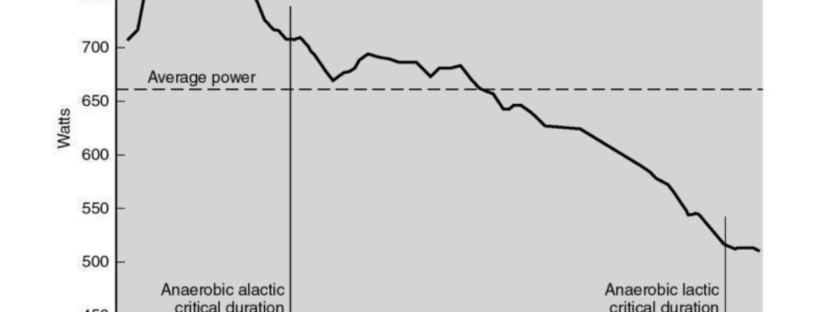
If you do it right, you end up with a graph that looks like this…

Screen Shot 2015-11-09 at 1.43.38 PM

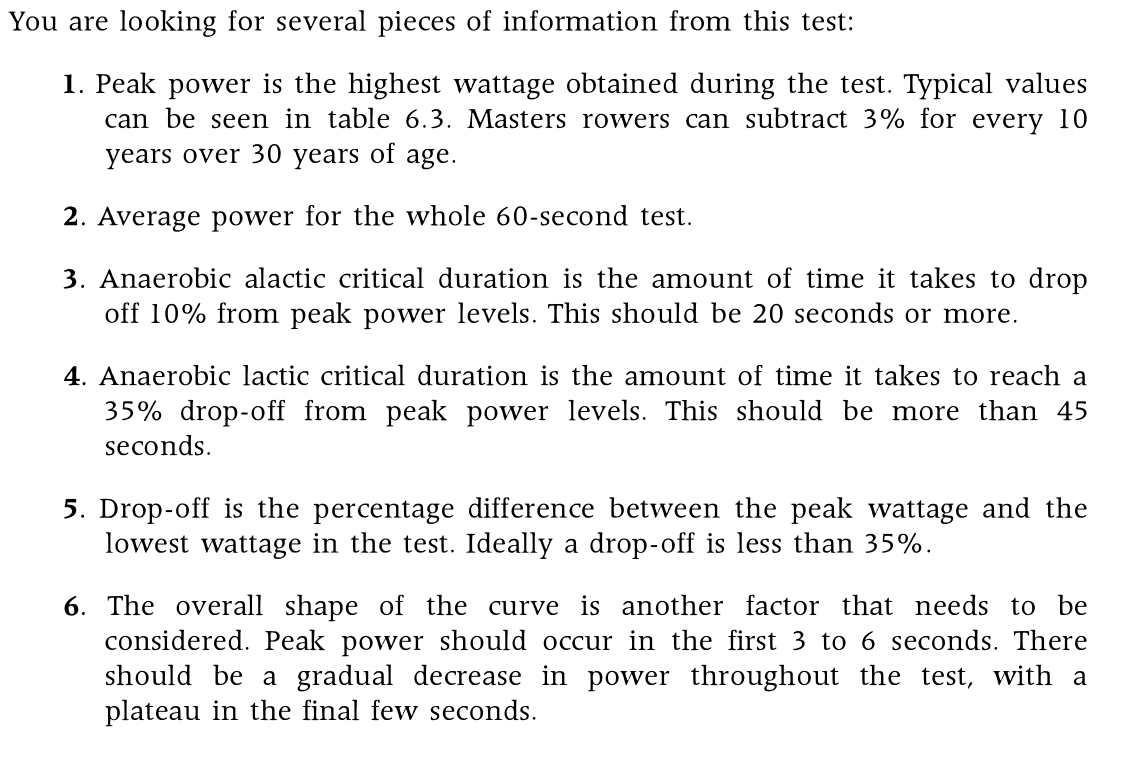
Here is what you try to get from the curve

Screen Shot 2015-11-09 at 2.12.31 PM

Here is Table 6.3

Screen Shot 2015-11-09 at 2.14.29 PM

So, for me as a heavyweight man, at 52 years of age.  The target peak power is

  • (1 – 22 * 0.3%) * 1000W = 934W (Holy smokes!  That’s a 1:12 pace.  My all time best Low Pull is 1:19.0 (710W), so I expect to fall way short of that benchmark.

As with the 2 speed test.  The main idea here is to get a baseline that I can use to compare to in the future.  Development of anaerobic power is best left to the last phase  pre-competition, unless there is a lot of strength training to be done.  So, I would likely rerun this test about a month prior to competition and then again at the beginning of the competition taper to hopefully see some improvement.

3.  2K Test

Not a lot to it.  Sit down, warm up.  Row 2K.  Record the time.  Used as a proxy for VO2Max power.

4.  6K Test

Same idea.  Used as a proxy to determine Anaerobic Threshold power

Interpreting the test results

In the same chapter of Rowing Faster, they provide the following guidelines for interpreting the test results.  All of these are in terms of power.

Screen Shot 2015-11-09 at 2.27.14 PM

If the ratios are different, then the amount of effort put into the lower areas should be increased in the training balance.

“Rowing Faster” <– Great book. Here are some thoughts on Chapter 6

I’m on a business trip and found myself without internet and had some time to kill, so I was rereading a terrific book.

Rowing Faster, by Volker Nolte

Chapter 6 in the book is by Ed McNeely who has been associated with the Canadian Rowing team and is titled “Rowing Physiology”. This single chapter is worth the price of the book in my opinion.

He provides references for the split of aerobic vs anaerobic in 1K, 2K and 5K races.

– 1k about 50/50
– 2k about 80/20 (could be up to 30%)
– 5k about 90/10

He includes the definitions and explains aerobic threshold, anaerobic threshold, and VO2Max. Then things get very interesting.

He describes a diagnostic test to measure anaerobic fitness. I think I will need to give this a try sometime when there isn’t enough suffering in my life. It is a modification of the wingate test which is usually done on a stationary bike. Here’s the procedure.
– You need a way to record the erg stroke by stroke. I think you can do this with ergdata. I know you can with rowpro. Worst case, you can set up a video camera to watch the PM.
– 10 minute warmup
– set up the PM for 1 minute work, and 1 minute rest.
– row the first minute as you did your warmup, nice and easy
– during the rest, grab a sip of water and continue to paddle lightly until there are 3-5 seconds left in the rest.
– Then crank it up. The objective is to pull as many watts as possible in every single stroke. You can use any rate as long as you are rowing full slide. Do not pace yourself. This is an all out test.

What will happen is you will get about 15 seconds in and you will begin to fade. Then you will fade some more. Then eventually, it’s all over and you can puke in the bucket you stationed next to the erg. From the stroke by stroke data you can get:
1. Peak power: Your highest wattage any any single stroke
2. Avg power for 60 seconds
3. Anaerobic Alactic Critical duration: This is how long it takes to drop off 10% from peak power.
4. Anaerobic lactic critical duration: This is how long it takes to drop off to 35% below peak power.
5. Drop off: percentage difference from peak power to lowest power

The test is most useful when used as an indicator of progress. So, a training program would use this test every 4 weeks or so to see if anaerobic performance was getting better. But just as a diagnostic, here’s what the book says.

– Peak power: There’s a table of benchmarks for men and women. For a heavyweight 52 year old rower like me, peak power should be 850-1050W
– Avg power: 680-820
– AACD: should be longer than 20 sec
– ALCD: Should be longer than 40 sec
– Drop off: Should be less than 35%

If you miss on these parameters, it might be a good idea to include more peak power and short interval work in your routines if you are focusing on 1K and 2K races.

But wait, there’s more! Then he goes on to his suggestions for the best balance of fitness variables for rowing. The variables he is talking about are:
– VO2Max
– Aerobic Threshold
– Anaerobic Threshold
– Peak Power

He suggests the following tests to determine the wattage associated with these thresholds.
– VO2Max: The dreaded 2km test
– Anaerobic threshold: 6km test
– aerobic threshold: 75 minute test
– peak power: 30 second sprint

Based on his measurements of the perfect specimens available to him, he asserts that the ideal ratios of these different paramaters are:

VO2Max to peak power: 40 to 45%
Anaerobic Threshold to VO2Max: 80 to 85%
Aerobic Threshold to VO2Max: 65 to 70%

So, he suggests that at the beginning of a training block, you do these tests over a week or so, with adequate rest between them, and then use your results to figure out if you should prioritize aerobic, anaerobic or power training. Which I think is pretty cool.

He goes on to talk about training volume, a subject that we’ve touched on in a number of threads. He is definitely in the “miles make champions” camp.

Anyway, I think that I will probably do the suite of tests at the end of the head racing season to help me figure out a training plan for indoor racing. I highly recommend the book, especially to OTW rowers. Only about a third of the book would be useful to indoor rowers, but it is a well researched and concise description of strategies to train for the unique demands of racing 2k.

2015 Head Racing Training Plan

I am planning to enter 3 or 4 head races this fall.

  • Textile River Regatta: Sunday, October 4, 6K race in Lowell
  • Quinsigmond Snake Race, October 10th or 11th, 4.5K race (Tentative)
  • Head of the Charles, October 17th or 18th, 5K race in Boston (Tentative)
  • Merrimack Chase: Saturday, November 6

Priority:

  1. HOCR
  2. Textile
  3. Merrimack
  4. Snake Race

If I don’t get an entry for the HOCR, then the Textile is my key event, so I need to plan to peak for the beginning of October and then maintain from then to the beginning of November.

The plan is focused on improving performance over a 5K to 6K race.  I have time for 6 sessions a week.  I seem to best with a polarized plan, so I am planning to do 3 lower intensity endurance sessions per week.  One hard distance piece a week (basically head race distance).  One set of long intervals (Like a WP L2 type session).

So far, this looks like the Pete Plan or the Wolverine Plan.  The difference is that I plan to substitute the short intervals (L1s in WP language) with another session focused on improving lactate clearance and tolerance.  I’m thinking that this would be an interval based session at about head race pace and rate, with short rests.  The intent here is to accumulate fatigue (and lactate) as the session goes on.  Examples of this type of workout on the erg are things like the 15×3’/1′ rest or 8x1K/2′ rest.

I like the cyclical nature of the Pete Plan, so I am planning a 4 week cycle after which the workouts repeat so I can try to measure progress.

Because of where I row, I have to limit the distance covered in each interval.  I have just about 3000 meters of river that can be rowed at full pressure.  Any turn is basically going to cost about 1 minute of rest time, so I would like to try to work within that constraint.  The one exception is that on weekend days, I can row on Lake Quinsigamond in a club boat, so that is why my hard distance days will be on weekends.

The plan is obviously going to be impacted by travel and life, but I figure having a plan and changing is better than having no plan at all.

I welcome feedback and suggestions for changes.

Date Weekday Workout Type Planned Workout
7/19/15 Sun Cross Training (Bike)
7/20/15 Mon Steady State UT1 Rate Ladder 4 x (1000 @ 18, 1000 @ 20, 500 @ 22, 250 @ 24) / 2′ rest
7/21/15 Tue Long Intervals 4 x 2500 / 5′ rest r24
7/22/15 Wed Steady State 4 x 3000 / 1′ rest r20 (HR limit at 80% HRR)
7/23/15 Thu Short Rest Intervals 4 x (3 x 3′ on / 1′ paddle) / 2′ rest
7/24/15 Fri Technique UT2/UT1 Square Blades / Slow Roll Up / r20 2 minutes each, repeated
7/25/15 Sat Hard Distance 5.5K r26
7/26/15 Sun Rest
7/27/15 Mon Cross Training (Bike) Vacation Week
7/28/15 Tue Cross training (Run)
7/29/15 Wed Cross Training (Bike)
7/30/15 Thu Cross training (Run)
7/31/15 Fri Cross Training (Bike)
8/1/15 Sat rest
8/2/15 Sun Hard Distance 5.5K r26
8/3/15 Mon Steady State UT1 Rate Ladder 4 x (1000 @ 18, 1000 @ 20, 500 @ 22, 250 @ 24) / 2′ rest
8/4/15 Tue Long Intervals 5 x 1500 / 5′ rest r26
8/5/15 Wed Steady State 4 x 3000 / 1′ rest r20 (HR limit at 80% HRR)
8/6/15 Thu Short Rest Intervals 8 x 1000 / 2′ rest
8/7/15 Fri Technique UT2/UT1 Bungee Row first half, Steady state r20 second half
8/8/15 Sat Hard Distance 5.5K r26
8/9/15 Sun Rest
8/10/15 Mon Steady State UT1 Rate Ladder 4 x (1000 @ 18, 1000 @ 20, 500 @ 22, 250 @ 24) / 2′ rest
8/11/15 Tue Long Intervals 3000 / 2500 / 2000 5′ rest
8/12/15 Wed Steady State 4 x 3000 / 1′ rest r20 (HR limit at 80% HRR)
8/13/15 Thu Short Rest Intervals 4 x (5 x 2′ on / 30″ paddle) / 2′ rest
8/14/15 Fri Technique UT2/UT1 Square Blades / Slow Roll Up / r20 2 minutes each, repeated
8/15/15 Sat Hard Distance 5.5K r26
8/16/15 Sun Rest
8/17/15 Mon Steady State UT1 Rate Ladder 4 x (1000 @ 18, 1000 @ 20, 500 @ 22, 250 @ 24) / 2′ rest
8/18/15 Tue Long Intervals 5 x 2000 / 5′ rest r28
8/19/15 Wed Steady State 4 x 3000 / 1′ rest r20 (HR limit at 80% HRR)
8/20/15 Thu Short Rest Intervals 5 x 20@32/10 off / 5 x 20@34/15 off / 5 x 20@36/20 off, 8′ between sets
8/21/15 Fri Technique UT2/UT1 Bungee Row first half, Steady state r20 second half
8/22/15 Sat Hard Distance 5.5K r28
8/23/15 Sun Rest
8/24/15 Mon Steady State UT1 Rate Ladder 4 x (1000 @ 18, 1000 @ 20, 500 @ 22, 250 @ 24) / 2′ rest
8/25/15 Tue Long Intervals 4 x 2500 / 5′ rest r24
8/26/15 Wed Steady State 4 x 3000 / 1′ rest r20 (HR limit at 80% HRR)
8/27/15 Thu Short Rest Intervals 4 x (3 x 3′ on / 1′ paddle) / 2′ rest
8/28/15 Fri Technique UT2/UT1 Square Blades / Slow Roll Up / r20 2 minutes each, repeated
8/29/15 Sat Hard Distance 5.5K r28
8/30/15 Sun Rest
8/31/15 Mon Steady State UT1 Rate Ladder 4 x (1000 @ 18, 1000 @ 20, 500 @ 22, 250 @ 24) / 2′ rest
9/1/15 Tue Long Intervals 5 x 1500 / 5′ rest r26
9/2/15 Wed Steady State 4 x 3000 / 1′ rest r20 (HR limit at 80% HRR)
9/3/15 Thu Short Rest Intervals 8 x 1000 / 2′ rest
9/4/15 Fri Technique UT2/UT1 Bungee Row first half, Steady state r20 second half
9/5/15 Sat Hard Distance 5.5K r28
9/6/15 Sun Rest
9/7/15 Mon Steady State UT1 Rate Ladder 4 x (1000 @ 18, 1000 @ 20, 500 @ 22, 250 @ 24) / 2′ rest
9/8/15 Tue Long Intervals 3000 / 2500 / 2000 5′ rest
9/9/15 Wed Steady State 4 x 3000 / 1′ rest r20 (HR limit at 80% HRR)
9/10/15 Thu Short Rest Intervals 4 x (5 x 2′ on / 30″ paddle) / 2′ rest
9/11/15 Fri Technique UT2/UT1 Square Blades / Slow Roll Up / r20 2 minutes each, repeated
9/12/15 Sat Hard Distance 5.5K r30
9/13/15 Sun Rest
9/14/15 Mon Steady State UT1 Rate Ladder 4 x (1000 @ 18, 1000 @ 20, 500 @ 22, 250 @ 24) / 2′ rest
9/15/15 Tue Long Intervals 5 x 2000 / 5′ rest r28
9/16/15 Wed Steady State 4 x 3000 / 1′ rest r20 (HR limit at 80% HRR)
9/17/15 Thu Short Rest Intervals 5 x 20@32/10 off / 5 x 20@34/15 off / 5 x 20@36/20 off, 8′ between sets
9/18/15 Fri Technique UT2/UT1 Bungee Row first half, Steady state r20 second half
9/19/15 Sat Hard Distance 5.5K r30
9/20/15 Sun Rest
9/21/15 Mon Steady State UT1 Rate Ladder 4 x (1000 @ 18, 1000 @ 20, 500 @ 22, 250 @ 24) / 2′ rest
9/22/15 Tue Long Intervals 4 x 2500 / 5′ rest r24
9/23/15 Wed Steady State 4 x 3000 / 1′ rest r20 (HR limit at 80% HRR)
9/24/15 Thu Short Rest Intervals 4 x (3 x 3′ on / 1′ paddle) / 2′ rest
9/25/15 Fri Technique UT2/UT1 Square Blades / Slow Roll Up / r20 2 minutes each, repeated
9/26/15 Sat Hard Distance 5.5K r30
9/27/15 Sun Rest
9/28/15 Mon Steady State UT1 Rate Ladder 4 x (1000 @ 18, 1000 @ 20, 500 @ 22, 250 @ 24) / 2′ rest
9/29/15 Tue Long Intervals 5 x 1500 / 5′ rest r26
9/30/15 Wed Steady State 4 x 500 taper
10/1/15 Thu Short Rest Intervals 3 x 500 taper
10/2/15 Fri Technique UT2/UT1 2 x 500 taper
10/3/15 Sat warm up only warm up only
10/4/15 Sun Textile
10/5/15 Mon rest
10/6/15 Tue Long Intervals 3000 / 2500 / 2000 5′ rest
10/7/15 Wed Steady State 4 x 3000 / 1′ rest r20 (HR limit at 80% HRR)
10/8/15 Thu Short Rest Intervals 4 x (5 x 2′ on / 30″ paddle) / 2′ rest
10/9/15 Fri Technique UT2/UT1 Square Blades / Slow Roll Up / r20 2 minutes each, repeated
10/10/15 Sat warm up only warm up only
10/11/15 Sun Snake Race
10/12/15 Mon rest
10/13/15 Tue Long Intervals 4 x 500 taper
10/14/15 Wed Steady State 3 x 500 taper
10/15/15 Thu Short Rest Intervals 2 x 500 taper
10/16/15 Fri Technique UT2/UT1 warm up only
10/17/15 Sat HOCR
10/18/15 Sun HOCR
10/19/15 Mon Steady State UT1 Rate Ladder 4 x (1000 @ 18, 1000 @ 20, 500 @ 22, 250 @ 24) / 2′ rest
10/20/15 Tue Long Intervals 5 x 2000 / 5′ rest r28
10/21/15 Wed Steady State 4 x 3000 / 1′ rest r20 (HR limit at 80% HRR)
10/22/15 Thu Short Rest Intervals 5 x 20@32/10 off / 5 x 20@34/15 off / 5 x 20@36/20 off, 8′ between sets
10/23/15 Fri Technique UT2/UT1 Bungee Row first half, Steady state r20 second half
10/24/15 Sat Hard Distance 5.5K r30
10/25/15 Sun Rest
10/26/15 Mon Steady State UT1 Rate Ladder 4 x (1000 @ 18, 1000 @ 20, 500 @ 22, 250 @ 24) / 2′ rest
10/27/15 Tue Long Intervals 4 x 2500 / 5′ rest r24
10/28/15 Wed Steady State 4 x 3000 / 1′ rest r20 (HR limit at 80% HRR)
10/29/15 Thu Short Rest Intervals 4 x (3 x 3′ on / 1′ paddle) / 2′ rest
10/30/15 Fri Technique UT2/UT1 Square Blades / Slow Roll Up / r20 2 minutes each, repeated
10/31/15 Sat Hard Distance 5.5K r30
11/1/15 Sun Rest
11/2/15 Mon Steady State UT1 Rate Ladder 4 x (1000 @ 18, 1000 @ 20, 500 @ 22, 250 @ 24) / 2′ rest
11/3/15 Tue Long Intervals 5 x 1500 / 5′ rest r26
11/4/15 Wed Steady State 3 x 500 taper
11/5/15 Thu Short Rest Intervals 2 x 500 taper
11/6/15 Fri Warmup up only warm up only
11/7/15 Sat Merrimack Chase