Friday: 16K in Wellfleet

Today was deceptive.  I launched from the base of our stairs.  I came in yesterday at our house and stored the boat on top of the breakwater (not an easy thing to do, by the way).

This morning I had some time to think through my technique.  Basically I do it in steps.  I lift the stern, carry it halfway down the seawall and set it down.  Then I do the same thing for the bow.  Repeat as necessary to get to the beach taking care to not let the boat slide along the rocks.  It’s a bit nerve wracking but a lot easier than cartopping to a long walk to the water.

Anyway, I got myself launched and headed out.  Again it took about 10 strokes of touching sand before I was in deep enough water.  Then I headed east across the bay.  The wind was from the north and as soon as I cam out from  the lee of the island, I got hammered by the waves coming at me from the stern quarter.  They were just over a foot, with some whitecaps. I decided that turning around and heading up to indian neck would probably give me better water.  A good idea.  As soon as I turned around and was heading up into the wind, I filled the cockpit with water.  It also splashed the crewnerd hard enough to turn the damn thing off.  I could still see my splits and rate, but it wasn’t recording any data.  I need to come up with some kind of a splash cover for the phone or just give in and buy a Speedcoach GPS2.

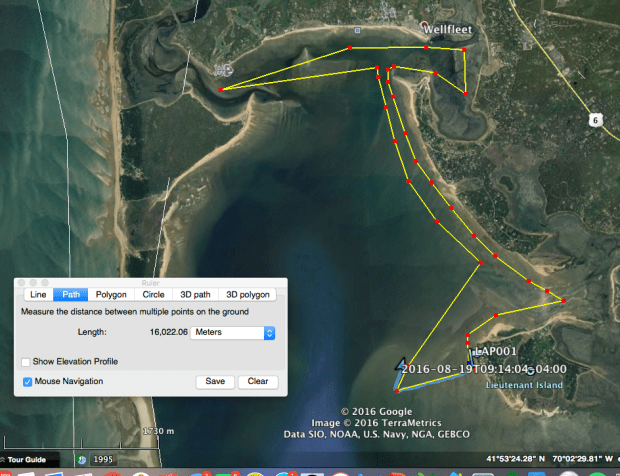
I was right about the water.  I rowed to indian head and the water smoothed out.  There was still a fair amount of wind, but it was entirely rowable, and quite enjoyable.  I rowed up to the north end of the bay, then turned west and rowed along the north shore to the north end of great spit.  Then turned and rowed back all the way to the inner harbor, and around the outside of all the moored boats back to the end of the breakwater.  Then I cut back to indian head and rowed south along the shore all the way to where the salt marshes inland of Lt Island are.  Finally I cut back west and rowed to the north point of the island and around the shore in front of our house.

All together, I’m guessing it was about 16km in about 90 minutes.

We have some company coming tomorrow, so I am not sure if I will get a row in.  If I do it will probably be a short one.  I’m liking this open water stuff, and I’m getting a hang of rowing this boat.  Basically, I need to rate a little higher and row a little lighter, with a gentler push at the catch, building up the pressure through the stroke.  It also is pointless to pay much attention to the splits because with the wind, waves and tidal currents, it bears only the slightest resemblance to effort going in and the quality of the rowing.  A much better indicator is heart rate.  Today, my HR was generally between 144 and 150.  144 was when I was rowing downwind which is easier but requires a fair amount of concentration.  150 was rowing into the wind, which is technically simpler but a lot more work.


Thursday: 15K Open Water Row

Tuesday:  To much going on.  We headed back to the cape in the late morning.  I stopped for groceries on the way.  Once I was set up in the house, the wind was too strong for rowing.  Whitecaps all over the bay.  I went for a walk instead.

Wednesday:  Lots of projects.  Furniture getting delivered.  Buying lumber and hardware and digging post holes to put up a clothesline.  I was hoping to go for a row in the afternoon, but it was still quite windy, sustained winds between 15 and 20mph with gusts to 25.

Thursday:  Weather report indicated lighter winds in the morning so I got up round 7:30 and headed out around 8:30.  I’ve decided that it is impractical to carry the boat own the stairs.  They are too steep and rickety, so I threw the boat on top of my car and headed off to a place by the beach that I could park.

The beach is not steep at all, so I had to carry my oars out to the water’s edge and then go back and get my boat.  This round trip took about 5 minutes or so.  In that time, the tide had come in enough to float my oars. I got myself setup in the boat and rowed out to deeper water.  I was touching my oars to the sand with just about each stroke at first but within 5 strokes, I was free and clear.

The goal for today was to get used to rowing this boat in open water.  It will take a while to get used to rowing in waves.  Each direction relative to the waves brought unique challenges.  From some respects, rowing right into the wind was the easiest.  It was also the most taxing.  Waves coming on the quarter bow or stern tended to really throw the boat around.  From the side, the main challenge was to get both oars firmly set at the catch.  Straight downwind was kind of fun.  It seems to work best if you adjust stroke rate to match the wave frequency and take a stroke at the crest of a wave and surf down on the recovery.

Thursday the wind was from the southwest.  It was blowing pretty good when I first started at 8:30, but died down a bit as I went along.  This wind direction is generally unprotected, so the waves get bigger.  I think they were maybe 8″ to 12″ high with some bigger ones.

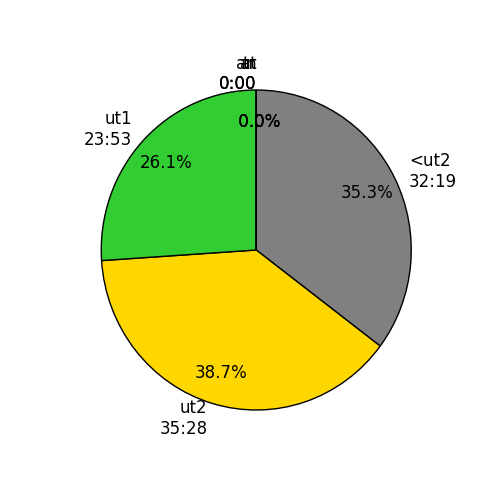
I was out for an hour and 15 minutes and covered about 16km.  All UT2 / UT1.

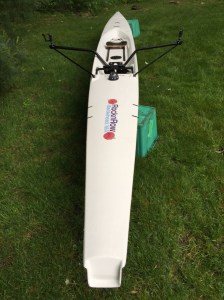
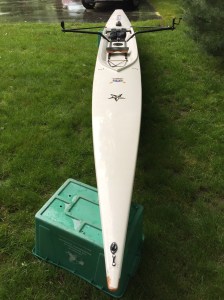
My new boat, an Alden Star

Previously owned by the Marblehead Rowing Club. I was impressed with the club.  They are set up in a corner of a big warehouse type building in a boatyard on Marblehead’s little harbor.

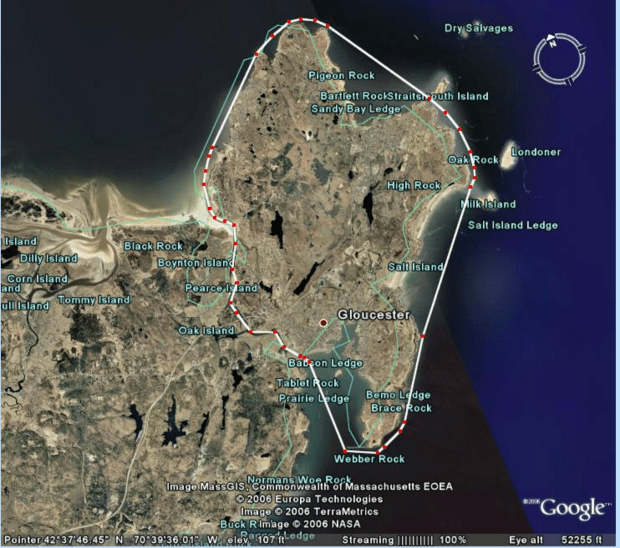
map

I was shown to the boat which was on the clubs immaculate racks.  There was a group of folks who had just rowed over the Manchester and back (that’s 11 miles round trip!) enjoying some coffee and scones.  The boat looked really nice.  Someone had cleaned it up nicely.  We took it out to the dock and the guy from the club who was selling the boat (and my Dad, who lives in Marblehead) got in a launch to follow me and make sure I didn’t die.

The boat seemed familiar and unfamiliar all at the same time.  It’s a lot wider, so it has a lot more intrinsic stability.  It is only 22′ long, so it has less directional stability.  I was expecting it to feel much heavier to row, but it did not.  In fact it felt quite responsive.

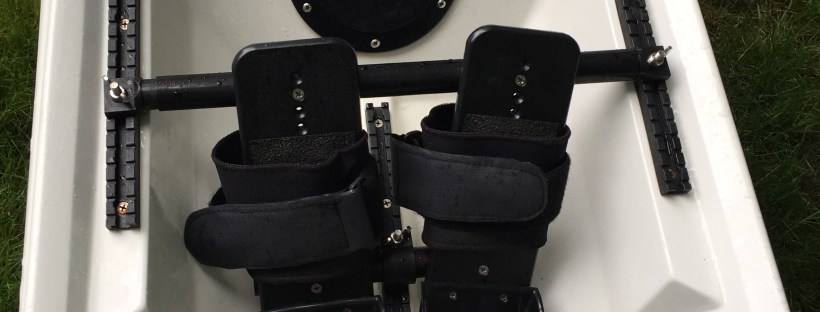
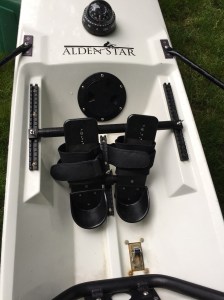
The cockpit is shallow, so that it will not get weighed down with water that inevitably gets into it.  There is an automatic bailer that will pull water out of the cockpit if you are rowing.  It has clogs instead of shoes.  These were very secure and comfortable in use.  On the stern deck is a reverse reading compass.  Even with coastal rowing, it is often very hard to get a point to steer from, and the compass is handy to keep a good line.

The riggers are a simple aluminum tube and can be removed by unscrewing 4 hex screws.  I’ve been warned that the rigger hasn’t been off in years and these screws might be tough to remove.  We’ll see if I ever need to get them off.  The oarlocks are standard issue concept2, set on pins that project up from the rigger, so the oarlocks can rotate 360 degrees around the pin.  There are two access ports.  The one on the seat deck has a gear bag inside it and a tow line in the bag.  The bow one does not.  There is shock cord tie downs to hold a PFD just toward the bow from the rower.

A close inspection of the hull and deck showed no significant scratches.  When held at the ends, there is a bit more flex in this boat than in a carbon fiber single, but I would expect that since there is more weight, the weight is in the middle and it’s fiberglass.  I didn’t notice any flexure when rowing.

I headed out of the harbor and into the confuse chop.  There was about a 1 foot swell, plus wakes from a whole bunch of motorboats buzzing around.  Coming out of the harbor, I was going up into it, and I started to get a feel for adjusting my timing to match the wave frequency.  I was a bit nervous about rowing across the waves, but the motion was not that bad and the boat was very stable when rowed.  I stopped and let the launch catch up with me and we noticed that the light mist had become a reasonably thick fog, so I decided to cut it short and loop back in behind the island.  I pushed up the pace and rate for the last 500 meters or so to see how the boat felt, and to put a bit more stress on the riggers and oarlocks.  The boat felt solid, and the riggers and oarlocks were stiff and smooth.  I was smitten.  Rowing on open water is a different experience.  The waves were quite small and I still managed to ship a fair amount of water in the cockpit from waves breaking over the bow.  I set the foot stretcher by eye and it turned out to be just about right.  I was very comfortable the way it was rigged.

On taking the boat out of the water, we noticed that it had taken on a little water, maybe a cup or so.  I suspect that there is a leak somewhere, perhaps around the bailer, or one of the ports.  I will give it a close inspection and recaulk the most obvious seams.

After I got the boat loaded, the guy selling me the boat gave me a scone and water and started telling me about the club.  They seem to have a lot of fun.  They send a group up to compete in the Blackburn Challenge every year.  This race is on my Rowing Bucket List.  This is a race that circumnavigates Cape Ann.  It is over 20 miles long and usually provides a pretty wild set of conditions.

Screen Shot 2016-06-05 at 7.11.30 PM.png

It starts in gloucester, around the place labeled Babson Ledge.  It then proceeds up the annisquam river to the north mouth of the river, then east along cape ann, then turns south, going past Rockport harbor, and then finally turning back south west for the leg back to gloucester harbor.  If there is a South East wind, there tends to be pretty big swells along the Southwest leg of the race.

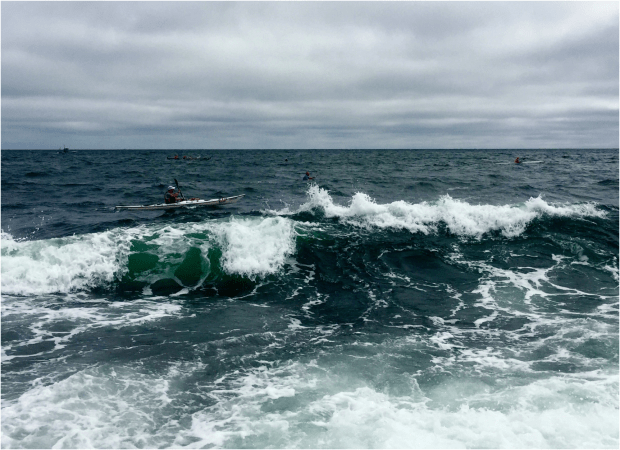
Last year it was a bit windy, and the wind was from the North.  When the races were coming out of the north mouth of the river, the tide was ebbing, so there was a wind blowing over the outgoing tide, building some big waves.

Screen Shot 2016-06-05 at 7.18.36 PM.png

Anyway, the guy who sold me the boat invite me up to join them for a practice or two, and to come with them to the race.  It’s July 16 this year, which is a bit too soon for me to feel comfortable, but I think I’m going to plan and train for it for next year.  It would basically be marathon training because it takes between 3.5 and 4.5 depending on conditions.  I think it would be a blast!