Friday: 2K Test

Plan:

  1. On slides
  2. 20 minute warmup with power 20s at race pace
  3. 2K test
    1. Time target: 6:48
    2. Pacing: Flat pacing at 1:42
    3. Rate: 32 to 34
  4. 20 minute cool down

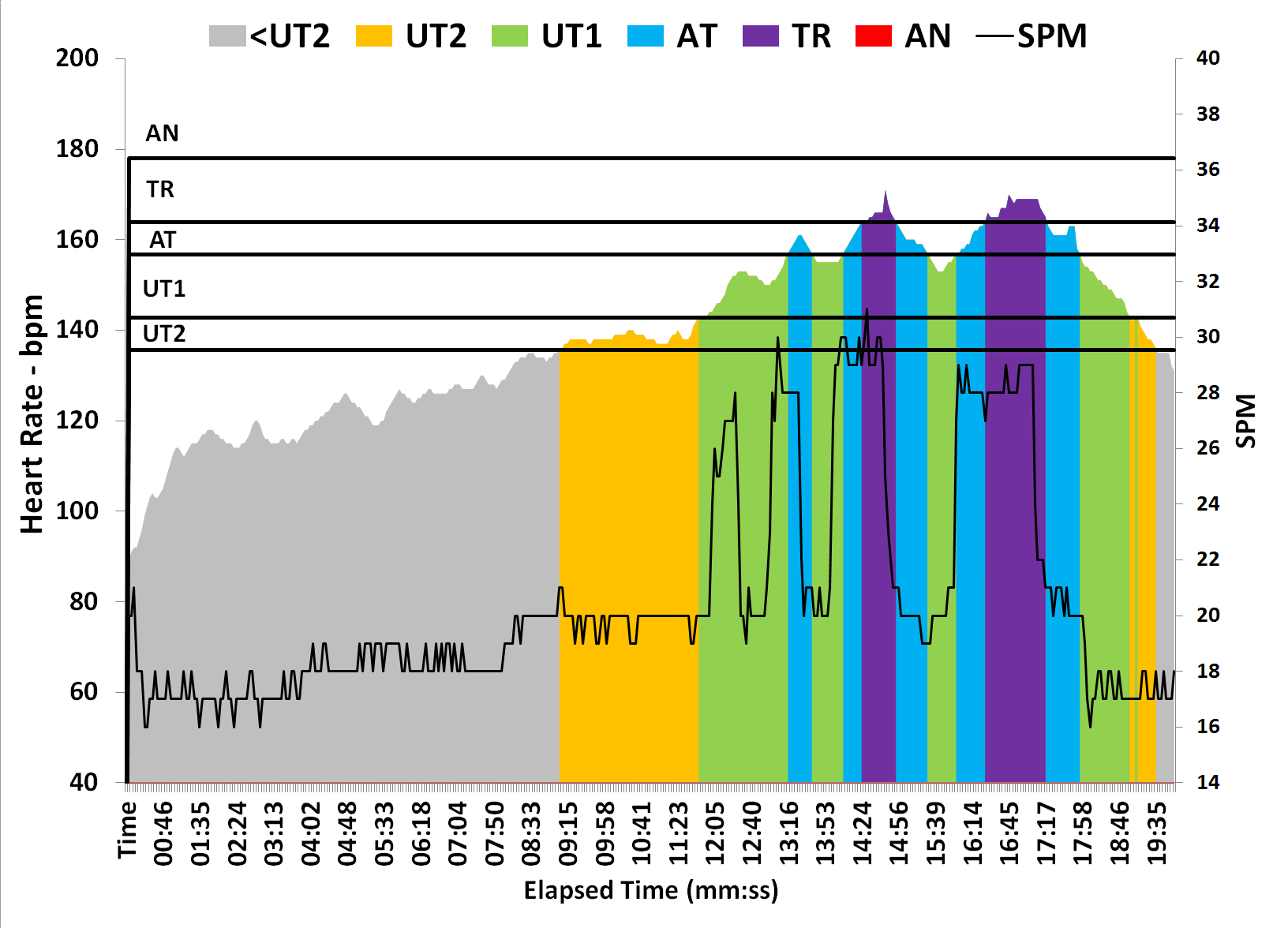
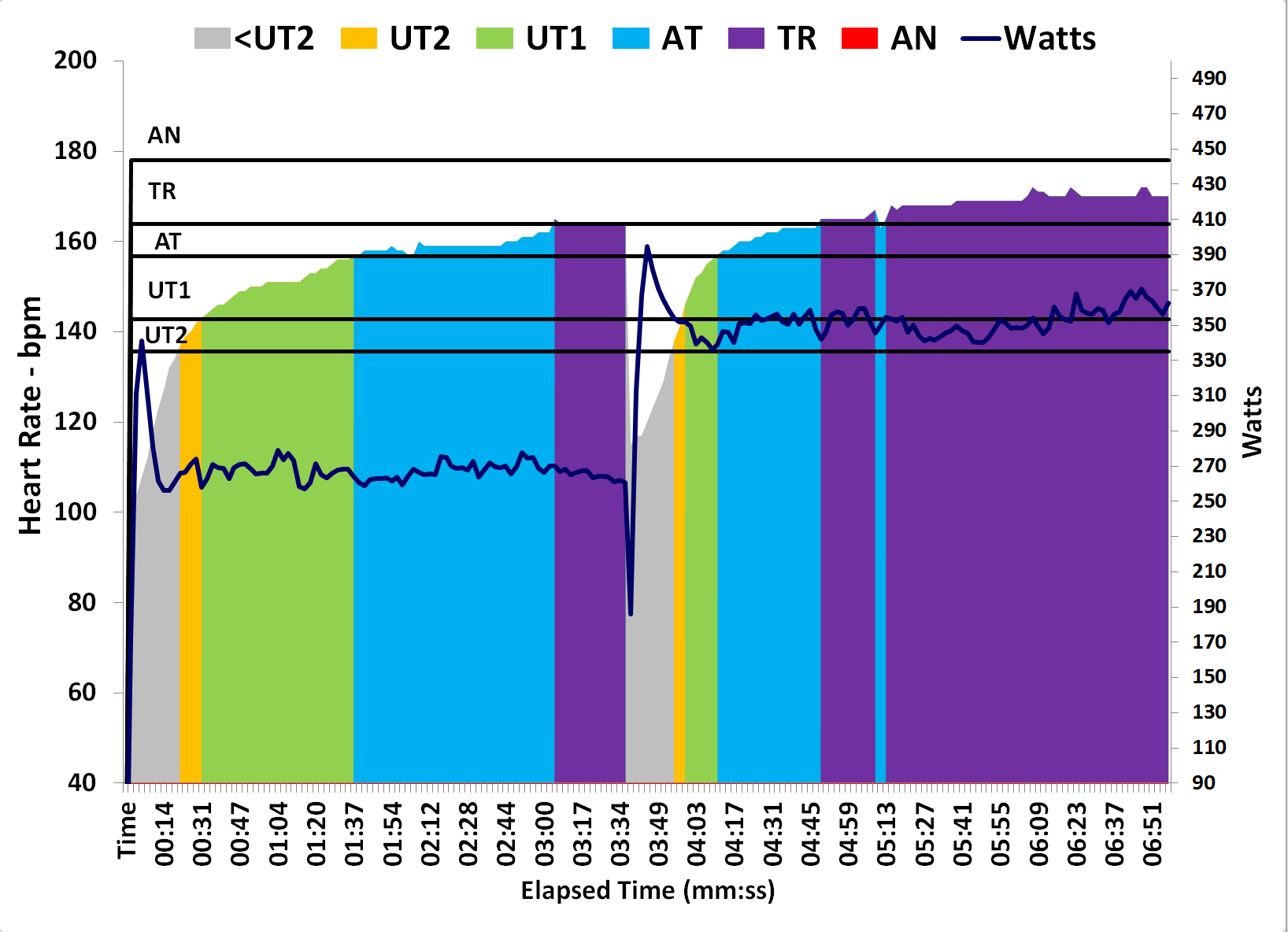
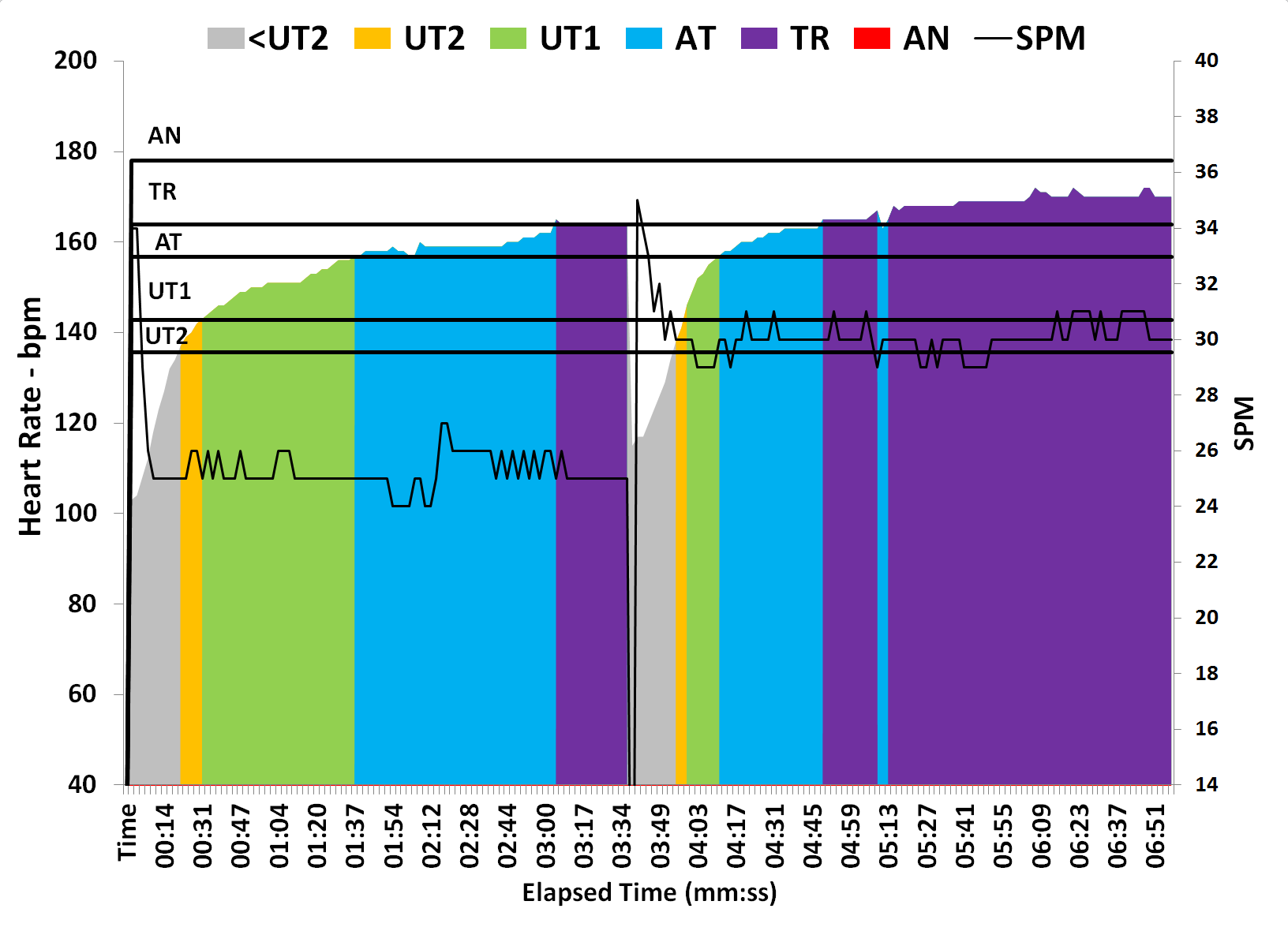
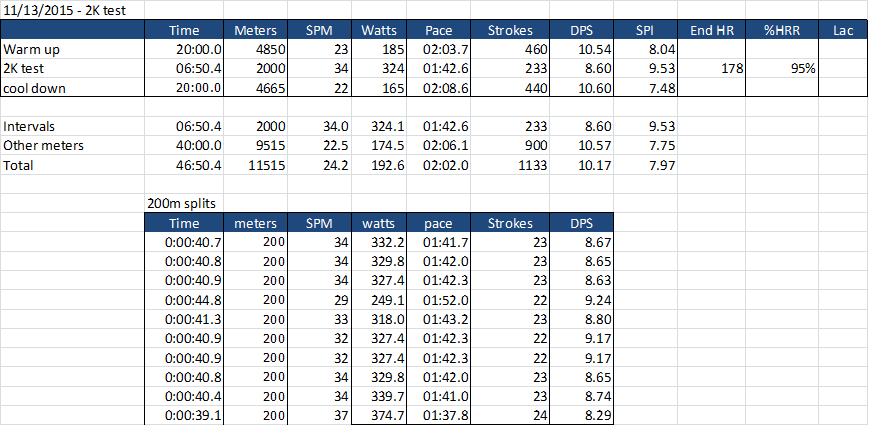
2k Screen Shot 2015-11-13 at 8.27.10 AM

6:50.4…Not terrible, but not as good as I could have done.  I had a little breakdown around 800 meters.  I was fully prepared for “the wave”.  When I do more speed work, I get used to the crisis moment that hits around then.  Kind of a combination pain, chills, nausea, drowning feeling that passes over the course of about 10 strokes.  Anyway, it hit me hard today and I paused before I really knew what was going on.  I started going again almost immediately and finished without any more drama.  Kind of a lame and it definitely cost me about 3 or 4 seconds off the time.

But as a marker for the start of the indoor season, it isn’t so bad.  I ranked it for fun and it’s 18 out 778 in my age group (97th %-ile).  I think with a month or so of base work, and then a couple months of sharpening, taking 3 seconds off my splits is entirely feasible.  I’d like to build a plan to be within striking distance of my 2K PB by the crash-bs.

Tomorrow:  3×20’/1′ steady state at 190W.

Thursday: 3 x 20′ / 1′ rest

More deviations from the test week plan.  As I drafted the plan, I had decided that between test days, I would do 2×20′ of steady state.  Today I changed my mind for a couple reasons.

  1. I wanted to take a lactate test at the normal 60′ minute point to check if a step up in steady power was justified.
  2. I didn’t really see the harm as long as I made it a consistent change for future test weeks
  3. I felt like rowing, dammit.

Plan:

  1. 3 x 20′ / 1′ rest
  2. Rate: <20 spm
  3. Pace:  Slow start at 2:15 for 5′, then 2:10 for 5′, then target pace thereafter (2:02)
  4. Lactate test immediately after last 20′ piece

Screen Shot 2015-11-12 at 4.25.00 PM Screen Shot 2015-11-12 at 4.24.47 PM

Workout Summary – Nov 12, 2015
–_|_Total_|_-Total-_|_–Avg–_|_-Avg-_|_Avg-_|_-Avg-_|_–Avg–_|_-Avg_|_-Avg
–_|_Dist-_|_-Time–_|_-Pace–_|_Watts_|_SPM-_|_-HR–_|_-%HRR–_|_-DPS_|_-SPI
–_|_14583_|_60:00.0_|_02:03.4_|_186.1_|_18.6_|_139.3_|_ 67.6% _|_13.1_|_10.0
Workout Details
#-_|_SDist_|_-Split-_|_-SPace-_|_Watts_|_SPM-_|_AvgHR_|_Avg%HRR_|_DPS-_|_-SPI

01_|_04741_|_20:00.0_|_02:06.6_|_172.7_|_17.8_|_124.6_|_ 57.2% _|_13.4_|_09.7
02_|_04922_|_20:00.0_|_02:01.9_|_193.2_|_19.0_|_143.0_|_ 70.2% _|_13.0_|_10.2
03_|_04920_|_20:00.0_|_02:02.0_|_192.9_|_19.1_|_149.4_|_ 74.8% _|_12.9_|_10.1

Lactate Reading after finishing was 3.0mmol/l vs target of <2.0.

11-12 lac

So, 193W is a bit too much for right now.  I will back off to 190W and monitor.  When I get 3 readings under 2.0, I’ll push again.

It’s tough for me to remember that there is little downside to going too slow, but pushing too fast reduces the effectiveness of the training.  That’s why lactate testing is such a useful  tool for me.

Tomorrow:  2K time trial.  I’d like to beat 6:50.

Wednesday: 1 Minute Power Test

So, I know that I was supposed to do a light day today, but looking at my work schedule, it didn’t look so good for a power test tomorrow.  I also felt pretty fresh.  I didn’t need to dig all that terribly deep for the 2 speed test.  Finally, thinking about the 2K test, the idea of keeping up the intensity seemed to more closely mimic the kind of taper I like to do.

The challenge was the PM on the erg.  I was doing this at work and it is a older model C with an old style PM.  The kind that you can’t hook up to rowpro.  So, I pulled my PM3 off of my erg at home with the idea of swapping it onto the erg at work for the day.  I was stymied by the fact that the mounting bracket has been changed between PM models and the new one would not fit on the old bracket.  Bummer.

So, I ended up setting my iphone on a upturned trashcan, leaning against a small dumbell and aiming at the PM.  Then I laboriously transcribed the power reading from each stroke into excel.  If you want to watch some really boring videos, I posted them to youtube.

Why are there two, you ask?  Well, there’s a story behind that.  Not much of a story, but a story nonetheless.

I did a nice gentle 20 minute warmup, and then got myself psyched up for the test.  Apparently I did not get myself psyched up nearly enough, because I blew up big time 32 seconds into the test.  I took the go all out advice to heart and I just totally lost it round the 30 second mark.  I was on slides, so I was cranking at close to 50 SPM.  I was rowing mostly with my eyes closed, and then opened them after about 25 strokes.  When I saw I had only made it halfway, I suffered a bout of acute despondency and dropped the handle.  Pity, it would have been a good test if I had the guts to keep going.  As it was, I set a new PR for peak power.  770W vs my old mark of 701W.  I also maintained with 10% of that value for 25 seconds, which shows that my “Anaerobic alactic critical duration” is reasonable.  “Rowing Faster” says you want to be able to hold that for longer than 20 seconds.  Of course for the other measures, average power and “Anaerobic lactic critical duration” were not measurable from this failed test.

I took a few minutes to get my head together and tried again.  This time, I made it less than 20 seconds into the test and I didn’t bother to transcribe the results.

I had a chat with myself, and decided to make yet another attempt, even though I knew that the test results would not be fully valid.  At least I would be able to get a completed test to score.  Maybe I’ll loop back to this in a week or so.

The last attempt was fine.  I definitely paced myself too much.  I certainly had a lot less power in the initial burst.  This one peaked at 726W.  AACD was 18 seconds.  ALCD was 60 seconds.  Average Power for the minute was 606W.  Maybe I was dogging it, but I was fairly shattered after I finished and the long 20 minute cool down was a struggle even at a 2:10 pace.

To summarize:

  • Peak Power: Target – 837W to 1023W, Actual: 770W
  • Average Power: Target – 674W to 814W, Actual: 606W

So, basically horrible compared to the benchmarks.  By the way, I don’t know too many guys my age with a low pull of 1:12.  Frankly, I don’t that many guys with a low pull of 1:12, so I am not sure how realistic these targets are.

The important thing is that it gives me something to compare against in future tests.  I will feel better if I redo the test in a week and get a complete first shot test done.

Here are my curves

power test

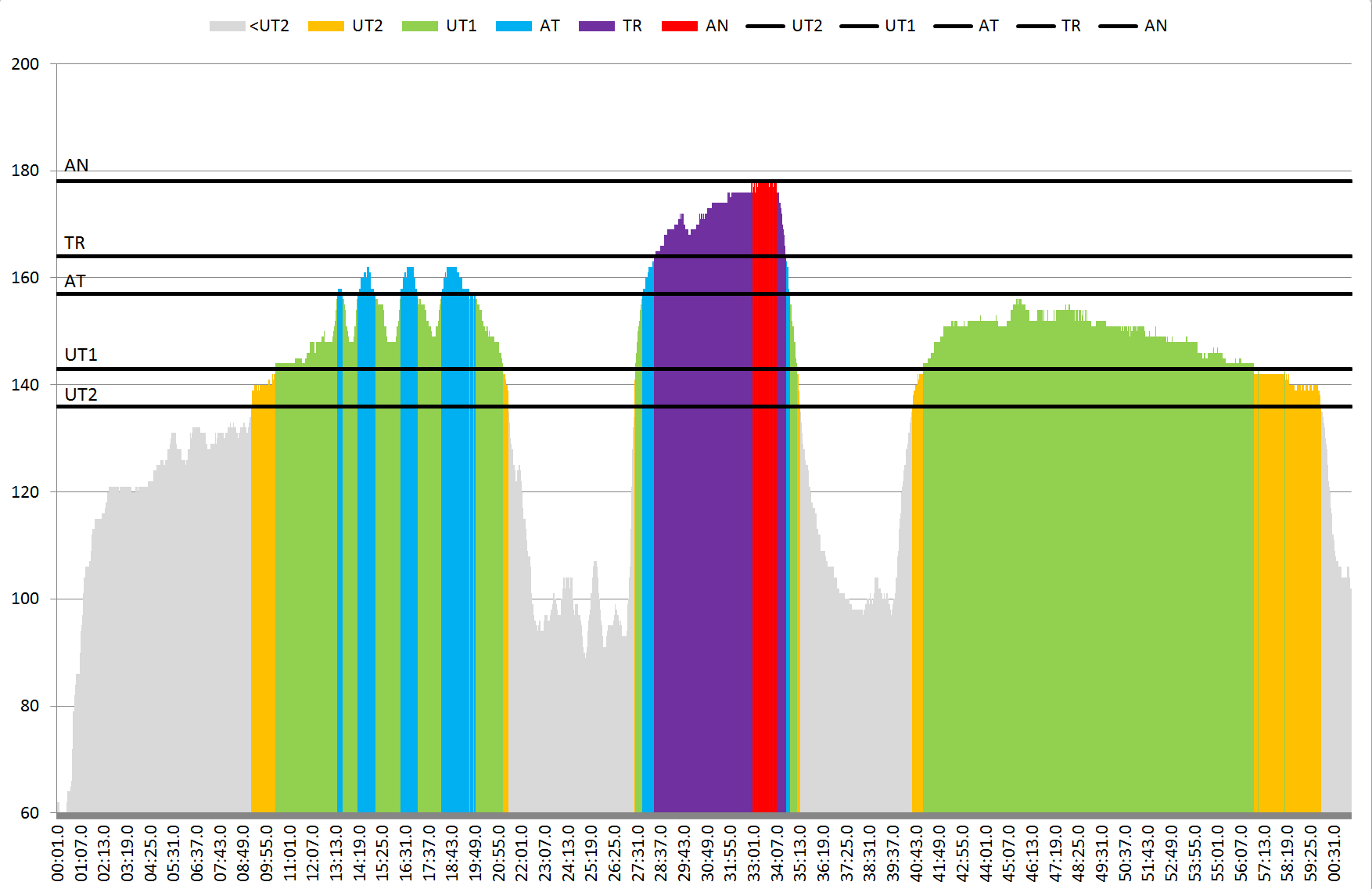
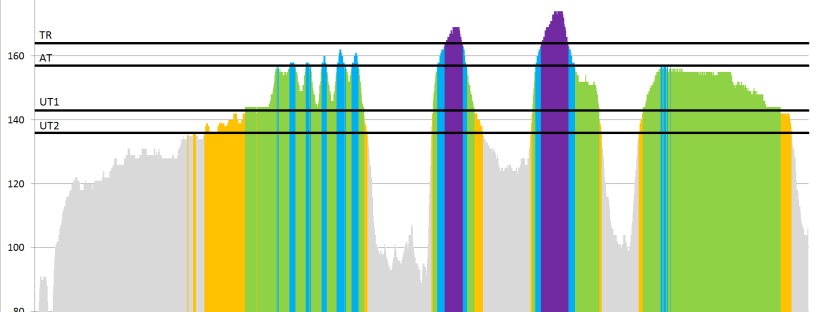
Here’s the HR plot for the whole disaster.

Screen Shot 2015-11-11 at 8.54.40 AM

Tomorrow:  40 minute steady state sometime during the day.  Then 2K trial on Friday.

Tuesday: 2-speed test

Test Protocol documented in yesterday’s post here

Done on my erg at home (static) with RowPro.

The 2-speed test is a 2 x 1000m with 15 minutes of rest between intervals.  The first interval is to be done roughly at LT pace, basically a 6K kind of pace.  For me right now, around 1:50 or so.  The second at V02Max pacing, basically 2K pace.  That would be around 1:42, but faster is better.  It’s supposed to be close to all out over the 1K distance.

I started with a 20 minute warmup.  I’ve been starting off more slowly lately and I like the change.  I used to do a Fletcher warmup, at the prescribed paces, but that starts at something like a 2:05 for me and then gets quite fast and frankly takes a lot of effort.  Now I start at 2:15, and then gradually pick up the pace and then do a few bursts at target pace or faster.  Then finish slowly.

Screen Shot 2015-11-10 at 11.36.38 AM Screen Shot 2015-11-10 at 11.36.25 AM

–_|_Dist-_|_-Time–_|_-Pace–_|_Watts_|_SPM-_|_-HR–_|_-%HRR–_|_-DPS_|_-SPI
–_|_04853_|_20:00.0_|_02:03.6_|_185.2_|_19.9_|_138.9_|_ 67.3% _|_12.2_|_09.3
Workout Details
#-_|_SDist_|_-Split-_|_-SPace-_|_Watts_|_SPM-_|_AvgHR_|_Avg%HRR_|_DPS-_|_-SPI

01_|_00895_|_04:00.0_|_02:14.1_|_145.3_|_17.0_|_111.9_|_ 48.1% _|_13.2_|_08.5
02_|_00930_|_04:00.0_|_02:09.0_|_163.0_|_18.5_|_124.6_|_ 57.2% _|_12.6_|_08.8
03_|_00988_|_04:00.0_|_02:01.4_|_195.6_|_19.8_|_137.1_|_ 66.0% _|_12.5_|_09.9
04_|_01584_|_06:00.0_|_01:53.7_|_238.4_|_23.7_|_159.0_|_ 81.6% _|_11.2_|_10.1
05_|_00232_|_01:00.0_|_02:09.2_|_162.1_|_17.0_|_150.4_|_ 75.4% _|_13.7_|_09.5
06_|_00224_|_01:00.0_|_02:14.2_|_144.8_|_18.0_|_138.4_|_ 66.9% _|_12.4_|_08.0

Then into the main event.  I set up Rowpro for variable intervals so that I wouldn’t have an extra 15 minute rest after my last interval.  I it up as follows

  • Variable Intervals (Distance, no rest)
  • 1000m Hard
  • 900s stop (you put the time in the distance box, don’t ask me why, but it works)
  • 1000m V. Hard

Screen Shot 2015-11-10 at 11.52.51 AM Screen Shot 2015-11-10 at 11.52.37 AM

Workout Summary – Nov 10, 2015
–_|_Total_|_-Total-_|_–Avg–_|_-Avg-_|_Avg-_|_-Avg-_|_–Avg–_|_-Avg_|_-Avg
–_|_Dist-_|_-Time–_|_-Pace–_|_Watts_|_SPM-_|_-HR–_|_-%HRR–_|_-DPS_|_-SPI
–_|_02000_|_06:58.4_|_01:44.6_|_305.8_|_27.4_|_157.2_|_ 80.3% _|_10.5_|_11.2
Workout Details
#-_|_SDist_|_-Split-_|_-SPace-_|_Watts_|_SPM-_|_AvgHR_|_Avg%HRR_|_DPS-_|_-SPI

01_|_01000_|_03:38.7_|_01:49.3_|_267.8_|_25.0_|_152.2_|_ 76.8% _|_11.0_|_10.7
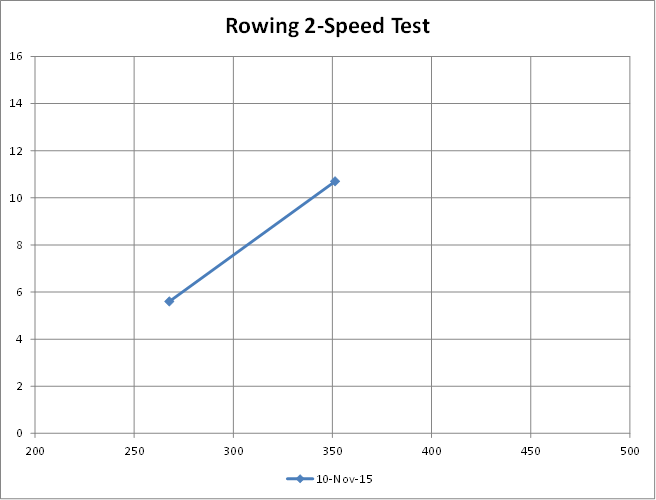
02_|_01000_|_03:19.7_|_01:39.9_|_351.4_|_30.0_|_161.9_|_ 83.6% _|_10.0_|_11.7

Lactate readings were taken at 1′ and 3′ after each interval.  The readings were:

  • Post LT Interval: 1′ – 5.6mmol/l, 3′ – 4.5mmol/l
  • Post VO2Max Interval: 1′ – 10.7mmol/l, 3′ – 10.7mmol/l

This results in the following chart:

11-10 2-speed

Future tests will show changes in aerobic fitness through displacement in the x-axis.  Changes in anaerobic fitness will show in changes in the slope of the line.

After that, I did a 2K happy ending, starting at 1:50 and slowing down by 5 seconds each 250m.

Screen Shot 2015-11-10 at 12.04.15 PM

So, that’s that.  I was happy that I could hold sub-1:40 for the second 1K.  I think that bodes well for being able to do something around 1:43 or better for the 2K test.

The rest of the test week is as follows

  • Wednesday: easy day: 40′ steady state
  • Thursday: 1 minute power test, then probably the November CTC
  • Friday: easy day: 40′ steady state
  • Saturday: 2K Test
  • Sunday: Easy day: 40′ steady state
  • Monday: 6K Test

End of Season Fitness Testing

The purpose of this testing period is to determine current fitness, balance of aerobic versus anaerobic capability.  The findings will be used to set priorities for my winter training plan.

My intention is to repeat this same set of tests at the beginning of each major training period to allow me to track long term trends in fitness and witness the ravages of aging quantitatively.

There are 4 specific tests.  These tests are to be done in this specific order.  Only one test will be done in a training session.  A light day of 40 minutes of steady state rowing (<2.0mmol/l lactate power) between each test day.

  1. 2- speed lactate test
  2. Anaerobic Fitness Test
  3. 2K Test
  4. 6K Test

Detailed Descriptions

  1.  2 Speed Lactate Test.

(source:  The Science of Winning, Jan Olbrecht.  Original Source:  Mader A. and H. Heck: A theory of the metabolic origin of “anaerobic threshold”. Int. J. Sports Med. 7, 45-65, 1986)

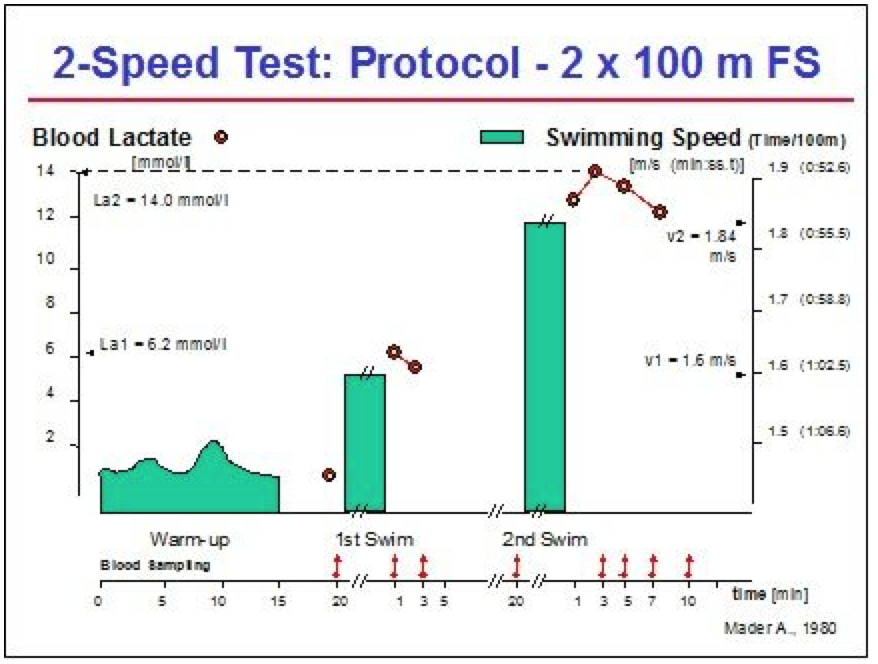
The Science of Winning is a book about training for competitive swimming.  Since spint rowing events are similar duration to longer swimming events, a lot of the training principles are almost directly applicable.  The 2 speed test is presented as a way to assess the balance of aerobic and anaerobic capability in a swimmer by completing the same test distance twice.  After a thorough warm up, the first trial is done at a submaximal pace, and then after a long rest (15 minutes, active rest) a second time as fast as the distance can be completed.  The test can be done on different distances.  In the book, it was presented with 100m, 200m and 400m distances.  For reference, the time to swim 100m is about a minute, so rowing equivalents would be 250m, 500m, and 1000m.  I believe that I will complete the test at 1000m to align better with the longer rowing competitive distances.

After each trial, a lactate reading at 1 minute and 3 minutes post exercise.  The book recommends testing at 5 min, 7 min, etc after the last trial until the lactate level starts to fall to try to get a more accurate idea of what the peak lactate level is.  Here is the graphic from the book.
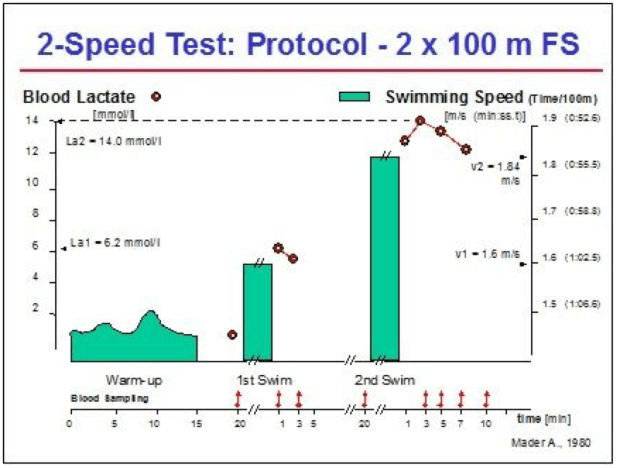
Screen Shot 2015-11-09 at 10.30.09 AM

The two readings are then plotted as power versus lactate and line drawn between the two points.

Screen Shot 2015-11-09 at 10.30.31 AM

The position of the line along the x-axis provides information about aerobic fitness.  The slope of the line can be used to understand the balance of aerobic to anaerobic power.  I do not expect to get much out of the first test beyond establishing a baseline for future testing.

The thing I like about this test is that it is not as susceptible to judgement as other tests (like the Rojabo test).  Basically, since you are measuring both power and lactate, even if there is minor variation in how hard you try, the line will still give a good idea of how your fitness has changed.

So, the specific guidelines for the test:

  1.  15′ minute warmup including 5 x 10 stroke bursts at test power
  2. Trial #1:  1000m, 6K pace (~1:50)
  3. 15′ rest:  at least 10 minutes active, with lactate tests at 1′ and 3′  (record max lactate and avg power)
  4. Trial #2: 1000m 2K pace (~1:42 ish)
  5. Cool down: 10′ with lactate tests at 1′, 3′, 5′ (record max lactate and avg power)
2. Anaerobic Power Test

(Source: Rowing Faster, 2nd Ed., Chapter 6)

This is a modified version of the Wingate test.  It’s pretty simple.  Row as hard as you can for 60 seconds.  That’s it.  The key to the test is what happens in the 60 seconds.

The instructions are:

  1.  Set the erg to maximum drag factor.
  2. Setup a way to record the power for each stroke, either take a video of the monitor to review afterward, or use rowPro.
  3. Do a 10 minute steady state warmup
  4. Set the monitor for 1 minute intervals with 1 minute rest.
  5. Paddle through the first minute and the first 50 seconds of the rest.
  6. In the last 10 seconds of the rest, crank up the power so you can hit the beginning of the test period going full blast
  7. Row as hard as you can with good form.  Rate up as much as you like, as long as you are taking full strokes.  Do not pace yourself.  The objective is to pull as many watts as you can on each stroke.
  8. As you continue through the minute, your power output will begin to fade.  This is expected and is precisely what the point of the test is.
  9. After you finish, throw up in a nearby trash can, cool down and then get working on data analysis.

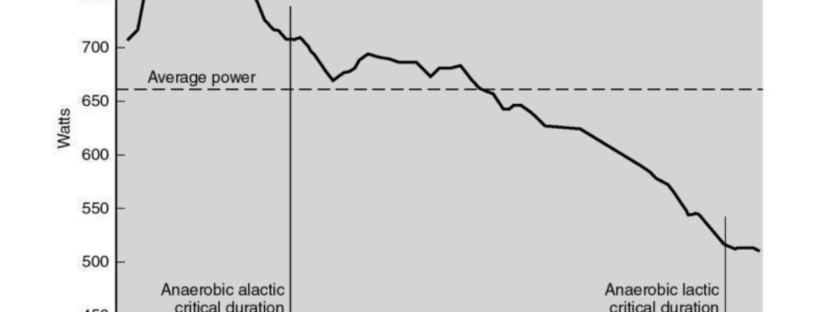
If you do it right, you end up with a graph that looks like this…

Screen Shot 2015-11-09 at 1.43.38 PM

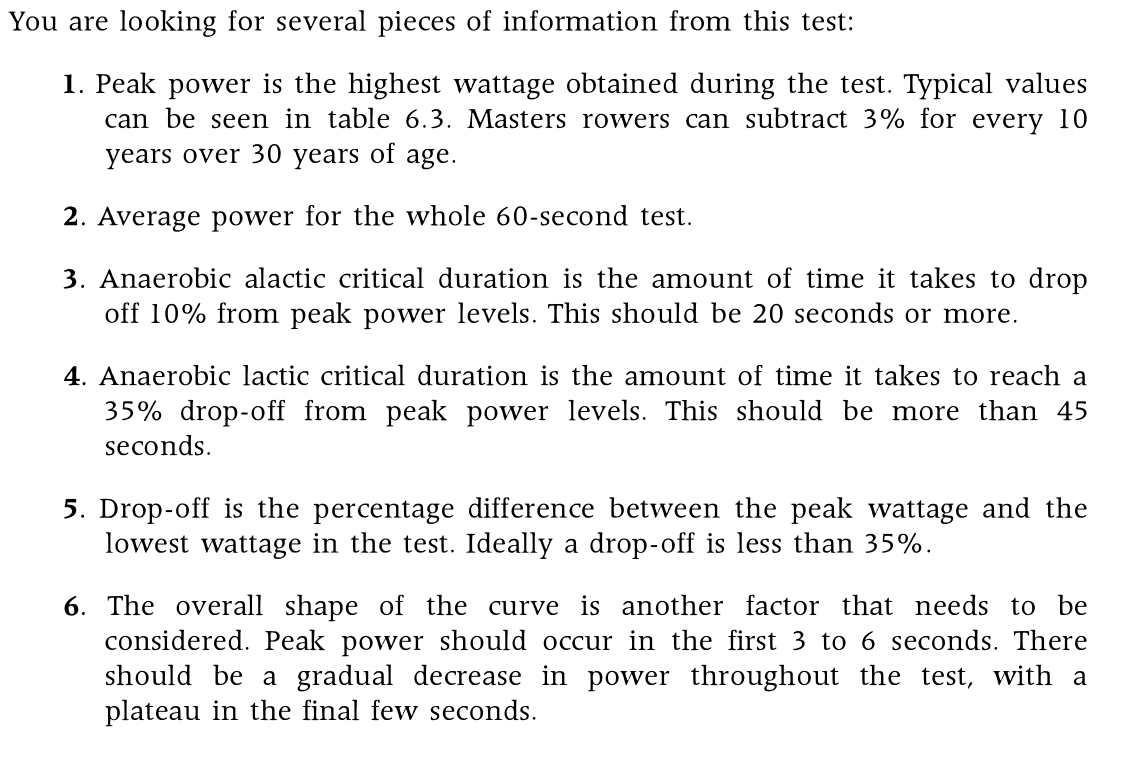
Here is what you try to get from the curve
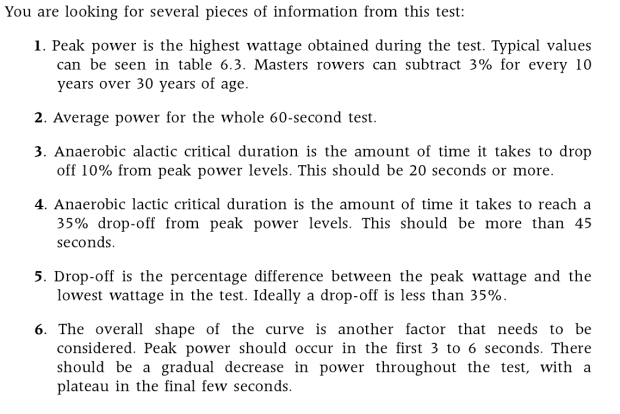
Screen Shot 2015-11-09 at 2.12.31 PM

Here is Table 6.3

Screen Shot 2015-11-09 at 2.14.29 PM

So, for me as a heavyweight man, at 52 years of age.  The target peak power is

  • (1 – 22 * 0.3%) * 1000W = 934W (Holy smokes!  That’s a 1:12 pace.  My all time best Low Pull is 1:19.0 (710W), so I expect to fall way short of that benchmark.

As with the 2 speed test.  The main idea here is to get a baseline that I can use to compare to in the future.  Development of anaerobic power is best left to the last phase  pre-competition, unless there is a lot of strength training to be done.  So, I would likely rerun this test about a month prior to competition and then again at the beginning of the competition taper to hopefully see some improvement.

3.  2K Test

Not a lot to it.  Sit down, warm up.  Row 2K.  Record the time.  Used as a proxy for VO2Max power.

4.  6K Test

Same idea.  Used as a proxy to determine Anaerobic Threshold power

Interpreting the test results

In the same chapter of Rowing Faster, they provide the following guidelines for interpreting the test results.  All of these are in terms of power.
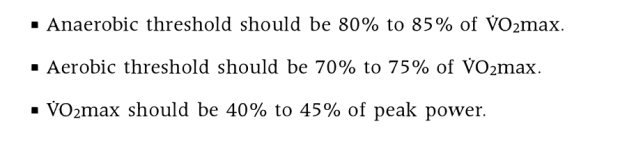
Screen Shot 2015-11-09 at 2.27.14 PM

If the ratios are different, then the amount of effort put into the lower areas should be increased in the training balance.

Monday: 4×20′ / 1′ rest – Back to basics

Sunday:  Rest day

Monday:

Weather:  It doesn’t matter 😦

Plan:

  1. 4×20′ / 1′ rest
  2. slow start 5′ @ 2:15, 5′ @ 2:10, then 2:03 the rest of the way
  3. rate: 19-21 (on slides)
  4. lactate test at 60 minutes

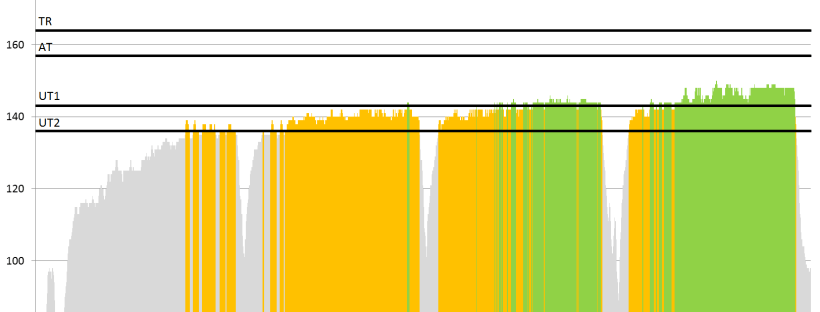
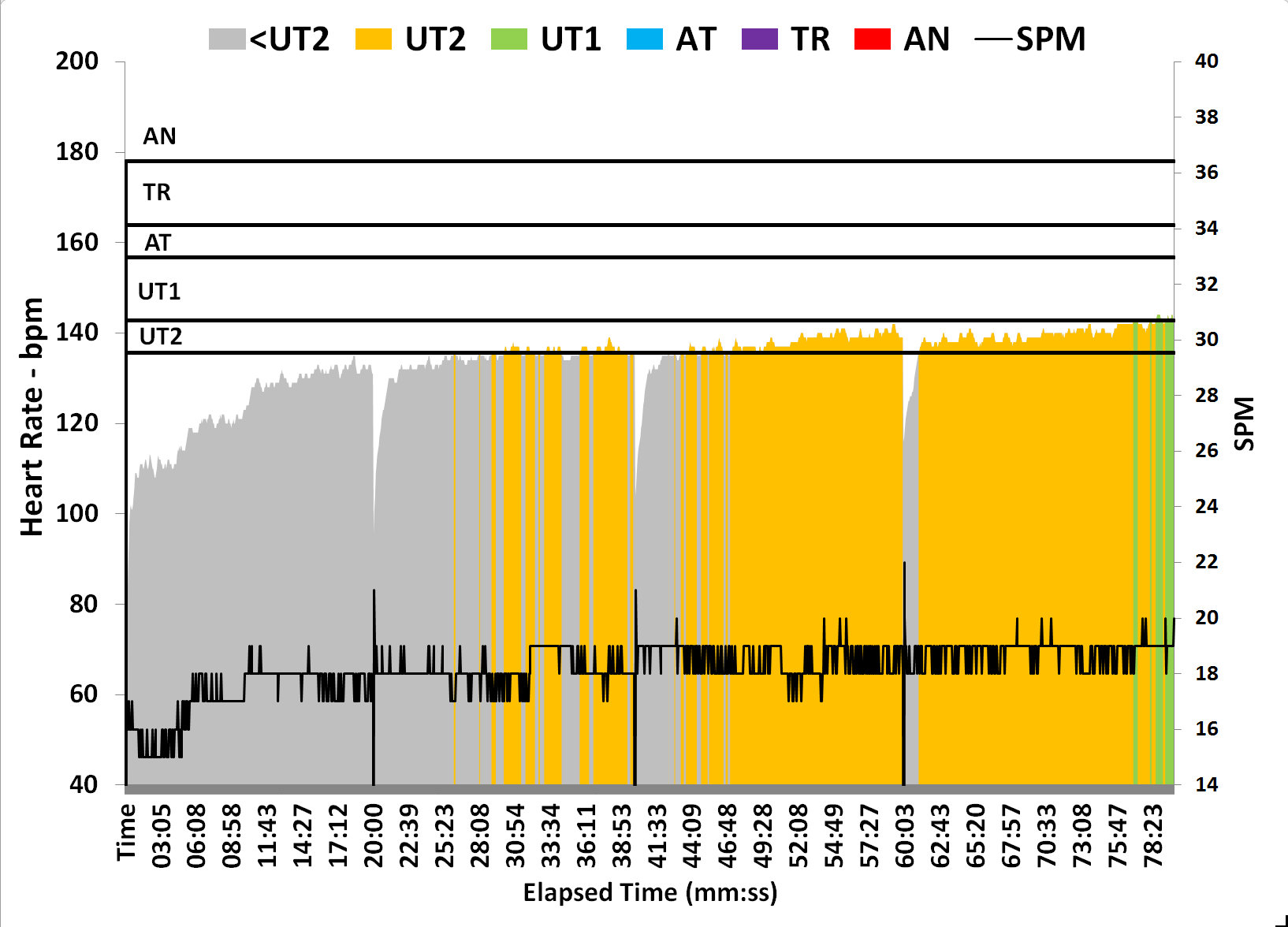
Nothing unusual in the HR chart.  I increased speed by about half a second for the last 20 minutes to see if I could hold the higher power without my HR running away.

Screen Shot 2015-11-09 at 9.20.01 AM

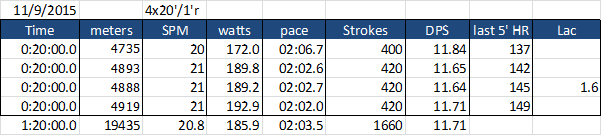
In the first interval, you can see the steps at 2:15 and 2:10, then the rise after the step to 2:03.  I was actually pulling around 2:02.7.  Then for the last 20 minutes, I pushed to 2:02.

11-9

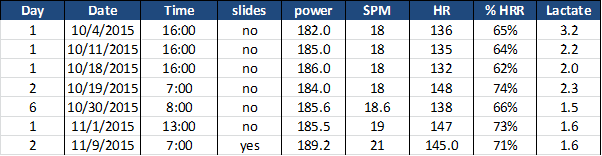
So, this is the third lactate in a row at or below 1.6mmol/l for a power between 185 and 190.  I’m going to target 2:02 (193W) for a few workouts to see how that goes.

11-9 lac

Tomorrow:  I will be starting a series of assessments to get a baseline before starting my winter training plan.

Thursday: Taper Day 2 –> 2 x 2′ / 5′ rest (on the erg)

Early meeting, so I missed a beautiful morning on the river.  I looked at the glassy smooth water as I drove past.

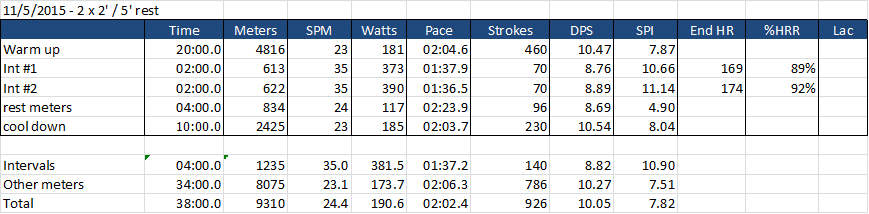
Plan:  Taper day 2.

  1. 20 minute warmup
  2. 2 x 2′ / 5′ rest
    1. rate: >30
    2. pace:  faster than 2K race pace (1:40ish)
    3. on slides
  3. Cool down

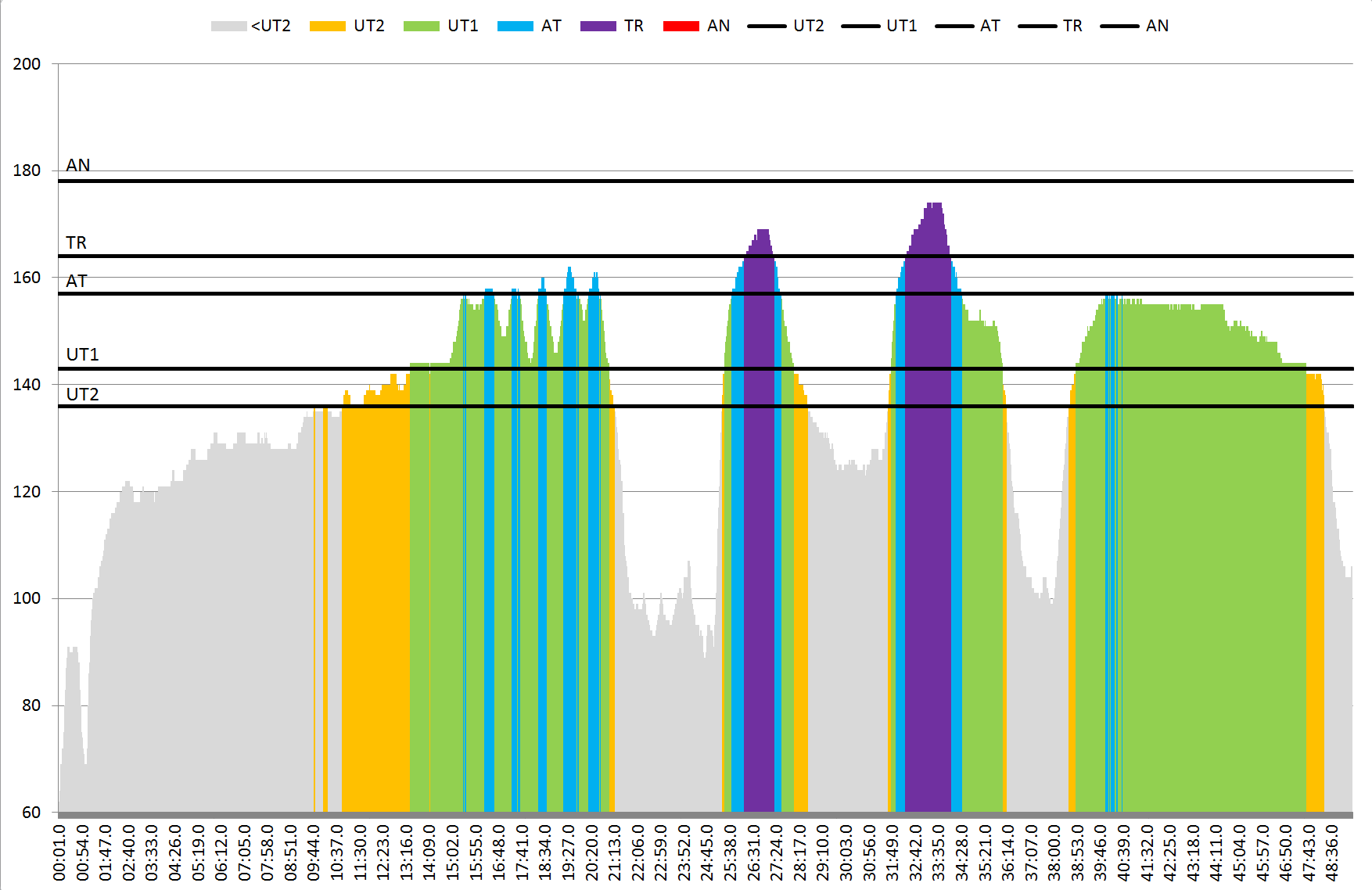
2x500 Screen Shot 2015-11-05 at 9.02.04 AM

It was mercifully brief, but each interval really stung.  I pushed a lot faster than 2k race pace and let the rate really climb on the theory that the whole point is to provide sufficient stimulus to avoid any fitness loss during the taper.  No evidence that this is the right thing to do, but it made me feel like I was giving it my all.

Tomorrow:  Back on the river.  A nice warmup, a single 500m interval, and an easy cool down focusing on technique.  Then load up the boat for the race.

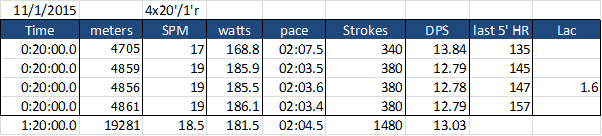
Sunday: 4×20′ / 1′ rest

Static erg.  Core perform seat. PC running rowpro died while I was rowing.  Very sad.  Need a new beater PC to sweat all over.  Good thing I had my iphone going as a redundant HR monitor!  How’s that for obsessive!

Plan:

  1. 4 x 20′ / 1′ rest
  2. slow start: 5′ at 2:15. 5′ at 2:10, then 2:04 the rest of the way
  3. rate: r19
  4. mechanics:  Work on controlling handle height and easing into the catch.

11-1 Screen Shot 2015-11-01 at 7.22.06 PM

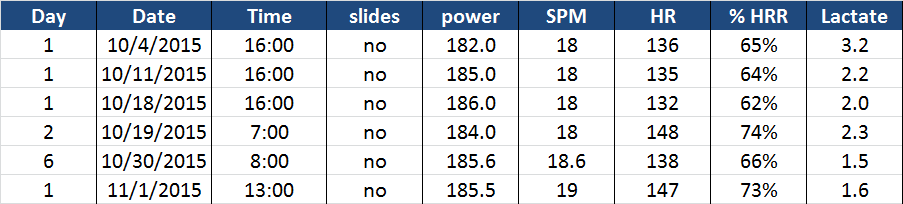
So, my HR was way higher than last session.  But the lactates were fine, delightful in fact.  So, I am definitely at the right training power, and I will push just a little bit faster next time.
lac

Just goes to show you that HR is not very well correlated with lactate level, even over the short term.

Friday: 4 x 20′ / 1′ rest Steady State on the erg

Today, I had a doctor’s appointment at 11am, so I decided to work from home before that.  That made getting to the river for a real row a hassle, so again, I opted to do my steady state session on the erg.  It was a lovely fall morning, but it was a bit blustery, so I wasn’t to disappointed to miss the OTW.

The plan for today was a steady state endurance session.  The objective is to do the whole session with lactates below 2.0 mmol/l.  To test  that, I did a lactate test at the end of the 3rd interval, so after 60 minutes of rowing.

I am also sticking with the slow start plan.  It’s a relaxing way to start and I think it has a measurable impact on how well my HR plateaus, and results in lower lactate readings.

Last few of these sessions, I have been working at a 2:04 pace, and I’ve been reading around 2.0 for lactate readings, which is a bit higher than I really want.  I decided that if today was above 2.0, I would slow down the pace by a second.

But as it turns out, today’s lactate reading was a delightfully low 1.5mmol/l, and HR was equally low.

lactates 10-30

The other thing that I would like to think is going on is that the change that I made to reduce the intensity of my steady state rowing and ergs is actually having a beneficial effect on my endurance and reducing lactate levels.  There isn’t enough data to support that, but I think the trend is good.

Screen Shot 2015-10-30 at 1.32.54 PM Screen Shot 2015-10-30 at 1.32.18 PM

Workout Summary – Oct 30, 2015
–_|_Total_|_-Total-_|_–Avg–_|_-Avg-_|_Avg-_|_-Avg-_|_–Avg–_|_-Avg_|_-Avg
–_|_Dist-_|_-Time–_|_-Pace–_|_Watts_|_SPM-_|_-HR–_|_-%HRR–_|_-DPS_|_-SPI
–_|_19284_|_80:00.0_|_02:04.5_|_181.6_|_18.1_|_133.3_|_ 63.3% _|_13.3_|_10.0
Workout Details
#-_|_SDist_|_-Split-_|_-SPace-_|_Watts_|_SPM-_|_AvgHR_|_Avg%HRR_|_DPS-_|_-SPI

01_|_01116_|_05:00.0_|_02:14.4_|_144.3_|_15.4_|_107.8_|_ 45.3% _|_14.5_|_09.4
02_|_01163_|_05:00.0_|_02:09.0_|_163.2_|_17.2_|_119.7_|_ 53.7% _|_13.5_|_09.5
03_|_02423_|_10:00.0_|_02:03.8_|_184.3_|_17.9_|_130.3_|_ 61.2% _|_13.5_|_10.3
04_|_04860_|_20:00.0_|_02:03.5_|_186.0_|_18.1_|_133.8_|_ 63.7% _|_13.4_|_10.3
05_|_04854_|_20:00.0_|_02:03.6_|_185.3_|_18.6_|_136.7_|_ 65.7% _|_13.1_|_10.0
06_|_04868_|_20:00.0_|_02:03.3_|_186.9_|_18.8_|_139.2_|_ 67.5% _|_13.0_|_10.0

While I rowed, I was listening to the Teaching Company audio course on “Turning Points in American History”.  I learned a bit about the King Philip War, the court case that laid the legal foundation for freedom of the press in colonial america, and the Boston Tea Party.  The time passed very enjoyably.

Tomorrow:  Head Race Simulation on Lake Quinsigamond.  Hard 5.5km.

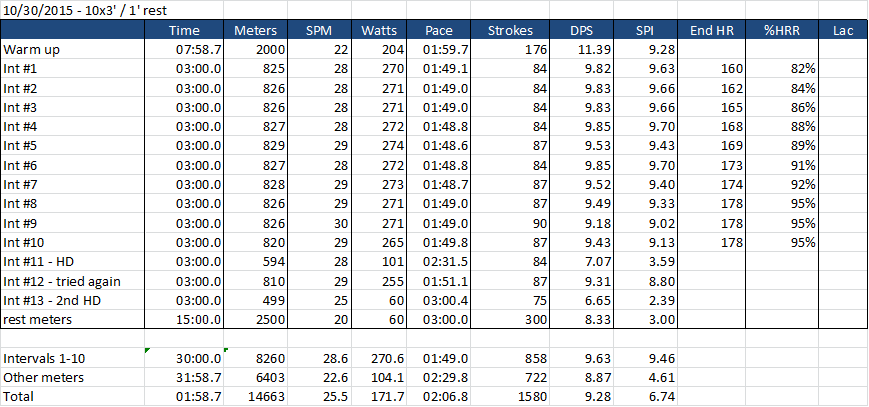
Thursday: 10×3’/1′ rest on the erg

Weather forecast was for rain, wind, and chance of thunderstorms.  So, even though the temperature was back in the high 50s, I decided to stay inside on the erg.  I did the workout on slides.

The OTW plan was for 4 x ( 3 x 3′ / 1′ paddle) / 2′ turn.  This was adapted from an erg workout 15×3’/1′ rest, so I decided to do that.  The problem coming back to the erg is always figuring out a good pace.

Today I guesses wrong and paid the price.  I decided to try to hit 1:50 or better, and ended up faster than 1:49 through 10 intervals, but I was totally done by that point and HD’ed in the 11th interval.  Once that happened, I basically gave up on the workout.  Looking in my old notebook, I saw that my fastest ever for this workout was 1:48.5, so I was a bit too ambitious with my pacing.  1:52 would have been a much better choice.

10x3 Screen Shot 2015-10-30 at 12.57.10 PM

I have trouble getting upset about this workout.  I did 30 minutes at head race pace and pushed it pretty hard.  I hate to bail on a workout, but trying to get 15 good reps in would have been an epic battle, probably without much additional training benefit.