Saturday: CRI Fall Challenge

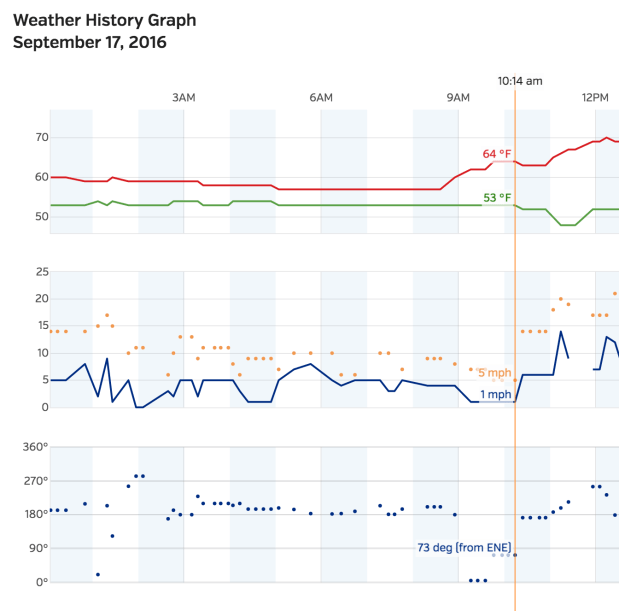
Weather:  Bright sunshine, temperature started in the low sixties, but warmed up.  A Southernly breeze kicked up right when we were starting our race.  This was mostly a cross headwind.
screen-shot-2016-09-17-at-7-21-06-pm

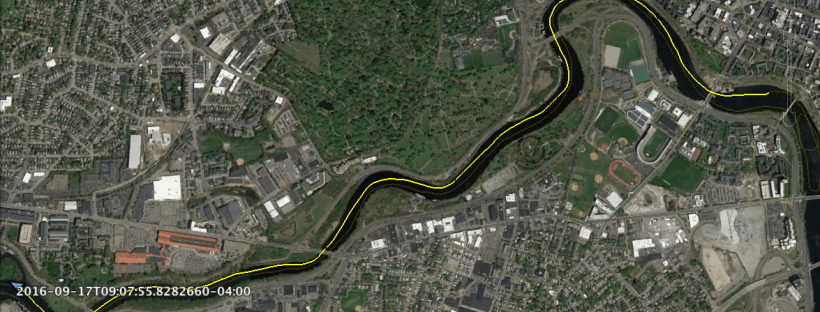
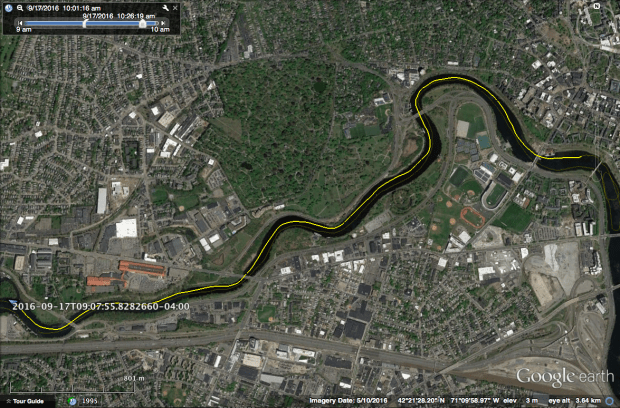
I was rowing stroke, Joe was in the bow.  This is a 5km head race that shares about half of it’s course with the Head of the Charles.  It starts upriver from the Weeks Bridge, and finishes at the CRI boathouse.

It’s not a big race.  There was one event with 2 boats in it before us, the Men’s Open 2x, then us, the Men’s Masters 2x.  There were 5 boats in our event.  And we were starting 5th.  Behind us were the Men’s Junior 2x and then the Men’s Masters 1x.
Screen Shot 2016-09-17 at 6.47.04 PM.png

The race starts at the right and proceeds to the left.  The race plan was broken into 4 parts.

1.  Anderson to Eliot: 1.2km
– Straight shot from  the bridge to the turn for about 600m, then a broad sweeping turn for another 600m
– The hard part is that the turn gets much tighter right at the end so you have to be ready to lean hard on starboard to make the middle arch.
– The race plan is to hit the first 500 pretty hard at about a r28, and then focus on trying to row clean at r26 through the turn.
2.  Eliot to Arsenal: 1.8km
– This is the guts of the race.  It’s pretty straight and there not much you need to do but stay reasonably close to the Cambridge side.
– In this section, we should stick around a r26 and work on keeping it together.
– It is probably a good idea to call some 10s in this section to focus on whatever parts of the stroke are getting wobbly.
3.  Arsenal to N Beacon: 1.2km
-Digging deep at this point.
– I am hoping that we will have managed our pace well enough over the prior section that I can lift the rate to 28 in this section.
4.  N. Beacon to the Finish: 400m (more or less depending on where they set the line.
– I plan to crank the rate up to 30 or higher while we are under  the bridge.
– Coming out of the bridge, with the rate still at 30, you need to call for tons of port pressure to hold  the line.
It didn’t play exactly to plan, but it was pretty close.  We were slower than either of us were hoping we would be.  And we finished last in our event.
Screen Shot 2016-09-18 at 12.28.39 PM.png
So, we finished 53 seconds behind the guys who finished fourth.  So, over a 5k course, that means that we need to improve our average pace by just over 5 seconds.  We did this race at a 2:23 pace.  Here are the splits

|06700|00500|02:15|02:15.0| 27.8  | 161  |08.0| tail wind

|07200|00500|02:14|02:14.0| 26.2  | 169  |08.5| tail wind

|07700|00498|02:27|02:27.6| 26.6  | 173  |07.6|head wind

|08198|00500|02:24|02:24.0| 27.6  | 174  |07.6|cross head for the rest of the way

|08698|00500|02:25|02:25.0| 27.0  | 176  |07.7|

|09198|00500|02:26|02:26.0| 27.3  | 176  |07.5|

|09698|00502|02:28|02:27.4| 27.1  | 177  |07.5|

|10200|00497|02:23|02:23.9| 28.3  | 177  |07.4|

|10697|00503|02:28|02:27.1| 27.8  | 179  |07.3|

|11200|00499|02:21|02:21.3| 29.5  | 181  |07.2|

Reviewing it, it is worthwhile to break it down into parts to try to improve.

1.  Rate:  The overall rate average for the race was a 27.5.  This is higher than it should have been, and that’s entirely on me.  I was over excited and I didn’t do a good job holding 26 through the guts of the course.  The higher rate made it tougher for Joe to stay in sync, especially with all the steering he had to do.  This is just a matter of having better discipline.

2.  Steering:  I am frankly quite impressed with the line that Joe steered.  He has never rowed this river before, and in comparison with the two boats behind us, it was clear that he was steering better and putting distance between us and them at a couple crucial spots in the race.  There were a few spots in the race where we needed to turn sharply enough to hammer our boat speed.  The first of these was right out of the Anderson Bridge, where the river turns toward Cambridge and the buoy line snuck up on us.  The second was the turn into the long straight section by Soldier field.  The river bends toward Cambridge and we swung out into the buoy line.  The final time was coming out of the N. Beacon Street Bridge, right before the finish line.  The turn is quite sharp and we needed really hammer the port strokes to stay on the course.  As I watched some races after ours, it seems like that last turn is a tough on, no matter how perfect your line is.

I think it will be critical for us to get some runs on the HOCR course so that Joe has a chance to learn the land marks and rehearse the turns.

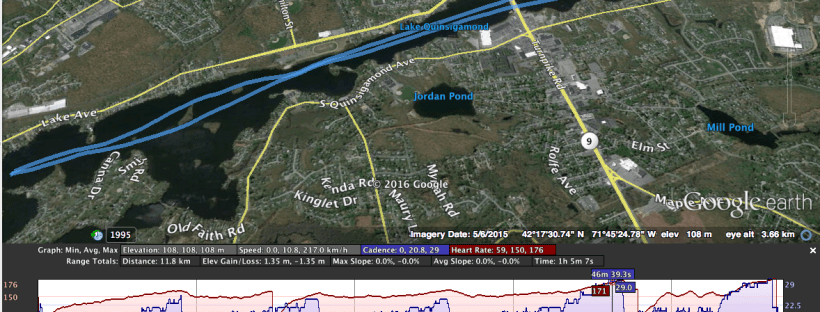
3.  Technique:  Here’s the area where we can do  the most to improve.  All of our practice together has been on Quinsigamond and so, we have just gotten to the point where we can get synchronized and clean on the gloriously long straight sections of the lake.  On a twisty turny river, where we are always pulling harder on Port or Starboard, and Joe has to have his head on a swivel to find the line, we were no where near clean.  I know that my finishes were sloppy, and I was typically dragging at least one blade on recovery.  Joe said essentially the same thing, that trying to steer and maintain the rate really made it hard for him to “get in a groove”.  So what do we do?  A couple of things.  First, I keep the rate at 26, don’t get all fancy with higher rate for now.  Focus on getting good at that rate.  Second, practice full pressure turns.  I took a look at the Eliot turn, and superimposed it on a same scale map of Quinsigamond.   If we turn at full pressure around the big island, and then loop around the small island to the east to go back up lake, we get something that is very much like 2 or 3 Eliot turns.  I think a couple of reps of that during each workout will give us enough time turning under pressure that we can hold our technique better.

9-18c.png

4.  Fitness:  Joe is still rehabbing from a surgical repair for a torn biceps tendon, and I haven’t had as much time or focus as I did last year.  So, I think we have to be realistic.  We have 34 days from now to the HOCR.  Maintaining as full of a training plan as possible will be helpful, but is unlikely to yield massive improvements.  I’m going to stick with my predefined plan.

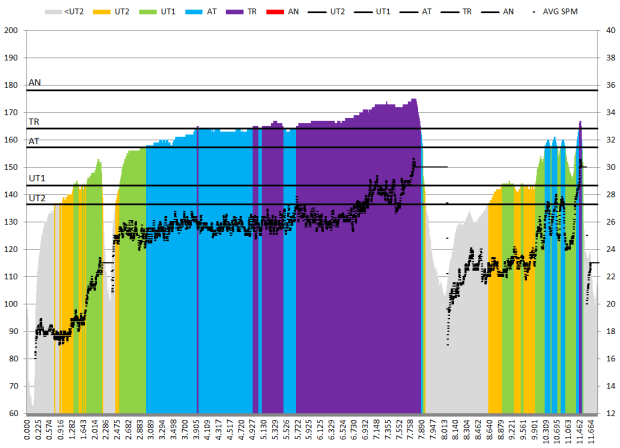
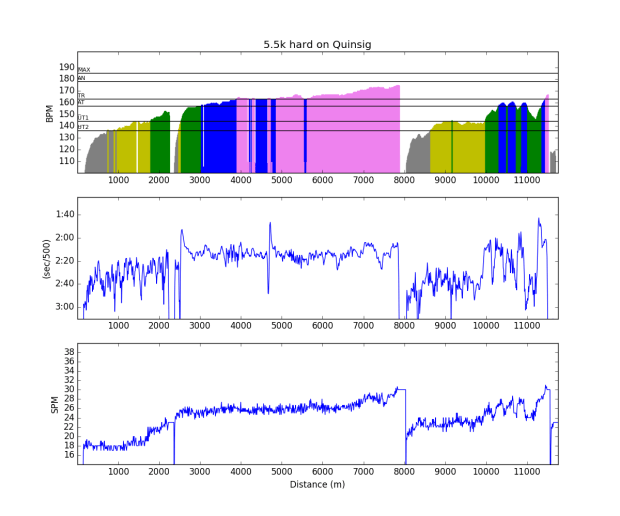
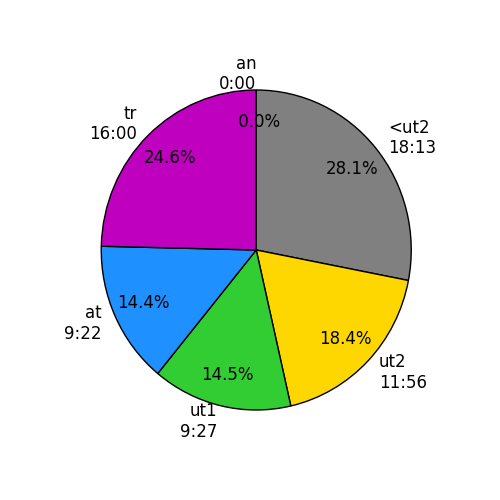
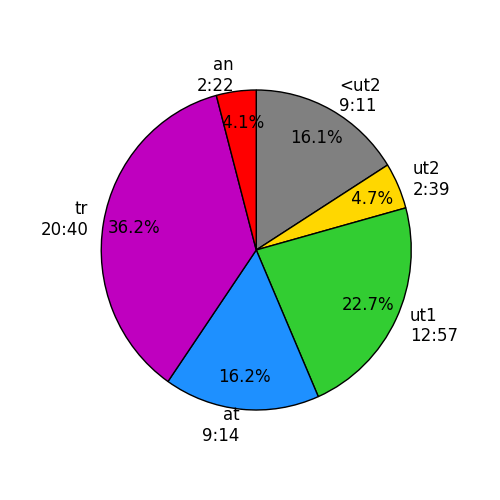
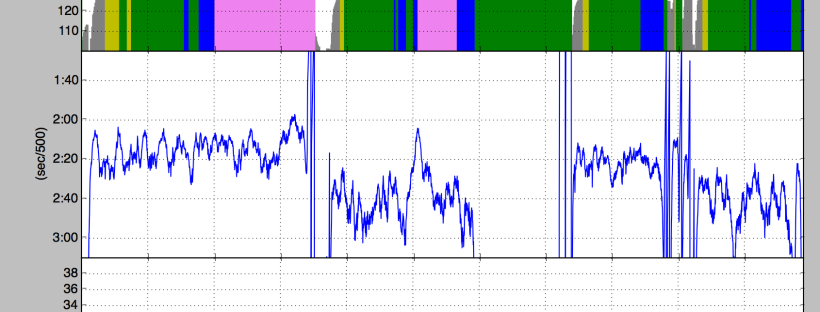
5.  Effort:  As near as I can tell, we both put everything we had into the race.  Here’s the Pace and Rate plots, with my HR.  So, the last 5 minutes of the race was anaerobic.  I felt spent at the end, but pretty much OK.  But at the dock, I experienced something new.  I had a massive coughing jag, and nearly threw up.  It didn’t feel exactly like an erg cough, but it was a bit disconcerting.  But, I certainly felt like I put everything I had into the race.

|00020|06684|53:33|04:00.4| 18.8 | 127 |06.6|warmup
|06700|04999|23:51|02:23.1| 27.5 | 174 |07.6|race
|11699|00493|07:13|07:19.1| 20.5 | 133 |03.3|back to dock

The race was a massively useful learning experience.  The good news is that there is a lot of stuff to work on that will make us significantly faster.  The bad news is that we have a lot of ground to make up.

Later today, I will do a normal endurance session.  Tomorrow morning, back to the lake for a session with Joe.


Monday: Head Race Piece on Quinsig in a 2x

Weather:  A bit chilly, around 50F.  Clear skies, but a low mist was rising from the lake.  This effected Joe a lot more than me because he had to make sure we didn’t hit anything or any body.  There was a very light breeze which seemed to mostly come out of the north, which was a slight tail wind.  Looking at weather stations near the lake, they show no wind at all.

Plan:

  • Warmup to the north end of the lake
  • Hard 5.5km from the north end of the lake to the south end.
    • rate: 26
    • pace: better than 2:15
  • Cool down and a few power pieces back to the dock.

We launched around 5:40 and the sky was just starting to lighten up in the east.  We headed north at an easy 18 spm and got warmed up.  We were in the club’s Vespoli 2x, which I think is a better boat for us.  My foot position was also a bit better.  I had more room at the finish and I like my catch position.  I was still coming down hard on the track ends, so I need to remember by bite guards.

We spun up at the north end and then started the piece.  The intent was to simulate a head race at our target rate and race pressure.  I wanted to make sure that we had some time trying to row hard while carrying a lot of fatigue before we raced next weekend.

I liked this boat a lot more.  I felt like I was getting good strokes in, and there were sections where the boat really felt like it was moving very well.  Probably the best section was during the last third of the piece.  When we passed the first island past the narrows, the boat just seemed to get a lot lighter and we were in very good synchronization.

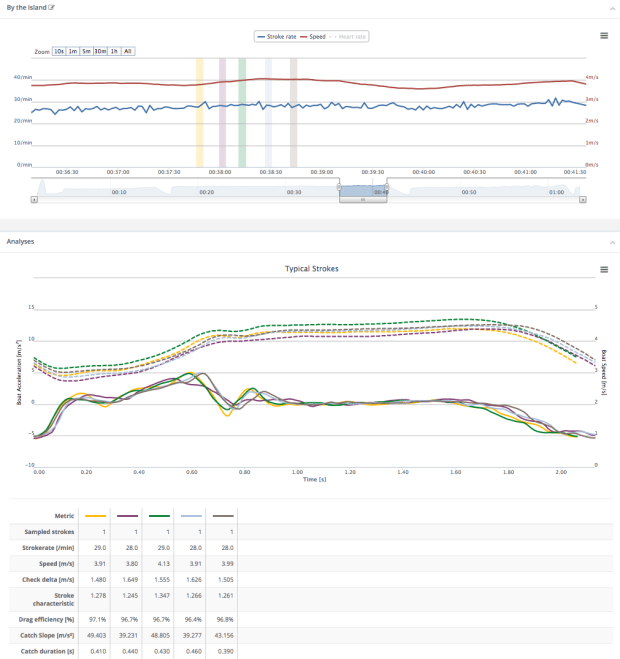
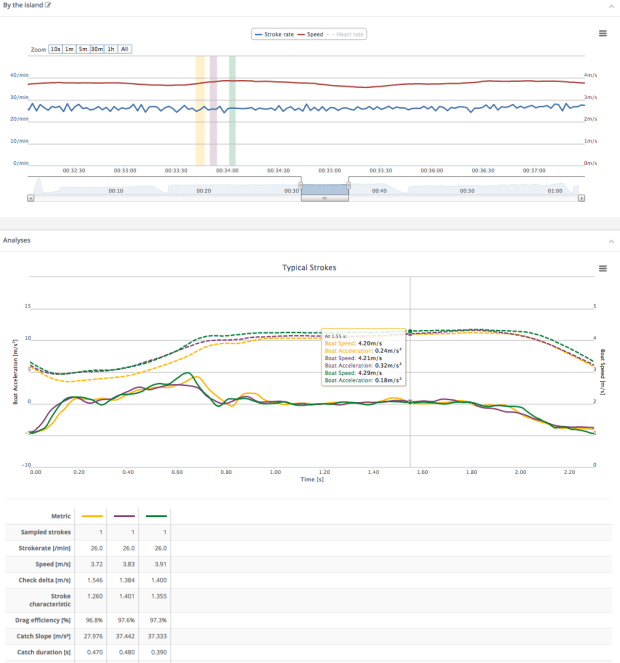
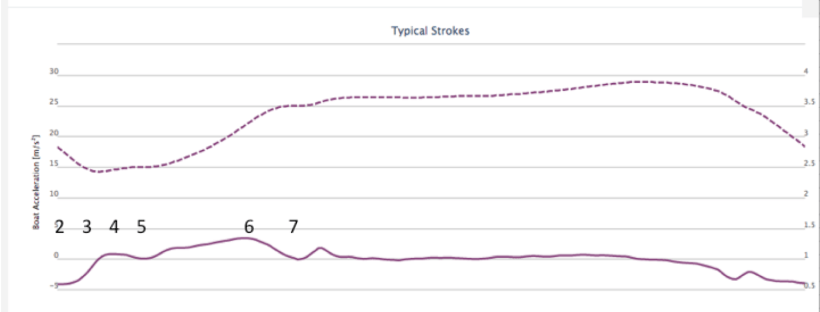
Here is a comparison of our strokes in the first 1000, when we were fresh, but the boat felt a bit heavier and the “magic” section.

I specifically tried to pick out single strokes to avoid any averaging.  The thing that jumps out at me is that we had better finishes in the magic section.  The hump between 0.8 and 1.0 sec is lower.  The acceleration is still sloping up to a peak right before the finish, and I’ve changed my mind to say that it’s probably OK.  In the boat, when we are running well, I can feel the surge late in the leg drive and through the body swing.  It makes sense that it takes more of the stroke to accelerate a heavier boat and two rowers than a single.  The thing that we have to work on is consistency.  Hopefully a couple of rows per week between now and the HOCR, we can lock it in.

This was a much better piece that the one we did on Friday.   The avg pace was 2:14.4, and a fair amount of the time, we were hovering around 2:10.  We would have done even better, if we hadn’t been waked about 500m from the end.  That slowed us down a bit and we struggled to get back up to speed for the last bit of the piece.

On the way back up lake, we took it easy all the way up through the narrows and then did 4 sets of 20 on/10 off.  Then to cap it off we did a 30 stroke piece after we got past the rt9 bridge.

|Start|Dist_|Time_|_Pace__|_SPM__|avg HR|DPS_|Remarks
|00020|02330|13:16|02:50.8| 18.2 | 129 |09.6|warmup
|02350|05502|24:39|02:14.4| 26.2 | 164 |08.5|hard 5.5k
|07852|02046|12:52|03:08.7| 24.1 | 136 |06.6|rowing light
|09898|01349|06:27|02:23.4| 25.7 | 154 |08.1|20 on 10 off
|11247|00239|00:57|01:59.2| 28.9 | 160 |08.7|last 30
|11486|00251|03:08|06:14.5| 24.4 | 122 |03.3|back to dock

|Start|Dist_|Time_|_Pace__|_SPM__|avg HR|DPS_|Remarks
|00000|02330|13:16|02:50.8| 18.2 | 129 |09.6|warmup
|00000|06851|31:06|02:16.2| 26.1 | 162 |08.4|main set
|00000|02046|12:52|03:08.7| 24.1 | 136 |06.6|rests
|00000|00490|04:05|04:10.0| 25.5 | 131 |04.7|cool down

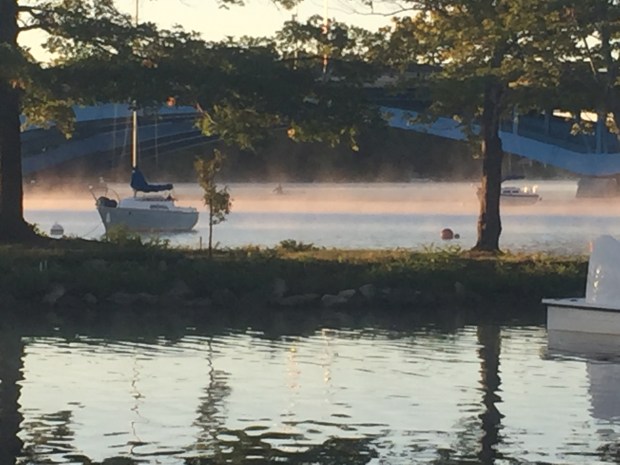
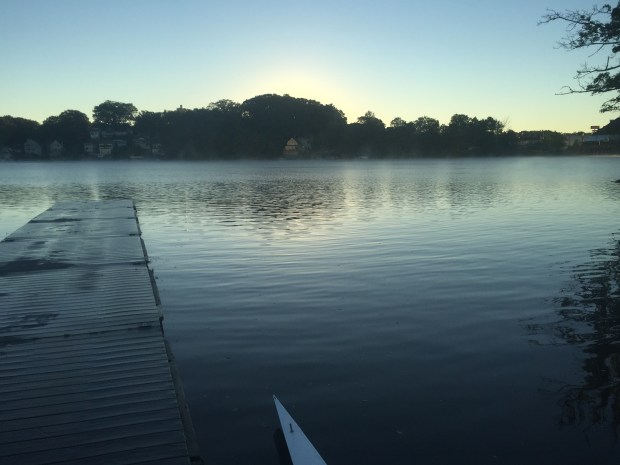
It was so pretty this morning when we landed I could resist taking a few pictures.

Tomorrow:  Back in my single on the Charles for a long and slow endurance session.  r20 and HR cap at 155.


Friday: 5km Threshold in 2x

Weather:  light and variable wind ~2mph from the south.  This was a minor head wind for the main piece.

We boated at about 5:45.  It was just starting to get light out.  Dawn was at 6:21.  This was the first prep session for Joe and I in the double.  We have our first race on Sept 17, and the HOCR on October 22.  The objective for today was to get a baseline for where are now, and to work on timing and technique at head race rates.  Not too concerned about pace yet.  We also have to figure out which boat to use.

Plan:

  • ~2km warmup to the North end of the lake.
  • 5km from north end of the lake to the south cove.
    • 2km at 22
    • 2km at 24
    • 1km at 26
  • Additional short pressure pieces at 26 from south end of the lake to the boathouse.

It was a very enjoyable outing.  I really like rowing with Joe.  He seems to like being in bow, and I LOVE being able to ignore everything else and focus on rowing hard.  I’m not sure about Joe, but I was wiped out when we were done.

screen-shot-2016-09-09-at-12-31-22-pm

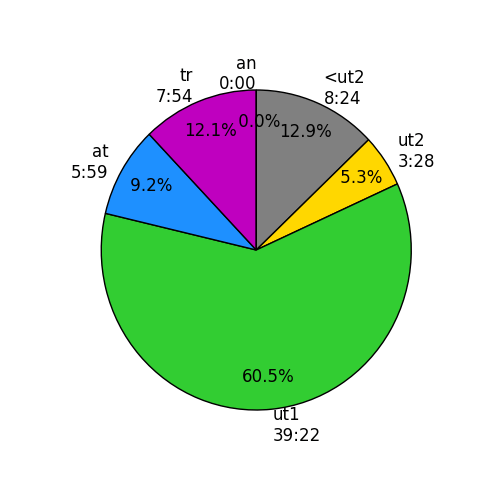
The heart rate indicates that I was working pretty hard at the end.  The pace indicates that we have a fair amount of work to do.

As soon as we started rowing with pressure, it was clear to me that we wanted to rate higher than 22.  We were at 23 or 24 through the first 2k.  Next we shifted up to about a 25 and this felt pretty good, and got better as we went along.  I tried to push the last 1k up above 26 and we probably were closer to 27 on average.   This was a little ragged, but I think it is the right rate target for us to work on.

On the way back up the lake we did 3 sets of 10 strokes and 4 sets of 20 strokes at rates between 26 and 28.  We tried to work on synchronization by rowing very lightly, but at the same rates during the “off” parts of that.

I used RIM for the session and a spent a couple minutes looking at the boat acceleration curves.

Screen Shot 2016-09-09 at 12.25.07 PM.png


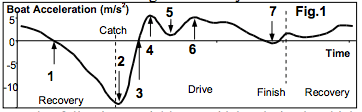
For reference, here is an annotated view of the parts of the stroke on an acceleration curve.

screen-shot-2016-09-09-at-1-05-01-pm

It comes from Rowing Biomechanics newsletter (Kleshnev).

Here is a view of a single stroke from the r24 chunk of the row with the same features noted.

9-9


Looking at the curves and metrics, I think it backs up a couple things I noticed in the boat.  I am not really used to looking at these curves for a double, so I’m not all that sure of my conclusions.

  1. The positive bump right at the finish, right after the #7 is way more pronounced than what I see in the single.  I think this is my fault.  I felt like we were hanging up a bit at the finish.  I was not comfortable with my foot position today.  I was crowded at the finish and so I was pushing down early and hard.  I think an inch more to the bow and I would have been fine.
  2. The peak of the drive bump is quite late in the stroke.  I think that might be a sign that one or both of us is “shooting the slide” a little bit.  I probably need to sit up a bit taller at the catch and really engage early in the stroke.

Next time we row, I think it might be a good idea to use the live display of acceleration and do some 10 stroke bursts with minor changes to technique to see if we can see the change in acceleration.

Tonight:  I’m heading down to the cape. It looks like the weather will be nice for an open water row.  If it doesn’t pan out that way, I’ll go for a bike ride.  In either case, it will be long and slow.

Tuesday: Rate Ladders in a 2x

I had an appointment to have my car serviced this morning and the dealership is out near Lake Quinsigamond in Shrewsbury.  I dropped my friend Joe a note yesterday to find out if he would be interested in taking out a double this morning for a row before I dropped off my car.  He was.  So we met at the lake around 5:45 and took out a nice Vespoli double that we have.

Joe is recovering from a surgical repair of a torn biceps tendon.  He missed all of last season, but this season he is starting to get back to his old form.  We put our names in the draw for the masters double event at the HOCR.  Today was the first time we’ve been out in a double for about 2 years.  We decided to do some rate ladders to work on our timing and try to match up our techniques a bit.

Plan:

  • Rate Ladders: 4′ @ 18, 3′ @ 20, 2′ @ 22, 1′ @ 24
  • Short rests at the south and north ends of the lake.

Weather:  Cloudy, some light rain, warm around 70F.  Wind was from the south at 3 to 5 mph. (1.8 to 2.2 m/s)  The boat felt a lot heavier rowing south than it did rowing north.

Screen Shot 2016-06-28 at 8.06.12 AM

We started out from just north of the rt 9 bridge and headed south.  The first ladder started at 2 minutes.  We hit the south end of the lake at the end of the r20 section of the second ladder and turned around to finish the r22 and r24 sections.  Rowing north was a treat.  The boat felt light and I felt like our timing was working better.  One challenge we have to work on is that Joe and I seem to want the boat to lean in slightly different directions.  I always feel like the boat is leaning a bit to port.  Another thing to work on is finishes.  I noticed that my finishes were sloppier in a double than in the single, I imagine because the stroke is a bit quicker.

We finished the 3rd ladder about 1000m south of the route 9 bridge and continued into the fourth.  By the time we got to the r24 part of the fourth interval, I felt like we were rowing pretty well together and I called that we would go keep pushing the rate up.  I heard the reaction, I was hoping for from Joe in the bow…”Alright!”.  So, a minute at 26 felt great.  Then up to 28.  This started to be a bit more ragged, but still good fun.  Then finally to 30.  This was pretty nasty rowing, and not really any faster than the r28 bit.  I don’t know about Joe, but I was feeling pretty winded by the time we were into the r30.  We finished the r30 section right before we got to the I290 bridge and paddled it out to the north end of the lake.

There is just about 3K from the north end of the lake to the boathouse.  We decided to do 20 strokes on / 20 strokes off until we had about 500m to go and then finish hard…just in case there was anyone at the boathouse to impress :-).

With about 700m to go, I brought up the rate and with 500m to go we went to full pressure at r28 and I started counting strokes to the finish.

I really enjoyed that.  From a pure training effectiveness perspective, I probably should have kept the intensity a little lower, but I think it was good to work on technique at higher rates, and it was fun.

Looking at the biorow data, the wind would have slowed the pace down about 9 seconds going south and sped us up about 7 seconds going north.

Tomorrow:  Back in the single.  Race prep.  Standing starts, 15 strokes, 1′ rests over and over.


Saturday: Windy outing in a 2x

Out on Lake Quinsigamond with Bob in a double.  Quite windy.  Here’s the weather data from the station nearest the south end of the lake.

Screen Shot 2016-04-17 at 4.12.26 PM.png

So, wind speed 10 to 15 mph from the NNE, which is a head wind heading up lake.  The gusts were impressive, basically boat stoppers.  Bob was in bow and he tried to hug the easter shore of the lake when we were heading north.  This helped a bit and gave us flatter water to work with.

The north end of the lake was off limits because of racing.  So we did a loop to the south end of the lake, and then a shorter loop just down through the narrows.

Screen Shot 2016-04-17 at 4.09.38 PM.png

Because the conditions were a bit challenging, we basically just did it as a steady state row.  We were out with a two quads.  The only time we really pushed it was when we were going south on the first leg and were in a position to pass one of the quads.  That was the boost in heart rate in the first section.  The blank bit from 6000 to 7000 meters was while we were rowing up lake into the wind and my phone got splashed just right to fool Crewnerd into thinking I wanted to go to the setup screen.

Screen Shot 2016-04-17 at 3.49.09 PM

The conditions were not ideal, but I had a good time.  I enjoyed rowing with Bob and frankly, anytime I get to get on the water right now is a welcome change.