Training Principles

It’s a rest day, I’m on a plane heading out to San Diego, and I am bored.  I’m also still trying to workout the best way to train with my work and travel schedule as crazy as it has been.

Any training plan that I devise will need to be quite flexible and simple in order to succeed.  To do that well requires a return to the principles that I have learned about successful training approaches.

Principle #1:  Decide why you are exercising or training.

It is possible to have multiple answers to this question.  In fact, the more reasons you have, the more likely you are incorporate exercise into your life on a permanent basis.  I started exercising as part of an effort to lose weight, and it worked.  I took off 50 pounds.  I also was diagnosed with high blood pressure and my family has a history of cardiac and circulatory disease, and I don’t want to die.  These are the underlying, bedrock reasons why I want to regularly exercise.  But these have been true for my entire adult life, and they were not sufficient to motivate regular exercise until I found a way to connect in to my competitive drive.  Basically, as soon I found the Concept2 online rankings, I wasn’t exercising anymore, I was training.  Specifically, I was training to row faster.  Even more specifically, I was training to row faster than other people.

Rowing on the erg led me to rowing on the water, and that opened up new challenges, both in trying to master the technique and also new ways to compete.  Not only did physical fitness matter, but so did technique, steering, strategy and experience.

Now in addition to objectives to stay healthy, I work to be a better, faster rower than I was the year before and to try to catch up with people that are faster than I am.

Principle #2: Decide how much time you have to train.

Once you do, try to stick to it.  Be brutally honest with yourself up front.  I’ve experienced how demotivating it is to plan more training than I can do and then miss sessions and lose momentum on a training plan.  It would have been much better to set my sights lower.

Principle #3: Set specific a objective and use it to guide your training.

I choose a specific race in the future.  Right now, it is the Cromwell Cup, a 1000m sprint in a few weeks.  After that it will be the Head of the Charles, which is a 5K head race.  You need to know what you are training for to plan out how to train.

Principle #4:  Plan your training before you go to train.

This can be at different levels of specificity.  It might be much easier to decide ahead of time the exact sessions that you will be doing for the next three months, but that only works if you have very good control of your schedule.  If you schedule is erratic, a specific day by day plan won’t work.  In that case, planning a certain mix of training for the week and shuffle it around to make sure that the highest priority sessions get done.  Right now, I am in final prep for a sprint race on July 10th, so my weekly guide is:

  • 2 or 3 sessions that include racing starts
  • 1 session a week with 500m to 1000m intervals at close to race pace
  • 1 session a week with 100m to 500m intervals at faster than race pace
  • as much volume below 2.0mmol/l lactate as I have time for

Principle #5:  Hold yourself accountable.

I find this easiest to do by training publicly.  I try to define my next day’s workout the day before and put it in my blog.  I know that very few people read it, but the fact that I’ve done that makes me feel accountable to either do what I planned or explain why I didn’t.  It is important to make the distinction between accountability and rigidness.  If I don’t follow through with the planned workout, or if I don’t hit my targets, that isn’t a failure.  I just want to be honest with myself about why I changed the plan or wasn’t able to execute it.  That way I can adjust and improve.

Principle #6:  Evaluate performance objectively.

Set quantitative goals and use performance tracking to determine if they are met.  Use past performance to set goals for future workouts.  Try to do the same thing if you are working on technique.  Either use video, or acceleration data to see if changes in technique actually occur.  My ability to remember past performance and discern if I have corrected technique problems is limited at best.

Principle #7: Seek advice, carefully evaluate it and decide if you will use it

There are many people with opinions.  Not all of them are well informed.  It is up to you to figure out what advice is credible and useful and what is not.  Try to establish the quality of the source of advice.  Try to understand the principles on which the advice is based.

Principle #8: Miles make champions

Endurance is critical to all rowing competitions longer than 500m. Building a strong aerobic base is necessary to perform well. The most important factor to building endurance is the volume of training done at low intensities.

Low Intensity Training (LIT) is defined by a blood lactate level below 2.0 mmol/l at the completion of the workout. In order to maximize the effectiveness of endurance training, blood lactate level should be greater than 1.4-1.6mmol/l at the end of the session. Lactate levels should be periodically checked and as fitness improves, LIT intensity should increase to ensure that the end work criteria of 1.4-2.0mmol/l is met.

Endurance training can be continuous or interval based, constant rate or variable rate, as long as it meets the intensity criteria. Up to 1/2 of all endurance training can done as cross training.

Lactate testing is a pain in the ass, does not provide realtime feedback and is pretty much impossible to do in a boat, so an alternative method of gauging intensity is needed. The best alternative for is to use heart monitoring and Rate of Perceived Exertion (RPE) together. By using HR in sessions where lactate is checked, a rough correlation between ending HR and lactate level can be drawn. This can be used as a limit in future workouts until another lactate test is done. The important thing to remember is that this is not a very exact thing. A little too hard or a little too easy will not have much impact on the effectiveness of the workout. The key thing is that easy workouts should be easy.

Principle #9:  If all you do is row slow, you will get good at rowing slow

High Intensity training is necessary to maximize performance at any distance from 100m to a full marathon.  There are different energy systems that are used in maximal efforts.  If these are not specifically trained, performance will suffer.  At least 2 sessions of high intensity training per week.  High Intensity Training (HIT) includes very short intervals, short intervals, long intervals, and hard distance workouts.  The key criteria of these workouts is that lactate levels well above 4.0mmol/l are achieved.  The most convenient way to measure this is to track HR and measure time above lactate threshold.

Principle #10:  You need to be able to pull hard to win races

The ability to generate high peak force on the handle is critical to achieving good speed off the line and to be able to sprint at the finish.  The more force you can exert also means that you can work at lower stroke rates with higher efficiency.  Including some kind of peak power training is useful, especially for sprint racing (1Ks, 2Ks). This can be done on the erg or in the boat with very short intervals with generous rests, or through weight training.  During sprint season, at least one session per week should include peak power training.

Principle #11:  Strength Training is useful, but not critical

This is disputable.  If you have specific strength deficits, then strength training can help with them.  Otherwise, it is mainly useful for muscle group balance and injury prevention.  Right now, I have deprioritized strength training in favor of additional endurance training within the time budget that I have set.  I know that other folks believe this should be a higher training priority.

Principle #12:  Mesocycles work, change it up.

Performance improvements will plateau after 4 to 8 weeks of training with a specific focus.  To combat this plateau, mesocycles can be used to vary the focus of training in blocks.  This can be programmed in a way to build toward a specific event and yield better results than a plan that has the same types of sessions over time.  The final mesocycle before a key event should be focus on maximize performance for the event type.

Principle #13:  The overload principle

Improvement in performance comes from the overload principle. For high intensity workouts, setting targets for pace to be slightly faster than previous results.  For low intensity workouts, increasing duration, and nudging up pace to stay in the desired lactate range over time.  Gradual overload is important.  Big steps in pace are an invitation to disaster.  Big increases in volume can lead to injury as form suffers when you are fatigued.

Principle #14:  Resting is part of training

Rest and recovery are critical to progress.  It is OK to have weeks that over load and under recovery, but these must be followed by weeks where the recovery takes place.  As a general rule taking one day of complete rest per week is vital.  By complete rest, I mean no rowing at all.  The logic behind no rowing is to reduce the risk of repetitive strain injury.  Some kind of other gentle exercise is OK as long as it isn’t long duration and isn’t intense.

Principle #15:  Get a coach

A principle I haven’t been able to follow, but is holding me back.  Real time feedback on performance, especially on technique is critical to improvement.   One Caveat, you and coach need to agree on principles.

Principle #16: Training is easier and more fun if you have training partners.

Thats the thing that I miss most by developing my own training plans.

Principle #17: Lighten up.

If you are reading this, then it is more than likely that you aren’t a professional athlete. We all have jobs, friends and family that are more important than achieving perfection in the execution of our training plans. I am all for having the grit to pound out that last 500 when your legs feel like jelly. I am all for dragging my ass out of bed at 5:15 to get in a training session before work, but if life gets in the way, that’s OK. There are more important things in life than rowing a long skinny boat faster.

Principle #18: Be resilient.

This one goes along with the one before. If sports are not your number one priority, then it is likely that your life will sometime conspire to make you miss your training objectives. When it happens, and it will, just pick yourself up, honestly assess where you fitness is and make a new plan. One of the best things about keeping good training records is that you can look to see how much training you’ve missed and spot trends like regularly missing training volume plans. You can use this to make your plans more realistic or change your priorities or schedule.

Principle #19: Be skeptical.

The world is full of people that are full of crap. They use the internet to spread the fertilizer. There is a lot of good advice out there too. It’s hard to know what is real and what isn’t. Here are my thoughts.
– Research is limited and flawed, but at least multiple people with lots of training in the field have looked at and critiqued it. Its up to you to figure out if it actually applies to your situation.
– Beware of plans for Olympians: I think the most important factor in race performance is total training volume. Elite athletes spend 40 hours a week training. I spend less than 10. That difference is huge and limits the applicability of anything done at an elite level.
– Beware of the “It worked for me” folks. That means you should beware of me too. The critical test is whether or not the advocate can answer the question, “Why does this work?” If it is not based on testable principles or there are not good answers to reasonable questions, then proceed with some caution.
– Beware of facts not in evidence. If someone says that they improved their 2k score by 20 seconds by doing two high intensity erg sessions a week, try to find out what else they are doing. For all you know, they might be running 10 miles every morning. If you just do the erg part, you will probably not see the same results.
“Grit”

Today while I rowed, I listened to a podcast called “Hidden Brain” on the topic of “Grit”.  Here’s a link if you are interested.  

There is a fair amount of research that links success in many fields not to innate talent, but rather to the tenacity, passion and drive needed to put in the work.  The key appears to be a willingness to engage in the most unpleasant type of practice, the deeply mindful concentrated work on the things you find most difficult.  I think another aspect to “grit” is the ability to take setbacks and then just go back to work on improving.  To quote a slightly different source, there is a lyric in the musical “Hamilton” that is stuck in my head.  There is a character in the play named Hercules Mulligan, a spy in the revolutionary war.  I have no idea what he was like actually, but in the play he is a brash talking, tough guy.  Here’s the quote…

MULLIGAN:
To my brother’s revolutionary covenant
I’m runnin’ with the Sons of Liberty and I am lovin’ it!
See, that’s what happens when you up against the ruffians
We in the s**t now, somebody gotta shovel it!
Hercules Mulligan, I need no introduction
When you knock me down I get the f**k back up again!

I like the attitude embodied in “somebodies gotta shovel it” and “When you knock me down I get the F back up again”.  I think success has a lot more to do with getting back up again, than anything else.

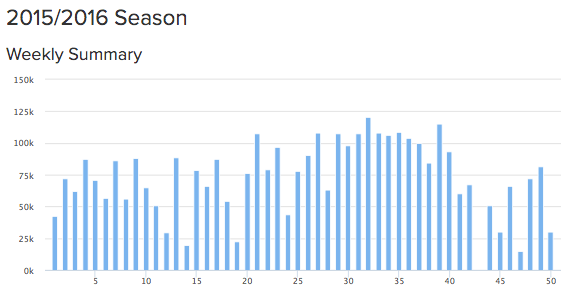
Sorry to get all philosophical, but the past month and half have been difficult for me.  My new role at work is demanding a lot more travel, and frankly a much deeper commitment, and I have been dealing a bunch of minor disruptions at home as well.  The result is a dramatic reduction in training volume.

Screen Shot 2016-04-08 at 10.28.28 AM

Week 41 is the beginning of February, and I went from averaging over 100km per week to around 50km per week.  This is just rowing meters, so, there was training volume in week 42 (while on vacation), and other weeks while on travel, but it is inevitable that I will have a decline in rowing fitness with this reduction.

So, the plan is to just keep on plugging.  I will train as much as I can, and make maintaining my aerobic base the priority until  things are a little more under control.  So, as much endurance training as I have time for and then 1 or 2 spicier sessions a week.


Re-evaluating objectives

Well, I started this blog post about 5 times and couldn’t even figure out what title to give it.  The bottom line is that I have to change how much time I devote to training, and thinking about training.  The good news is that I was promoted at work and my new job is an exciting new challenge.  But along with this new challenge, I think that I need to focus my energy on succeeding in my new role to an extent that I have to budget my time more carefully.

One of the challenges of my personality is that I am not one for moderation.  If I row, I want to achieve at the highest level that my physiology will allow.  Working out for the sake of heath and fitness bores me to tears.  I really live for competition and half the fun is trying to figure out how to get better.  I’m genuinely struggling with the idea of setting limits on training and then “doing my best” at competition.  It sounds dangerously like phoning it in.

Obviously this is something that I am going to have to figure out for myself.

The first decision I need to make is whether or not to compete at the CRASH-Bs this Sunday.  My race prep has been hampered by the fact that 2 of the last 4 weeks I have been traveling for business and last week, I was on vacation in Aruba (I know, life is tough, isn’t it).  But now I have 5 days to competition and I’m sure I will struggle to post a respectable time.  Part of me thinks using this week to determine a doable pace and going to the race is the best idea.  Part of me wants to just blow it off since I’m pretty sure I will be no where near PB territory and it might be my slowest race ever.

Beyond this weekend, I think I need to come up with a simple, periodized approach that limits weekday workouts to 60 minutes of gym (or water) time.  I also need to find a more efficient way to log and analyze training results.  Finally, I think I need to limit my OTW racing to a couple events per year.

It will be interesting to find the balance that keeps me challenged on the erg and in the boat, and manages the time commitment more closely.

My least favorite thing to think about: Nutrition

Sander posted a comment on yesterday’s post that referred to a very good article on nutrition from world rowing.  I really appreciated the advice, and  wanted to make sure I could refer to it in the future, so I’m linking to it here.

Fueling the Sponge

I have made slight changes to the way that I eat to try to improve performance.  The biggest was doing endurance sessions in a fasted state because of some stuff I read that high blood sugar levels would lead to preferential use of CHO metabolism versus fat metabolism. Essentially it would push the cross over point between CHO and Fat metabolism to a lower training power, and potentially higher lactate levels for a specific power.

Beyond that, I try to eat a reasonably healthy diet, but I really like some stuff that is bad for me.  Sweets, red meat, salt  all the bad stuff.

I’ve read some material about very low carbohydrate diets and “Fat Fueled athletes”, but they seem to be a bit too much of a lifestyle commitment for me.

This is an area that is rich in controversy and replete with opinions, both informed and uninformed.  But this article seems simple and reasonable.


HOCR Steering Notes

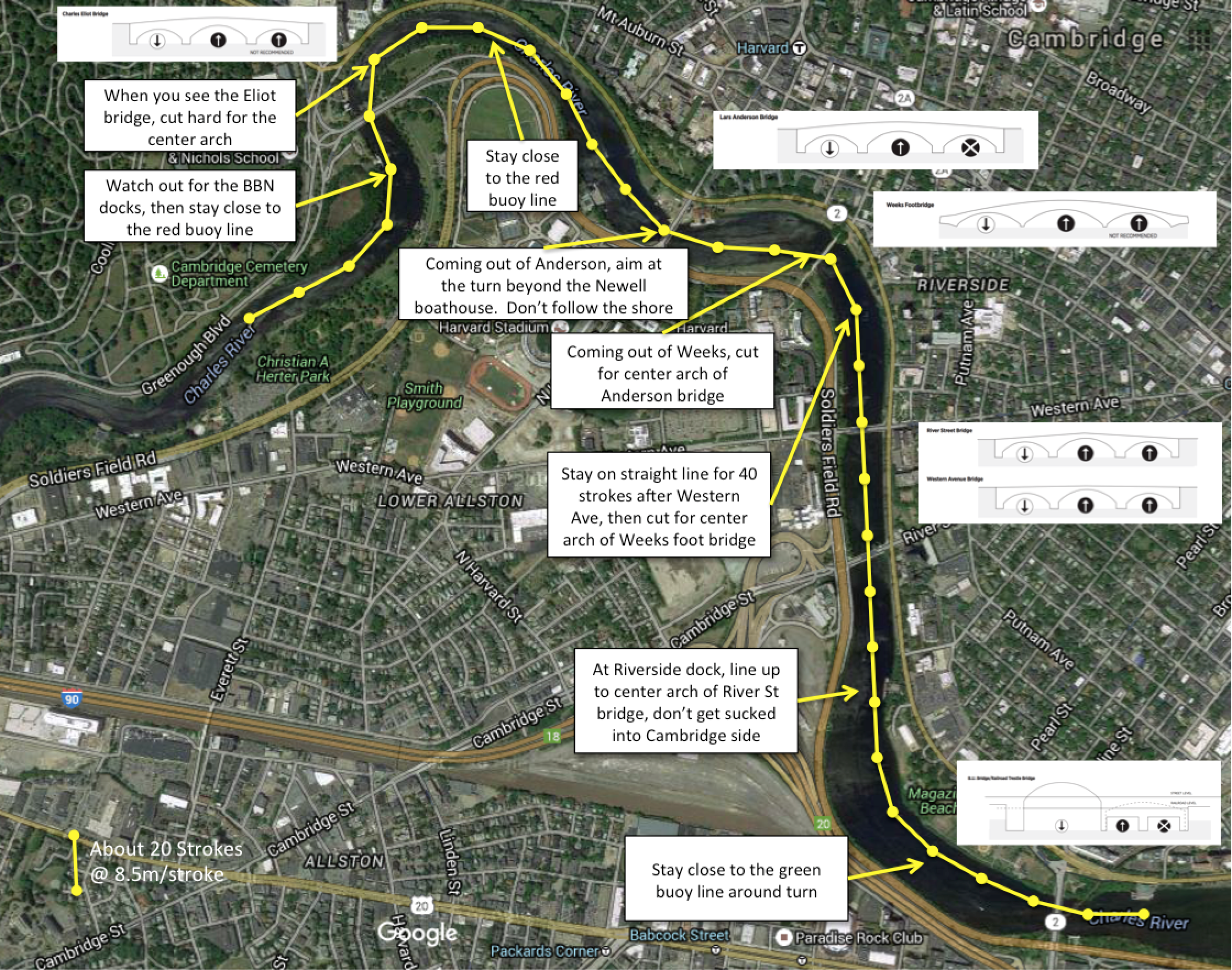
I’ve read and watched a bunch of different descriptions of the best line to take through the course.  I decided to try to put it all on a map so I can try to memorize it.  The key thing for me was to try to understand roughly how many stroke it is between different points in the race and where I need to take steering actions.  Apparently the turn for the Weeks bridge is a big one that you can mess up by going too soon or too late.

Screen Shot 2015-10-14 at 4.14.54 PM

Another taper plan – From Rowing Faster (Ed McNeely)

Based on the a comment from Tom (Stelph), I went and looked at Chapter 19 of the second edition of Rowing Faster.  This chapter is written by Ed McNeely and in principle is quite similar to the taper I wrote up from the Shepley Paper.

Basically, the idea is to maintain the intensity of the training, but reduce the volume.  In the Shepley paper, the protocol was to warmup, do a small number of ~75sec intervals then cool down.

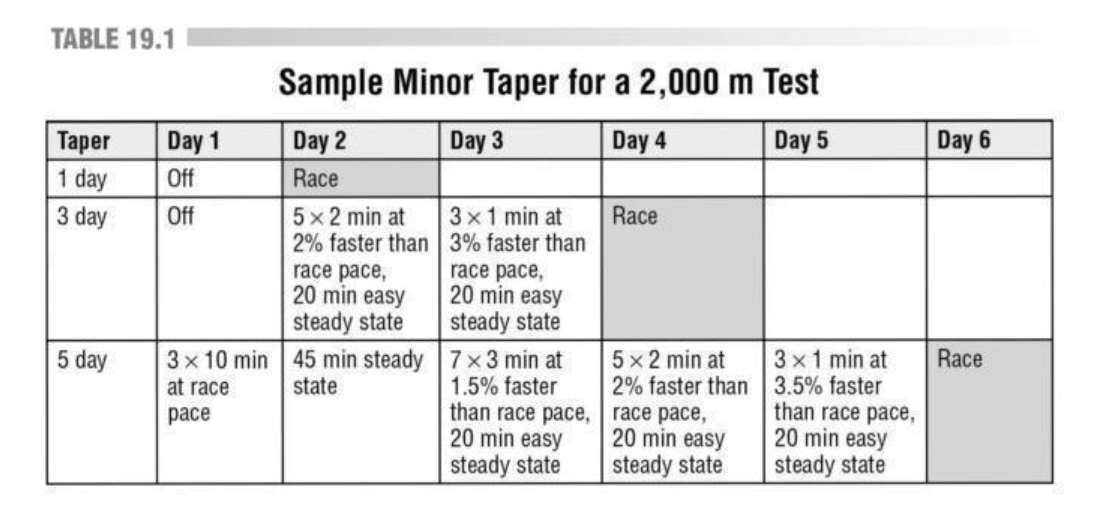
The chapter defines 3 types of what it calls “minor tapers”.  I doubt anyone who isn’t competing at a collegiate or elite level would consider the moderate or major tapers, unless perhaps you are planning to race against blood thirsty cannibals in a set number of months and your life depends on the extra second of pace.

But back to minor tapers.  Here is a table of the three that were defined.

Screen Shot 2015-10-02 at 3.23.35 PM

The primary difference is that instead of doing the same type of interval and just reducing the number as you approach race day, you change the number, length and intensity of the intervals.

The type of taper is driven by your training load.  A 1 day taper for athletes training 6 to 10 hours a week.  3 days for athletes training 10-15 hours.  5 day taper is for those hardy souls training more than 15 hours a week.  I checked my log and I am training about 7 to 10 hours a week, so I guess in Ed’s world, I don’t need or deserve a taper.  I actually think this is an elite versus masters kind of difference.  The amount of taper you need is probably driven by how much recovery you need from whatever training load you are carrying.

The 1 day taper is a misnomer.  It just means that you take a complete rest day the day before the race.  I don’t like that idea much.

The 3 day taper seems simple enough.  It seems like 5 x 2′ at faster than race pace might be a bit harrowing.  I did 4 x 2′ at 2k pace on the erg and I don’t think I could have done them 2% faster (1:38 vs 1:40 pace).  Maybe an elite athlete could.  The 3 x 1′ at 3% faster than race pace looks pretty cool, and I think the 20 minutes of steady state is probably about the same as the warmup and cooldown from the Shepley paper.

I have to admit some confusion about the 5 day taper.  This is a taper for a 2000m race, which will probably take somewhere between 6 and 8 minutes.  So how is it possible to do 3 x 10 minute intervals at race pace.  I have to assume that is a typo.  If you can do 10 minutes at race pace, it isn’t race pace. After that there is a steady state session, then 7 x 3′ at faster than race pace, which I would not be capable of doing on my best day.  Then the 5×2′ and then the 3×1′ sessions from the 3 day taper.

How would I apply this to my world?  I honestly don’t know.  I think that I would probably look at the 3 day taper and ignore the other ones.  For the 3 day taper, I would need to adapt it by adjusting the pace targets.  I would target about race pace for both the 2′ and 1′ intervals.

Unlike the Shepley paper, there is no real evidence presented about the effectiveness of the taper versus other approaches, so it is hard to judge how well it works, but Ed McNeely certainly has impressive credentials so you could do worse than to trust his advice (other than the 3×10′ at race pace thing).

By the way, Rowing Faster is a great book.  I have the kindle version of the 2nd edition.

What the best way to taper for a race?

I’m sure that there are an infinite variety of ways to taper and just as many principles and theories about what works best to delivery peak performance on race day.  In the Wolverine Plan, Mike Caviston writes the following…

Tapering is the practice of reducing training volume & intensity prior to competition to ensure peak performance. While it is a common perception among athletes that a taper is necessary to allow maximal performance, this is not clearly supported by scientific research. The benefits of tapering are most evident in situations where athletes were clearly overtraining in the first place. In other words, the benefit is not so much the taper per se, but removing the negative effects of overtraining. In situations where training volume and intensity are properly controlled, the effects of tapering are less substantial. Now, this is not to say we won’t taper before important tests and competitions. We will. Rest assured that we have your best interests at heart. But some athletes expect a vacation and are disappointed when all they get is a modest reduction in a pretty demanding schedule. The fact is the only noticeable reduction in training will occur during the week prior to NCAAs. And the benefits are probably far more psychological than physical.

Needless to say, there are different view points, and in fact some research that contradicts this point of view.  For example this paper:

This paper is from 1992, and it is an interesting experiment.  It was a study of collegiate middle distance runners.  There were 9 participants that went through a 8 week training period where all of them followed the same training plan.  They were then divided into three groups of 3 and each group followed a different taper plan.  Then after four weeks they did another taper, and after 4 more weeks a final taper.  So each athlete used each taper once.  At the end of each taper, there was a series of performance and physiological tests including:

  • VO2Max
  • time to exhaustion at 1500m running pace
  • Strength
  • Blood lactate
  • Blood volume
  • Red Cell Volume

The three tapers were all 7 days long, day 1 and day 6 were both rest days.  The Low Intensity and High Intensity tapers both included warm ups in addition to the details below.

  • rest only
  • Low Intensity: 10km run at 57 to 60% VO2Max on day 1, 8km on day 2, and so on.
  • High Intensity: 5 x 500m interval at 115% VO2Max with 6 to 7 minutes rest between.  This is roughly 75 seconds of running in each interval, at roughly 1500m pace.  On day 2, 4×500, and so on.

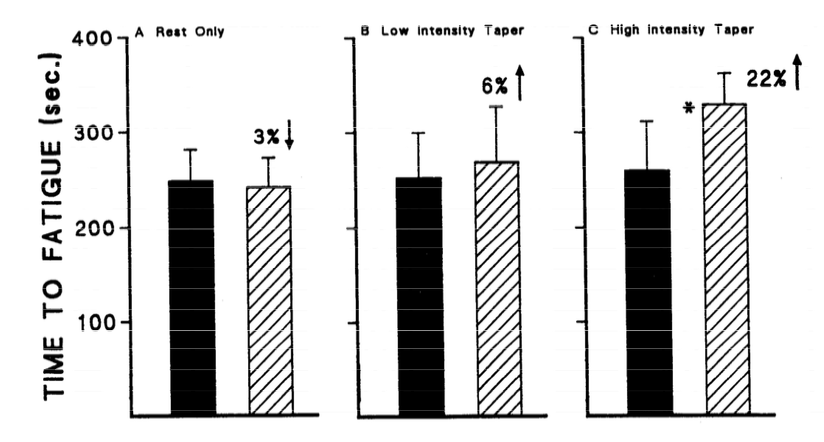
The results are interesting.  Here is the money plot.

Screen Shot 2015-09-30 at 9.26.01 AM

The rest only taper resulted in a 3 percent decline in performance relative to tests right before the taper. A low intensity taper resulted in a 6% improvement. The high intensity taper resulted in a 22% improvement in time to exhaustion at 1500m pace.

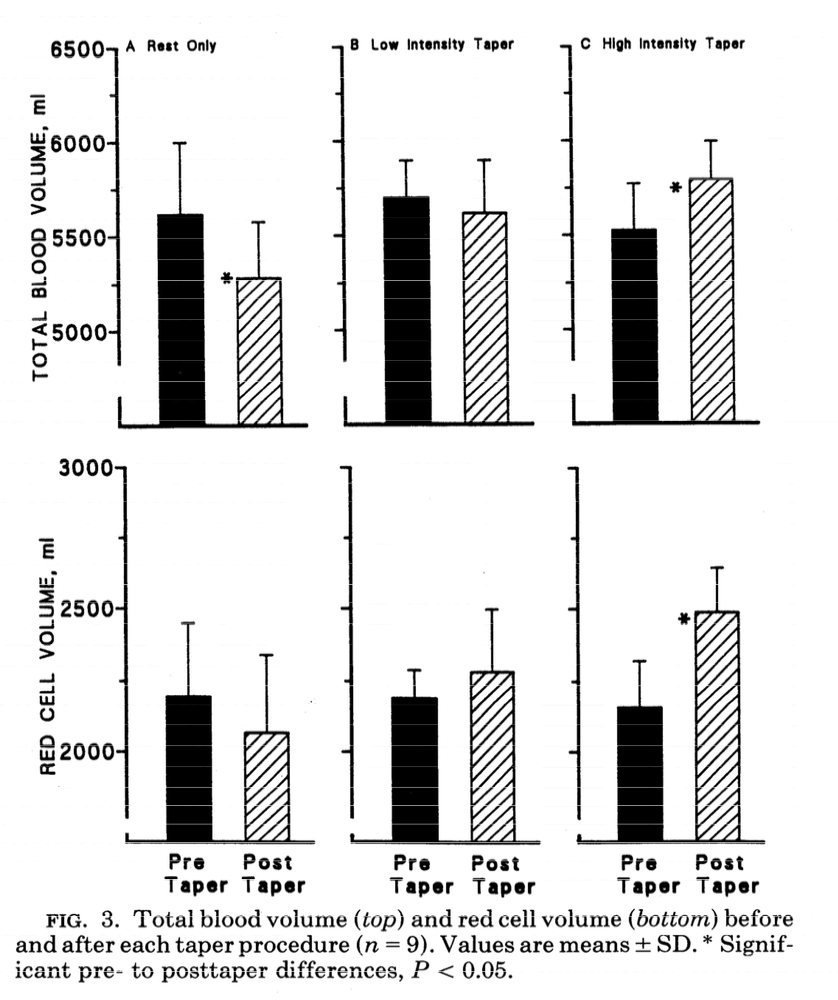
This performance measure is backed up with the blood tests.

Screen Shot 2015-09-30 at 9.30.02 AM

Both blood volume and red cell volume were increased the most in the HIT group.

Based on this paper, I plan out tapers simply by counting back from race day as follows

  • Race day
  • rest day
  • 2 x 500 (or 1:30) with 5 min rests
  • 3 x 500 (or 1:30) with 5 min rests
  • 4 x 500 (or 1:30) with 5 min rests
  • 5 x 500 (or 1:30) with 5 min rests
  • rest day

I would do this for the most important race of a season.  For less important races, I would shorten the taper by 2 days and start with the 3 x 500.

I’d like to thank Ben Redman for pointing me to this paper.

From Polarized to Optimized. New Lecture from Prof. Steven Seiler

I am trying to get a handle on periodizing my training.  The book The Science of Winning by Jan Olbrecht makes a big point that an athlete will plateau after 8 to 10 weeks of consistent training and the training durations and intensities must be modulated to maintain progress.  This lecture takes a different view.  That periodization is highly variable from athlete to athlete and must be evaluated with a view toward individual progress.  Changes have to be made if the desired training effect is not seen.

He describes an experiment conducted with well trained cyclists.  The 69 cyclists were divided up into 3 groups.  Each group followed an 80/20 polarized training plan, but the higher intensity training was varied between the groups.  Here is the plot showing the average training hours per athlete per week in the study.

Screen Shot 2015-09-27 at 4.49.00 PM

All three groups had 4 week mesocycles with varying workloads and you can see the difference in how well rested the athletes felt in those week.

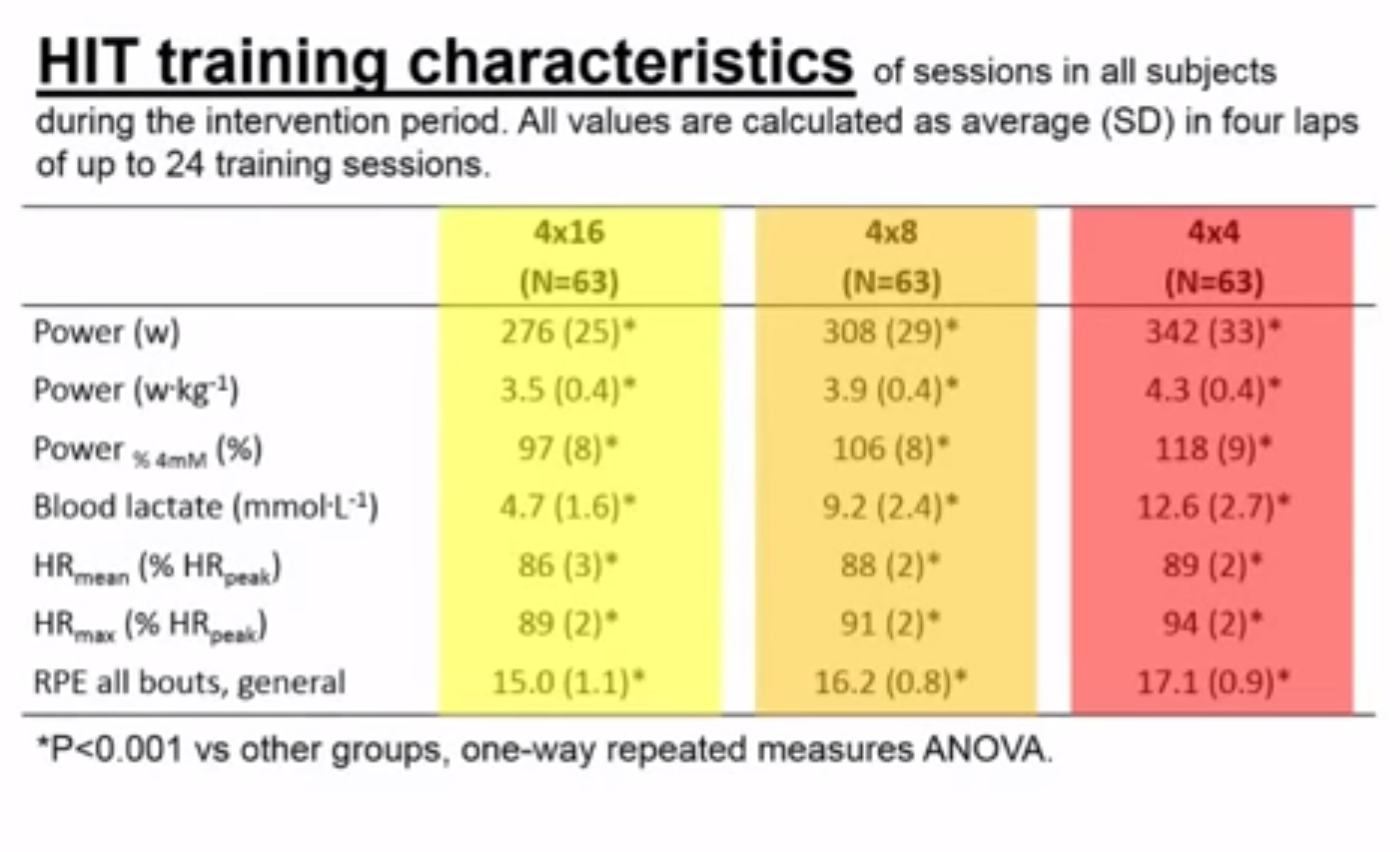
Each of these three groups were given different a training plan.

Screen Shot 2015-09-27 at 4.41.11 PM

Screen Shot 2015-09-27 at 4.41.47 PM

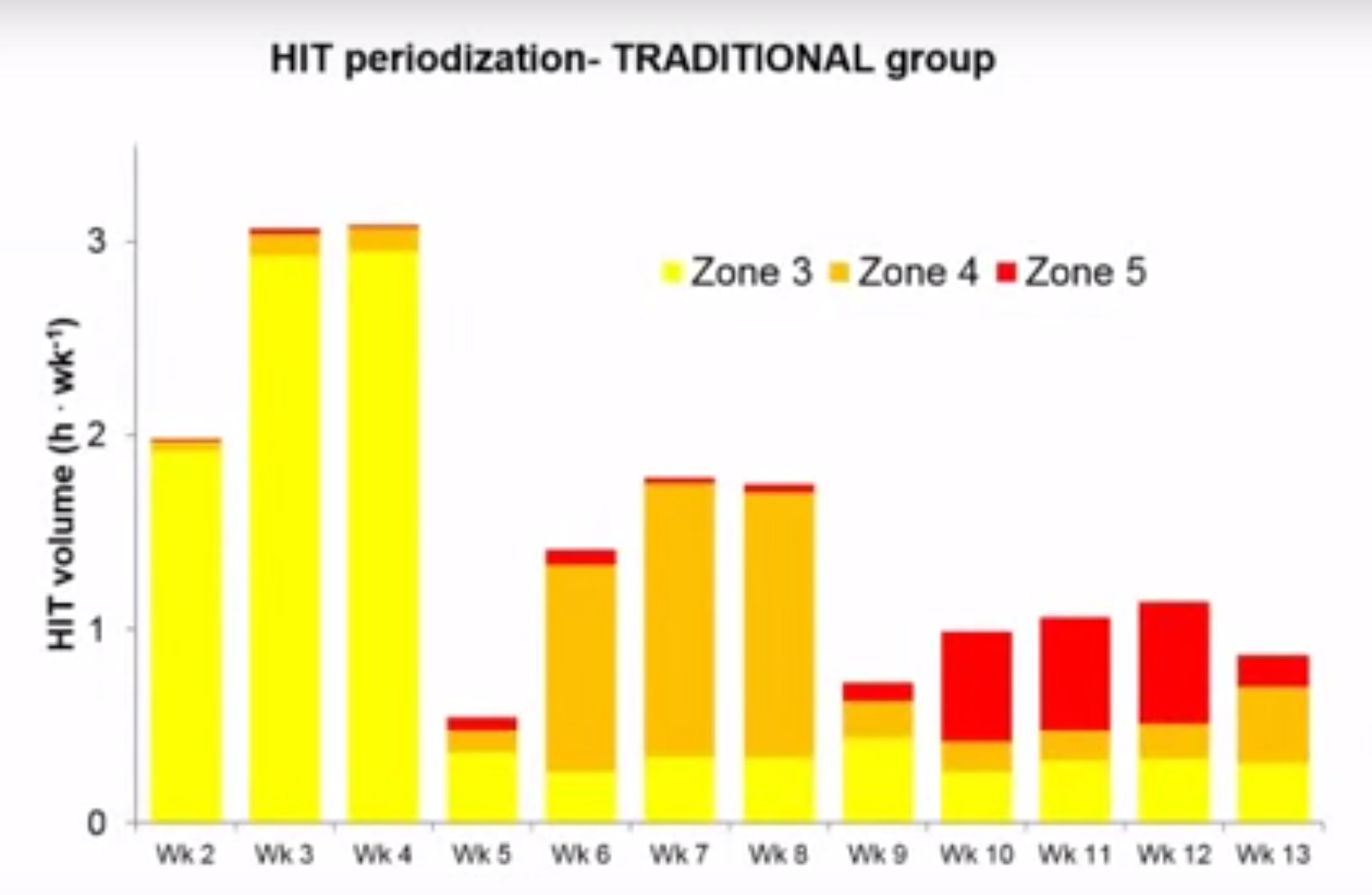
Pretty neat experiment, huh?  In the traditional group, the intensity build in each mesocycle.

Screen Shot 2015-09-27 at 4.42.37 PM

In the hybrid group, each mesocycle had a mix of each type of training.  This is very much like the Pete Plan or Wolverine plan.

Screen Shot 2015-09-27 at 4.57.25 PM

In the Reverse group, it all started with hell week with 3 high intensity sessions, then moved to intermediate and longer intervals.

Screen Shot 2015-09-27 at 4.42.56 PM

The results were interesting.  In the traditional group 60% of the athletes made significant gains in VO2max power.  The other groups significantly lower part of the group made big gains.

Screen Shot 2015-09-27 at 4.38.48 PM

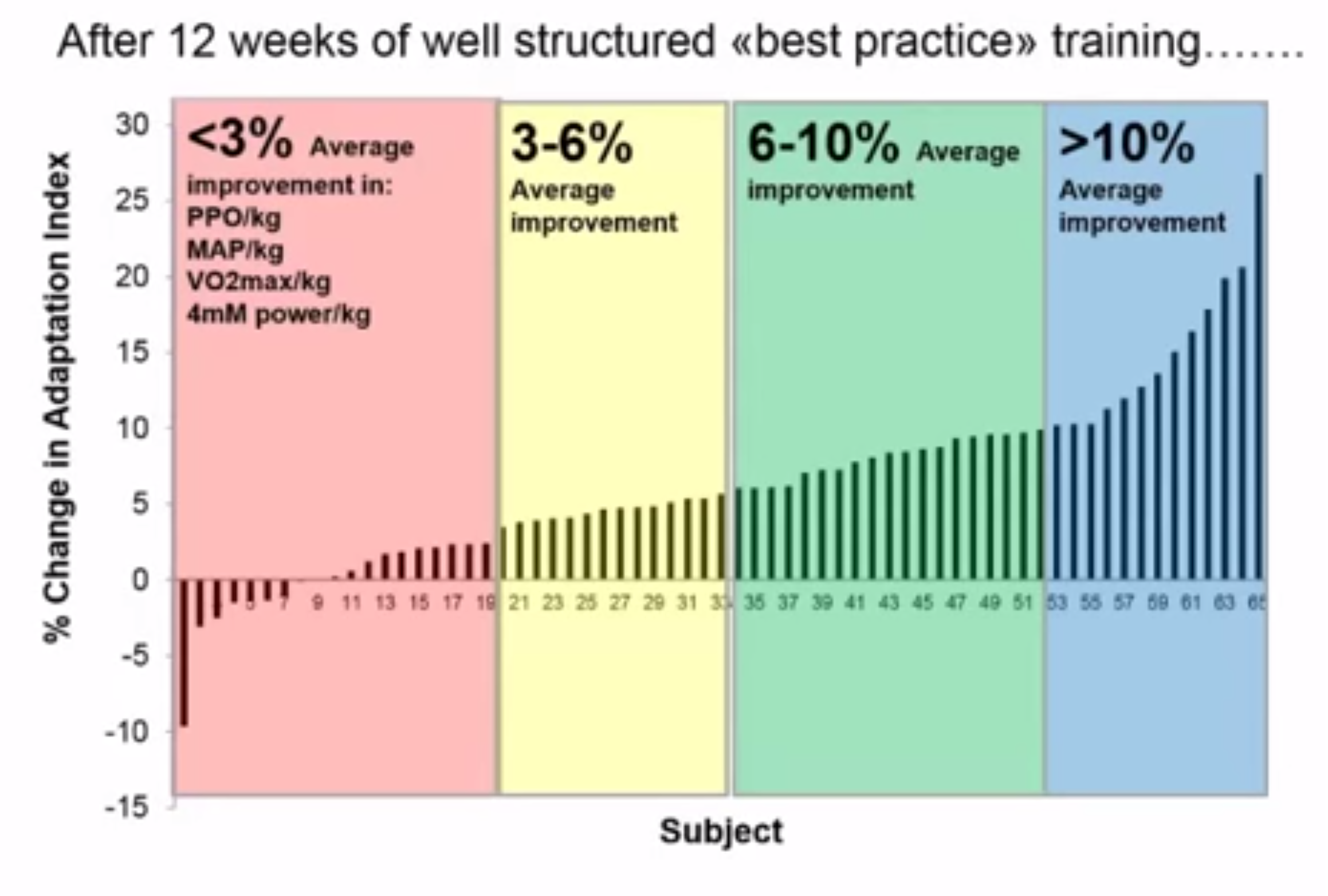
The main point that Seiler made though, was that significant portions of each group did not make progress with the plan that they were on.

Screen Shot 2015-09-27 at 4.39.44 PM

As a scientist, the reaction is “Huh?”.  As a coach, the reaction needs to be “Change the plan!”.

For me, the big take away is that the lowest level of success was with the hybrid plan and that is basically what I have been using for the past 4 years with very little variation.  I think I will start to plan out training loads and intensities following the “Traditional model” for my winter training plan and track progress.  Of course all of this is in the context that 80% of the training will be low intensity steady state, but the type and amount of high intensity work will change by mesocycle.  The other take away is to monitor progress and make changes when things are not progressing as I expect.

Where I row: Charles River Newton

Screen Shot 2015-05-30 at 6.44.13 PM

There is a cool thread going on over at the google plus site rec.sport.rowing about where people row.  I thought I would chime in about my rowing location and double post between here and there.

During the week, I row on the Charles River, but not down in Boston.  I launch in Newton, at the Paddle Boston location where I rent a rack for my boat.  I chose this location because it is right on my commute from home to work so I can maximize my rowing time and minimize my driving time.

From this location you can row up river for nearly a mile, but it is very narrow and quite twisty, so no one ever does that.  Downstream from the launch point is about 4km of rowable water with absolutely beautiful surroundings.  The boathouse is on a lagoon with a hotel overlooking it.  At the north end of the lagoon, the river winds into Nahantan park.  You start by going through a tight s turn and then the river widens out into a nice straight section about 500m long.  It’s perfect for a couple of power 10s during a warmup.

At the end of the straight section, the rower is confronted with a choice.  You can go around a large island in a broad turn to starboard, or dash through “The Cut”.  I almost always go through the cut because I’m ready to start doing some serious rowing.

As you exit the cut, you continue through a straight but narrow section with houses built into the woods on both sides.  On the north bank of the river, the homeowner has realistic sculptures of various animals (bears, alligators, iguanas) lurking in the woods near the water.  He also puts out a tub full of bottled water on weekend days as a gift to paddlers going by.  I’ve never partaken, but it makes feel better about my fellow man every time I pass.

When you exit the narrow section, there is a long cove on the south side.  In this cove, is where I will usually start and finish intervals, since it is more aligned with the rest of the 1K section than the other branch.  The cove is fun because there is a town park on one side with swing sets and a little beach and big grand homes on the other side.  One house has a boat rack and upon a very fine empacher double and a few singles.

Continuing down river, it widens out into a broad area, but only the main channel that I’ve marked stays weed free during the summer.  On both sides are woods.  After passing a small island and a prominent point on the south bank, you turn slightly toward the s-turn.  There is a sunken tree that sticks out of the point that cost me an impeller and damaged the fin my precious Fluid because I strayed too close.

The s-turn is a broad bit of water and you can maintain full pressure through it, but it definitely is a challenge to hold a pace.  The best 2K course runs through the s-turn and I think it is a perfect training ground for head races.  Not so perfect for 2K sprints.

When you emerge from the s-turn, you com into a straight that is about 800m long.  About halfway through it, on what is now the east side of the river, is the Waltham Watch Factory.  Until the 1960s it was a genuine watch factory, but now it is mixed use with commercial space and condos.  They’ve done a great job restoring it.

At the end of this straight bit is the Prospect Street Bridge.  It’s a old stone bridge with three narrow arches.  One of the arches is too shallow to use.  The east arch is used downstream and the center arch upstream.  It takes some careful steering to align to the bridge because it isn’t a straight shot through, but angled to the river.  I do row at full pressure and head race paces through the bridge when I am training 2.5K or 3K pieces, but it costs me some pace to make sure I don’t hit an abutment.

After the bridge, you come into a narrow channel about 200m long with a biomed plant on the west bank.  By coincidence, they are the maker of my lactate meter and strips, Nova Pharmaceuticals.  On the east side are two family homes.  This bit is nice a straight and it is almost irresistible to dig a bit harder and speed up.

The channel empties into a broad basin and you find yourself in the heart of downtown Waltham.  There is a commuter rail line on the west bank, a bridge with lots of traffic at the end of the basin and a dam just beyond it.  On the east side is a big apartment complex with a dock that rents paddle boards and kayaks.

So, in about 4 km you go from scenic parkland with Great Blue Herons, Swans, Geese and Ducks, through an industrial section and into a bustling town center.  There is little boat traffic.  I share the river with one University team during the spring and fall (Brandeis) and a small collection of very nice fishermen.  If I row later in the day on weekends, there is a ton of paddleboards, kayaks and canoes out, so that isn’t too practical, but early mornings basically belong to me and a few other rowers.

It’s a really lovely place to row, and you certainly get a lot of practice steering.