On Thursday and Friday of last week, I was seeing elevated heart rates, and I felt terrible during my steady state sessions. On Saturday, I busted out a season best 6K. On Sunday I had a nice rest day.
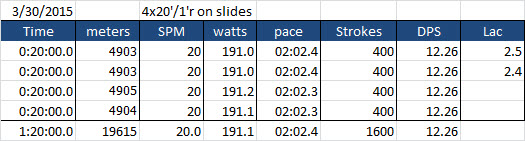
Then today, it was back to more steady state. I sit down, and 190W watts feels easy, and I cruise through the first 20 minutes with very low perceived exertion and a nice low HR. I struggled with getting a good sample for a lactate test. My first prick didn’t yield, so I did a second, and with the xtra time and fumbling around, who knows if it was a good test or not. But the reading was 2.5mmol/l. Whaaat?
So, I did another 20 minutes at 190W and tested again. Good sample this time and I read 2.4mmol/l. Arghhh. I still felt mighty fresh and my HR was still nice and low, so I did the next 2 pieces at 190W. I have to say that I am mightily confused about why my lactates were so high today.
I will drop back to 185W tomorrow to see what happens.

 Quantified Rowing
Perhaps Lactate based training, even though based on a more direct measurement of what you want to measure, is just as erratic as heart-rate based training, because of the error margin on the measurements? What is the claimed accuracy of the strips? If you would be preparing precisely determined concentrations of lactate in blood and did a series of measurements with the strips, what would the error be? Add on top of that the other influences on your lactate level and you may end up with an expensive method that is just as good as “going on feel”?
LikeLike
There was a discussion about measurement accuracy over on the free spirits thread. I think the conclusion was probably +/-0.1 unless you flubbed the sample.
Just like hr based training the are confounding factors that influence the actual concentration of lactate in the blood. Some of these are similar to the ones that impact hr, like temperature and airflow and incomplete recovery. In addition, there are some factors unique to lactate testing, like the amount of glycogen in your muscles and stuff like that.
I think the advantage of lactate level is that it is directly related to metabolism and does not change significantly with training. So, you always aim at 1.5 to 2.0 lactate after 20 minutes, you just end up working harder to get it as you improve your aerobic base.
In other words, most folks who do lactate based training end up eventually training at marginally high hr levels as they improve. If they were working to hr caps, they might stagnate.
All this is pure theory for me because I haven’t got enough reliable data from hr based training to compare.
LikeLike
I agree +/- 0.1 is a workable error margin. Also agree about the external factors.
I wonder if the threshold value isn’t individual, though. For example 1.9 for you but 2.3 for me?
LikeLike
Possible, but what I’ve seen written seems to argue against that. What I have seen is that some folks do not respond well to polarized training because they have a very high ratio of fast twitch to slow twitch muscles. These folks are lactate producing machines and have to go very slow to stay under 2.0.
I think it would take a long time to experiment with different limits to see which yields the best rate of improvement, but it might be a hobby for next indoor season😀
LikeLike