I’ve been thinking a bit about the relationship between rate and pace in steady state workouts. It started with a suggestion from Ben Redman that his target 2K pace was based on his steady state pace governed by the relationship
steady state power ( W ) = 2k power ( W ) * 55%
I had seen this before on the Rowing Illustrated boards and it was generally paired with the guideline that one should row steady state at 18 SPM to try to make sure that power per stroke was roughly the same as race pace work.
This made me go back and dust off the old Wolverine Plan pace charts. These give specific paces for r16 up to r26 based upon your 2K test pace. Here is an excerpt.

When I looked at them, I couldn’t make sense of how there were derived.
They are not based on linear increase in pace with stroke rate, nor an linear increase in power, nor are they constant SPI, nor are they constant distance per stroke. They are closest to constant SPI, but start at a high SPI, decrease a bit in the middle and then increase markedly as you get up to r24 and r26. Here are the splits, watts and SPI for a reference pace of 1:43.

An alternative to the L4 paces that are included in the wolverine plan are to use a constant “Work Per Stroke”, or “SPI”. to derive training pace or power for different rates. One example of this is a model posted on the BioRow website. There is a spreadsheet for erg training paces that allows you to plug in the intended race rate and then provides paces for stroke rates higher and lower than that rate for different 2K times. Basically, the model calculates the SPI for your race pace and rate and then maintains that SPI for different rates.
Another, different approach to constraining rate and pace is “S10MPS”. This stands for “Strapless 10 Meters per Stroke”, and I think it was promoted as an approach by Paul Smith (His website is here). A number of very good ergers use this approach which constrains your efforts to try to hit exactly 10 meters per stroke, indendent of stroke rate. This naturally constrains the pace. Here’s what that looks like from a wattage, pace and power perspective.
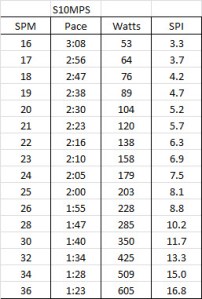
Having looked at the workouts that Paul recommends for his clients, they seem to be constrained to a relatively narrow range of paces from 2:00 to 1:45, which translates to rates between 25 and 30. I have also drawn the conclusion, but I’m not sure if it is true that S10MPS is a training technique, and then for time trials, and races and some high intensity interval sessions, you strap in and row to pace, without regard to maintaining 10 meters per stroke. The thing I find interesting about this is that it does really hammer home the idea of maintaining stroke power as you increase rate. You can see this with the SPI going way up as the paces get faster.
Anyway, having looked at all of this stuff, I have settled on using the simple idea of using linear increases of power with increasing stroke rate. I am using the 55% of 2K power formula to come up with a reasonable power level for 18SPM and increasing 10 watts for every 1 spm increase. This is not far off of the L4 levels and the same as the Biorow eWPS approach, It’s also handy because it’s easy to remember a 10 watt change for each rate. Here’s are my current targets.
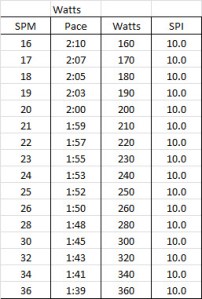
These are reasonable powers levels for rowing on a static erg. For rowing on slides, where it is quite uncomfortable to row at low rates, I find that I need to shft this whole table by 2SPM. So, I target 160W for r18, 180W for r20, and so on.
If anyone wants to play with the spreadsheet, here it is:L4 variations




 Quantified Rowing