More musings on Lactate

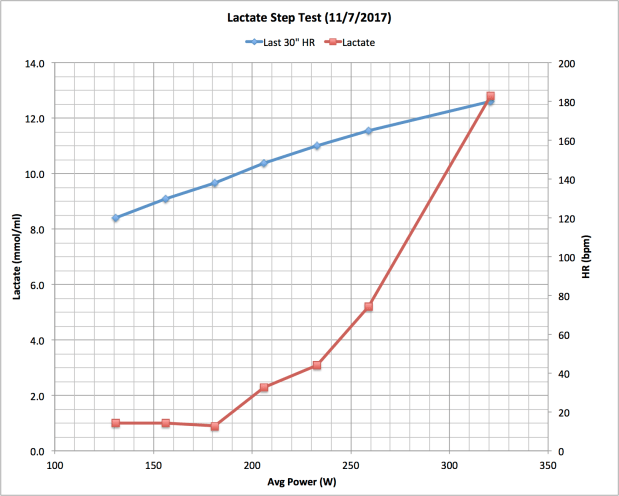
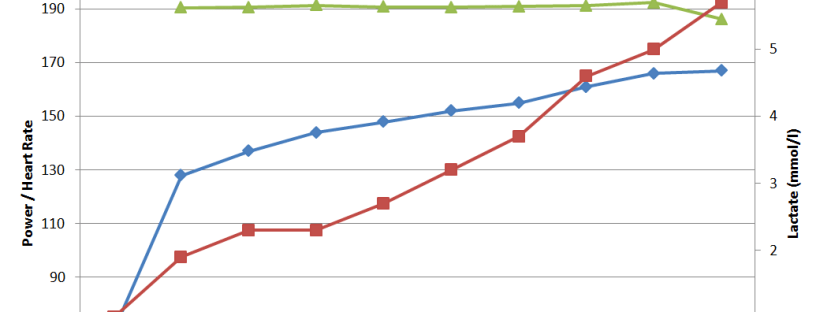
Comparison of two lactate tests.

11-10a

Roughly similar, but lower readings for the powers below the aerobic threshold.  I think that’s a good thing.  4mmol power is about 5W higher now, also good.  HRs are right on top of each other which is just plain weird.

So I see this as a very hopeful sign.  I went from this baseline to setting most of my distance PBs using lactate based training.  There’s no reason I can’t do it again.


Lactate Step Test

Using the AIS Step Test Protocol

I estimated that my current 2k time would be around 7:00, or a 1:45 pace.  The protocol provides the following step powers

Screen Shot 2017-11-06 at 12.18.05 PM

Getting myself setup was a bit complicated.

  • HR sensor, connected to PM5
  • PM5 connected to painsled
  • headphones on, connected to iphone
  • Spotify set to my “8×500” playlist
  • Drag set to 130
  • Seat pad on erg
  • wet towel
  • dry towel
  • lancet tool
  • lactate meter battery OK
  • lay out 10 lactate test strips neatly
  • fan on
  • PM set to 4 minute intervals/1 minute rests, display to power

Then I did a baseline lactate test, just to make sure that I remembered the process.

  • wipe hands with dry towel
  • wipe sample finger with wet towel
  • dry sample finger
  • lance fingertip
  • pick up meter with non-sample hand
  • pick up strip with sample hand and insert strip
  • make sure meter has woken up
  • visually judge size of droplet
    • If it is too small, put hand down low for 5 seconds
  • dab droplet with strip, starts 13 sec count down on meter
  • wipe finger
  • get a drink
  • get feet set for next interval
  • write down reading

When executed well, this whole process takes about 45 seconds.  If there are any hiccups, it takes the whole 1 minute rest time.

The baseline was 1.4mmol/ml which is a perfectly reasonable reading.

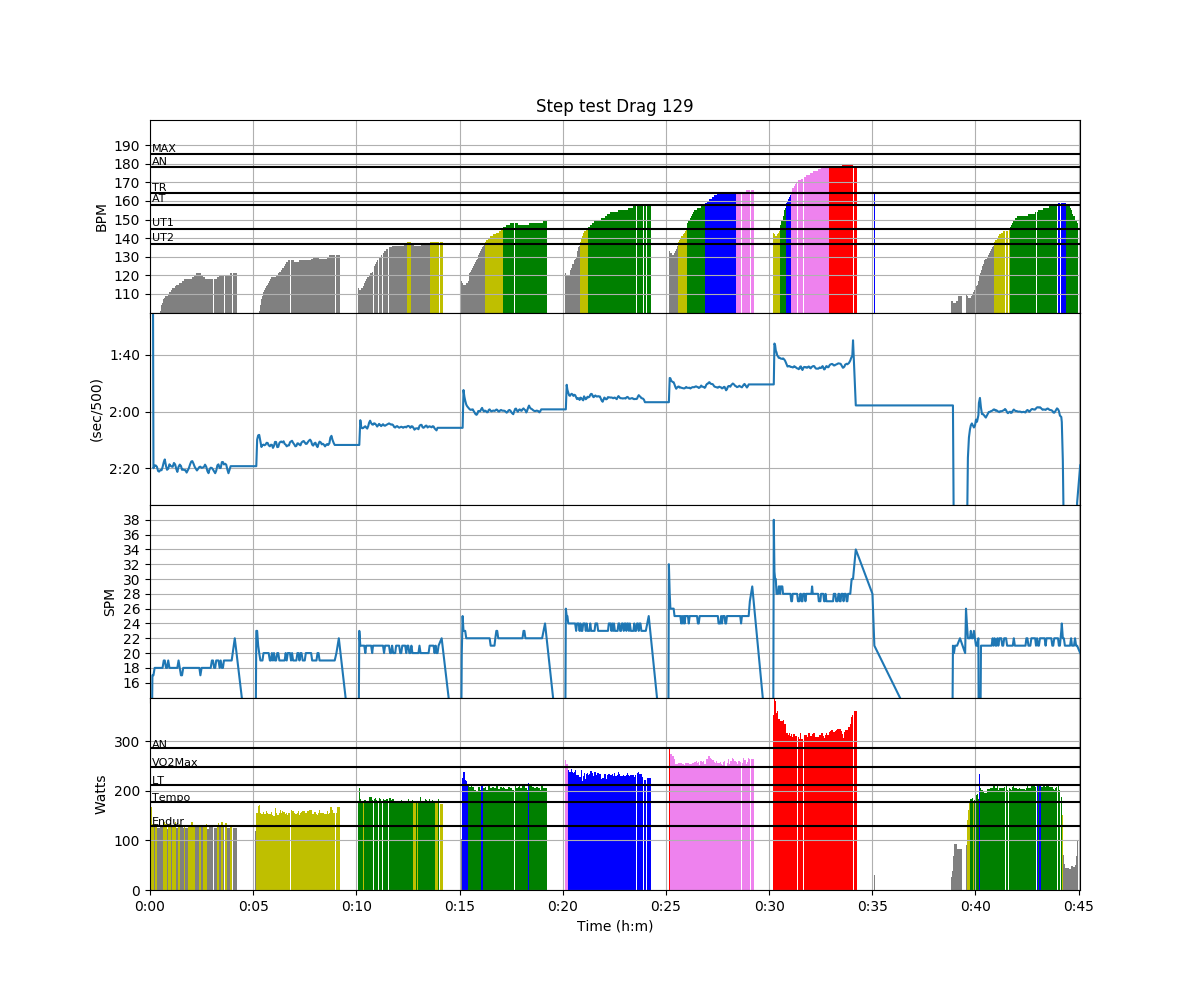
Then I did the test.  The steps start ridiculously easy.  The key thing in my mind is to try to hit the power exactly on every stroke.  I ended up bouncing a few watts up and down, but staying focused on the target kept me occupied while it was easy.

The target for the last step is “max”.  I changed the display from watts to pace per 500.  I wasn’t quite sure how hard I could hold for 4 minutes.  I decided to try to make sure I did it faster than 1:45.  As it turned out, I was able to accelerate in the last minute, so I probably could have pushed it a bit harder, but my HR was above 180 at the end so I was working pretty hard.
11-7a

11-7b

OK, so I did the test.  What’s the point?

The main reason to do the test was to have a baseline to compare after training blocks are completed.

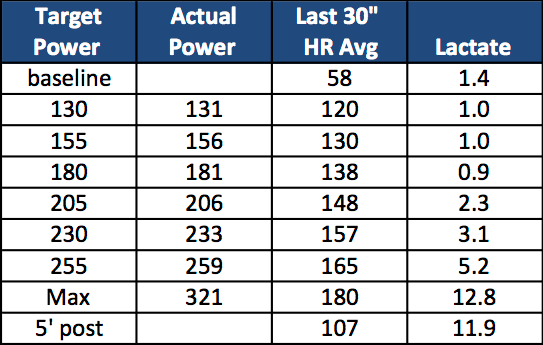
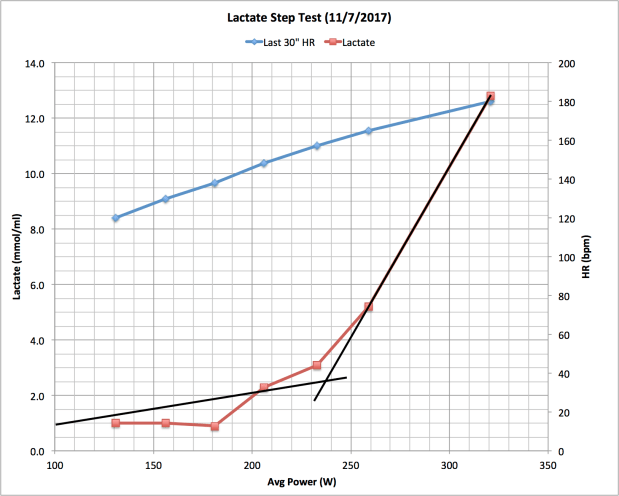
Beyond that, the curve can be used to estimate my current Lactate Threshold.  There are multiple ways to extract this from the curve.  The simplest is the power at which the lactate level exceeds 4.0mmol/ml.  This gives an estimate of 243W (1:52.9).  A more conservative method is to draw a best fit line for the sub-2.0mmol points and another for the steep part of the curve, and the point where they meet is the LT.
11-7c.png

This method yields about 238.  So, about 240 is a good guess.  How does this compare with the 20′ test?  The test measured 244W.  So there!

The other useful output is a first cut at appropriate steady state training power.  The goal here is to train at the highest power that results in a steady state lactate level at or below 2.0mmol/ml.  From this test, training power should be between 180 and 205W.

Other testing I have done in the past shows that lactate tends to drift up slowly over a long steady state session, so something towards the bottom of this probably more appropriate.
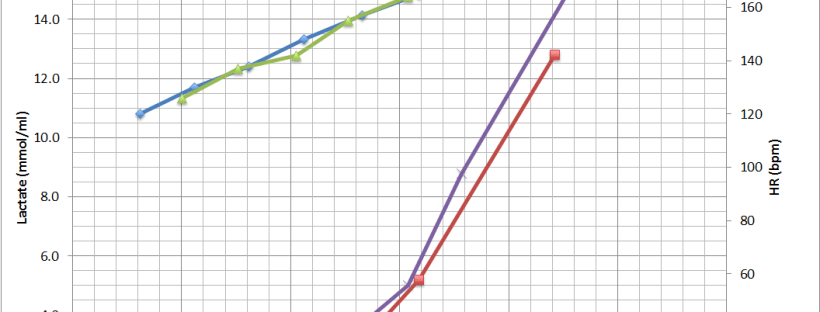
Sunday: Lactate 10′ Step Test

Plans for any training down on the Cape this weekend were disrupted by other priorities.  We had all kinds of appointments on Saturday morning, and the main mission for the day was to prepare the deck around the house for a coat of wood sealer.  This took much longer than I was hoping because I vastly underestimated how much deck there was to prepare.  (1400 SQ FT!)  Anyway, by the time that was done, I was not in the mood to do much of anything beside hang out with my wife and drink a couple of beers.

I was thinking I could go for a row on Sunday morning, but when I woke up, it was blowing like crazy.  The peak gust was 50mph (80km/h) and sustained winds were around 35mph (55km/h).  I didn’t even like the thought of trying to pedal a bike into that kind of a headwind, so I decided to wait until the afternoon and just do an erg session.

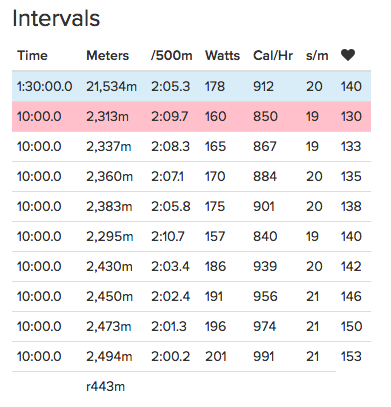
But what session to do?  I was planning on an early morning row in the Double with Joe on Monday morning, so I didn’t want anything too intense.  And there was a fresh new box of lactate test strips that had just arrived.  So, I quickly decided to do the same 10 minute step test that Sander did last week.

My protocol:

  • No warmup
  • 10 minute steps
  • 1:30 rests
  • start at 160W and increment by 5W to 200W
  • Measure HR throughout and lactate at the end of each step

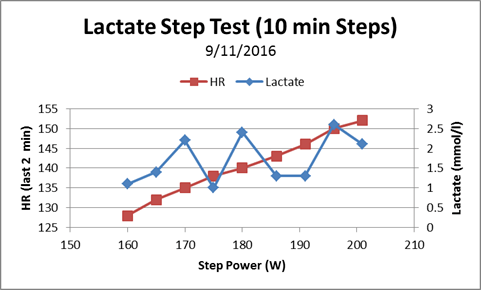
The purpose of the test is to help define an appropriate steady state intensity for endurance training.  I suspect that it would be around 180-185W or so.

When yo put the data  into a plot, it looks a bit weird.  The test did not go entirely smoothly.  I suspect the lactate test for 170 was contaminated with sweat, leading to a high reading.  The one at 175 had to be redone due to an “E-4” (insufficient sample size).  At 180, I also suspect contamination.  The rest of the readings I think were good.  I had my method down pretty smoothly by then and I was doing a good job cleaning my hands.  I suspect that the inflection above 190W is totally legit. Based on this data, I could try to train at 190W, but I suspect that this would be a bit too intense.  I did this test after a full rest day, and late in the afternoon (my best time of day).  The temp was warm, but cooling down during the session.

9-11

I had plenty of time to think, and one of the things that occurred to me is that it is entirely plausible that it takes me 30 minutes to really warmup for a steady state session.  Some of my best results a couple of seasons ago were when I eased into the first 20 minute session by starting at a lower power and then hitting target power for the second 20 minute piece.  When I did that, I think I was able to hold higher “watts at 2.0 lactate”.  I think I might make that my standard procedure over the winter.

So, 185W will be my training power for now.  Next weekend, I think I will do a 90 minute session at 185W and do lactate tests every 10 minutes to see what happens.  The hypothesis I am testing is that my lactate will initially rise toward 2.0, then fall back toward 1.0, hitting a trough around 40 minutes, and then start to rise again after 60 minutes.

Saturday: 90′ Lactate Experiment

I was really tired on Friday night, so I decided to sleep in instead of rowing on Saturday morning.  I needed the sleep, all 12 hours of it!

After running around, doing errands, I decided to do an erg session in the late afternoon.  I had not eaten since 9AM, and I started around 4PM, so I was reasonably fasted.  I wanted to duplicate my situation rowing in the mornings as closely as I could.

I wanted to get a better feeling for what my lactate and HR did in a longer session at constant power.  I’ve been doing steady state sessions around 190W and I thought that was reasonably close to a 2.0 mmol/l intensity.  So, the experiment design was simple.

Row a sequence of 9 – 10 minute pieces at 190W, and measure lactate after each during a 1:30 rest.  Here is the RowPro view of the experiment

Screen Shot 2015-09-13 at 11.38.39 AM Screen Shot 2015-09-13 at 11.38.52 AM

And the split data:

Output
Workout Summary – Sep 13, 2015
–_|_Total_|_-Total-_|_–Avg–_|_-Avg-_|_Avg-_|_-Avg-_|_–Avg–_|_-Avg_|_-Avg
–_|_Dist-_|_-Time–_|_-Pace–_|_Watts_|_SPM-_|_-HR–_|_-%HRR–_|_-DPS_|_-SPI
–_|_19862_|_90:24.0_|_02:16.5_|_137.5_|_17.9_|_145.8_|_ 72.2% _|_12.2_|_07.7
Workout Details
#-_|_SDist_|_-Split-_|_-SPace-_|_Watts_|_SPM-_|_AvgHR_|_Avg%HRR_|_DPS-_|_-SPI

01_|_02450_|_10:00.0_|_02:02.4_|_190.7_|_19.5_|_129.2_|_ 60.5% _|_12.6_|_09.8
02_|_00049_|_01:30.0_|_15:22.2_|_000.4_|_02.7_|_116.3_|_ 51.2% _|_12.2_|_00.2
03_|_02453_|_10:00.0_|_02:02.3_|_191.4_|_20.0_|_135.2_|_ 64.7% _|_12.3_|_09.6
04_|_00038_|_01:30.0_|_19:59.2_|_000.2_|_02.0_|_130.0_|_ 61.0% _|_12.5_|_00.1
05_|_02451_|_10:00.0_|_02:02.4_|_190.9_|_19.9_|_141.6_|_ 69.2% _|_12.3_|_09.6
06_|_00057_|_01:30.0_|_13:03.5_|_000.7_|_03.3_|_125.2_|_ 57.6% _|_11.5_|_00.2
07_|_02450_|_10:00.0_|_02:02.4_|_190.7_|_19.8_|_144.9_|_ 71.5% _|_12.4_|_09.6
08_|_00055_|_01:30.0_|_13:33.1_|_000.7_|_04.0_|_125.2_|_ 57.6% _|_09.2_|_00.2
09_|_02451_|_10:00.0_|_02:02.4_|_191.0_|_20.0_|_147.7_|_ 73.6% _|_12.3_|_09.5
10_|_00043_|_01:30.0_|_17:23.5_|_000.3_|_02.7_|_135.3_|_ 64.7% _|_10.8_|_00.1
11_|_02453_|_10:00.0_|_02:02.3_|_191.3_|_20.3_|_152.0_|_ 76.6% _|_12.1_|_09.4
12_|_00038_|_01:33.0_|_20:28.0_|_000.2_|_01.9_|_147.3_|_ 73.3% _|_12.6_|_00.1
13_|_02458_|_10:00.0_|_02:02.1_|_192.5_|_20.2_|_157.3_|_ 80.4% _|_12.2_|_09.5
14_|_00032_|_01:33.0_|_24:08.3_|_000.1_|_01.3_|_146.0_|_ 72.3% _|_16.1_|_00.1
15_|_02383_|_09:48.0_|_02:03.4_|_186.3_|_20.2_|_160.3_|_ 82.5% _|_12.0_|_09.2

This resulted in the following data:

lactate table

Which, when graphed, looks like:

Screen Shot 2015-09-13 at 11.37.52 AM

So, what does this mean?

  1. 190W is too high of a power level for me right now.
  2. My HR takes a while to work it’s way up, but the lactate tracks effort pretty quickly
  3. My endurance is suspect.  The plateau from 20 to 30 is interesting.  I was able to hold that for that period, but I guess I fatigued and started to rely on more fast twitch muscles, which started to generate more lactate.  That’s also the point in the row where it started to feel like work.
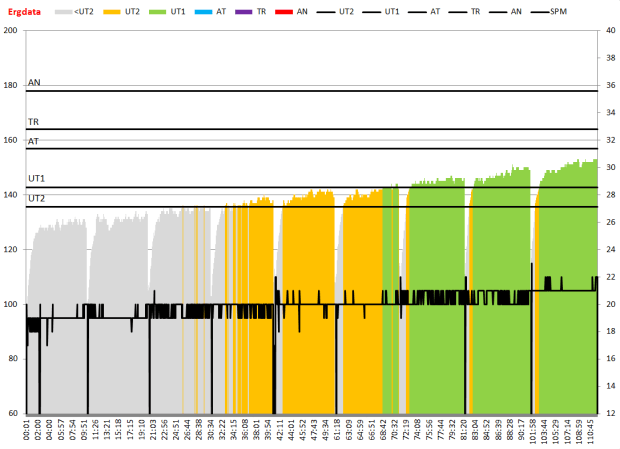
  4. I was still in my UT1 band until after 60 minutes of rowing, but my lactates were way above the 2.0mmol/l target.  My rule of thumb of keeping it below the top end of UT1 is NOT a good guideline.

This was valuable enough that I think I will try it again next weekend at 185W.  I suspect that the plateau will be lower and longer, but will break free again and start to climb.