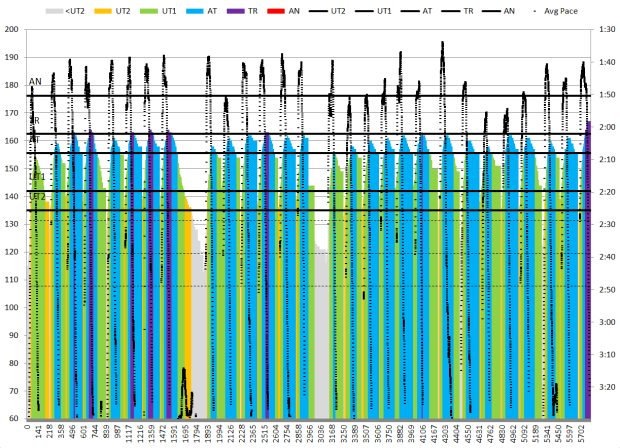
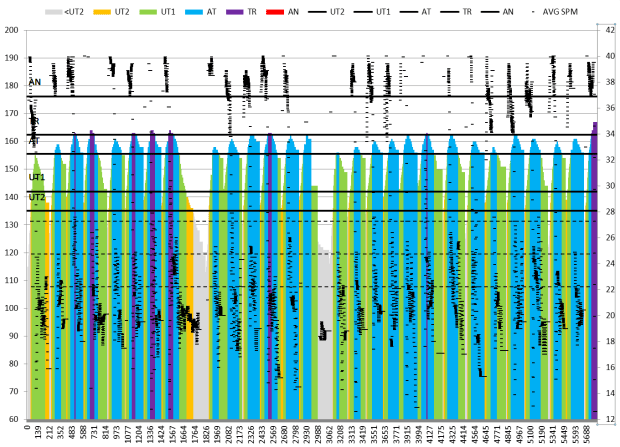
Friday: 20K Steady State / Technique

I got home around 11pm and got to bed around 1AM.  There was no way that I was getting up at 5:15 to go rowing.  I did pack my rowing stuff in case I was able to sneak out and go for a row in the afternoon.  It turns that I did.

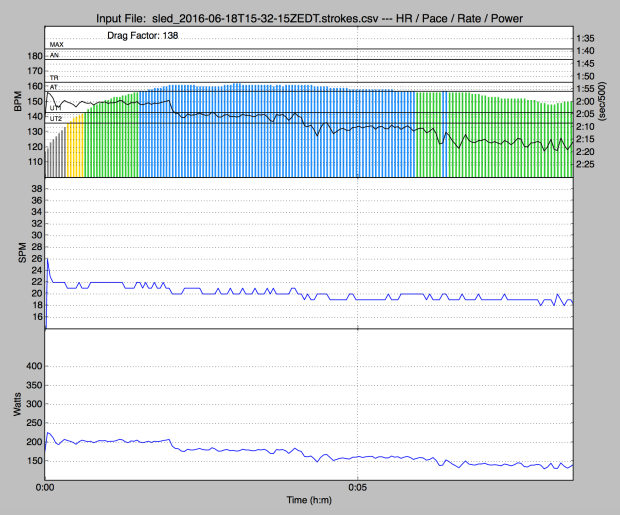
I was not in the mood for the planned 6 x 750.  I still felt pretty worn down from all the plane flights and jet lag.  Also, I had not been in a boat since the previous Sunday.  Even that didn’t entirely count since it was my chubby boat.  So, I thought it would be a good idea to work on technique.  I went to my go session for working on balance and technique

  • 2′ square blade rowing
  • 2′ alternating square and normal
  • 2′ normal
  • Rate target: 18 to 20
  • Pace target: none
  • HR cap:  < 150  (hopefully a lot under 150 for most of it)

It was beautiful out today.  Around 80F, but with a nice breeze from the ENE around 5mph, with gusts higher.

It was a really nice outing.  Nice and easy.  It’s hard to concentrate for that long, but I had stretches where I felt like my rowing was fluid and natural.  I also had periods where it was just wobbly and awful.

The XGPS160 was acting up badly today.  It froze and I cycled power four times.  Each time, the symptoms were identical.  The pace and distance would stop updating.  I would power it off, power it back on, it would start talking to the iphone again and everything worked fine.

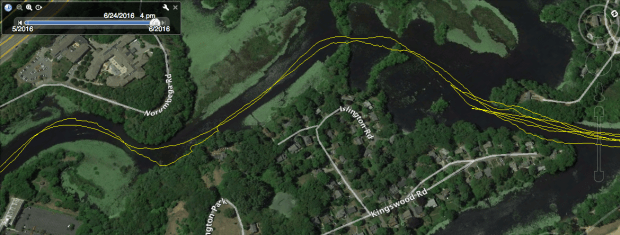
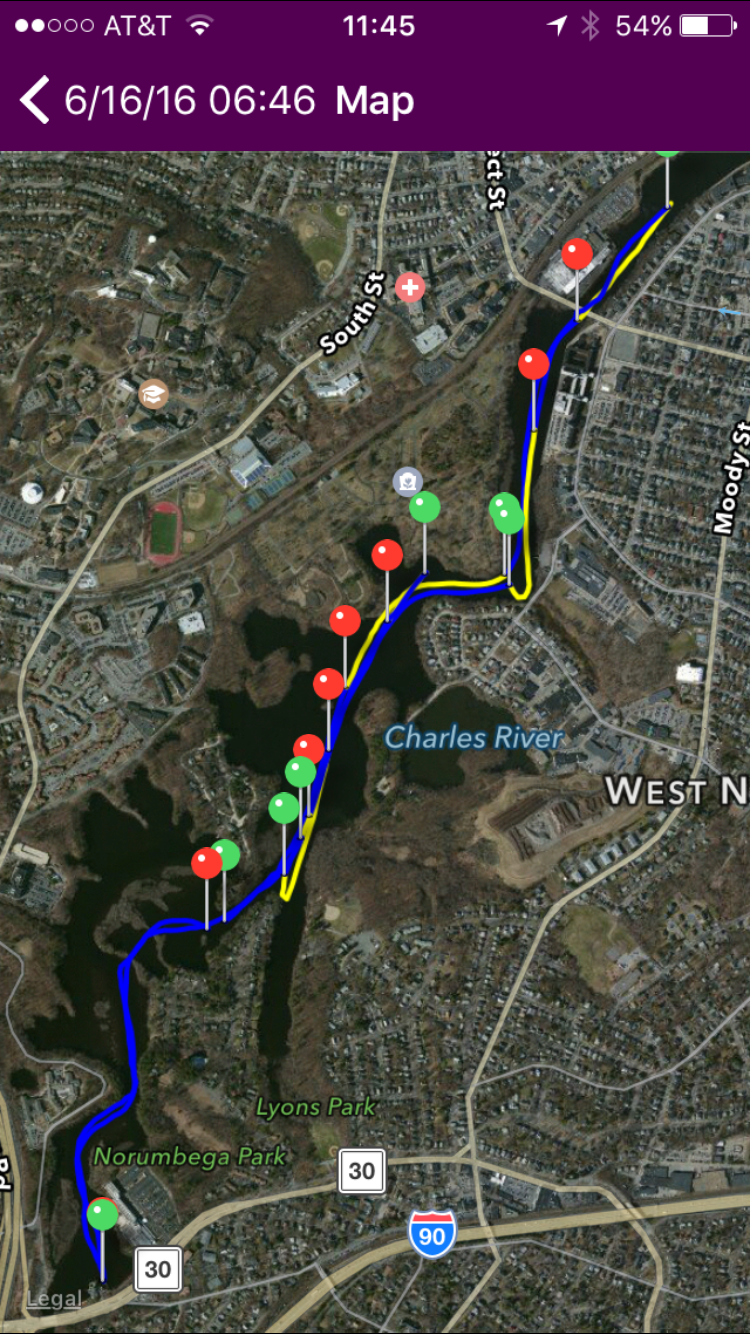
It was also navigating horribly.  Here’s the map of the whole outing.

Screen Shot 2016-06-24 at 10.16.50 PM.png

Some of the lines look a little jagged.  When you zoom in it gets much more apparent that the position it is reporting has a lot of uncertainty to it.

The first map is the leftmost third.  The jaggy line is the beginning of the row.  Look at the sudden jumps in the position.  Further over, notice that the position is just wrong.  It has me rowing through the penisula.

The second picture also has navigation errors showing me rowing into the north bank of the river coming out of the s-turn.  I assure you, I did not.

The third picture is the Moody street basin and you can see the weird results by the bridge.  Also, the lines down the canal are wrong.  The good water is very narrow and I tend to follow it quite consistently, the lines are all over the place.

At this point, I think I am going to be leaving the XGPS160 in my kit bag until I hear something back from the vendor.  With this much error in the position and the impact it has on the instantaneous pace display, which is jumping all over the place, it’s worse than the much slower updates of the internal GPS of the iphone.

Tomorrow:  The promised 6×750.


Thursday: 4 x 20′ / 1′ L4

Tuesday:  Arrived in Munich at 10AM.  Showered, connected by plane to Stuttgart.  Meetings with customer in the afternoon, back to the airport, flew to Paris, connected to Marseille.  Got to my hotel at midnight. No Training

Wednesday:  Decided to sleep in, instead of trying to workout.  Prep sessions all morning, customer meeting in  the afternoon, then back to the airport to fly back to Munich.  Arrived at the airport around 8:30PM, took the s-bahn  to my hotel.  Met with a couple of colleagues at the hotel.  Got  to bed around 1AM. No Training

Thursday:  Up at 7:30AM for a breakfast meeting with a customer.  That finished around 10AM.  My flight leaves around 4:10PM, so finally, I had a window to go to the gym.  I went to the hotel fitness center and saw a meticulously clean Concept2 Model E with a PM4.  Yesss!!!

Plan:

  • 4 x 20′ / 1′ rest
  • L4 format.  Power target –> 10W x stroke rate (16spm = 160W, etc)
  • HR Cap: 156

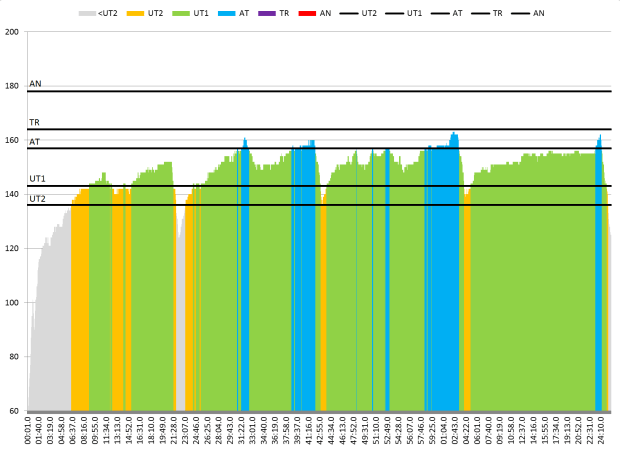
I figured with all the flying around, irregular meals and reasonable consumption of beer, that this would be a difficult session.  I was right.

I started slow and within 10 minutes I knew that I would struggle.  Here’s the stroke sequences I did.

  • 16 / 17 / 18 / 19 / 20
  • 16 / 17 / 18 / 19/ 20
  • 3′ @ 16 / 3′ @ 17 / 3′ @ 18 / 1′ @ 19
  • 3′ @ 16 / 3′ @ 17 / 3′ @ 18 / 1′ @ 19
  • 4′ @ 16 / 3′ @ 17 / 2′ @ 18 / 1′ @ 19 (dropped off the target power in this one)
  • 4′ @ 16 / 3′ @ 17 / 2′ @ 18 / 1′ @ 19
  • 10′ @ 16
  • 9′ @ 16 / 1′ @ 20

Very disappointed with what has happened to my aerobic fitness.  But pleased with the gigantic puddles under the erg.

Screen Shot 2016-06-23 at 12.35.23 PM

Tomorrow:  Sprint session in the boat.  6 x 750 / 5′ rest.

Article Review: Optimizing Fat Oxidation Through Exercise and Diet

One of the primary tenets of a polarized training program is to separately train the different energy systems by tailoring the intensity of the specific session.  If you are trying to training the Anaerobic Alactic system, then short sprints with long rests allow the athlete to produce more power in each rep and thereby increase the focus on that energy pathway.  Similarly, when doing low intensity endurance training, the idea is to keep the intensity high enough to elicit a training response, but low enough so that the metabolism of fat predominates.

The most direct way to determine the proper training intensity is to measure blood lactate levels.  This is because the metabolism of fat does not produce pyruvate, which is transformed into lactate, whereas the metabolism of carbohydrate (CHO) does end up producing lactate.  The body can use lactate as a fuel, so at a certain exercise intensity, the amount of lactate produce and consumed is at equilibrium and will stay stable over relatively long exercise sessions (60 to 80 minutes at least).

The problem is that routine measurement lactate is expensive, inconvenient and not continuous.  So it becomes desirable to find other measures that can be roughly correlated with lactate that are easier to measure, and more importantly to continuously monitor during an exercise session.

That brings us to this review paper:

Screen Shot 2016-06-21 at 4.20.33 PM

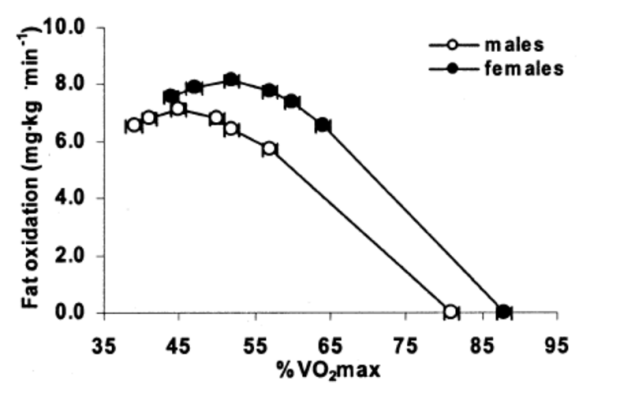
The key findings are:

  • Fat metabolism is maximized at a higher percentage of VO2Max for fit people than non fit people.
    • 59% to 64% of VO2Max for trained subjects
    • 47% to 64% of VO2Max for untrained subjects

Screen Shot 2016-06-21 at 4.41.46 PM.png

  • That the fat metabolism is maximized at different VO2Max percentages for different modes of exercise
    • 58% of VO2Max for walking
    • 64% of VO2Max for bicycling
    • No data about rowing 😦

Screen Shot 2016-06-21 at 4.41.53 PM

  • That ingesting Carbohydrates immediately before exercise reduces the amount of fat metabolism.
    • At the same percentage of V02Max, fasted subjects nearly doubles the fat metabolism of subjects that consumed CHO before exercise.

Screen Shot 2016-06-21 at 4.42.04 PM

  • Men maximize fat metabolism at a higher percentage of VO2Max than women

Screen Shot 2016-06-21 at 4.42.11 PM

So, one thing that always trips me up is calibrating myself to VO2Max.  The best rule of thumb that I have read is that VO2Max power on an erg is roughly 2K pace or power.  So, if you can row a 7:00 2K (302W).  If maximizing fat oxidation occurs between 59% and 64% of VO@Max power, then the power range for endurance training would be 179W (2:05.0) to 194W (2:01.7).

Monday: 3 x (6 x 1′ / 1’r) / 5’r

Inside, on the erg.  I originally planned to do it on slides, but I couldn’t get them set up so they were sliding freely.  They kept binding so that I would end up banging against the end while I was warming up, so I took the erg off of them for the rest of the workout.

The plan was

  • 4 x ( 6 x 1′ / 1′ rest ) / 5′ rest
  • Rate target: 30
  • Pace target: 1:40

While I did the workout, I had enough time to think through the plan.  That would be 24 minutes at faster than 2K pace.  Even with the generous rests, that seemed a bit excessive.  Compared to other sprint workouts like a 4 x 1k or 8 x 500, they have about 14 minutes of work.  Anyway, during the first 5 minute rest I decided to stop after 3 sets.  It certainly felt like enough.

I wasn’t all that sure about pace, since I haven’t been doing many sprint sessions on the erg lately, but 1:40 turned out to be a good pick.  I was able to beat it by a bit, but the last set really stung.

1min

I am very happy with that.

Now I am over Germany, about to descend into Munich. I’ll be connecting over to Stuttgart, and then going straight into meetings all day. So no training for Tuesday.  Hopefully, I will be able get a workout in tomorrow morning.


Sunday: 70 minutes steady state in the Alden

Sunny, 70s, windy.  Wind SW 5mph with gusts to 15.  Sun sparking on the water.  Really beautiful.

Today the plan was a low intensity steady state session.  I decided to take my Alden out for a spin to get used to rowing it and to figure out what kind of paces are reasonable in a shorter and wider boat.   I went to Lake Whitehall, which is about 5 minutes from my house and is a popular kayaking, fishing, and canoeing spot.  No rowing though.  It works OK, but the longest straight is about 2K and that requires some fancy steering through a couple of narrow spots.  As I found today, it also builds some chop.  It was not an issue in an open water boat, the power boat wakes weren’t either.  They were kind of fun to row over.

The Dual XGPS160 acted up again today.  For the first 15 minutes of the row, the pace was just bouncing all over the place.  Getting stuck for a few seconds, then dropping down to 0:02/500, then returning to normal.  Looking at the view on the map, there were a bunch of zigs and zags as the GPS position got messed up and then locked in again.  For some reason, it started working after about 15 minutes.

whitehall

myimage (20)

The first half of the row was quite enjoyable.  Since the boat turns on a dime, I tried to hug the shoreline more closely than I normally would.   After that, the heaviness of the boat started to get to me.  I learned that the analogy that Concept2 uses to describe drag factor is spot on.  The heaviness on the drive and the faster deceleration were exactly the same.  The only difference is that you don’t have the magical PM making the splits faster for that extra effort.  You just go a bit slower. My best guess is about 0:20/500 slower.  So, the same effort that produces a 2:30 pace in my fluid, produces a 2:50/500 pace in the Alden.

In essence, I will be doing a fair amount of bungee rowing.  This has good and bad aspects to it.  The good is that it slows everything down on the drive so it is easy to focus on blades depth and not missing water at the catch.  The bad is that the load is heavy and I will need to adapt to two very different boat feels.  One thing is clear though.  It is much better than erging, both in terms of the stroke mechanics and also just getting outside and having some great scenery.

By rowing for over an hour, I found two additional issues with the boat.  The first is the seat.  I must have a different butt geometry than what the seat was designed for.  I started noticing some pain at my right sitz bone about halfway through the row and it kept getting worse and worse.  By the time I finished, I could barely support my weight on my right leg, and I was concerned that I might not be able to carry my boat out of the water.  After about 5 minutes, the pain subsided a bit and I could function, but it’s still quite sore today.  I’m going to try to get the exact same seat as what I have in my fluid.  I can sit on that for hours without pain.

The second issue was much more serious, and far more abrupt.  As I was rowing back from the south end of the lake to the launch ramp, about halfway, all of the sudden I heard a big bang off to starboard in the middle of my drive.  I was sure that something had broken, but I wasn’t sure what.  I looked at the rigger and I couldn’t see any damage immediately, so I took a couple of gentle paddle strokes while watching the starboard rigger.  Ah ha!  I saw that the starboard backstay on the rigger had parted right at the oarlock pin.  Every stroke, the rigger was flexing toward the bow.   This picture shows where the backstay broke.

boat

So, now I will try to get some new backstays and get it all fixed up.

Start_|_Dist_|__Time_|_Split Pace_|_Strokes_|_SPM__|_DPS__|_Remarks
00010_|_4190_|_14:23_|_1:43.0_____|_276_____|_19.2_|_15.2_|_corrupted data
04200_|_1872_|_11:29_|_3:04.1_____|_224_____|_19.5_|_08.4_|_headwind
06072_|_3000_|_16:33_|_2:45.5_____|_327_____|_19.8_|_09.2_|_tail wind
09072_|_0078_|_01:13_|_7:51.1_____|_013_____|_10.6_|_06.0_|_rest
09150_|_2800_|_16:25_|_2:55.8_____|_337_____|_20.5_|_08.3_|_headwind
11950_|_0150_|_01:18_|_4:21.6_____|_019_____|_14.5_|_07.9_|_rest
12100_|_1800_|_10:06_|_2:48.3_____|_195_____|_19.3_|_09.2_|_tailwind
13900_|_1303_|_10:06_|_3:52.7_____|_177_____|_17.5_|_07.4_|_broken rigger

Distance_|_Time__|_Pace___|_Strokes_|_SPM__|_DPS__|_Remarks
4190_____|_14:23_|_1:43.0_|_276_____|_19.2_|_15.2_|_warmup
9472_____|_54:32_|_2:52.7_|_1083_____|_19.9_|_08.7_|_Main set
1531_____|_12:38_|_4:07.6_|_209_____|_16.5_|_07.3_|_rest meters
15193_____|_21:34_|_2:41.0_|_1568_____|_19.2_|_09.7_|_Total

Today:  I skipped rowing this morning because I didn’t get to bed until after 1AM last night.  I’m hoping to get a sprint session in on the erg before I fly to Germany tonight on the red eye.  The plan is 4 x (6 x 1′ on / 1′ off) 5′ rest.


Saturday: June CTC – 30R24

Friday:  “Rest Day”.  Flew to San Diego in the morning, and back on the red eye.  I arrived at 7:00AM.  Drove home and slept until around 10:30.

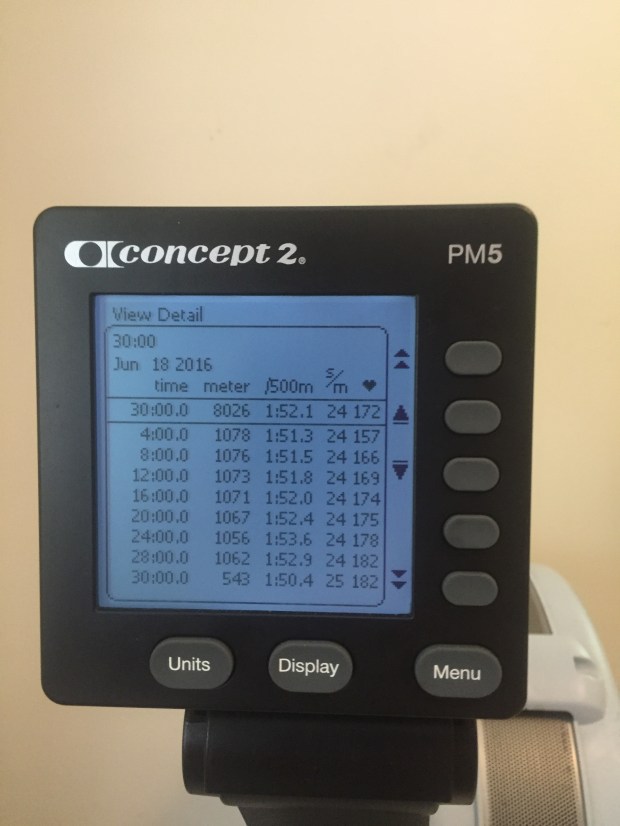
A little after 2, after doing some domestic chores, I found time for an erg session.  The month is passing and I hadn’t made an attempt at the Cross Team Challenge.

Screen Shot 2016-06-18 at 5.55.01 PM.png

I started with a 2K warmup, with 3 bursts of 20 strokes each near my target pace and rate.

Screen Shot 2016-06-18 at 5.49.51 PM

2016-06-18 14.55.56

Then it was onto the main event.  I felt like an 8K target was about right.  Maybe a bit aggressive since I haven’t been doing much erging and very hard distance work, but I would have felt bad doing less.

I turned out to be doable.  I was a bit fast through the first half, and I needed to bleed off a bit of pace to keep from blowing up in the second.  It was very close to a maximal effort.

Screen Shot 2016-06-18 at 5.50.43 PM

2016-06-18 15.30.23

I took 721 strokes exactly, according to the painsled file.

Then a 2K cool down

Mission accomplished.

Tomorrow:  Steady State OTW


Training Principles

It’s a rest day, I’m on a plane heading out to San Diego, and I am bored.  I’m also still trying to workout the best way to train with my work and travel schedule as crazy as it has been.

Any training plan that I devise will need to be quite flexible and simple in order to succeed.  To do that well requires a return to the principles that I have learned about successful training approaches.

Principle #1:  Decide why you are exercising or training.

It is possible to have multiple answers to this question.  In fact, the more reasons you have, the more likely you are incorporate exercise into your life on a permanent basis.  I started exercising as part of an effort to lose weight, and it worked.  I took off 50 pounds.  I also was diagnosed with high blood pressure and my family has a history of cardiac and circulatory disease, and I don’t want to die.  These are the underlying, bedrock reasons why I want to regularly exercise.  But these have been true for my entire adult life, and they were not sufficient to motivate regular exercise until I found a way to connect in to my competitive drive.  Basically, as soon I found the Concept2 online rankings, I wasn’t exercising anymore, I was training.  Specifically, I was training to row faster.  Even more specifically, I was training to row faster than other people.

Rowing on the erg led me to rowing on the water, and that opened up new challenges, both in trying to master the technique and also new ways to compete.  Not only did physical fitness matter, but so did technique, steering, strategy and experience.

Now in addition to objectives to stay healthy, I work to be a better, faster rower than I was the year before and to try to catch up with people that are faster than I am.

Principle #2: Decide how much time you have to train.

Once you do, try to stick to it.  Be brutally honest with yourself up front.  I’ve experienced how demotivating it is to plan more training than I can do and then miss sessions and lose momentum on a training plan.  It would have been much better to set my sights lower.

Principle #3: Set specific a objective and use it to guide your training.

I choose a specific race in the future.  Right now, it is the Cromwell Cup, a 1000m sprint in a few weeks.  After that it will be the Head of the Charles, which is a 5K head race.  You need to know what you are training for to plan out how to train.

Principle #4:  Plan your training before you go to train.

This can be at different levels of specificity.  It might be much easier to decide ahead of time the exact sessions that you will be doing for the next three months, but that only works if you have very good control of your schedule.  If you schedule is erratic, a specific day by day plan won’t work.  In that case, planning a certain mix of training for the week and shuffle it around to make sure that the highest priority sessions get done.  Right now, I am in final prep for a sprint race on July 10th, so my weekly guide is:

  • 2 or 3 sessions that include racing starts
  • 1 session a week with 500m to 1000m intervals at close to race pace
  • 1 session a week with 100m to 500m intervals at faster than race pace
  • as much volume below 2.0mmol/l lactate as I have time for

Principle #5:  Hold yourself accountable.

I find this easiest to do by training publicly.  I try to define my next day’s workout the day before and put it in my blog.  I know that very few people read it, but the fact that I’ve done that makes me feel accountable to either do what I planned or explain why I didn’t.  It is important to make the distinction between accountability and rigidness.  If I don’t follow through with the planned workout, or if I don’t hit my targets, that isn’t a failure.  I just want to be honest with myself about why I changed the plan or wasn’t able to execute it.  That way I can adjust and improve.

Principle #6:  Evaluate performance objectively.

Set quantitative goals and use performance tracking to determine if they are met.  Use past performance to set goals for future workouts.  Try to do the same thing if you are working on technique.  Either use video, or acceleration data to see if changes in technique actually occur.  My ability to remember past performance and discern if I have corrected technique problems is limited at best.

Principle #7: Seek advice, carefully evaluate it and decide if you will use it

There are many people with opinions.  Not all of them are well informed.  It is up to you to figure out what advice is credible and useful and what is not.  Try to establish the quality of the source of advice.  Try to understand the principles on which the advice is based.

Principle #8: Miles make champions

Endurance is critical to all rowing competitions longer than 500m. Building a strong aerobic base is necessary to perform well. The most important factor to building endurance is the volume of training done at low intensities.

Low Intensity Training (LIT) is defined by a blood lactate level below 2.0 mmol/l at the completion of the workout. In order to maximize the effectiveness of endurance training, blood lactate level should be greater than 1.4-1.6mmol/l at the end of the session. Lactate levels should be periodically checked and as fitness improves, LIT intensity should increase to ensure that the end work criteria of 1.4-2.0mmol/l is met.

Endurance training can be continuous or interval based, constant rate or variable rate, as long as it meets the intensity criteria. Up to 1/2 of all endurance training can done as cross training.

Lactate testing is a pain in the ass, does not provide realtime feedback and is pretty much impossible to do in a boat, so an alternative method of gauging intensity is needed. The best alternative for is to use heart monitoring and Rate of Perceived Exertion (RPE) together. By using HR in sessions where lactate is checked, a rough correlation between ending HR and lactate level can be drawn. This can be used as a limit in future workouts until another lactate test is done. The important thing to remember is that this is not a very exact thing. A little too hard or a little too easy will not have much impact on the effectiveness of the workout. The key thing is that easy workouts should be easy.

Principle #9:  If all you do is row slow, you will get good at rowing slow

High Intensity training is necessary to maximize performance at any distance from 100m to a full marathon.  There are different energy systems that are used in maximal efforts.  If these are not specifically trained, performance will suffer.  At least 2 sessions of high intensity training per week.  High Intensity Training (HIT) includes very short intervals, short intervals, long intervals, and hard distance workouts.  The key criteria of these workouts is that lactate levels well above 4.0mmol/l are achieved.  The most convenient way to measure this is to track HR and measure time above lactate threshold.

Principle #10:  You need to be able to pull hard to win races

The ability to generate high peak force on the handle is critical to achieving good speed off the line and to be able to sprint at the finish.  The more force you can exert also means that you can work at lower stroke rates with higher efficiency.  Including some kind of peak power training is useful, especially for sprint racing (1Ks, 2Ks). This can be done on the erg or in the boat with very short intervals with generous rests, or through weight training.  During sprint season, at least one session per week should include peak power training.

Principle #11:  Strength Training is useful, but not critical

This is disputable.  If you have specific strength deficits, then strength training can help with them.  Otherwise, it is mainly useful for muscle group balance and injury prevention.  Right now, I have deprioritized strength training in favor of additional endurance training within the time budget that I have set.  I know that other folks believe this should be a higher training priority.

Principle #12:  Mesocycles work, change it up.

Performance improvements will plateau after 4 to 8 weeks of training with a specific focus.  To combat this plateau, mesocycles can be used to vary the focus of training in blocks.  This can be programmed in a way to build toward a specific event and yield better results than a plan that has the same types of sessions over time.  The final mesocycle before a key event should be focus on maximize performance for the event type.

Principle #13:  The overload principle

Improvement in performance comes from the overload principle. For high intensity workouts, setting targets for pace to be slightly faster than previous results.  For low intensity workouts, increasing duration, and nudging up pace to stay in the desired lactate range over time.  Gradual overload is important.  Big steps in pace are an invitation to disaster.  Big increases in volume can lead to injury as form suffers when you are fatigued.

Principle #14:  Resting is part of training

Rest and recovery are critical to progress.  It is OK to have weeks that over load and under recovery, but these must be followed by weeks where the recovery takes place.  As a general rule taking one day of complete rest per week is vital.  By complete rest, I mean no rowing at all.  The logic behind no rowing is to reduce the risk of repetitive strain injury.  Some kind of other gentle exercise is OK as long as it isn’t long duration and isn’t intense.

Principle #15:  Get a coach

A principle I haven’t been able to follow, but is holding me back.  Real time feedback on performance, especially on technique is critical to improvement.   One Caveat, you and coach need to agree on principles.

Principle #16: Training is easier and more fun if you have training partners.

Thats the thing that I miss most by developing my own training plans.

Principle #17: Lighten up.

If you are reading this, then it is more than likely that you aren’t a professional athlete. We all have jobs, friends and family that are more important than achieving perfection in the execution of our training plans. I am all for having the grit to pound out that last 500 when your legs feel like jelly. I am all for dragging my ass out of bed at 5:15 to get in a training session before work, but if life gets in the way, that’s OK. There are more important things in life than rowing a long skinny boat faster.

Principle #18: Be resilient.

This one goes along with the one before. If sports are not your number one priority, then it is likely that your life will sometime conspire to make you miss your training objectives. When it happens, and it will, just pick yourself up, honestly assess where you fitness is and make a new plan. One of the best things about keeping good training records is that you can look to see how much training you’ve missed and spot trends like regularly missing training volume plans. You can use this to make your plans more realistic or change your priorities or schedule.

Principle #19: Be skeptical.

The world is full of people that are full of crap. They use the internet to spread the fertilizer. There is a lot of good advice out there too. It’s hard to know what is real and what isn’t. Here are my thoughts.
– Research is limited and flawed, but at least multiple people with lots of training in the field have looked at and critiqued it. Its up to you to figure out if it actually applies to your situation.
– Beware of plans for Olympians: I think the most important factor in race performance is total training volume. Elite athletes spend 40 hours a week training. I spend less than 10. That difference is huge and limits the applicability of anything done at an elite level.
– Beware of the “It worked for me” folks. That means you should beware of me too. The critical test is whether or not the advocate can answer the question, “Why does this work?” If it is not based on testable principles or there are not good answers to reasonable questions, then proceed with some caution.
– Beware of facts not in evidence. If someone says that they improved their 2k score by 20 seconds by doing two high intensity erg sessions a week, try to find out what else they are doing. For all you know, they might be running 10 miles every morning. If you just do the erg part, you will probably not see the same results.

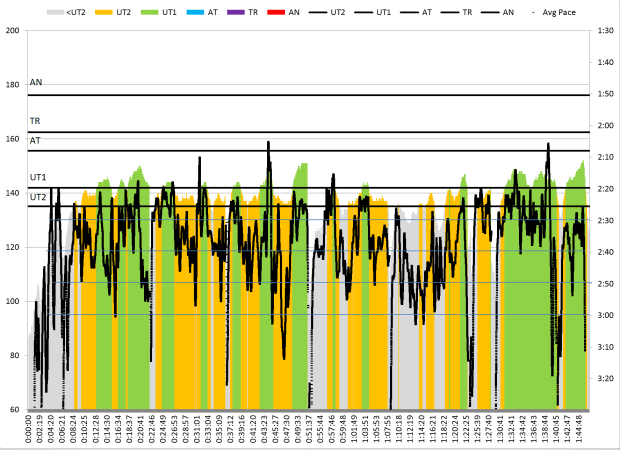
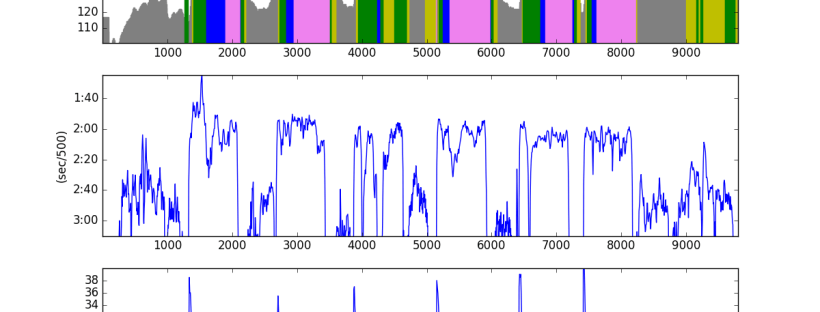
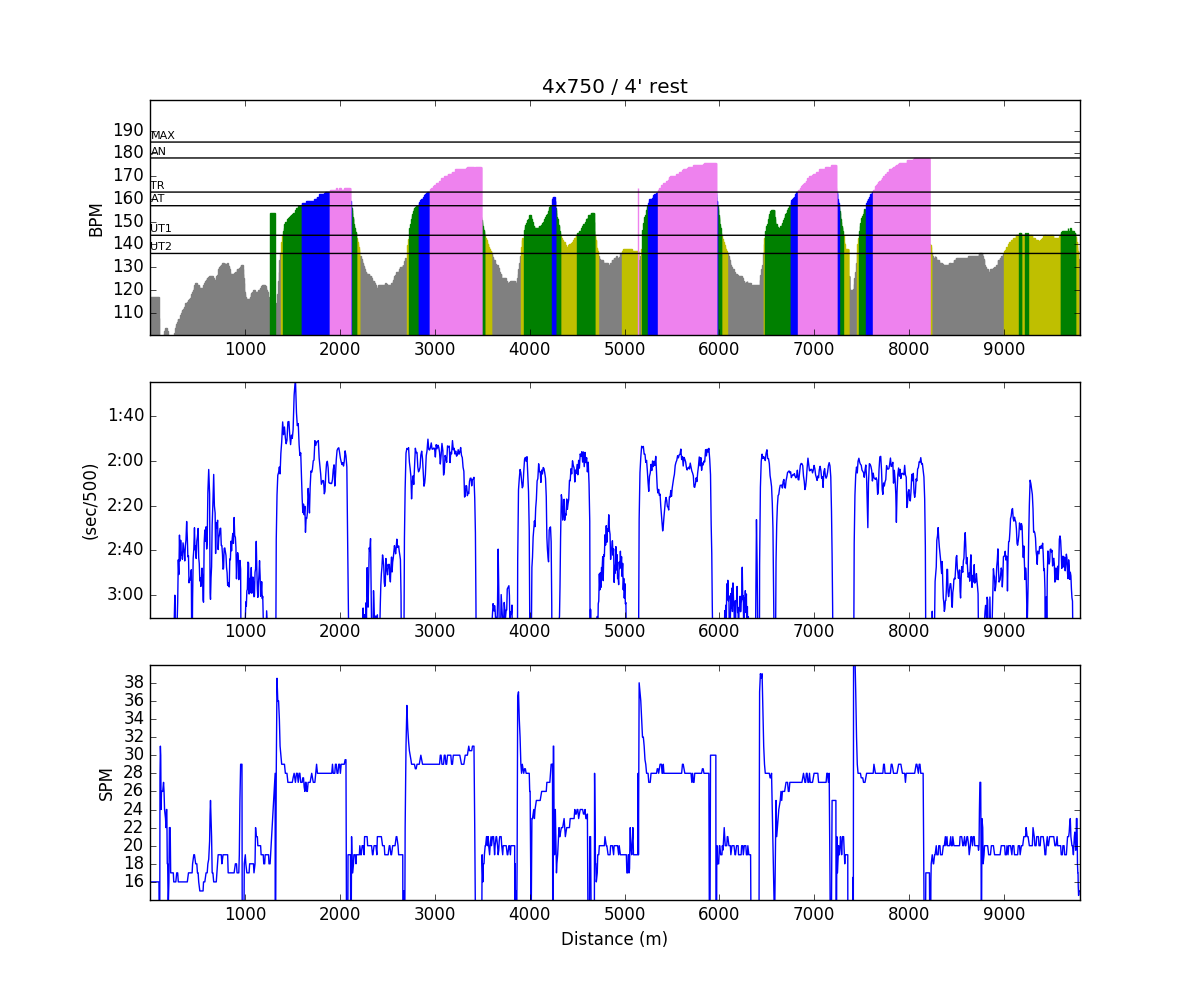
Crushed by the lactate wave. 750m intervals

Weather: sunny, warm mid-70s, basically no wind. A great day for rowing. 

Pity it was such a shitty workout. 

Plan:

  • 8×750 / 4′ rest
  • Rate: 28-32
  • Pace: 2:00
  • Standing starts
  • Paddle in the rests

I am feeling the effects of a big increase in Volume. I got my boat back last week and I’ve rowed everyday since last Friday. I’ve also done longer sessions this week. Last night, I got enough sleep, but I woke up feeling very sore and lethargic. I also had stomach issues which forced me stop for an unscheduled pit stop on my way to the boathouse. 

By the time I got on the water, it was nearly 7am, and I had less than an hour for the workout. I did a quick warmup and then attempted to start the first interval. I got 5 strokes in and noticed that I hadn’t pushed start on CrewNerd. The second attempt at the start actually worked and off I went. I took a little too long to settle down to a realistic pace, and I felt the familiar “Lactate Wave”. Nausea, feeling like I’m drowning. This is a feeling I hate, but I need to get used to in order to well in sprint races. It’s kind of the whole point of this workout. 
The problem is that I was not mentally prepared for what this workout demanded. I made it through the wave in the first interval by slowing down. The second interval, I powered through it and was happy that I hit the target pace, even while steering to the bridge. This one really hurt after I finished. I nearly puked, but by the end of the rest I thought I was better. 

Twenty strokes into the next interval, I discovered that I wasn’t. I bailed out the interval approaching the bridge, and then slowly picked back up to a reasonable pace for about the last 400m. I was pretty annoyed with myself. 

I paddled through the s-curve during the rest and decided to hold the rate a bit lower during the next interval. The result was a slower split and a more manageable wave. 

I quit on the next interval and frankly, I’m not even sure why. It was after about 20 strokes, and this time I picked back up pretty quickly and pushed through the rest of the piece. This was not going well. 

I was running out of time and so I decided to make the next one my last. No quitting allowed on this one. I managed the wave and finished reasonably well. 

I rowed feet out back to the dock. I have to come back and do this workout again soon. 


Workout Summary – media/20160616-173853-2016-06-16-0646.CSV–|Total|-Total-|–Avg–|Avg-|-Avg-|-Max-|-Avg

–|Dist-|-Time–|-Pace–|SPM-|-HR–|-HR–|-DPS

–|07319|36:50.0|02:37.1|22.6|134.1|145.2|08.5

Workout Details

#-|SDist|-Split-|-SPace-|SPM-|AvgHR|MaxHR|DPS-

01|01240| 07:56 |03:11.9|16.4|117.0|132.0|09.5

02|00000| 00:10 |0000:00|00.0|0.0|0.0|0nan

03|00750| 03:07 |02:05.1|28.1|154.0|165.0|08.5

04|00750| 03:00 |02:00.6|30.2|164.0|174.0|08.2

05|00750| 03:41 |02:27.7|23.8|146.0|161.0|08.5

06|00750| 03:09 |02:06.2|28.8|165.0|176.0|08.2

07|00750| 03:15 |02:10.4|27.0|158.0|174.0|08.5

08|00750| 03:11 |02:07.7|29.1|165.0|178.0|08.1

09|01579| 09:21 |02:57.7|20.1|138.0|147.0|08.4

Tomorrow: “rest day”. I’m flying to sandiego in the morning and back on the redeye. Some rest day. 

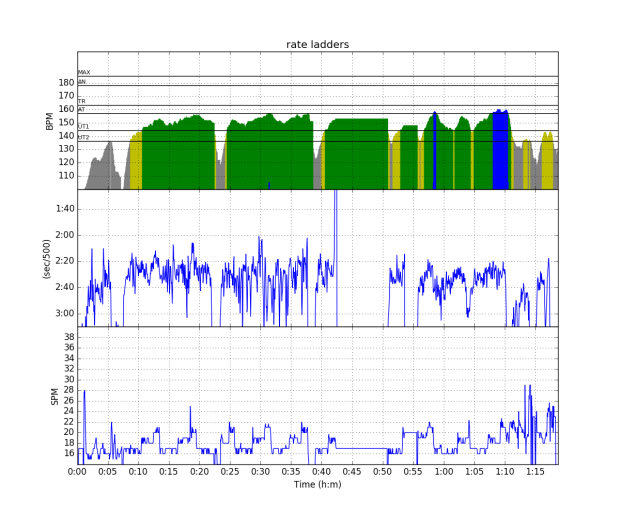
Wednesday: Steady State Rate Ladders

Weather: Sunny, 70F, light shifty wind from the WNW about 2-4 mph.  Wind was not really a factor, but slowed me down at times.

Plan:

  • 6′ Rate Ladders
  • 3′ @ 17 / 2′ @ 19 / 1′ @ 21
  • 1′ rests when I turned at the ends of the river.
  • Technique Notes:  Keep the drive smooth.  Get the blades off the water.

Screen Shot 2016-06-15 at 9.22.44 AM

Notice the purple box?  If you look over to the right hand side at the speed scale, it indicates that I was going 4600 km/h.  Pretty nice acceleration, eh?

What actually happened was the Dual XGPS160 unit and it took me a little while to notice.  The interesting thing is that the pace and distance seemed to update for a while after the point where the straight line started.  I thought it was only about 30 seconds or so where I saw the pace and distance frozen before I stopped and cycled power on the unit, but the data is missing for nearly 9 minutes.  Some weird s**t going on here.

Cycling the power made everything happy again.

Today was a day of mishaps.  On my last trip down the river,  Was trying to squeeze in the end of a ladder and I pushed it too far.  There is a cable across the river with big orange floats (about 18″ in diameter) strung on it.  I put on the brakes, and tried to turn, but managed to get my bow and starboard oar blade under the cable between two floats, and my boat basically parallel to the float line.  What ensued was an ungainly display of backing and forthing and turning and wobbling as I tried to get my bow extracted, my boat turned around and get myself clear.  It was an ugly demonstration of what not to do in a boat.

After that, I finished the journey up river and was approaching the dock.  There are a few challenges to deal with.  First, there was a bit of cross wind.  No big deal.  Second, there is an underwater propeller under one side of the dock that is artificially creating a current to try to keep area by the dock clear of weeds.  Also no big deal if you approach the other side of the dock.  Third, is the weeds themselves.  They are floating in great clumps right now.  This was the cause of my downfall today.  I was aiming to put my bow about a foot away from the side of the dock, so I would come in on the port side of the boat.  But when I was about 6 feet from the dock, my port oar caught a great hunk of weed, and turned my bow to the port side.

With a small bump, I hit the end of the dock.  No big deal, right.  The bow ball is there, right?  Well, on this specific dock, there is a 4″ wide gap between the board along the side of the dock and the one on the end of the dock, and my bow hit that gap with extraordinary precision, and the bow became wedged between the two bits of wood.  I had to back the boat with a fair amount of pressure to get it free, and it took a couple of strokes to do it.

Between those strokes, I was processing what the hell I would do if I couldn’t get it free.  I guess, jump out and swim.  That would have been pretty damn humiliating!  I’m glad it didn’t come to that.  There was no damage to the boat.  In the future, I will approach the dock with less speed and more paranoia.

myimage (19)

Tomorrow:  8 x 750 / 4′ rest.


Tuesday: Starting to work on Starts

Weather:  Basically like yesterday.  Sunny, cool and blustery.  Generally WNW, 5 mph with gusts to 15 mph.

Plan:

  • Rojabo style warmup to the moody street dam
  • Do as many starts as I can stand
  • 15 strokes each start, 10 stroke paddle, then stop the boat, reset and do it again
  • In each start work on:
    • Get set comfortably at the catch.
    • Do NOT go to full compression, stop when it feels like my heels are beginning to lift.  The key is to be rock solid at the start of the first stroke.
    • First stroke:  Smooth, powerful acceleration, very early finish, get the blades way off the water, barely feather.
    • Second Stroke:  get back to 1/2 slide fast!  get the blades in, keep it smooth, finish early, get the blades clear
    • Third through fifth:  keep taking short strokes and focus on balance and finishes
    • fifth through tenth: extend out to full slide.  Keep stroke rate up above 38, but keep recovery smooth.
    • 10 to 15:  full pressure, good strokes
  • Long cool down focusing on technique

Here is the whole session in google earth.  I paddled to the lap02 flag, then did the Rojabo warmup.  That took me to the end of the basin in Waltham.  Then I turned and did 14 starts going up river and generally with a cross/tail wind.  That took me back to the beginning, I had a drink, turned again, and did another 14 starts going back down river, now with a bit of a head wind.  A few of them, especially #’s 22 to 25 were definitely impacted by a reasonable strong headwind at the time.

Screen Shot 2016-06-14 at 2.00.23 PM

Here’s the whole session as interpreted by Rowsandall

myimage (17)

This is time based, so it gives you a better picture of the gap between intervals.  There is something fishy about the pace display.  The graph from google earth is in km/h.  Here is a closer view of the speed.

Screen Shot 2016-06-14 at 2.20.57 PM

The top speed is 18.7 km/h.  This is a foreign unit to me, so here’s the translation

  • 15 km/h = 2:00.0/500
  • 17 km/h = 1:45.9/500
  • 19 km/h = 1:34.7/500

This intrigued me enough that I exported the CSV file from crewnerd and plotted it in Excel.

That matches Google earth.

Next time, I will set it up as a predefined workout in Crewnerd.  15 strokes on and about 1:30 rest would be about the same thing.  I’ll have to pause it sometimes to get to a fortuitous starting point, but it should workout OK.

Other than the interesting pace discrepancies, it was a useful and interesting workout.  The key really is the first stroke.  Being a little conservative and finishing clean is the biggest thing.  Once the boat starts to build a little momentum, it gets easier.

I’ve registered for the Cromwell Cup.  This is a 1km sprint race on July 10th.  So, that should provide some motivation to do some more start practices.

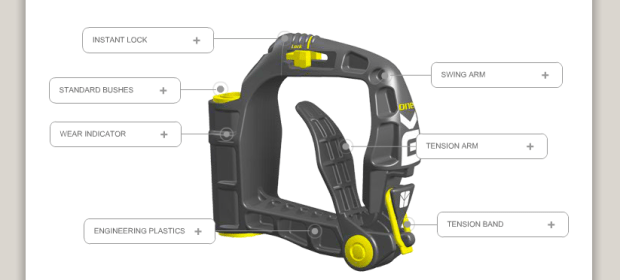
I also had a useful live demonstration of the value of magik oarlocks.  Right now, one of the tension bands, the one on my port oarlock, is busted.  So that oarlock acts just like a normal C2 oarlock.  The tension band on the starboard oarlock is intact, so the little lever applies pressure to the stern side of the oar.

Screen Shot 2016-06-14 at 2.35.06 PM

In normal rowing, I can detected no difference between port and starboard, but sitting at the catch with blades buried, I sure could.  With the wind today, there was a bit of chop, and I could feel my port oar rattling around at the catch, my starboard oar was just solid.  No movement at all.  I don’t know if it was coincidence, or self fulfilling prophesy, but most of the problems that I had with imperfect first strokes were on the port side.

I enjoyed the cool down.  I did two repetitions of 500m SBR, 500m of alternating SBR and normal, and 500m of slow roll ups.  That took me back to the cut.  From there it was just a paddle back to the dock.

Tomorrow:  Another session of easy rate ladders.  HR cap at 155.