Correlation between lactate and HR (hint: there isn’t much)

Many training plans use HR to determine training zones.  Other training plans use direct measurement of blood lactate levels to determine training zones.  Inevitably, there are questions about how well correlated these two measures are.  In other words, can you heart rate as an accurate indicator of blood lactate level.

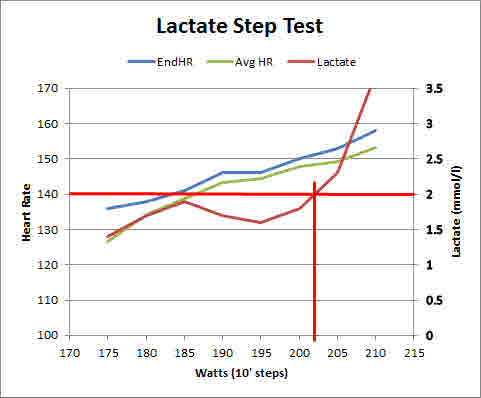
To a first order, there is a rough correlation.  A step test will show a increasing lactate level and increasing heart rate as the steps increase in intensity, as shown below above 195W.
2014-11-28_17-22-32

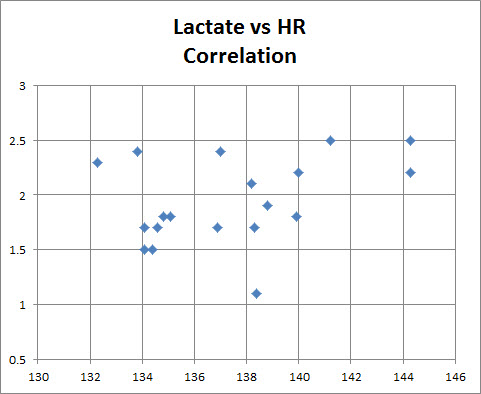
The question is, can HR be accurately used  to determine a good training power to ensure that blood lactate is below 2.0mmol/l.  Over the past month or so, I’ve taken lactate readings after 20 minutes of steady state.  In all cases, I was aiming for a lactate level of 1.6 to 2.0mmol/l.  As you can see, I often miss on the high side, because I have trouble containing my exuberance.  The data shows very little correlation between HR and lactate level in this narrow range.
2015-03-16_11-20-24

Heart rate data is not entirely useless.  If the average HR over the last 5 minutes of the piece is above 140BPM, then it is very likely that blood lactate is above 2.0.  The problem is that a low HR is not necessarily indicative of low lactates, so if you train to a HR limit in a session you might end up with higher than ideal lactates in some of your sessions.  No real harm done, but you might not get the ideal training effect.

A more serious issue is that HR changes constantly through a steady state session as dehydration and other factors induce CV drift.  So training to a HR limit will generally cause a slow down as the session progresses.  If one is using HR as an analog for lactate, then you would probably want to use a HR limit that increases as the session continues.  For me, 140 after 20′, 145 after 40′, 150 after 60′ and 155 after 80′.  At the end that would be right at the top end of my UT1 range.  Ideally, a session would run about 5 beats lower than that at each point.

Another 10K Threshold Workout

Pressed for time today and in the mood for something a bit spicier than the normal steady state.  So, I thought doing another 10K at about a 200W pace and working on keeping the stroke rate up around 25 and using half decent form.

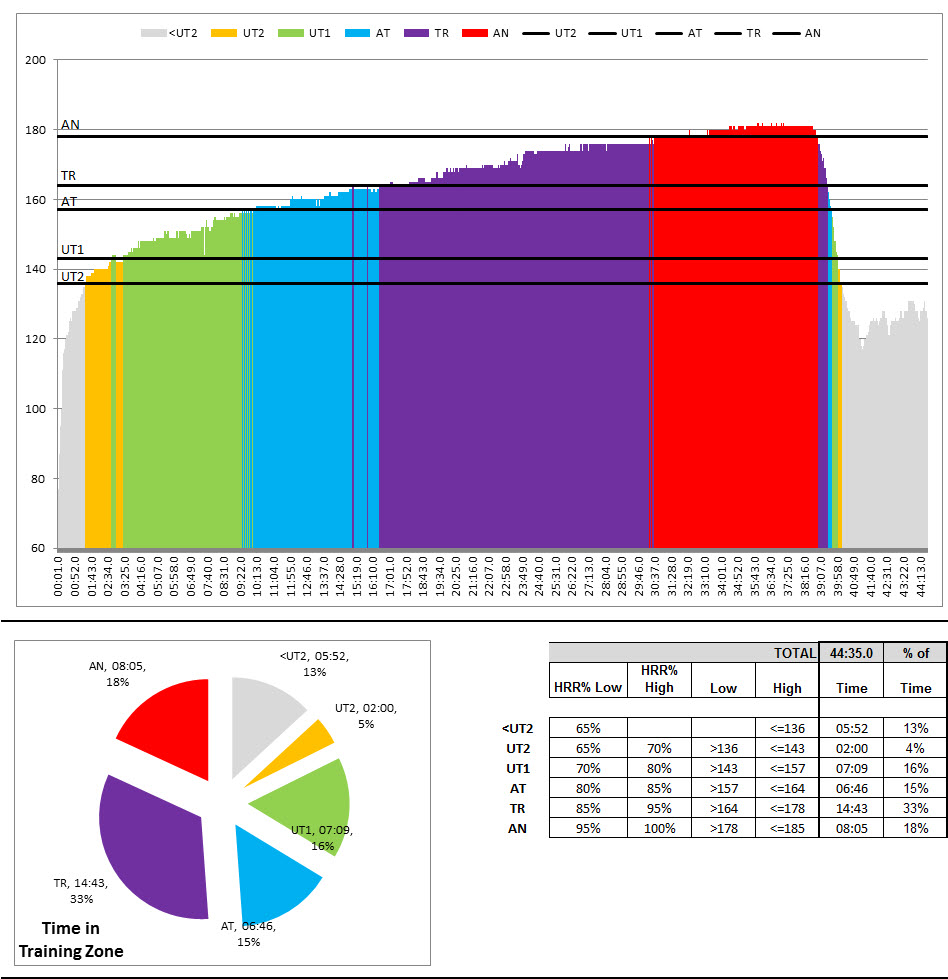
As it turned out, I felt more comfortable up at about 220W and I decided to just go with it.  Rowing up at 25 on slides felt nice and smooth and I was able to maintain pretty good posture.  My HR got pretty high at the end, but I didn’t feel like I was in trouble at any point.

2015-03-16_9-45-28 2015-03-16_9-39-42

A very satisfying row.  Based on the high heart rate at the end, it appears I am not yet as efficient on slides for longer rows.

Tomorrow:  Tonight I am heading out toe Phoenix.  I’ll see if I can find myself a nice crossfit box to row in tomorrow morning.  4×20 would be the plan.

Lactate Testing Equipment and Procedure

I use a lactate plus meter, which you can get from lactate.com.

The meter costs about $250.  I bought a starter kit that included lancets, test strips, alcohol wipes and a DVD of lactate training information, this set me back about $370.  The test strips get expensive.  They cost $46 for a box of 25, or nearly $2 per strip.

I use lactate measurement to try to make sure that I am doing steady state training at an intensity that maximizes fat metabolism and develops increased aerobic capacity.  Through various posts over on Rowing Illustrated, it seems that the magic range for steady state training is from 1.6 to 2.0mmol/l.  Above this level, improvements in aerobic capacity and training power stall, but in this range, long term improvements can be achieved.

Lactate will vary over time during a steady state workout.  It will initially rise, and then fall as the metabolic processes that use lactate as an energy source kick in.  Then a period of stasis where lactate should be roughly correlated with training power.  Finally, when muscle fatigue begins to set in, lactate levels will rise.

For consistency, I always measure lactates after 20 minutes (or sometimes 5K).  Here is how that works.

Before starting I set up everything.  I get a lancet in the little lancet machine.  I take out 1 test strip, and an alcohol wipe.  I have one wet paper towel and one dry one.

When I finish the piece, here is what I do:

1.  I wipe both hands with the wet paper towel

2.  dry them with the dry paper towel

3.  swap my left ring finger tip with the alcohol wipe

4. Prick my finger

5.  Get a drop and wipe it with the dry paper towel

6. Put the test strip in the meter, which turns it on

7.  Make sure I have a nice beefy drop on my finger (do a little squeezing if I don’t)

8.  Touch it to the end of the test strip and wait 13 seconds

9.  read the meter

All of this takes just about 1 minute.  I usually take a drink and stretch a little bit and then start my next piece 2 minutes after finishing the first.

All of these steps are basically to try to avoid having sweat contaminate the reading, which causes false high readings.  I’ve gotten pretty consistent at this point.