My knee surgery

On December 22, I had arthroscopic surgery on my right knee.  I was diagnosed with a tear in the medial meniscus cartilage.  Here’s a diagram of what that means.
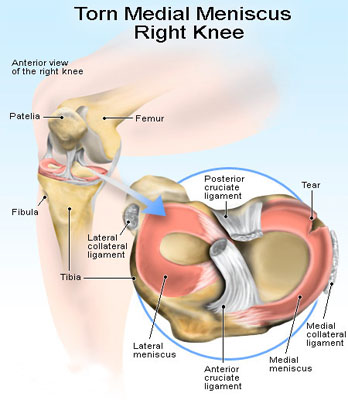
torn_meniscus

The tear was diagnosed by an MRI.  Unlike the diagram, my tears appeared to on the inside edge of the cartilage, not the outside.  In addition to the meniscus tear, I was also diagnosed with osteoarthritis, which showed up as “fuzziness” in the surface cartilage in the tibia and femur in x-rays.

I was under general anesthesia for the operation which took less than an hour.  Three small incisions were made to introduce the camera, light source and surgical instruments.

Here are a couple picture of the inside of my knee showing the torn (frayed really) menicus cartilage.  The stuff that looks like fringe is the torn up inner edge of the cartilage.
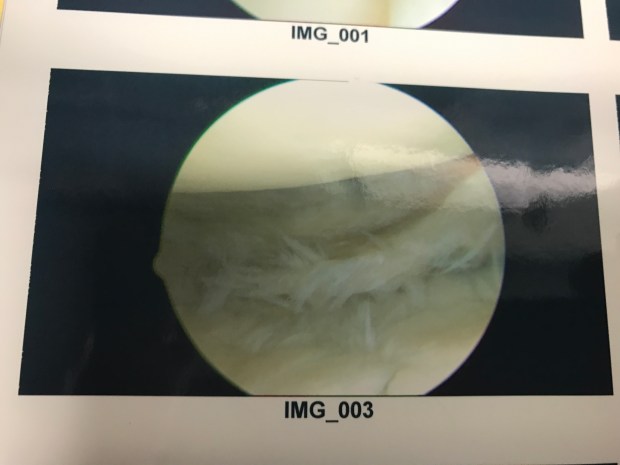
There were also some pictures of the meniscus after the repair, but I didn’t manage to take photos of that.  The doctor also showed me pictures of the surface cartilage where it was degraded from the arthritis.  He said it was likely that this will potentially get worse over time, but could be treated with cortisone, simvisc and stuff like that.

I asked him if I should avoid impact sports like running.  He said that the research was inconclusive and contradictory.  He advised me to go by how the joint felt.  If it started to hurt, then avoid running.  I asked if I was OK to start rowing again and he gave me the green light for that.

After the surgery, I recovered quickly.  I was on crutches for a day.  I kept it iced during the day over the first 2 days, and it was basically immobilized with an ace bandage for four days.  After 4 days, I took off the ace bandage and changed the little bandages on the incisions daily.  I was walking a little stiffly on day 4, but gradually increased the range of motion of the knee.  By day 6, the range of motion was just about normal.  The only time I felt a twinge was walking down stairs.  I found out later that this is likely to be related to the osteoarthritis, not the meniscus and I should just get used to it.

I didn’t have any trouble with pain.  The doctor prescribed over the counter anti-inflammatory (Ibuprofen) to minimize swelling and I took that constantly for the full 10 days until the follow up appointment.  I did not need to take any of the stronger painkillers that he gave me.

And now I’m back at it.  Yesterday’s CTC session was slower than I liked, but that’s due to a lack of fitness, not a knee problem.  This morning, after rowing hard at r28, I have no knee pain or swelling.  I’m ready to call the surgery a success.


Update on my knee

I saw the Orthopedist on Friday.  We reviewed the MRI together.

He pointed out the areas on the surface cartilage of the knee where there was evidence of arthritis, he also showed me an area on the meniscus cartilage that was damaged.  He said that was likely the cause of my knee clicking and locking (and hurting).

He was somewhat ambivalent about doing surgery to trim the meniscus. I asked him is the knee would get any better without it.  He thought that it would not.  I told him that I wanted his honest opinion.  I really wanted to be able to restore the full range of motion of my knee, or at least not have it lock, so that I could resume rowing.  But I didn’t want to do something that would have negative long term effects on my health just so I could keep doing this specific sport.

He said that the surgery had a low risk of complications (<1%) and that there was a better than 50% chance that it would fix the mechanical issues with the knee.  There was a 5% chance that surgery could make it worse.  I guess the other 40 to 45% chance is that it doesn’t help all that much, but doesn’t make it worse.

Since my knee worked well enough to row 10 days ago, I decided that trying to fix whatever damage is there would be the best course of action.  I will be setting up a surgery date on Monday.

Until then, I think I will stick to very low intensity stationary bike, along with core and upper body strength work.  I think I need to give the joint a rest.


Wednesday: November CTC

After my cortisone injection yesterday morning, my knee felt better almost immediately.  I think the combination of getting the excess fluid out of the joint, and the anti-inflammatory effect of the steroid made things a lot better.  There is still a lot of instability in the joint.  I have a vicious clicking if I fully flex and although the pain is much reduced, I still notice that my joint has two modes of operation; good and not so good.

Needless to say, I want to avoid the not so good mode of operation.  And as far as I can tell that is done by avoiding  fully flexing my knee.

Yesterday evening, I went and had an MRI done of the joint.  That was a new experience for me.  The imaging center (Metrowest MRI) was prompt, professional and friendly. They did 4 image sequences.  Each took about 4 to 5 minutes, during which I was instructed to keep my knee perfectly still while the machine banged and buzzed.  I looked at the pictures, which were very clear, but I don’t know enough about knees to figure out if there is anything good or bad going on.

This morning, I was pain free and so I headed off to workout in the morning.

The Plan:

  • 20 minute warmup on the stationary bike
  • If I was pain free, try some erging
    • 1k at 2:00
    • 1k at 1:55
    • 1k as hard as I could tolerate for the CTC
  • Strength training

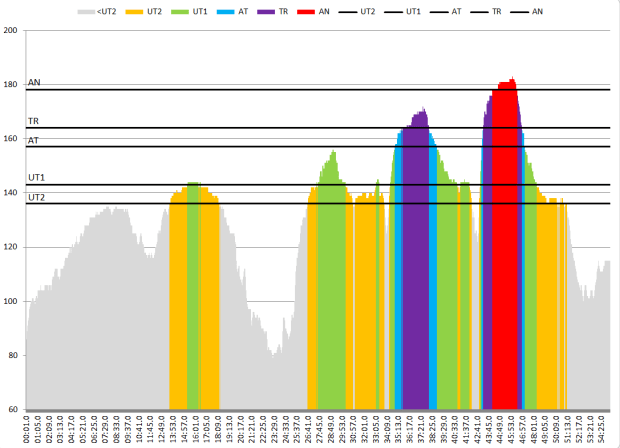
Here is heart rate data for the bike warmup and the 3 intervals on the erg

Here’s the details on the erg stuff.  I was concerned about bending my knee too far so I put a bandaid on the rail at a point before my knee would click.  This provided enough of a bump when the seat rollers hit it that I was reminded to keep my strokes shorter.  Over the intervals, I was able to modify my recovery timing so that I would be fully rocked over before I hit the bump.  This enabled me to get a bit longer drive.  On the last interval, I pushed past the bandaid with no significant pain.  That was heartening.

myimage11-30c

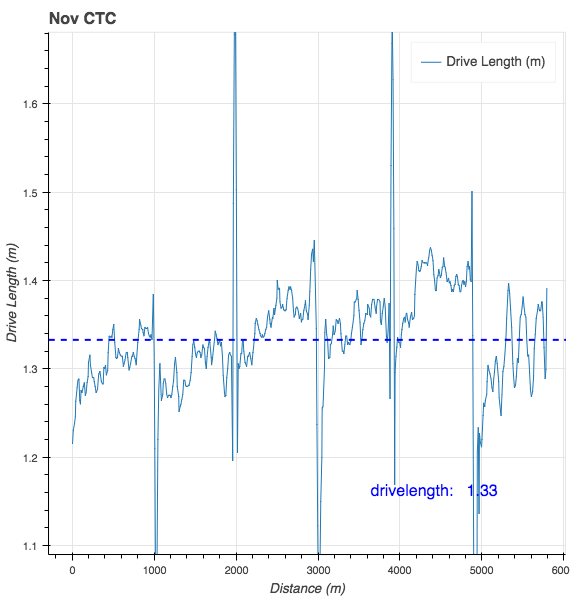
I was interested in looking at my drive length.

bokeh_plot-66

So, for the first interval, I was pulling about a 1.3m stroke.  For the second, around 1.35m.  For the final interval, it was about 1.4m.   Compare that to the 8x750m workout that I did last week.

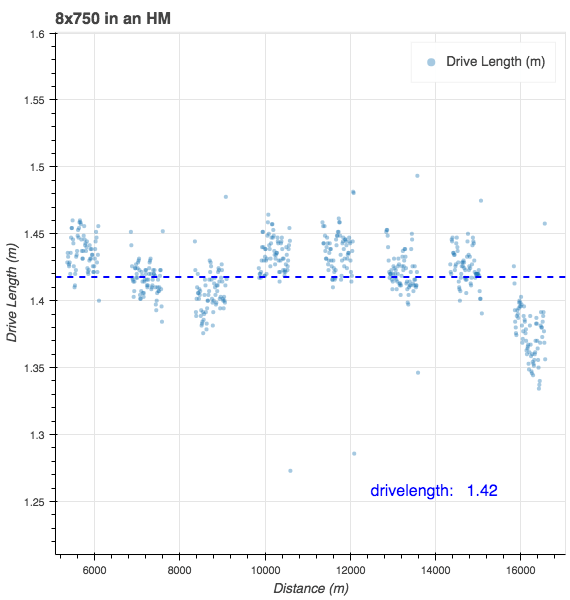
bokeh_plot (69).png

For this workout, I was maintaining over 1.4m for all but the last interval.  It looks like I had gone back to just about my full stroke in the final rep.

A couple of other interesting plots.

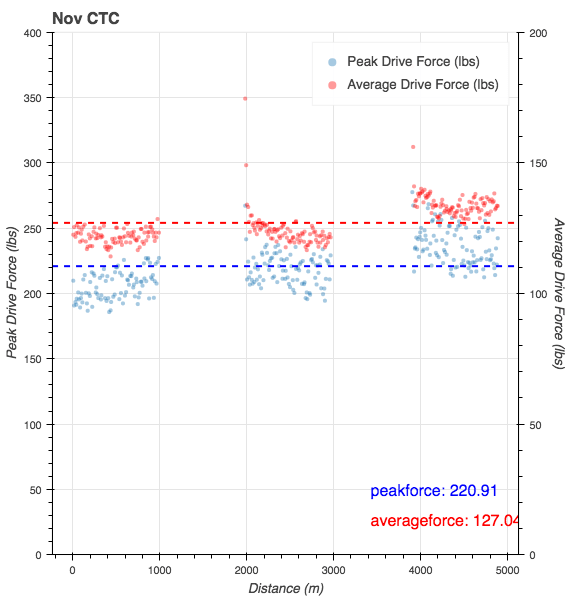
The left shows the peak and average force.  This shows a very consistent increase in both peak and average.  The right is the drive time.  You can see that the drive time was slowing down as my drive length increased.  I was surprised by this since the pace on the last rep was much faster.

After that, I went and changed my shirt and did a few strength exercises

Chin ups
unassisted x5
red band assist 3 sets of 4 reps

standing dumbell press
2×25 10
2×30 2 sets of 10 reps

Bent over barbell rows
45 x 10
95 x 10 x 3 sets

dumbell bench press
2×30 x 10
2×35 x 10 x 2

Tomorrow:  Slow HM (limit compression)

Tuesday: 60′ stationary bike

My knee continues to be mysterious and painful.  The joint has two modes of operation.  The first mode is entirely normal.  No pain, no weakness, nothing.  The second mode is extremely painful.  It limits the range of motion (I can’t fully extend it).  I have trouble bearing weight on my leg.  Going between the two modes is a bit erratic, but I am getting the hang of it.  The best way to transition from pain free to painful is to fully flex.  Adding in radial movement of my foot while flexed seems to encourage the transition.  Getting from painful to pain free is more hit and miss.  Sometimes, if I put steady pressure to extend it fully, my leg, which stops at about 10 degrees from fully extended, will slowly finishes extending and the pain will diminish.  Other times, if I get off my feet and put my leg up for 15 minutes it will get back into working order.  Last night it hurt when I went to sleep, and was fine when I woke this morning.

I had an appointment with the orthopedist today.  I was pain free walking in and thinking he might pat me on my head and send me on my way.  I was wrong.  He grabbed my leg, pushed to full flexion, he and I felt the click in the joint as it flexed and it hurt like hell when he extended the leg again.  He did some more manipulations of the joint to see which motions hurt and which did not.  Then he sent me for x-rays.

The x-rays confirmed the first part of his diagnosis.  Osteo-Arthritis.  There is the potential that there is additionally a tear in the meniscus cartilage.  That will be checked by getting an MRI this evening.

This same doctor treated me 5 years ago for arthritis in my left knee.  Back then, my knee was very sore and swollen.  He treated that knee with a cortisone injection and I decided to limit the amount of running I was doing.  I was running up to 5 times per week then and rowing much less.  The treated and training change worked completely… until recently.

This season, I started noticing problems with my right knee.  Generally the problems happened when I was doing something like putting my oars in the boat and getting into a deep crouch.  My knee would lock or I’d get a sharp pain.  But extending the leg would fix the problem, and I would go on with a normal rowing session.  Other times, in an erg session, I would notice my joint clicking during the first few strokes, but by either limiting the amount of compression at the catch, or just by warming up, it would go away.  This was not painful at all, just annoying and a little scary.  Then things seemed to get much worse after my pants removal incident on Thanksgiving.  Now the pain would not go away and was much more intense.

Anyway, the reason that I am writing this all down is because I am trying to process all of this.  Essentially, there is no doubt that I have Arthritis in the joint, but if there is a serious tear, getting it fixed will probably make my knee work a lot better.  But if the tear is minor, or there is not tear, then the prognosis is not very good.  I will likely have to figure out how to live with my knee giving out on a regular basis.  I have no idea what impact that will have on rowing and, frankly, that’s bumming me out.

I guess I just don’t think about that until I know more.

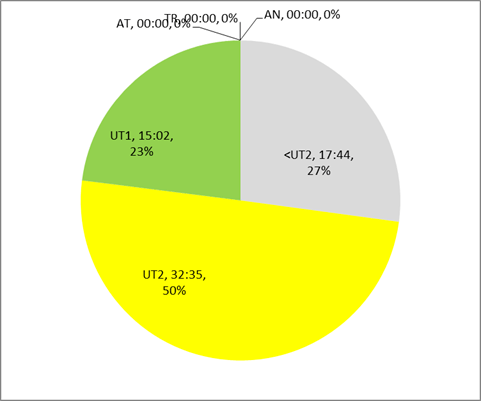
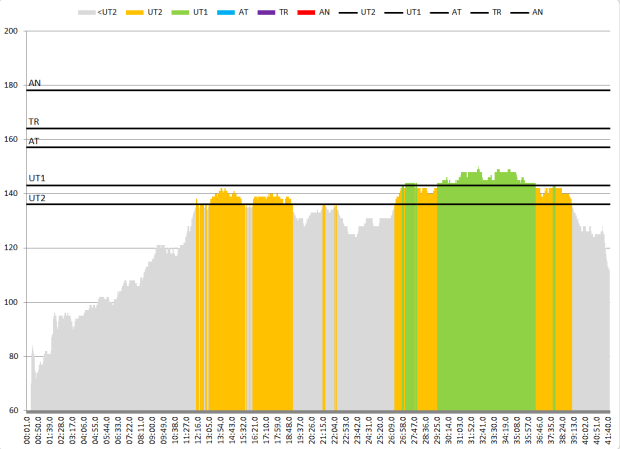
For training today, I was back on the stationary bike.  I just set it to resistance of 10 and did 2 x 30 minute intervals.  I tried to pedal hard enough to keep me right at the boundary between UT2 and UT1.

screen-shot-2016-11-29-at-4-11-30-pm

untitled11-30

No pain from biking.  Just a gathering gloom in my soul.

Tomorrow: 40 minutes on the bike plus strength training.

Monday: Easing back into it

I had not exercised since Wednesday of last week.  This morning, I am back at work and I decided that I need to get back in the gym and see what I can do that wouldn’t screw up my knee.

I wore a elastic brace on my knee mostly to remind me to not do anything stupid.

First up, 40 minutes on the stationary bike.  Rolling hills program.  Level 12 for the first 20 minutes, then I got bored and increased it to 13.  That was a bit better.

screen-shot-2016-11-28-at-10-50-32-am

untitled11-28a

I’m gonna need to work a bit harder than that.

Then onto some strength work.

Chin ups
5 unassisted
4 x 3 (red band)

Good mornings
45 x 10
65 x 10
85 x 10 x 3

Barbell Rows
45 x 10
65 x 10
85 x 10 x 3

Standing Dumbell Press
2×25 x 10
2×30 x 10 x 3

Lat Pull Down (My shoulder hurt when I did these with a wide grip.  I’ll do it with a pull up grip next time)

Dumbell bench press
2×25 x 10
2×30 x 10 x 3

This was a pretty good session.  My knee was fine with pedaling.  And by going reasonably light in the strength exercises, I didn’t do any damage there either.

Tomorrow:  I have an appointment with the Orthopedist at 10:30 tomorrow morning.  I will probably do 40 minutes on the Stationary bike in the morning, and some core work.