The Voyage of the Doomed

Or…The Accidental Triathlon

The day started like any other day.  I woke up, did my hated core exercise routine, and drove to Newton to go for a row.  Little did I know that my easy steady state session would end up…in disaster.

It was cool and grey out.  They was a brisk, gusty wind from the ENE blowing about 15mph with gusts to 20.  This was a cross head wind going downstream.  The 4km trip from the dock to the dam was an uneventful slog.  I have not spent enough time in the boat and my rowing was terrible.  There was a bit of chop in some places, and the wind was hard enough to toss around my oars.  But I just worked on trying to keep my oars off the water on recovery and take nice smooth strokes.

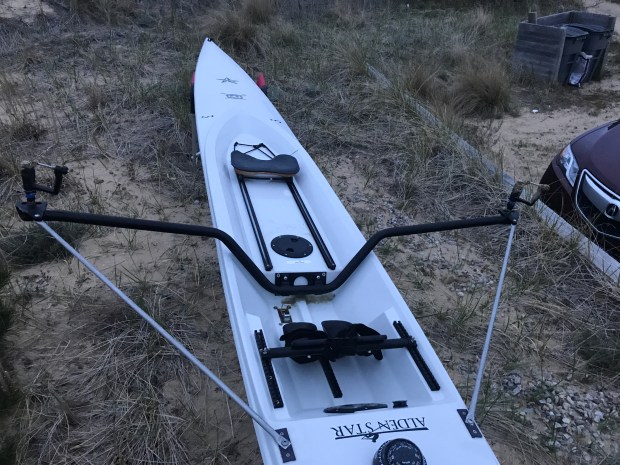
I turned around at the dam, and I was really looking forward to working with a tail wind.  I rowed back under the bridge, and in front of the watch factory.  As I was approaching the s-turn, I heard a loud metallic pop behind me and my port oar washed out.  I looked over my shoulder and my rigger had failed.  I row in a Fluid which has a bow mounted rigger.  There is a main strut and a smaller reinforcing strut.  The main strut had completely severed, right near the edge of the hull.  The only thing holding the rigger on was the thin reinforcing strut.

After a few moments considering my situation.  I was roughly 3km of river away from the dock.  I decided to see if I could gently paddle along on what was left of the rigger and make back to the dock.  This worked great!  For about 20 strokes.  Then the joint connecting the severed main strut to the reinforcing strut parted and I was left holding an oar that just dragging in the water.  An immediate moment of panic passed when I realized that I could keep the boat balanced by leaning to starboard a bit on my good oar.  That gave me time to think.  The first thought was…I am not getting out of this boat without getting wet.

Obviously, I wasn’t going to be able to make it back to the dock, but there was a boat launch ramp about 100m from me.  100m is not far to go, but if you have no means of propulsion, and it’s 100m upwind, it isn’t really close either.  For about a minute, I thought the wind would push me to the bank of the river and I could get out there.  Then it became clear that I was getting pushed to a part of the bank where there was a lot of underbrush, and I wouldn’t have been able to get out.

I made the decision to eject.  I leaned to port, and quick as a wink, I was in the water next to my inverted boat.  I kept a grip on the loose oar.  I was worried that the extra weight of the broken rigger on it might be enough to make it sink, which I now doubt would have happened, but at the time, it seemed quite important to me.  With my free hand, I flipped the boat back over, got my water bottle and flip flops back in the cockpit and started swimming upwind to the dock.

The swim took a while, maybe 5 minutes or so.  I’m looking at this as the second leg of my triathlon.  Then I put my boat and oars off in a grassy corner of the little park where the ramp is.  It was a bit worrying that I could hear water sloshing around in the bow.  I’ll have to look into that later.

OK.  So I was on land and I had a boat.  What’s my next step.  I knew that I was 3km from the dock on the river.  I had no idea how far it was to get there on foot.  And then I discovered reason #67 to have a smartphone with you when you row.

Reason 67 to have a smartphone with you in a boat:  If your rigger fails and you need to get back to your car, you can use it to give you directions!

It turns out that there is a path that runs along the river, but cuts out a lot of the twists.  Google maps told me that my car was 1.5 miles away.  I put on my flip flops and jogged the whole way for the final leg of the Triathlon.  I got to my car, changed into some dry clothes and  then drove to pick up my boat.  I never knew that it would be so handy to keep my boat rack on my car.  I’m just glad that I do!  I picked up my boat and my oars and headed to work.  The crazy thing is that I got to work almost exactly at the time that I normally do.  It was a disaster, but a very efficient one from a time point of view!

Part 1 of the row.  No HR data because it was connected to the speedcoach that ran out of battery power.  This took me about 3km into the row.  When the speedcoach packed up, I stopped this session and hooked the HR monitor to RIM to continue with part 2.

9-22a

Screen Shot 2017-09-22 at 3.42.47 PM

Part 2 of the row.  Finishing the trip down to the dam, turning around and rowing until the boat busted.  Then the swim to the ramp!
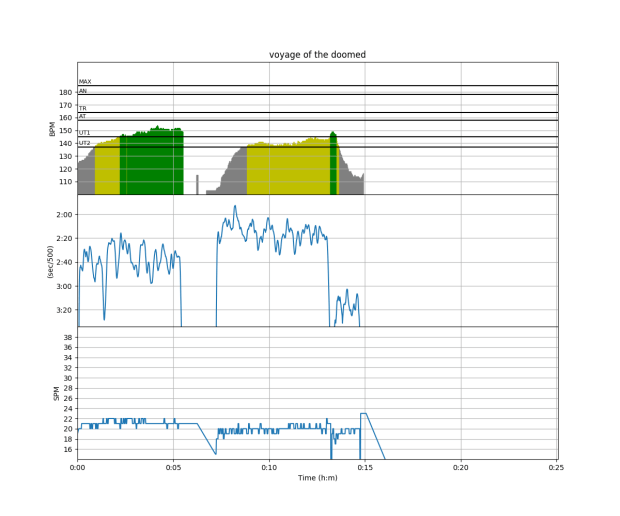
9-22b

Screen Shot 2017-09-22 at 3.43.52 PM

I didn’t bother tracking HR or pace on the run back to my car, but it took about 15 minutes.

Tomorrow:  We’re heading to the cape tonight.  If the wind dies down I might go for a coastal row tomorrow.  Other wise it will be on the erg.  In either case, the goal will be head race simulation.  30 minutes at 24 spm.

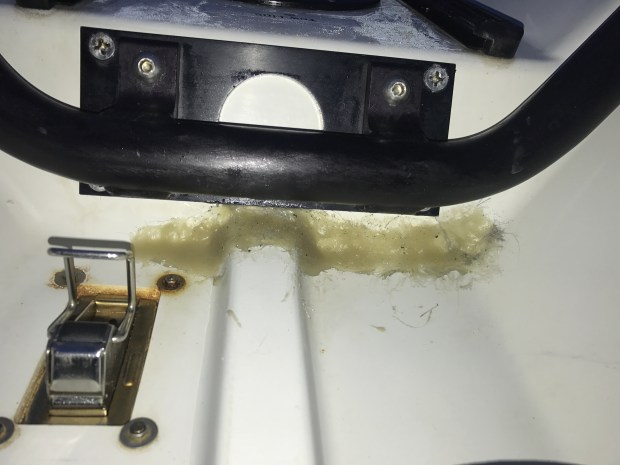
Here are few pictures of the busted rigger


Another 10K on the bay

Today was going to be my grand adventure.  But it didn’t turn out that way.

I got to bed around 11, and I slept hard until almost 9am.  So, I got a later start than I wanted to.  I finally was loaded up and left the house around 9:30.  While I loaded up, I realized that I had forgotten to print out my map.  Damn.  I guess I would do the best I could from memory.  I drove over to a different beach which I thought would be better for launching near low tide.  It was.

I got everything down to the beach and was about to put my boat down in the water when I noticed that I didn’t have my seat.  Blast!  I put my boat up high on the beach (the tide was coming in) and drove home to get my seat.  About 10 minutes later I was back on  the beach putting my boat in.

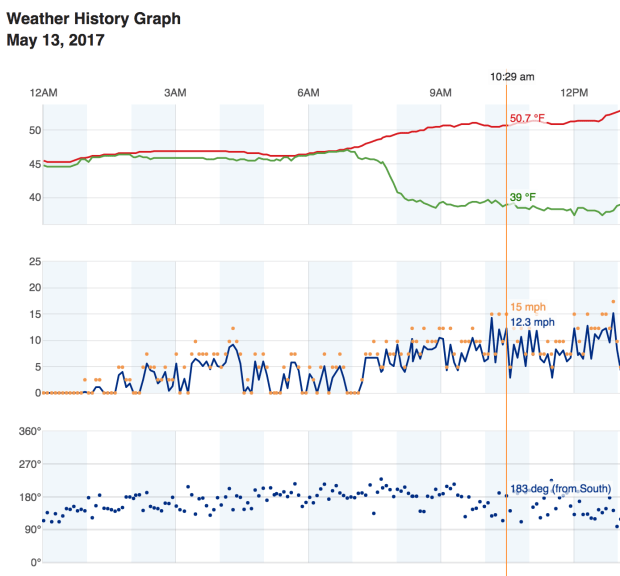
The partly cloudy and light easterly winds that were advertised did not seem to be in evidence.  The sky was grey, and a moderate wind from the South was blowing.  This beach faces north so the water was nice and flat off this beach.  The wind was going to get worse.  Here’s the weather data.

Screen Shot 2017-05-13 at 6.42.06 PM

I finally launched just before 10am.  I wanted to be home before noon, so I decided that I would limit my adventure to about 90 minutes.

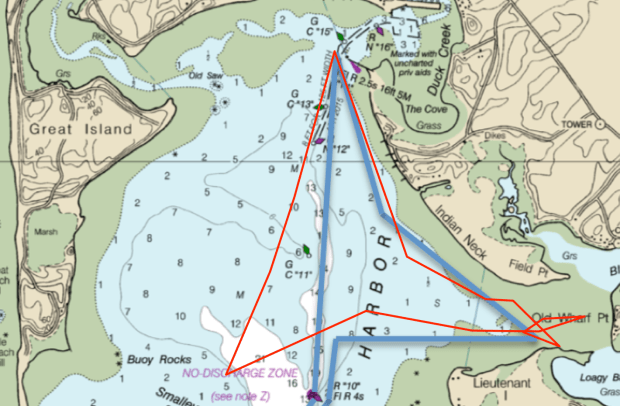
Here was my original plan.

Screen Shot 2017-05-10 at 9.27.40 PM

Here is what I actually did, superimposed on the plan.

Screen Shot 2017-05-13 at 7.25.45 PM.png

Here is the course, from Google earth, with heart rate, which helps tell the story.

Screen Shot 2017-05-13 at 7.28.42 PM.png

a. Launch from beach.  Notice that the Speedcoach isn’t showing pace.  Remember that speedcoach is set to use impeller, which this boat doesn’t have.  Stop and change the setting of the speedcoach.  Start rowing again.  Take 10 strokes, notice that the speedcoach is not started.  Start the speedcoach.  Get going.  Notice that the water is getting quite shallow.  Decide to change course to take me a bit offshore.

b.  Stay on the same course until I reach 1.5km.  Then return to original course (330deg).  The wind is building a bit now, and the waves are pushing around the stern.  I’m surfing on some of the waves.  This part of the row was good fun.

c.  When I reach the breakwater at the mouth of Wellfleet inner harbor, I stop and turn.  Now I really notice how much the wind has built.  I made this turn at about 10:10.  The wind was 12 mph sustained with gusts up to 15.  The waves were starting to build.  I started to push up into the headwind.  I thought the course from my plan was 210 deg, it was actually 200.

d. Anyway, I was doing fine for a while, and then I hit a stretch with particularly nasty waves.  I stopped to open up the bailer and started again.  That’s the little dip in the HR.  Looking at the chart, that place seems to be a bit shallower.  I guess it would make sense that the waves would be nastier in the shallower spots.  It’s hard to see the difference looking over your shoulder.  Anyway, after opening the bailer and getting going again, I was doing ok.  Until…..

e.  If you look at the google earth image, you can see the color of the water change.  On the chart, you can see that the bottom shoals here.  The waves suddenly got really, really bad.  I wished that I had the gopro mounted because I’d like to look at it after the fact.  It felt like the waves were well over a foot tall, and my bow was plunging right into them.  They would roll back over the deck and completely fill the cockpit.  This happened 3 times in a row and I decided that it was stupid to keep going in this direction.  I had no idea if the wind would build and I was barely able to make headway as it was.  I decided to turn for home.

f.  I steered due east, and tried to work my way through the beam seas.  You can see that my HR was pretty low in this stretch because I couldn’t really take full strokes.  I just picked my way through the waves and when I would get a really bad set of waves, I would just paddle through them, then try to accelerate during the smoother chunks.  After a while, I could see  that my easterly course was going to take me too far north, so I turned and rowed to SE for a while.

g.  As I rowed into the lee of the island, the waves were blocked and the water flattened out very nicely.  I started to row with longer strokes and it felt really wonderful.  My HR was quite low today for the level of effort.  This section was very enjoyable.

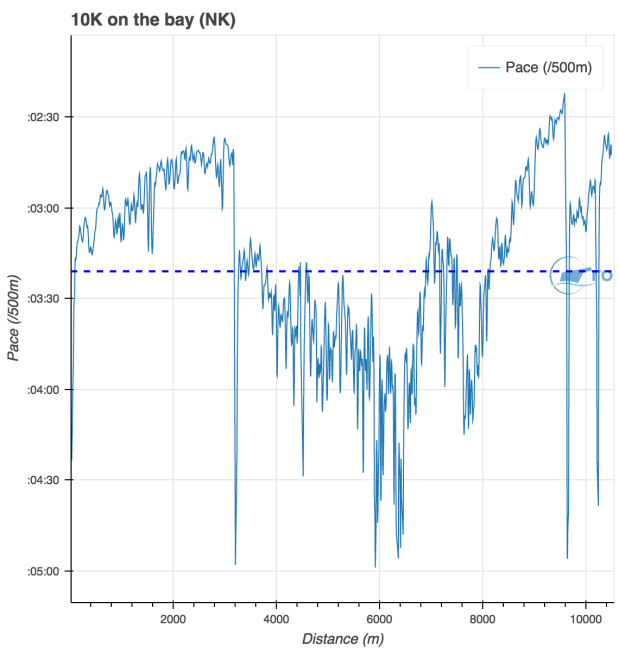
I noticed that the pace was quite fast for open water, and I realized that even though I had a little bit of headwind, I was rowing with the current.  I got back to the beach with about 9000m on the speedcoach.  I like the blog title “10K on the Bay”, so I did 500m more past the beach, turned and came back.  I was having so much fun, I kept going.

5-13d

5-13a

5-13c

It wasn’t the long row I intended, but it was useful practice.

A side note.  I spent an hour trying to fix the leak in my boat.  It turned out that there are a couple of cracks in the bulkhead between the seat deck and the bottom of the footwell.  The rigger attaches to this bulkhead and the screws that hold it in place were frozen in place.  The whole bulkhead looks like it is about to go.  Ultimately, I will need to cut out the whole bulkhead and replace it (or more likely just sell the boat).

But since I wanted to fix the leak and I couldn’t get the rigger off, I decided to just work around it.  I mixed up a batch of epoxy resin and cut a few strips of fiberglass and just reinforced the area where the cracks were.

2017-05-13 19.53.21

This photo shows the rigger attachment to the seat deck bulkhead.

Here’s a close up of the ugly repair.

2017-05-13 19.53.42

It is not pretty, but it seemed to work.  After bashing into the waves, I only had about a cup of water drain out after I was finished.

Tomorrow:  Marathon training session.

M2 3 x 20′ / 2′ MP, 10KP, HMP 90.0% (167)

Paces:

  • MP –> 180 to 195W
  • HMP –> 195 to 210
  • 10KP  –> 210 to 225

Boat repair

On Wednesday night, I stopped at the hardware store and bought epoxy, silicone caulking, and the tools I needed to do my fin repair.

On Thursday morning, I stopped and picked up my boat and threw it on my car roof.  At lunch on Thursday, the weather was nice, it was warm enough to use the epoxy and silicone, so I put my boat on slings in the parking lot and set to work.

Job one was to extract the fin without doing any more damage to the boat.  So, I sliced the existing caulking on both sides, and front and back and then slowly worked the fin out of the fin box.  Then it was on to caulking removal.  I was able to get all the caulking off the fin and most of the caulk off of the outer surface of the hull.  I was able to cut the caulking away from the top of the fin box where the seam was between it and the hull of the boat.  I cleaned this up with the knife as much as I could and I could see where the seam was delaminated on both side from about half way back to the stern.

I mixed up some epoxy and delicately smushed it into the crack all the way around trying to avoid getting any drips down the sides of box.  Then I waited about 10 minutes for the epoxy to setup and stop being tacky.  The last thing I wanted was to permanently glue the fin in with epoxy.  That would be bad.  While I waited, I put down masking tape on the hull marking the outside line of where I wanted caulk.  I did the same thing on the fin.

Once it was dry to the touch, I carefully reset the fin in the box.  It appeared that the box stayed laminated all the way around during this process and the fin appeared to my eye to be aligned and in the same position as before.  At that point, I put down a big bead of caulking along both sides, trying to make sure that all voids were completely filled.  I then took a caulk bead tool and used it to form a small 45 degree fillet between the hull and the fin along both sides.  I carefully faired the caulking at the front and back to make sure that it was completely filled and smooth.  Then I pulled away the tape.  It actually looked pretty good for an amateur job.

I left the boat as it was for the afternoon, and when I left for the night, the fin was stable in the slot.  I suspect that it is not entirely perfect, but this morning when I used the boat, it tracked straight and didn’t leak, so I think it’s good for the rest of the season. I might get a pro to look at it this winter.